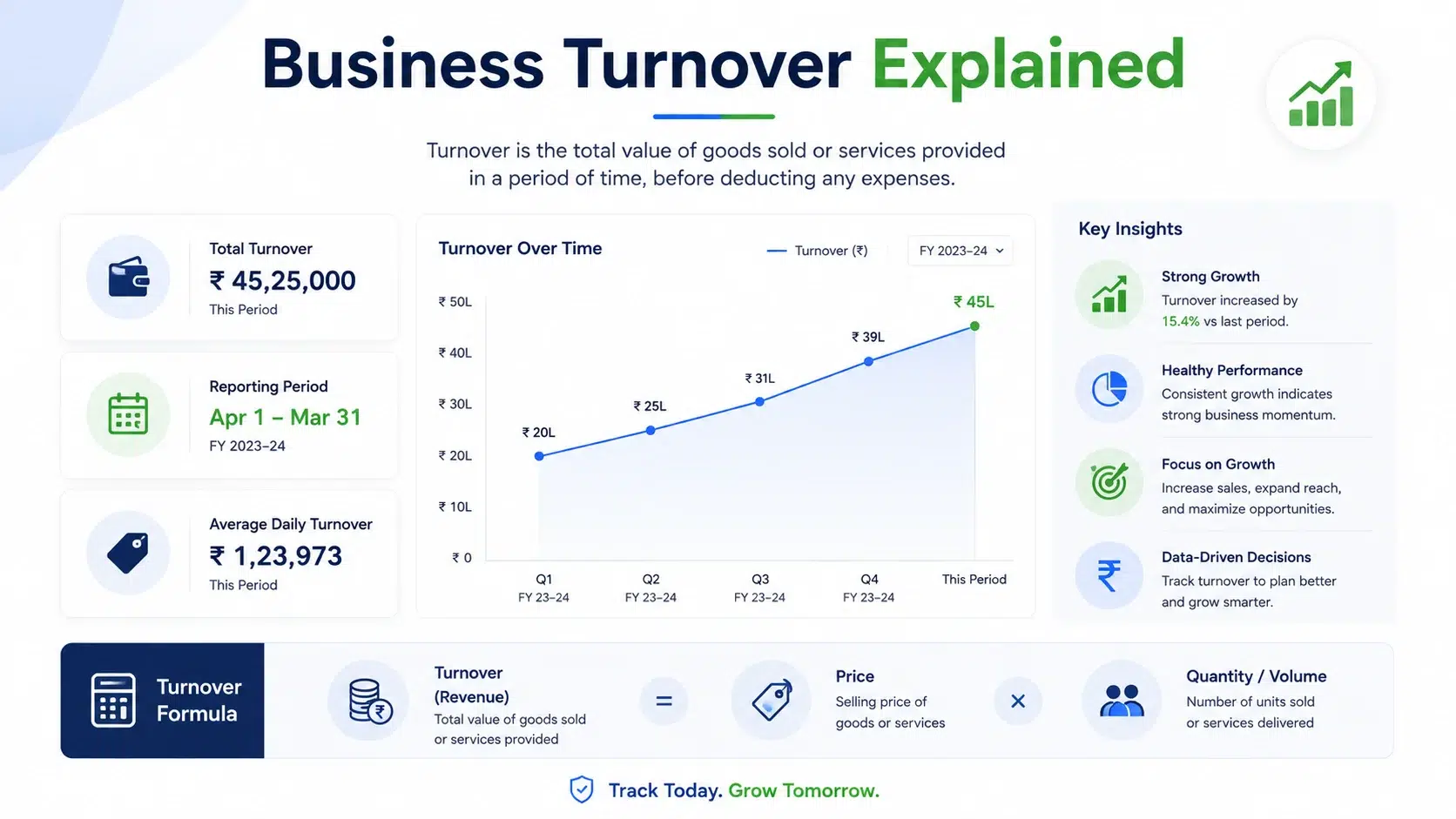
To define turnover correctly is to understand one of the most important measurements in business finance. Turnover represents the total revenue generated from the sale of goods or services during a specific period before any expenses are deducted. It is often referred to as gross revenue or total sales, and it serves as a direct indicator of business activity, customer demand, and operational scale.
For restaurants, retail stores, service providers, and small businesses, turnover is far more than a number on a financial report. It reflects how effectively a business attracts customers, converts transactions, prices products, and maintains operational consistency. Businesses that monitor turnover carefully are often better positioned to forecast growth, improve decision-making, and identify operational weaknesses before they become serious financial problems.
Although many people confuse turnover with profit, the two measurements serve entirely different purposes. Turnover measures total revenue generation, while profit measures what remains after costs are removed. Understanding this distinction is essential for building a financially sustainable business.
This guide explains how to define turnover accurately, how turnover differs from profit, how businesses calculate turnover, and how modern systems such as Biyo POS help businesses monitor and increase turnover strategically.
Table of Contents
- What Does It Mean to Define Turnover?
- Turnover vs Profit
- Why Turnover Matters in Business
- How to Calculate Turnover
- Strategies for Increasing Turnover
- The Role of POS Systems and Digital Tools
- How Biyo POS Supports Turnover Growth
- Common Misconceptions About Turnover
- Frequently Asked Questions
What Does It Mean to Define Turnover?
To define turnover in business terms is to identify the total income generated from normal business activities during a defined time period. This includes all revenue generated through sales of products or services before deducting expenses such as payroll, taxes, rent, utilities, or inventory costs.
Turnover appears at the top of a business income statement because it represents the starting point of financial analysis. Every expense and operational cost is subtracted from turnover to determine gross profit and net profit later in the accounting process.
Business turnover generally includes revenue generated from:
- Product sales
- Service fees
- Online orders
- In-store purchases
- Delivery transactions
- Catering services
However, turnover does not include operational expenses or non-business income sources. Loan proceeds, asset sales, and investment gains are not considered turnover because they do not come from normal operational activity.
For example, if a restaurant generates $150,000 in monthly food and beverage sales, its turnover is $150,000 regardless of how much profit remains afterward.
 Turnover as a Measure of Business Activity
 Turnover as a Measure of Business Activity
Turnover provides businesses with a clear measurement of operational activity and customer demand. High turnover often signals strong market interest, effective pricing, successful marketing efforts, or increased customer traffic.
For restaurants, turnover may reflect:
- Table occupancy rates
- Average ticket size
- Delivery order volume
- Customer frequency
- Menu pricing performance
For retail businesses, turnover commonly reflects:
- Foot traffic
- Inventory movement
- Seasonal demand
- Product assortment effectiveness
- Sales conversion rates
Businesses that carefully monitor turnover trends can identify growth opportunities and operational issues far earlier than businesses relying only on profit analysis.
Turnover vs Profit
One of the biggest financial misconceptions is believing turnover and profit are the same thing. While closely related, they represent completely different financial measurements.
Turnover measures total revenue generated before expenses.
Profit measures what remains after expenses are deducted.
Consider this example:
- Total turnover: $500,000
- Food and inventory costs: $180,000
- Labor costs: $140,000
- Operating expenses: $110,000
- Net profit: $70,000
In this scenario, turnover equals $500,000 while net profit equals $70,000.
A business may generate very high turnover while remaining financially weak if operating expenses consume most of the revenue. Likewise, smaller businesses with lower turnover can sometimes maintain stronger financial health through better margins and tighter operational control.
Why Understanding This Difference Matters
Understanding the difference between turnover and profit allows business owners to make smarter operational decisions. High turnover with poor margins may indicate overspending, poor pricing strategy, weak inventory management, or excessive labor costs.
Strong turnover combined with healthy profit margins usually indicates operational efficiency and long-term financial sustainability.
Businesses that focus only on increasing turnover without controlling costs may eventually experience serious cash flow issues despite growing sales volume.
Why Turnover Matters in Business
Turnover is one of the most widely used performance indicators because it reflects overall business momentum and customer demand. Businesses across nearly every industry rely on turnover data to evaluate growth trends, benchmark performance, forecast future revenue, and identify operational opportunities.
Turnover as a Growth Indicator
Consistent turnover growth often signals:
- Increasing customer demand
- Successful marketing strategies
- Improved customer retention
- Effective pricing structures
- Strong operational execution
Declining turnover may indicate:
- Competitive pressure
- Poor customer experience
- Weak pricing strategy
- Inventory shortages
- Economic slowdowns
Because turnover measures sales performance directly, businesses often use turnover trends as early warning signals for operational problems.
Turnover and Investor Confidence
Investors and lenders frequently evaluate turnover when assessing business strength. Strong turnover demonstrates market demand and revenue-generating capability.
However, turnover alone is never enough. Investors also examine:
- Profit margins
- Cash flow
- Debt levels
- Operational efficiency
- Customer retention
Balanced performance across these areas creates true financial stability.
How to Calculate Turnover
Calculating turnover is relatively straightforward, but businesses must ensure that all operational revenue streams are included accurately.
Basic Turnover Formula
Turnover = Total Revenue Generated During a Specific Period
Examples:
- Daily turnover: $5,000
- Monthly turnover: $150,000
- Annual turnover: $1,800,000
Include All Revenue Channels
Restaurants should include revenue generated from:
- Dine-in sales
- Online orders
- Delivery services
- Catering events
- Gift card redemptions
Retail businesses should include:
- In-store purchases
- E-commerce revenue
- Marketplace transactions
- Mobile sales
Exclude Non-Operational Income
Businesses should not include:
- Asset sales
- Insurance settlements
- Investment profits
- Loan funding
Including these figures can distort turnover analysis and produce misleading growth measurements.
Turnover Growth Formula
Businesses often track turnover growth using percentage analysis.
Turnover Growth % = ((Current Period Turnover − Previous Period Turnover) ÷ Previous Period Turnover) × 100
Example:
- Previous month turnover: $100,000
- Current month turnover: $120,000
- Growth rate: 20%
Growth percentages provide much clearer performance insights than raw numbers alone.
Strategies for Increasing Turnover
Businesses increase turnover through improvements in customer acquisition, pricing, operations, marketing, and sales optimization.
Increase Customer Volume
More transactions naturally increase turnover.
Common strategies include:
- SEO optimization
- Digital advertising
- Loyalty programs
- Referral incentives
- Social media marketing
- Local promotional campaigns
If a café increases daily customer traffic from 120 to 180 customers while maintaining the same average ticket size, turnover rises substantially without changing pricing.
Increase Average Transaction Value
Encouraging customers to spend slightly more per visit can significantly increase turnover.
Methods include:
- Upselling
- Cross-selling
- Combo offers
- Premium upgrades
- Limited-time specials
Even small increases in average spend can compound dramatically over thousands of transactions.
Optimize Pricing Strategy
Strategic pricing adjustments often improve turnover without requiring additional traffic.
Businesses should regularly evaluate:
- Menu engineering
- Competitor pricing
- Customer demand elasticity
- Profit margins
Restaurants and retailers using data-driven pricing strategies often outperform competitors that rely on static pricing models.
Expand Revenue Channels
Adding additional sales channels can diversify and increase turnover significantly.
Examples include:
- Online ordering
- Delivery services
- Marketplace integrations
- Subscription services
- Mobile commerce
Multiple revenue streams reduce dependence on a single customer channel while increasing convenience and market reach.
The Role of POS Systems and Digital Tools
Modern businesses increasingly rely on digital systems to monitor turnover and optimize operational performance in real time.
Real-Time Sales Analytics
Advanced POS systems provide businesses with live dashboards showing:
- Hourly sales performance
- Peak traffic windows
- Top-performing products
- Average order value
- Revenue by location
This visibility allows businesses to respond quickly to changing customer behavior and operational trends.
Inventory Synchronization
Inventory shortages directly reduce turnover by preventing sales opportunities.
Integrated inventory systems help businesses:
- Prevent stockouts
- Reduce waste
- Improve forecasting
- Track inventory movement
Businesses that maintain accurate inventory alignment typically experience fewer lost sales and stronger turnover consistency.
Customer Behavior Insights
Modern POS systems also provide customer purchasing insights that support:
- Personalized promotions
- Loyalty campaigns
- Targeted marketing
- Upselling strategies
Understanding customer behavior helps businesses increase average transaction values and improve customer retention.
How Biyo POS Supports Turnover Growth
 How Biyo POS Supports Turnover Growth
Biyo POS provides businesses with tools specifically designed to maximize turnover while improving operational efficiency.
Key features include:
- Real-time sales reporting
- Inventory tracking
- Customer behavior analytics
- Integrated online ordering
- Multi-location reporting
- Automated financial summaries
Restaurants and retailers using integrated POS systems often experience improved order accuracy, stronger upselling performance, reduced inventory shortages, and better customer retention — all of which contribute directly to turnover growth.
Businesses interested in operational optimization can also explore tutorials and demonstrations through Biyo POS resources.
Common Misconceptions About Turnover
High Turnover Always Means Success
High turnover alone does not guarantee profitability. Businesses with weak margins or excessive expenses may still struggle financially despite strong revenue generation.
Low Turnover Means Failure
Some niche businesses intentionally maintain lower turnover while operating with premium pricing and higher margins.
Turnover Is the Only Important Metric
Turnover should always be analyzed alongside:
- Profit margins
- Cash flow
- Debt levels
- Customer retention
- Operational efficiency
Long-term sustainability depends on balanced financial performance across all these metrics.
Frequently Asked Questions
What is turnover in business?
Turnover refers to the total revenue generated from normal business operations before expenses are deducted.
Is turnover the same as profit?
No. Turnover measures total revenue, while profit measures what remains after operational costs and expenses are subtracted.
How do businesses calculate turnover?
Businesses calculate turnover by adding all operational sales revenue generated during a specific period.
Why is turnover important?
Turnover helps businesses evaluate customer demand, sales performance, operational scale, and revenue growth trends.
Can a business have high turnover but low profit?
Yes. Businesses with high operating costs or weak pricing strategies may generate strong turnover while maintaining low profitability.
How can businesses increase turnover?
Businesses typically increase turnover through customer acquisition, pricing optimization, upselling, improved operations, expanded sales channels, and stronger customer retention strategies.