
Choosing the right restaurant POS system can shape how smoothly your operation runs every single day. For many owners, the decision often comes down to Table Service vs Quick Service POS. While both systems process orders and payments, they support very different workflows, customer experiences, and operational goals.
Restaurants that offer full dine-in service operate differently from counter-based or fast-casual concepts. Because of this, the POS system must match how orders flow, how staff interact with guests, and how speed and accuracy are balanced. When the system does not align with the service model, inefficiencies show up quickly.
This guide breaks down the real differences between table service and quick service POS systems. It explains how each model works, where each excels, and how restaurant owners can choose the right setup for their business.
Table of Contents
Understanding Restaurant Service Models
Before comparing systems, it helps to understand how service models shape daily operations. The difference between dine-in service and counter service goes far beyond where customers sit.
Service style influences order flow, payment timing, staff roles, and even how menus are designed. Because of this, POS systems must support these differences naturally.
What Defines a Table Service Restaurant
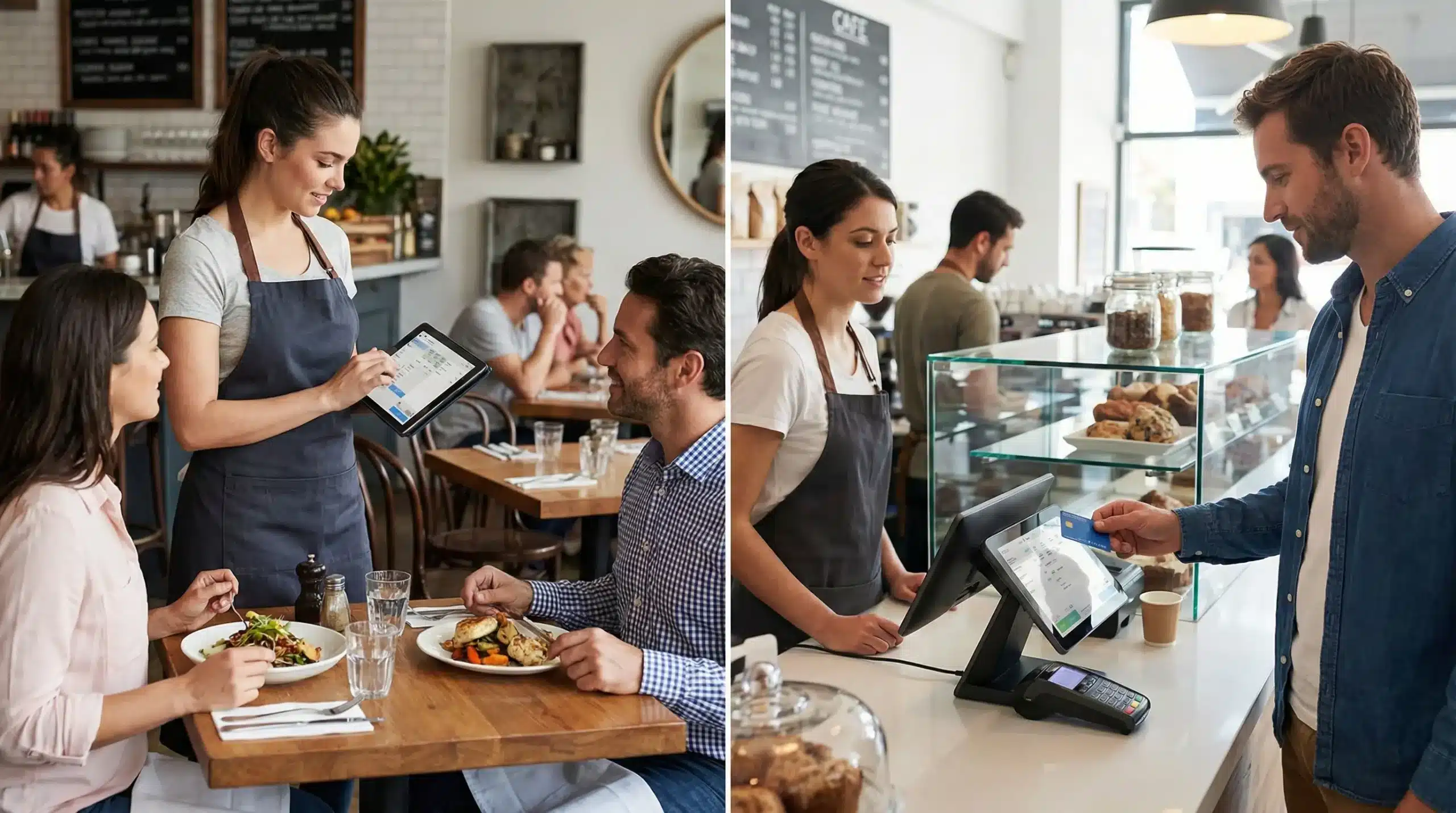
Table service restaurants focus on dine-in ordering. Guests sit at tables, review menus, and place orders with servers.
Servers manage multiple tables at once, sending orders to the kitchen while tracking courses, modifications, and guest preferences.
Payment usually happens at the end of the meal, which means the POS must support open tabs and table management.
Because service is personalized, the POS must support flexibility. Servers need quick access to table layouts, seat numbers, and order adjustments.
Accuracy matters just as much as speed. Mistakes disrupt the guest experience.
As a result, table service POS systems emphasize control and visibility.
What Defines a Quick Service Restaurant
Quick service restaurants focus on speed and volume. Guests order at a counter or kiosk, then pay immediately.
Orders move straight to the kitchen, often with minimal customization. Staff roles remain more focused.
Because payment happens upfront, the POS must process transactions quickly and reliably.
Quick service POS systems emphasize simplicity. Fewer steps reduce errors and wait times.
High transaction volume requires stable performance.
Therefore, efficiency becomes the top priority.
Hybrid and Fast-Casual Concepts
Some restaurants blend both models. Fast-casual concepts may offer counter ordering with dine-in seating.
These businesses require flexible systems that adapt to both workflows.
As a result, the POS must support multiple service modes.
Hybrid operations often struggle when systems feel locked into one style.
Flexibility becomes a deciding factor.
This is where modern POS platforms stand out.
 Workflow Differences Between Table and Quick Service
 Workflow Differences Between Table and Quick Service
The most visible contrast in Table Service vs Quick Service POS appears in daily workflows. From order entry to fulfillment, the steps differ significantly.
Understanding these differences helps restaurant owners avoid mismatched systems.
Order Entry Flow
In table service, servers enter orders while moving between tables. The POS must allow fast navigation.
Meanwhile, quick service staff enter orders while customers wait. Speed matters more than depth.
As a result, table service POS systems offer more detailed screens, while quick service systems stay streamlined.
Each design serves a purpose.
Choosing the wrong one creates friction.
Friction slows service.
Payment Timing and Handling
Table service payments happen after dining. The POS tracks open checks until guests request the bill.
Quick service POS systems close transactions immediately.
Because of this, table service systems require stronger tab and payment splitting features.
Quick service systems prioritize fast card processing.
Different timing demands different tools.
The POS must handle both cleanly.
Kitchen Communication
Table service orders often arrive in stages. Appetizers, entrees, and desserts require pacing.
Quick service kitchens receive orders instantly in full.
Therefore, table service POS systems focus on coursing and modifiers.
Quick service POS systems focus on speed.
Both require accuracy.
However, the communication style differs.
Order Management and Guest Experience
The guest experience connects directly to how orders move through the system. POS design influences this experience.
From the guest’s perspective, smooth service feels effortless.
Managing Dine-In Ordering
Table service POS systems support dine-in ordering with detailed controls.
Servers can modify orders, track allergies, and manage courses.
This flexibility enhances guest satisfaction.
Guests feel attended to.
Attention builds loyalty.
Loyalty drives repeat visits.
Handling Counter Service Orders
Quick service POS systems focus on speed at the counter.
Clear menus and fast entry reduce wait times.
As a result, lines move faster.
Customers appreciate efficiency.
Efficiency improves throughput.
Throughput increases revenue.
Order Accuracy and Adjustments
Table service requires ongoing adjustments. Guests may change orders mid-meal.
Quick service rarely allows changes after payment.
Therefore, table service POS systems support edits and notes.
Quick service systems minimize steps.
Each approach serves its audience.
The POS should match expectations.
Speed, Accuracy, and Staff Efficiency
Speed and accuracy affect both service models, though priorities differ.
The right POS system supports staff instead of slowing them down.
Speed in High-Volume Environments
Quick service restaurants depend on speed. Seconds matter.
POS systems must process payments quickly.
Delays create lines.
Lines frustrate customers.
Fast systems protect satisfaction.
Speed supports growth.
Accuracy in Complex Orders
Table service orders often include modifiers.
The POS must capture details clearly.
Errors disrupt service.
Clear order management prevents mistakes.
Accuracy protects reputation.
Reputation drives success.
Staff Training and Ease of Use
POS usability affects training time.
Quick service systems train faster.
Table service systems require deeper learning.
However, intuitive design helps both.
Ease of use reduces turnover stress.
Lower stress improves performance.
How to Choose the Right POS System
Choosing between table service and quick service POS depends on your concept.
The wrong system limits growth.
Match POS Features to Your Restaurant Type
Full-service restaurants need table management.
Quick service concepts need speed.
Hybrid businesses need flexibility.
Matching features prevents frustration.
Prevention saves money.
Smart choices last longer.
Plan for Growth and Change
Restaurants evolve over time.
A POS should adapt.
Rigid systems create future costs.
Flexible systems protect investment.
Growth requires adaptability.
Adaptability drives longevity.
Consider Customization and Support
Support quality matters.
Customization helps unique workflows.
Strong support reduces downtime.
Reliable systems keep doors open.
Reliability builds confidence.
Confidence fuels expansion.
Why Restaurants Choose Biyo POS
 Why Restaurants Choose Biyo POS
Biyo POS supports both table service and quick service workflows within one flexible platform. Restaurants can switch modes based on service style without changing systems.
Because Biyo POS adapts to dine-in, counter service, kiosks, and hybrid operations, it fits restaurants as they grow. Custom workflows help teams work efficiently.
If you want to see how Biyo POS supports different service models, you can schedule a call with the Biyo POS team. Restaurants ready to get started can also sign up without long-term commitments.
FAQs
What is the main difference between table service and quick service POS?
Table service POS supports dine-in workflows, while quick service POS focuses on fast counter ordering.
Can one POS handle both service types?
Yes. Flexible systems like Biyo POS support both models.
Which POS is better for fast-casual restaurants?
Fast-casual restaurants benefit from hybrid POS systems.
Does POS choice affect customer experience?
Yes. The right POS improves speed, accuracy, and service flow.