Every restaurant feels busy. Tickets pile up, staff rush between stations, and customers wait. However, being busy does not always mean being productive. In many cases, the chaos comes from hidden inefficiencies that quietly drain hours from every shift. These issues rarely feel dramatic, yet over time they cost money, frustrate staff, and slow growth. That is why identifying Restaurant Time-Wasters You Can Eliminate is one of the fastest ways to improve performance without increasing labor.
Most operators assume time loss is just part of the industry. Long prep, slow checkouts, repeated questions, and manual work feel unavoidable. However, many of these problems exist only because systems have not evolved. When workflows rely on outdated processes, small delays repeat hundreds of times a day. As a result, minutes turn into hours of wasted effort.
This article breaks down the most common Restaurant Time-Wasters You Can Eliminate and explains how modern tools and smarter workflows can remove them. If your restaurant feels busy but still struggles with margins, the answers may lie in how time disappears during service.
Table of Contents
- Manual Tasks That Steal Hours Every Week
- Slow Order Processing and Rework
- Staff Workflow Problems That Add Friction
- Checkout Delays and Payment Bottlenecks
- End-of-Day Reporting and Admin Time Loss
- How Biyo Helps Eliminate Restaurant Time-Wasters
- FAQ
Manual Tasks That Steal Hours Every Week
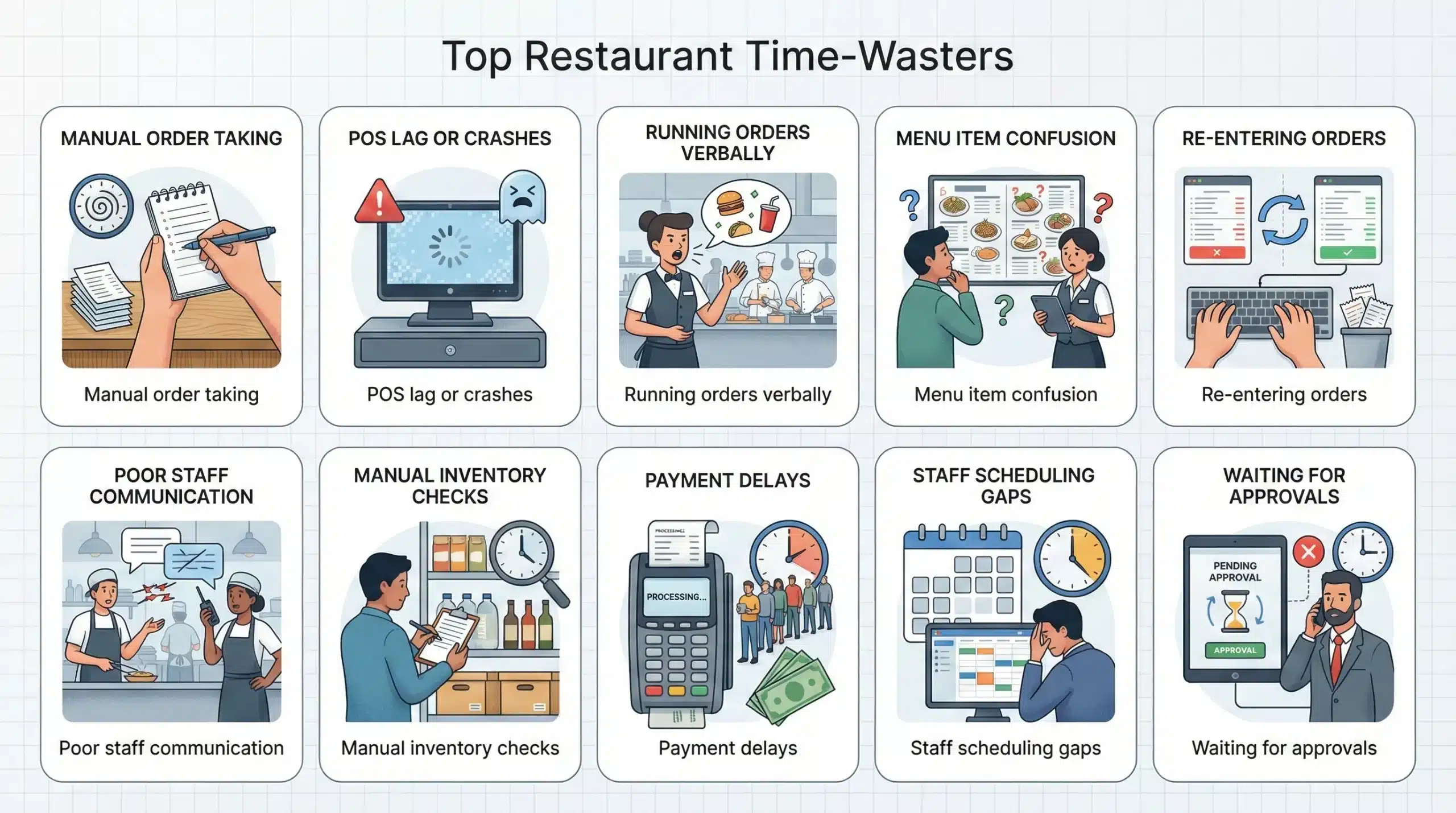
Manual work is one of the biggest Restaurant Time-Wasters You Can Eliminate, yet many restaurants still depend on it. Writing orders, updating spreadsheets, counting inventory by hand, and reconciling receipts all feel harmless individually. However, these tasks repeat daily and pull staff away from service and revenue-generating work.
Paper-Based Ordering and Notes
Paper tickets slow everything down. Servers write orders, runners interpret handwriting, and cooks ask for clarification. Each step introduces friction and the chance for mistakes. Meanwhile, staff spend time correcting errors instead of serving guests.
When orders require re-entry into a system later, the time loss doubles. A task that should take seconds stretches into minutes. Across a full shift, this inefficiency compounds into hours of wasted labor.
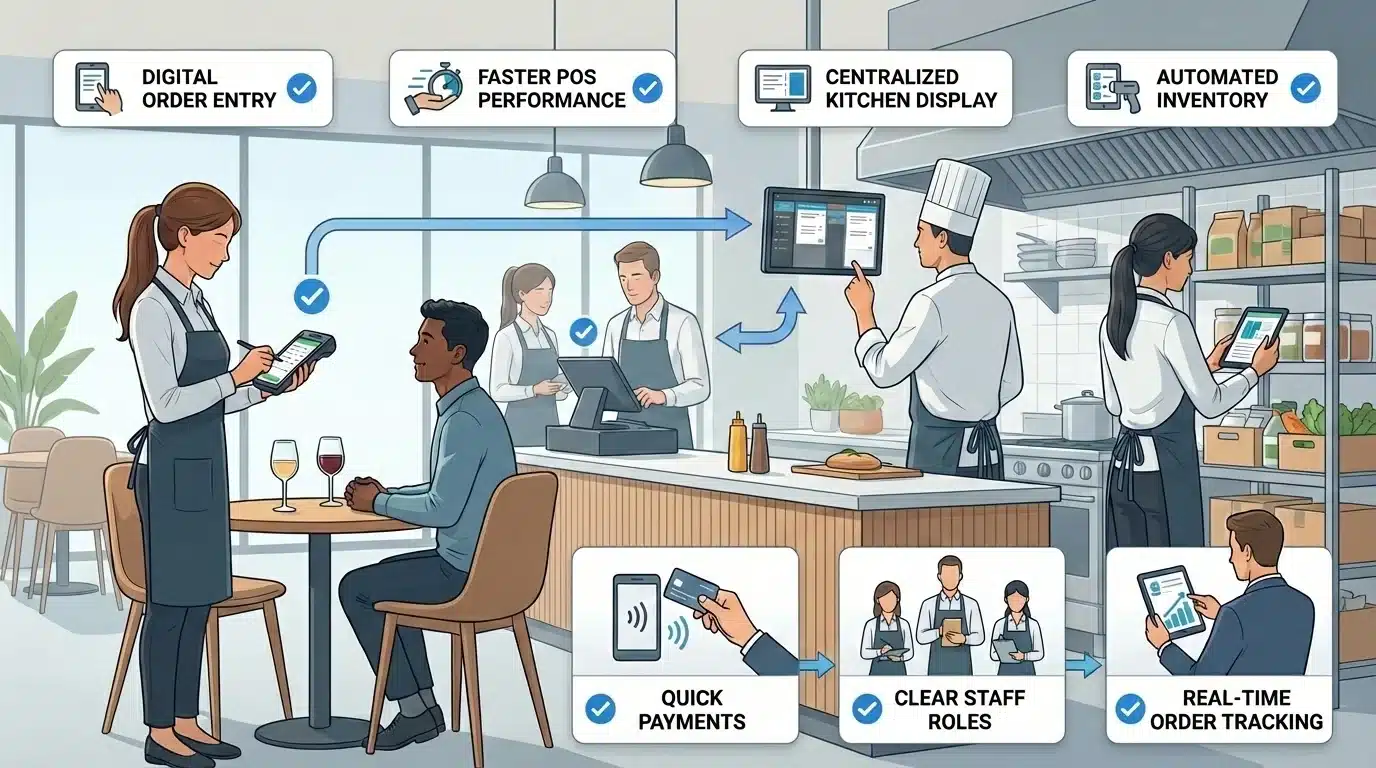
Digital order entry removes this delay entirely. Orders flow directly to the kitchen, reducing confusion and eliminating the need for rework. As a result, service becomes smoother and faster.
Another manual process often goes unnoticed until it becomes overwhelming.
Handwritten Inventory Counts
Counting stock manually takes time and rarely stays accurate. Staff must stop operations, walk storage areas, and write numbers down. By the time counts finish, the data is already outdated.
Because manual counts feel painful, many restaurants do them less often. That leads to stockouts, emergency runs, and over-ordering. Each issue steals time during service and prep.
Automated inventory tracking updates levels in real time. This removes guesswork and eliminates one of the most common Restaurant Time-Wasters You Can Eliminate in back-of-house operations.
Administrative paperwork also drains energy.
Manual Scheduling and Time Tracking
Creating schedules manually requires juggling availability, labor laws, and forecasts. When changes happen, managers redo work repeatedly. Meanwhile, staff request adjustments through messages or notes.
Time tracking errors add another layer of inefficiency. Managers must review punches, correct mistakes, and resolve disputes. These tasks rarely show value but consume attention.
Digital scheduling and time tracking systems streamline the process. With fewer corrections, managers regain hours each week.
Slow Order Processing and Rework
Order processing sits at the center of restaurant operations. When it slows down, everything else follows. Many Restaurant Time-Wasters You Can Eliminate hide in the way orders move from guest to kitchen.
Repeated Order Clarifications
Servers often return to tables to clarify modifications. Kitchens ask questions when tickets lack details. These interruptions break flow and slow preparation.
Each clarification seems minor. However, when it happens dozens of times per shift, the lost minutes add up fast. Staff move back and forth instead of focusing on execution.
Clear modifiers and standardized menus inside the POS reduce confusion. Orders arrive complete, which keeps the kitchen moving efficiently.
Rework also eats time silently.
Remakes Due to Input Errors
Wrong items, missed modifiers, and incorrect sizes all lead to remakes. Staff must stop current tasks to fix past mistakes. This disrupts rhythm and increases stress.
Remakes do more than waste food. They waste time across multiple roles, from cooks to servers to managers handling complaints.
Reducing input errors removes one of the most expensive Restaurant Time-Wasters You Can Eliminate because it protects both labor and food costs.
The way menus are structured also matters.
Overly Complex Menus
Large menus slow ordering. Guests take longer to decide, staff answer more questions, and kitchens juggle too many variations. Each added option increases decision time.
Complex menus also slow training. New hires take longer to memorize items and processes. As a result, service speed suffers.
Streamlined menus with clear upsells improve speed and reduce friction across the entire operation.
Staff Workflow Problems That Add Friction
People want to work efficiently. When workflows fight against them, time disappears. Many Restaurant Time-Wasters You Can Eliminate come from how staff move and communicate during service.
Unclear Role Responsibilities
When roles overlap, tasks get duplicated. Two people handle the same issue while another task goes untouched. This creates confusion and wasted motion.
Unclear responsibility also leads to delays because staff hesitate or wait for direction. Momentum drops during peak periods.
Defined workflows and task ownership remove hesitation. Staff act faster when expectations are clear.
Physical movement also plays a role.
Poor Station Layout
If staff walk long distances for simple tasks, time drains away. Reaching for supplies, printing receipts, or checking screens should not require extra steps.
Inefficient layouts increase fatigue and reduce speed. Over a long shift, this affects performance and morale.
Optimizing station layout cuts wasted movement. Fewer steps mean faster service and less strain.
Communication gaps cause additional friction.
Verbal Communication Instead of System Updates
Relying on verbal updates creates delays and misunderstandings. Shouted changes get missed in noisy environments. Notes fall through the cracks.
When information lives only in people’s heads, tasks stall. Staff must ask questions instead of acting.
System-based communication ensures everyone sees updates instantly. This eliminates one of the most frustrating Restaurant Time-Wasters You Can Eliminate.
Checkout Delays and Payment Bottlenecks
Checkout is the final impression. When it drags, customers notice immediately. Payment issues are among the most visible Restaurant Time-Wasters You Can Eliminate.
Slow Payment Processing
Outdated terminals take longer to process cards. Network delays increase wait times. Customers grow impatient as lines build.
Each slow transaction delays the next guest. During rushes, this bottleneck limits how many orders you can complete.
Modern payment systems process transactions faster and support multiple payment types, reducing delays.
Payment failures make things worse.
Declined Transactions and Retries
When payments fail, staff must retry or switch methods. This creates awkward pauses and holds up service.
Repeated failures often cause customers to abandon purchases. Even when they stay, the delay hurts throughput.
Improving payment reliability removes a major Restaurant Time-Wasters You Can Eliminate at the front counter.
The receipt process also matters.
Manual Receipt Handling
Printing, signing, and storing paper receipts slows checkout. Staff manage slips instead of serving the next guest.
Digital receipts reduce steps and keep lines moving. Customers appreciate faster exits.
Removing unnecessary receipt handling saves seconds on every transaction, which adds up fast.
End-of-Day Reporting and Admin Time Loss
The shift may end, but managers often stay late. Reporting tasks represent some of the most draining Restaurant Time-Wasters You Can Eliminate.
Manual Sales Reconciliation
Matching cash, cards, and reports manually is time-consuming. Errors require double-checking numbers repeatedly.
This work adds stress at the end of long days. Managers lose hours each week to reconciliation.
Automated reporting shortens closeout time and improves accuracy.
Inventory reviews also extend the day.
Post-Shift Inventory Adjustments
When inventory updates happen after service, managers must correct discrepancies manually. This delays closing and increases frustration.
Because updates lag behind reality, decisions suffer. Ordering becomes reactive.
Real-time inventory removes this Restaurant Time-Wasters You Can Eliminate entirely.
Finally, performance analysis can drag on.
Scattered Data Across Systems
Using multiple tools forces managers to jump between screens. Gathering insights takes longer than it should.
When data is fragmented, decision-making slows. Valuable time goes into searching instead of improving operations.
Centralized dashboards streamline review and free managers from unnecessary admin work.
How Biyo Helps Eliminate Restaurant Time-Wasters
Eliminating Restaurant Time-Wasters You Can Eliminate requires systems designed for speed and clarity. Biyo POS brings ordering, payments, inventory, and reporting into one unified platform. This reduces manual work and removes friction at every stage of service.
With faster checkout, real-time inventory, and clear reporting, staff spend less time fixing problems and more time serving guests. Managers regain hours each week that would otherwise disappear into admin tasks.
If you want to see how much time your restaurant can recover, schedule a walkthrough here: https://biyopos.com/schedule-call/. When you’re ready to get started, sign up here: https://signup.biyo.co/.
FAQ
What are the biggest restaurant time-wasters?
Manual tasks, slow order processing, checkout delays, and fragmented systems cause the most time loss.
Can technology really save that much time?
Yes. Small efficiencies repeated hundreds of times per day create massive time savings.
How do I know where time is being wasted?
Watch where staff pause, repeat tasks, or wait. These moments reveal hidden inefficiencies.
Is eliminating time-wasters expensive?
Often no. Many improvements come from better workflows and smarter POS tools.