Great food is the heart of your restaurant, but it's no longer enough to guarantee a full house every night. If you're serious about increasing sales, you need to look beyond the kitchen. The real secret lies in a handful of key areas: mastering your menu's profitability, building an undeniable online presence, creating die-hard customer loyalty, and making your daily operations run like a well-oiled machine.
Let's dive into how you can turn these areas into your biggest strengths.
Your Modern Restaurant Growth Blueprint
In today's crowded market, you can't just wait for customers to walk in. They have endless options, and their expectations for great food, seamless service, and a memorable experience are higher than ever. To really move the needle on sales, you need a smart, connected strategy that makes every part of your business—from the layout of your menu to how your staff takes an order—work harder for you.
The global restaurant scene is growing, but it's not a one-size-fits-all game. The market is projected to hit $4.03 trillion, but where that growth happens is what matters. Quick-service spots are booming, while full-service restaurants are leaning into unique dining experiences and tech to draw people in. Success means putting your energy where customers are headed. You can explore these global restaurant industry statistics to get a clearer picture of the trends.
A Holistic Approach to Sales Growth
Thinking about growth isn't about running a single two-for-one special. It’s about building a system where all your efforts feed into each other, creating real momentum that lasts.
Here are the pillars we'll build on:
- Menu Engineering: Think of your menu as your most valuable salesperson. It's not just a list of what you sell; it's a carefully crafted tool designed to guide guests toward your most profitable and popular items. We'll show you how to analyze it.
- Digital Presence: Your website, Google profile, and social media are your new front door. A slick online ordering system isn't a luxury anymore—it's essential for attracting today's diners.
- Customer Loyalty: It costs a lot more to find a new customer than to keep one you already have. A smart loyalty program and personalized service can turn casual visitors into regulars who keep your tables full.
- Operational Efficiency: Wasted time is wasted money. When your operations are smooth and your team is on point, you can turn tables faster, reduce errors, and see a real bump in your average check size.
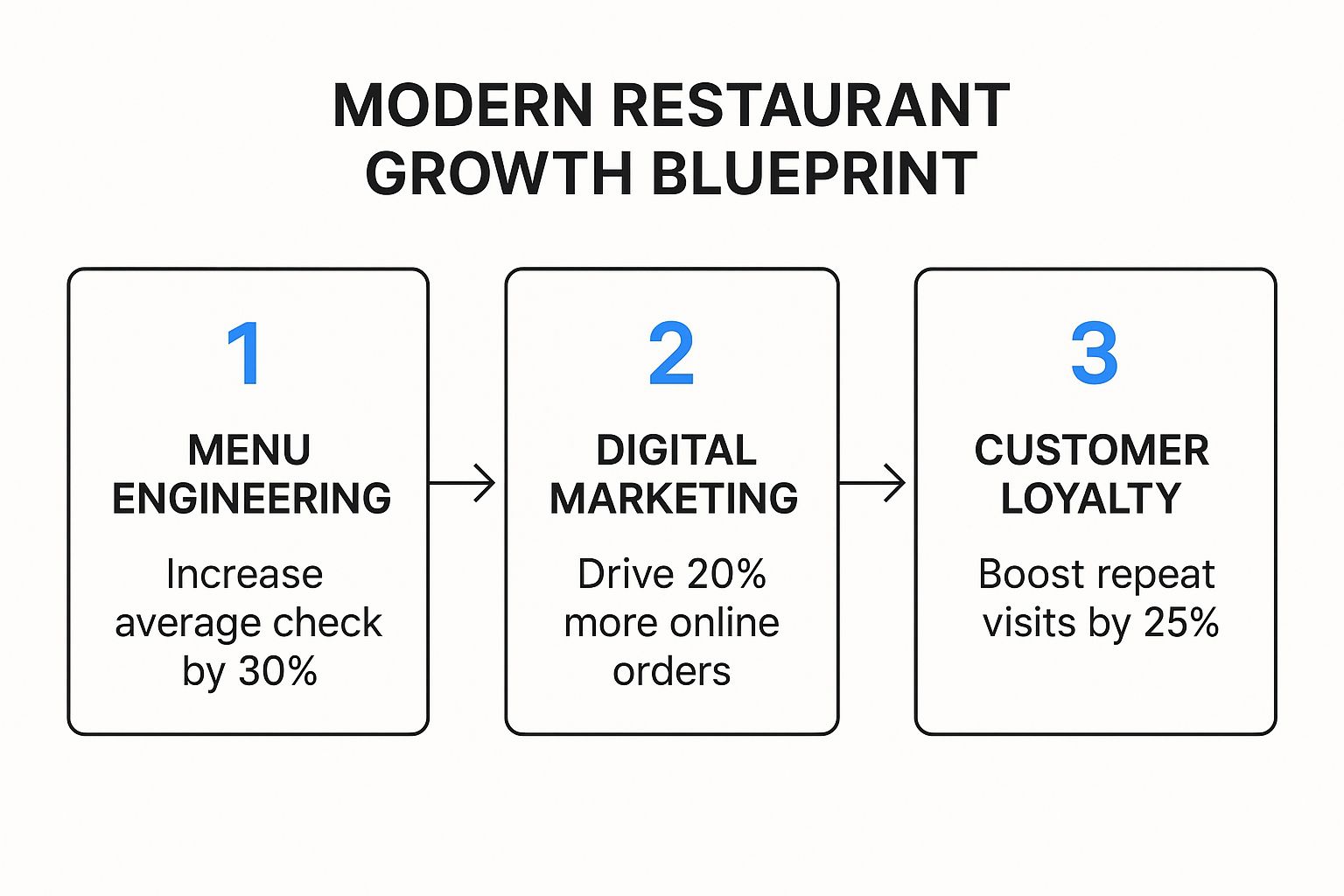
The infographic below breaks down how these pieces fit together to create a powerful cycle of growth.
This isn't just theory. When you combine smart menu design with targeted digital outreach and loyalty perks, you start seeing real, measurable improvements across the board.
To help you visualize how these components work together, here’s a quick summary of the game plan.
Key Strategies to Boost Restaurant Sales at a Glance
| Strategy Area | Primary Goal | Key Actions |
|---|---|---|
| Menu Engineering | Increase Profit Per Customer | Identify and promote high-margin, popular dishes. Redesign menu layout. |
| Digital Presence | Attract New Diners | Optimize Google Business Profile, run targeted social media ads, enable online ordering. |
| Customer Loyalty | Drive Repeat Business | Implement a points-based rewards program, send personalized offers, gather feedback. |
| Operational Efficiency | Improve Service Speed & Accuracy | Use a modern POS to streamline orders, manage inventory, and train staff effectively. |
By focusing on these four areas, you create a powerful, self-reinforcing system that doesn't just boost sales in the short term—it builds a more resilient and profitable restaurant for the long haul.
Turn Your Menu Into a Sales Machine
Your menu is so much more than a list of food. It's the single most powerful sales tool in your restaurant. When you set it up the right way, it can quietly steer customers toward your most profitable dishes, bumping up the revenue from every single table. Just thinking of it as a price list is a massive missed opportunity.
The secret is something we call menu engineering—a perfect mix of art and hard data. It’s all about digging into the popularity and profitability of every single item on your menu to make smarter decisions about pricing, placement, and promotion. This is how some restaurants consistently pull in higher check averages than their competition, even with the exact same amount of foot traffic.
Understanding Your Menu Matrix
The first thing you need to do is sort every dish by how well it’s performing. By charting each item’s popularity (how many you sell) against its profitability (how much you make on each one), you can group them into four key categories. This simple exercise instantly shows you which items are carrying your business and which ones are dead weight.
- Stars: These are your rockstars—everyone loves them, and they make you great money. Your job here is simple: highlight them on the menu and make sure you never, ever run out.
- Plowhorses: People order these all the time, but the profit margins are thin. They’re reliable crowd-pleasers, but they aren't making you rich. Try tweaking the price up just a bit or slightly adjusting the portion size to boost their margin.
- Puzzles: These dishes are goldmines in disguise—high profit, but they just don't sell well. They need a little marketing push. Get creative with the descriptions, have your servers recommend them, or feature them in a special to get people to give them a shot.
- Dogs: These items don't sell and they don't make you money. Honestly, they’re just taking up valuable real estate on your menu. It's usually best to cut them loose, unless they're incredibly cheap to make or fill a very specific dietary need for a key customer group.
Thinking about your menu this way gives you a clear, data-driven plan for every single item you offer. For a much deeper dive into this whole process, check out our complete guide on menu engineering as a strategic approach to maximizing profitability.
Design and Psychology Tricks That Actually Work
Once you know which dishes are your Stars, you can start redesigning your menu to subtly guide your guests' eyes. Most people don't read a menu from top to bottom like a book. Their eyes naturally jump to certain spots first.
We call this scanning pattern the "golden triangle"—the top of the page, the middle, and the upper-right corner. By placing your high-profit Stars in these hotspots, you make it way more likely that customers will see them and, more importantly, order them.
A small change in a dish's description can have an outsized impact. Studies have shown that using vivid, appealing language—like "tender, wood-fired steak" instead of just "steak"—can increase sales of that item by nearly 30%.
Beyond where you place items, the words you use and your pricing strategy tap into powerful psychological triggers.
- Ditch the Dollar Signs: When you remove the "$" from your prices, it makes customers feel less like they're spending money. It’s a subtle shift that can encourage them to order more freely.
- Embrace Charm Pricing: We've all seen it. Prices ending in .99 or .95 are perceived as being a much better deal than the next whole number. A dish priced at $9.95 just feels friendlier than one at $10.00.
- Bundle for Better Value: Create combo deals or prix fixe menus that pair a Star with a lower-cost item like an appetizer or dessert. This makes the customer feel like they’re getting a fantastic deal, while you increase the overall profit margin on the sale.
When you start applying these proven techniques, your menu transforms from a passive document into an active, hard-working tool that drives your restaurant's success.
Master Your Digital Marketing and Online Ordering
Let's be honest, most dining decisions these days start with a quick search on a phone. Your restaurant's online presence isn't just a website; it’s your new front door. A strong digital footprint is no longer a "nice-to-have"—it's a core part of your business that directly fuels sales. Getting this right is one of the most impactful ways to boost your restaurant's revenue.
This is about more than just existing online. It’s about being there at the exact moment a potential customer searches "tacos near me" or is scrolling through Instagram deciding what to get for dinner.
Become a Local Search Champion
For nearly every restaurant, the real customer battle is won or lost within a few square miles. This is where mastering local search becomes your secret weapon, and it all begins with your Google Business Profile (GBP).
Think of your GBP as your digital billboard. It's often the very first impression someone gets of your restaurant, so you have to keep it pristine. It's absolutely non-negotiable.
- Claim and Complete: Make sure every single field is filled out accurately. We're talking hours, address, phone number, and website—the absolute basics.
- Upload Great Photos: I can't stress this enough: visuals sell. Post mouth-watering photos of your signature dishes, shots that show off your dining room's vibe, and even a few candid pictures of your happy team.
- Encourage Reviews: A steady flow of recent, positive reviews is gold. It's social proof that tells people you're the real deal. Actively ask your happy customers to leave feedback, and always—always—respond professionally to every review, good or bad.
A well-tended profile means that when someone nearby gets hungry, you're the first name they see.
Craft a Social Media Presence That Actually Connects
Social media isn't just for posting your daily specials. It's where you build a community and give your brand a personality. Instead of just pushing out ads, focus on content that feels real and gets people talking.
Instagram, in particular, is a powerhouse for restaurants. You don't need a huge budget, just some smart tactics:
- Share Customer Photos: When a guest tags your restaurant in a great-looking photo, share it on your story! This is free, authentic marketing that shows real people loving your food.
- Go Behind the Scenes: Post short video clips of your chefs working their magic or your team getting ready for service. It makes your followers feel like they're part of an exclusive club.
- Run Polls and Q&As: Use Instagram Stories to ask your audience what new dish they'd like to try or to answer questions about your menu. It's a simple way to build a real conversation.
The goal isn't just to rack up followers. It's to build a loyal online community that shows up at your door. When you interact genuinely, your social media becomes a powerful magnet for foot traffic.
Build Your Own Online Ordering System
Third-party delivery apps can get you in front of new customers, but that visibility comes with a hefty price tag—often 15-30% in commission fees. They're a decent starting point for discovery, but your long-term strategy should always be to bring those customers over to your own direct ordering platform.
A commission-free system, like the one that integrates seamlessly with your Biyo POS, means you keep more of your hard-earned money. Even better, you get direct access to your customer data. That information is crucial for building an email list and running targeted marketing campaigns that actually work. To see how to get started, check out our guide on setting up an online ordering system.
Don't sleep on email marketing, either. It’s still one of the most effective ways to drive repeat business. You can build your list with simple in-store promotions, like offering a free drink for signing up. From there, send out targeted campaigns with exclusive offers that keep your restaurant top-of-mind and bring those regulars back time and time again.
Build Loyalty to Secure Repeat Business
It’s always a thrill to see new faces walk through the door, but let’s be honest—it’s the regulars who are the heart and soul of any successful restaurant. Winning over a new customer can cost five times more than keeping an existing one. That makes building loyalty one of the smartest things you can do to boost sales and create a stable, predictable stream of revenue.
Think of your regulars as the foundation of your business. They’re the ones who keep you afloat during the slow seasons and help you build momentum for real growth.
Go Beyond the Paper Punch Card
The days of digging through a wallet for a crinkled, ink-smeared punch card are long gone. Today's loyalty programs, integrated right into your POS, are a much smarter and more personal way to encourage your best customers to return again and again.
A modern loyalty program doesn't just count visits; it gives you a window into who your customers are and what they truly enjoy. This data is pure gold. It lets you craft experiences that feel less like a marketing gimmick and more like a genuine relationship. The trick is to pick a model that feels right for your restaurant's personality.
Here are a few popular loyalty models that work wonders:
- Points-Based Systems: This is the tried-and-true classic. Customers earn points for every dollar spent, which they can then cash in for free food, discounts, or even some cool branded merch. It’s simple, everyone gets it, and it provides a clear, tangible reward for their business.
- Tiered Rewards: Want to make your top spenders feel like A-listers? This is the way to do it. As customers spend more, they climb the ranks from "Silver" to "Gold" to "Platinum," unlocking better perks at each level. Think priority seating, a sneak peek at new menu items, or invites to exclusive tasting events.
- Cashback Programs: Simple, direct, and incredibly effective. Customers get a percentage of their spending back as a credit for their next visit. For instance, offering 5% cashback means a guest gets a $5 credit for every $100 they spend. It’s a powerful nudge to get them to come back and use that credit.
No matter which path you choose, the mission is the same: show your customers you appreciate them and give them a great reason to pick your place over the one down the street.
The Magic is in the Personal Touch
The real power of a great loyalty program comes from using the data you collect to make your offers personal. Your POS should be tracking what your customers order, how often they visit, and even their birthdays. This isn't just data; it's a treasure trove of insights for crafting targeted promotions that feel special.
Think about it. What’s more impactful? A generic "10% off" email blast, or an automated message sent to a loyal customer on their birthday with a coupon for a free dessert? If you see a regular who always gets the spicy chicken sandwich, you can surprise them with an offer for a free side of fries next time they order it.
When you focus on what your individual customers actually want, your marketing shifts from a generic broadcast to a personal invitation. That’s the kind of attention to detail that builds real, lasting loyalty.
Great Service is the Real Foundation
At the end of the day, no rewards program in the world can fix a bad experience. The bedrock of customer loyalty will always be exceptional service. Every single time your staff interacts with a guest, it's a chance to make or break that relationship.
Give your team the power to create those small, memorable moments. It can be as simple as remembering a regular's name and their go-to drink or going a little out of their way to handle a special request. When your staff is trained not just to take orders but to connect with people, they have the power to turn a first-time visitor into a lifelong fan—someone who will not only come back but will tell their friends, too.
Smooth Out Your Operations and Supercharge Your Staff
Slow service, order mix-ups, and a stressed-out team aren't just frustrating—they're quiet profit killers. Every little hiccup in your daily operations slowly eats away at your potential to grow sales. The secret to plugging these leaks and turning them into big revenue gains lies in sharpening your workflows and truly empowering your staff.
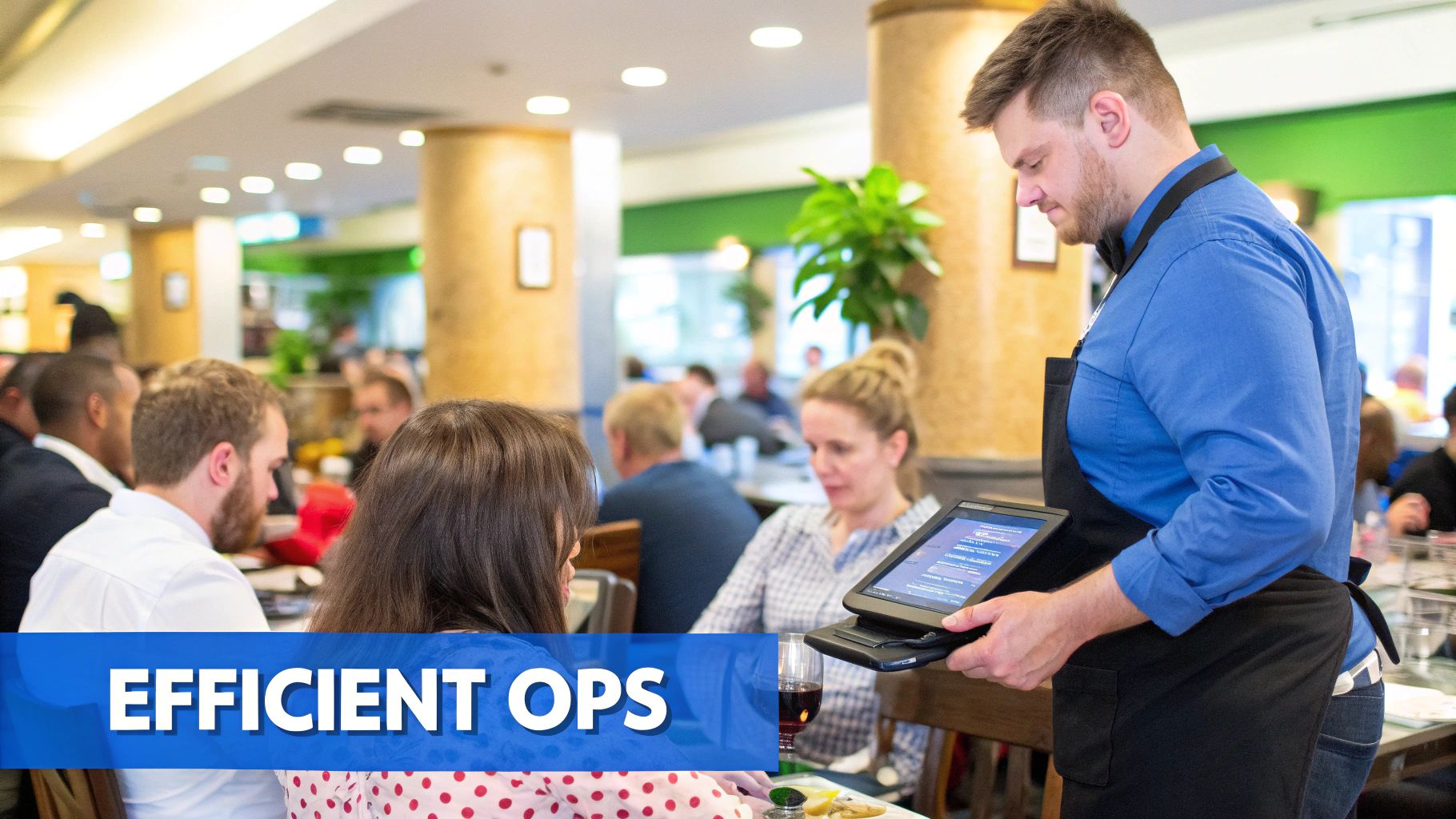
Think of a modern POS system as the central nervous system of your restaurant. It creates a seamless link between the front and back of the house. When a server punches in an order on a tablet, it pops up instantly on the kitchen display system (KDS). This simple change slashes errors and shaves minutes off ticket times, helping you turn tables faster all night long.
Turn Your Team Into Sales Champions
Your servers aren't just order-takers; they are your most valuable salespeople. But effective upselling isn’t about being pushy. It’s all about making genuine, helpful suggestions that make a guest's meal better while also bumping up the average check size.
Instead of the flat, "Anything to start?" train your team to make a specific, irresistible recommendation.
- Here's how that sounds in the real world: "While you're deciding on your mains, our chef just pulled a fresh batch of the crispy calamari out of the fryer. It’s perfect for sharing and comes with a fantastic spicy marinara."
This feels less like a sales pitch and more like an insider tip. The same goes for drinks. A server who can confidently suggest a specific wine that pairs perfectly with the steak special can easily add $10-$15 to a check. Give your team the tools—like simple scripts and regular menu tastings—so they can talk about your food and drinks with genuine excitement.
A happy, well-supported team delivers incredible service, which is the number one driver of customer satisfaction and repeat visits. When your staff feels valued, that positive energy fills the entire dining room.
Make Inventory Management a Profit Center
We all know food waste is a massive drain on restaurant profits. Your best defense is smart inventory management, and your POS data is the key. Stop guessing and start using real-time sales reports to see exactly what’s flying off the shelves and what’s just sitting there.
A data-driven approach to inventory helps you:
- Stop Over-ordering: By tracking exactly how much you use, you can order with surgical precision and minimize spoilage.
- Spot the 'Dogs': If a dish isn't selling and uses expensive, perishable ingredients, your data will flag it as a source of waste.
- Create Money-Making Specials: Have a little too much of one ingredient? Use that info to create a limited-time special that turns potential waste into pure profit.
This kind of control is a game-changer in an industry with famously thin margins. The average net profit margin for most restaurants is just 3% to 5%, so every dollar you save on waste goes straight to your bottom line. You can learn more about how operational efficiency impacts restaurant margins and see how you stack up against industry trends.
The Ripple Effect of a Great Workplace
Finally, never, ever underestimate the financial impact of a happy, empowered team. High staff turnover is incredibly expensive when you factor in the costs of recruiting, hiring, and training new people. By creating a positive environment where your team feels respected and has the right tools to succeed, you dramatically reduce that churn.
When your crew is confident and efficient, service runs like a well-oiled machine, guest satisfaction soars, and the five-star reviews start rolling in. It's a powerful cycle where optimizing what happens inside your four walls creates fantastic results on the outside, proving that your staff is your single greatest asset in your mission to boost sales.
Still Have Questions? Let's Talk Strategy
Figuring out how to really move the needle on your restaurant's sales can feel like a puzzle. Here are some of the most common questions I hear from owners and my straightforward answers.
What's the Fastest Way to Get a Sales Bump?
If you need a quick win, your best bet is to pair menu engineering with a smart, targeted promotion. Don't overthink it. Just dive into your sales data and find one of your "Star" items—something that's both popular and highly profitable.
Once you've got your star dish, build a limited-time offer around it. Maybe it’s a "Date Night Special" that bundles the dish with a drink and a dessert. Push this deal hard on your social media and email lists, creating a real sense of urgency. You're essentially taking a proven winner and giving people an extra reason to come in right now, which can deliver an immediate sales lift without a huge cash outlay.
How Much Should I Actually Spend on Marketing?
The textbook answer is 3-6% of your revenue, but honestly, it's less about the percentage and more about the return on your investment (ROI). Start small with tactics that cost more time than money.
For instance, make sure your Google Business Profile is completely filled out and looks amazing. Get active on social media, responding to every comment and message. These things are practically free and build a loyal following. Once you see what works, you can reinvest some of those profits into paid ads. The trick is to track your results. If a $100 Facebook ad brings in $500 of new business, that's a winning formula you can confidently scale up.
Can Technology Really Make a Difference for a Small Restaurant?
Absolutely. It's one of the biggest equalizers out there. Modern, cloud-based POS systems aren't just for the big chains anymore; they're the nerve center for small, independent spots. Think of it as your command hub for handling online orders, running a loyalty program, and seeing exactly which dishes are making you the most money.
These tools take the tedious, manual work off your plate, giving you more time to actually be on the floor with your guests. More importantly, they give you the kind of data-driven insights that lead to smarter decisions and, ultimately, more sales. It's how you can compete and win.
Ready to streamline your operations and unlock new sales opportunities? Biyo POS offers an all-in-one solution designed for restaurants like yours. See how Biyo POS can help your restaurant grow.