You’ve probably seen advertisements promising free credit card processing for small business. At first glance, the offer sounds almost impossible to ignore. Accept credit cards, keep more revenue, and eliminate one of the most common operating expenses facing modern businesses. For small business owners managing tight margins, rising labor costs, and increasing overhead, the idea of removing payment processing fees can feel like an easy win.
The reality, however, is more nuanced. Credit card networks, issuing banks, and payment processors do not eliminate fees simply because a business signs up for a new program. The money still has to come from somewhere. In most cases, so-called free processing programs shift those costs from the merchant to the customer through surcharge programs or cash discount models. While this strategy can reduce merchant expenses, it can also influence customer behavior, brand perception, and long-term sales performance.
Understanding how these programs work is essential before making a decision. A payment strategy that works well for a convenience store may not be appropriate for a restaurant, boutique retailer, or service-based business. The right approach depends on customer expectations, transaction size, industry regulations, and competitive pressures.
In this guide, we’ll examine what free credit card processing actually means, how surcharge and cash discount programs operate, the hidden fees many businesses overlook, and smarter ways to reduce payment costs without creating friction for customers.
Table of Contents
- The Truth Behind Zero-Fee Processing
- How Surcharge and Cash Discount Programs Work
- Hidden Fees and Contract Traps
- Smarter Ways to Reduce Processing Costs
- Choosing the Right Payment Processor
- Why Payment Processing Strategy Matters
- How Biyo POS Helps Manage Payments
- Frequently Asked Questions
The Truth Behind Zero-Fee Processing
When a payment provider advertises “free processing,” it rarely means that processing fees have disappeared. Every credit card transaction travels through a complex payment ecosystem involving card networks, issuing banks, acquiring banks, and payment processors. Each participant receives a portion of the transaction fee in exchange for authorizing, securing, and settling the payment.
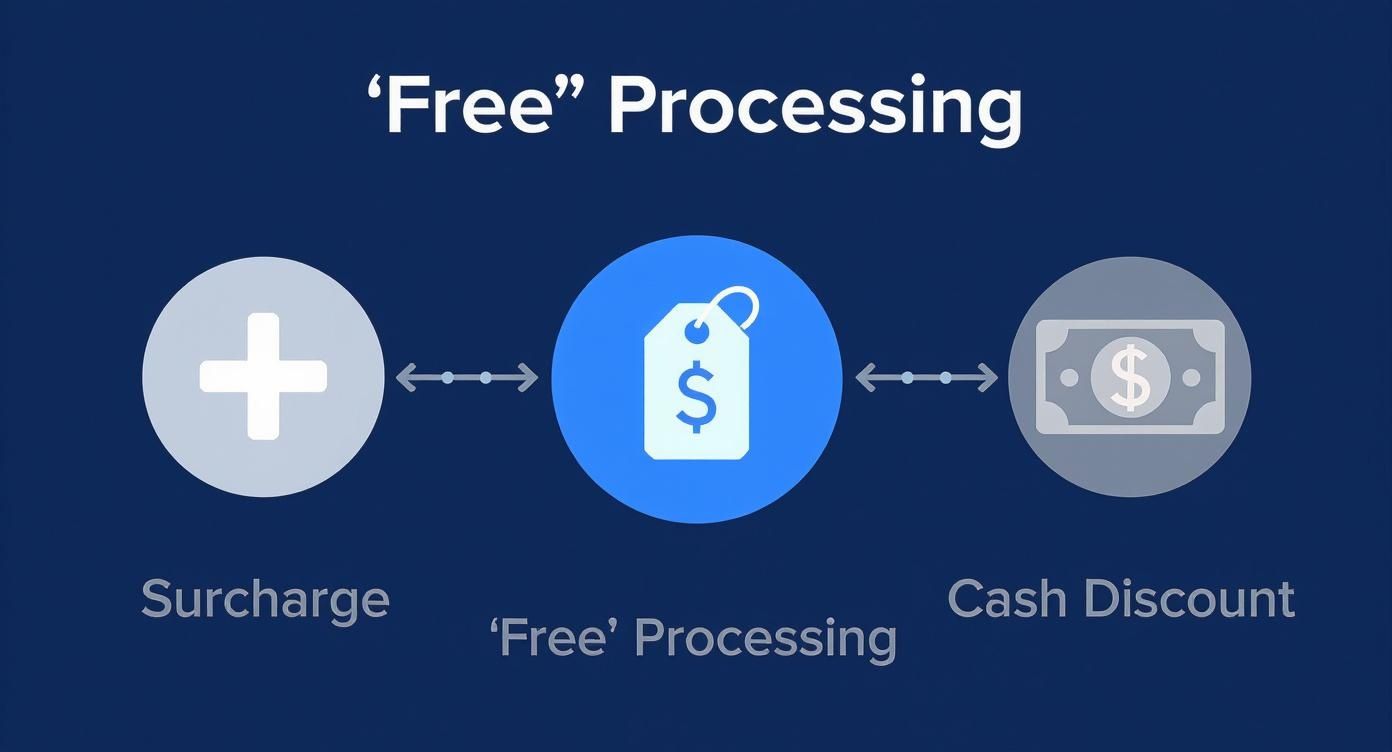
Because these fees are built into the payment infrastructure, they cannot simply be eliminated. Instead, free processing programs usually change who pays them. Traditionally, the merchant absorbs the cost as part of doing business. Under zero-fee programs, those costs are commonly passed to customers through surcharges or built into pricing structures that reward cash payments.
For many businesses, processing fees represent one of the largest recurring operating expenses outside payroll and rent. A merchant processing $40,000 in monthly card sales may easily spend between $600 and $1,400 per month depending on transaction types, card mix, and processor pricing. Over the course of a year, that expense can exceed $10,000.
This financial pressure explains why many businesses explore alternative payment models. However, reducing processing expenses should never be viewed in isolation. Customer satisfaction, repeat business, online reviews, and competitive positioning are equally important considerations.
Every card transaction generally includes three primary cost components:
- Interchange Fees: Paid to the customer’s card-issuing bank and typically represent the largest portion of the processing cost.
- Assessment Fees: Charged by card networks such as Visa, Mastercard, Discover, and American Express.
- Processor Markups: The fee charged by the payment processor for managing the transaction and providing payment infrastructure.
Understanding these costs helps business owners evaluate whether a free processing program genuinely creates savings or simply shifts costs elsewhere within the customer experience.
Standard vs. Free Processing Models
| Feature | Traditional Processing | Surcharge Program | Cash Discount Program |
|---|---|---|---|
| Who Pays Fees | The merchant pays all processing fees. | Customers paying with credit cards pay a surcharge. | Customers paying with cash receive a discount. |
| Pricing Method | Fees are deducted from the merchant payout. | A percentage is added to credit card transactions. | Menu prices include card costs; cash receives a lower price. |
| Customer Experience | Same price for all payment types. | Credit card payments cost slightly more. | Cash payments receive a reward. |
| Legal Status | Legal nationwide. | Legal in most states but regulated. | Generally legal nationwide. |
| Typical Use Case | Businesses prioritizing convenience. | Businesses wanting to offset processing fees. | Retail stores, cafes, and quick-service restaurants. |
How Surcharge and Cash Discount Programs Work
Most free credit card processing programs rely on one of two strategies: surcharges or cash discounts. While both approaches aim to offset payment processing expenses, they affect customers differently and can produce very different business outcomes.
Choosing between these models requires understanding not only the financial impact but also how customers perceive pricing. Small differences in presentation can influence purchasing decisions, customer loyalty, and brand reputation.
Surcharge Programs Explained
A surcharge program adds a fee to transactions completed using a credit card. The surcharge typically mirrors the merchant’s processing cost and appears as a separate charge during checkout.
For example, if a customer purchases a product for $20 and the surcharge is 3%, the final total becomes $20.60. Customers using cash or debit cards generally avoid the additional fee.
- Purchase price: $20.00
- Credit card surcharge: 3%
- Total charged: $20.60
Surcharge programs can reduce merchant costs significantly, but they also introduce potential friction. Some customers view surcharges as penalties rather than operational necessities. In highly competitive markets, even small fees can encourage customers to choose competitors who advertise simpler pricing.
Businesses considering surcharges should understand that card networks impose disclosure requirements and fee limitations. Compliance is critical because improper implementation can lead to penalties or account issues.
Cash Discount Programs
A cash discount program approaches the problem from a different angle. Rather than adding a fee to card transactions, the business incorporates processing costs into its listed prices and then offers a discount to customers who pay with cash.
For example:
- Listed price: $20.60
- Cash discount: $0.60
- Final cash price: $20.00
Psychologically, customers often respond more favorably to receiving a discount than paying a surcharge, even when the financial outcome is identical. This makes cash discount programs particularly popular among small retailers, independent restaurants, and service businesses.
Which Model Works Better?
The answer depends largely on customer expectations. A convenience store serving local customers making small purchases may experience little resistance to surcharges. A fine-dining restaurant or premium retail brand, however, could see customer satisfaction decline if fees feel unexpected.
Business owners should evaluate customer demographics, average transaction size, local competition, and purchasing behavior before choosing either model. What reduces costs on paper may not always maximize profitability in practice.
Hidden Fees and Contract Traps
One of the biggest mistakes business owners make is focusing exclusively on transaction rates. Processing fees matter, but they are only one part of the total cost of accepting payments. Many processors advertise attractive rates while generating revenue through additional charges hidden within lengthy merchant agreements.
Understanding these fees is essential because they can significantly reduce or completely eliminate the savings promised by free processing programs.

Common hidden charges include:
- Monthly service fees
- PCI compliance fees
- Payment gateway fees
- Statement fees
- Batch processing fees
- Chargeback handling fees
- Account maintenance charges
Equipment leasing is another area where merchants frequently overspend. A payment terminal worth a few hundred dollars can cost several thousand dollars over the life of a long-term lease agreement. Purchasing equipment outright is often significantly cheaper than leasing.
Contract Clauses to Review Carefully
Before signing any merchant agreement, review contract language carefully. Long-term commitments can become expensive if your business grows or your needs change.
- Three-to-five-year contract terms
- Automatic renewal provisions
- Early termination penalties
- Minimum monthly processing requirements
- Equipment return obligations
Transparent providers should clearly explain all fees, cancellation policies, and equipment arrangements before onboarding a merchant. If pricing seems difficult to understand, that complexity may be intentional.
Smarter Ways to Reduce Processing Costs
Passing fees to customers is not the only strategy available. Many businesses reduce payment expenses while maintaining positive customer experiences by optimizing their processing setup and transaction mix.
Use Interchange-Plus Pricing
Interchange-plus pricing separates interchange costs from processor markups, providing transparency and making it easier to compare providers. High-volume businesses often achieve lower effective rates under this model because processor margins become easier to negotiate.
Consider Flat-Rate Pricing for Simplicity
For smaller businesses, flat-rate pricing offers predictability and straightforward budgeting. While rates may be slightly higher than optimized interchange-plus plans, simplicity can save time and reduce billing confusion.
Encourage Lower-Cost Payment Methods
Not all payment methods cost the same. Businesses can reduce expenses by encouraging customers to use lower-cost options when appropriate.
- ACH transfers
- Debit cards
- Digital wallets
- Stored payment methods
- Recurring billing systems
Even small shifts in payment behavior can create meaningful savings over time, particularly for businesses processing thousands of transactions each month.
Improve Transaction Quality
Card-present transactions typically cost less than manually entered card payments because they carry lower fraud risk. Ensuring payment terminals support EMV chip cards, contactless payments, and secure tokenization can improve transaction quality while reducing chargeback exposure.
Choosing the Right Payment Processor
Finding the right processor involves much more than comparing advertised rates. The ideal provider should support your business model, growth plans, operational requirements, and customer experience goals.

When evaluating providers, consider:
- Transaction rates and pricing transparency
- Monthly and annual fees
- Hardware costs
- Contract flexibility
- Funding speed
- Customer support quality
- PCI compliance assistance
- Integration capabilities
Businesses that rely on inventory management, loyalty programs, reporting, or online ordering should also evaluate how well the processor integrates with their broader technology stack.
Why Payment Processing Strategy Matters
Payment processing is often treated as a minor operational detail, but its long-term financial impact can be substantial. Even small differences in effective rates become meaningful as transaction volume grows.
Consider the impact of just a 0.5% difference in processing costs:
- $15,000 monthly sales × 0.5% = $75 per month
- $50,000 monthly sales × 0.5% = $250 per month
- $100,000 monthly sales × 0.5% = $500 per month
Over a year, these savings can amount to thousands of dollars that can be reinvested into marketing, staffing, inventory, or business expansion.
At the same time, reducing fees should never come at the expense of customer satisfaction. The most successful businesses balance cost control with convenience, transparency, and trust. A payment strategy should support profitability while preserving the customer experience that drives repeat business.
How Biyo POS Helps Manage Payments
Payment processing is only one component of running a successful retail store, restaurant, or service business. To maximize profitability, businesses need visibility into sales trends, inventory performance, customer behavior, and operational efficiency. This is where an integrated POS platform becomes valuable.
Biyo POS helps businesses manage payments, inventory, reporting, customer engagement, and day-to-day operations through a unified platform. Instead of juggling multiple disconnected systems, owners can monitor sales performance, track inventory in real time, analyze customer purchasing patterns, and make informed decisions using actionable business data.
Businesses looking to modernize their payment and operational infrastructure can schedule a consultation to explore available features and implementation options. Companies ready to get started can also create an account and begin streamlining operations through the Biyo POS ecosystem.
Frequently Asked Questions
Is free credit card processing actually free?
Not entirely. Processing fees still exist because banks, card networks, and payment processors must be compensated. Most free processing programs simply shift those costs from the merchant to the customer through surcharges or pricing adjustments.
Is it legal to add a surcharge to credit card transactions?
In many jurisdictions, yes, but surcharges are subject to regulations and card-network requirements. Businesses must follow disclosure rules, comply with fee limitations, and verify local regulations before implementing a surcharge program.
Will customers react negatively to surcharge programs?
Customer reactions vary depending on industry, pricing transparency, and competitive alternatives. Businesses that clearly communicate payment policies generally experience fewer complaints than those that introduce fees unexpectedly during checkout.
Are cash discount programs better than surcharge programs?
Many businesses find that customers perceive cash discounts more positively because they are framed as rewards rather than penalties. However, the best option depends on customer preferences, payment habits, and business goals.
What is the average credit card processing fee for small businesses?
Most small businesses pay between 1.5% and 3.5% per transaction, although rates vary based on card type, transaction method, industry risk level, and processor pricing structure.
What pricing model is usually best for growing businesses?
Many growing businesses prefer interchange-plus pricing because it provides transparency and often becomes more cost-effective as transaction volume increases. However, businesses prioritizing simplicity may prefer flat-rate pricing.
Can switching processors save money?
Yes. Businesses frequently discover lower rates, better contract terms, improved support, and more advanced technology when reviewing alternative providers. Regularly evaluating payment processing costs can uncover significant savings opportunities.
Does PCI compliance affect processing costs?
PCI compliance does not directly reduce transaction fees, but it helps protect customer data, reduce fraud risks, avoid penalties, and maintain eligibility for secure payment processing services.