If you want to reduce employee turnover, you must focus on the employee experience. Employees stay longer when they receive fair compensation, see opportunities for career growth, and feel supported within a positive work environment. Reducing turnover is not simply about reacting when someone quits—it’s about building a workplace where employees want to stay, contribute, and develop their careers long term.
High employee turnover creates operational instability, increases hiring costs, lowers morale, and weakens customer experiences. Businesses that constantly replace workers often struggle to maintain consistency because new employees require onboarding, training, and time to reach full productivity.
According to workforce management research, replacing employees can cost businesses anywhere from 50% to 200% of an employee’s annual salary depending on the role and industry. Beyond direct hiring expenses, turnover also impacts productivity, workplace culture, customer relationships, and long-term business growth.
Modern employees expect more than just a paycheck. They value supportive leadership, career development opportunities, work-life balance, flexibility, recognition, and healthy workplace culture. Businesses that fail to provide these experiences often face ongoing staffing instability.
This guide explores practical strategies businesses can use to reduce employee turnover, improve retention, strengthen workplace culture, and build a more engaged workforce.
Table of Contents
- Why High Employee Turnover Is More Costly Than You Think
- Improve Hiring and Onboarding Practices
- Create Career Growth Opportunities
- The Role of Managers in Employee Retention
- Offer Competitive Compensation and Work-Life Balance
- Build a Positive Workplace Culture
- Why Employee Recognition Matters
- Use Technology to Support Your Workforce
- Future Trends in Employee Retention
- How Biyo Helps Businesses Manage Employees
- Frequently Asked Questions About Employee Turnover
Why High Employee Turnover Is More Costly Than You Think

Employee turnover affects much more than staffing levels. Every departure creates financial and operational disruption that impacts the entire organization.
Replacing employees requires businesses to spend money on recruiting, interviewing, onboarding, training, and temporary productivity losses. During staffing shortages, existing employees often take on additional responsibilities, increasing workplace stress and burnout.
Frequent turnover additionally weakens consistency in customer service. Customers often build trust and familiarity with experienced employees, particularly in hospitality, retail, healthcare, and service-based industries.
The Hidden Impact of Employee Turnover
When experienced employees leave, businesses lose valuable institutional knowledge that can take months or even years to rebuild. Team dynamics often suffer because remaining employees must adapt repeatedly to new coworkers and changing responsibilities.
High turnover can also damage workplace culture. Employees may begin questioning leadership stability or long-term company direction when they see coworkers leaving frequently.
Businesses experiencing chronic turnover often struggle with:
- Lost productivity: New employees require time to learn systems and procedures before reaching full efficiency.
- Lower morale: Frequent departures increase stress and uncertainty for remaining employees.
- Customer dissatisfaction: Inconsistent staffing can negatively affect service quality and customer relationships.
- Increased hiring expenses: Constant recruiting and onboarding create ongoing operational costs.
Employee turnover is often a symptom of deeper organizational challenges. Businesses that proactively improve culture, communication, and employee support usually achieve stronger long-term retention.
Core Strategies for Reducing Turnover
| Strategy Area | Problem Addressed | First Action Step |
|---|---|---|
| Hiring & Onboarding | Mismatched employees leaving quickly | Create realistic job descriptions and expectations |
| Scheduling & Fairness | Burnout from unpredictable schedules | Ask employees for scheduling preferences |
| Compensation & Benefits | Employees leaving for better pay | Benchmark compensation against competitors |
| Culture & Recognition | Employees feeling undervalued | Implement regular recognition practices |
| Training & Development | Employees feeling stuck professionally | Create career development discussions |
Improve Hiring and Onboarding Practices

Reducing employee turnover starts with hiring the right people. Many businesses rush to fill positions quickly, which often leads to poor long-term employee fit.
Effective hiring focuses not only on technical qualifications but also on personality compatibility, communication skills, workplace expectations, and long-term career alignment.
Create Honest Job Descriptions
Job descriptions should clearly explain responsibilities, work pace, scheduling expectations, and company culture. Transparency helps applicants determine whether the role truly matches their interests and expectations before accepting employment.
Employees who understand the realities of a position are generally more likely to remain satisfied long term.
Use Behavioral Interview Questions
Behavioral interview questions help employers evaluate how candidates handled real workplace situations in previous roles.
Questions about teamwork, conflict resolution, customer service challenges, or problem-solving experiences provide valuable insight into communication skills and emotional intelligence.
Build a Structured Onboarding Program
Strong onboarding experiences improve employee confidence, engagement, and retention. Employees who feel supported during their first few months are more likely to remain long term.
Many businesses implement structured 30-60-90 day onboarding plans that outline training goals, performance expectations, and milestones during the first three months of employment.
Clear onboarding reduces confusion while helping employees integrate more comfortably into workplace culture.
Create Career Growth Opportunities
Employees are significantly more likely to stay when they see long-term opportunities for advancement and development.
Workers who feel professionally stagnant often begin searching for opportunities elsewhere, even if they initially enjoy their current workplace.
Define Clear Advancement Paths
Businesses should communicate how employees can grow within the organization. Even small businesses can create progression opportunities through increased responsibilities, leadership development, or specialized training.
Employees who understand what steps lead to promotions or pay increases are generally more motivated and engaged.
Invest in Employee Development
Training programs help employees improve both technical and interpersonal skills. Cross-training employees across multiple responsibilities additionally improves operational flexibility while increasing employee confidence.
Professional certifications, workshops, mentorship programs, and leadership development initiatives all contribute to stronger employee retention.
Promote From Within Whenever Possible
Internal promotions strengthen loyalty by showing employees that hard work and commitment are rewarded.
Businesses that prioritize internal mobility often build stronger workplace cultures because employees believe long-term career growth is achievable within the company.
The Role of Managers in Employee Retention

Managers strongly influence employee satisfaction, morale, and retention. Many employees leave workplaces because of management issues rather than dissatisfaction with the company itself.
Develop Leadership and Communication Skills
Managers should learn how to provide constructive feedback, resolve conflicts professionally, recognize employee contributions, and communicate expectations clearly.
Supportive leadership helps employees feel respected and valued, which directly improves retention.
Encourage Open Communication
Employees should feel comfortable discussing concerns, workload challenges, scheduling conflicts, or career goals without fear of negative consequences.
Regular one-on-one meetings create opportunities for managers to identify problems before they escalate into resignation decisions.
Empower Managers to Solve Problems
Managers who have authority to adjust schedules, address minor workplace issues, or resolve operational concerns can respond more effectively to employee needs.
Responsive leadership helps create a more supportive and adaptable workplace environment.
Offer Competitive Compensation and Work-Life Balance
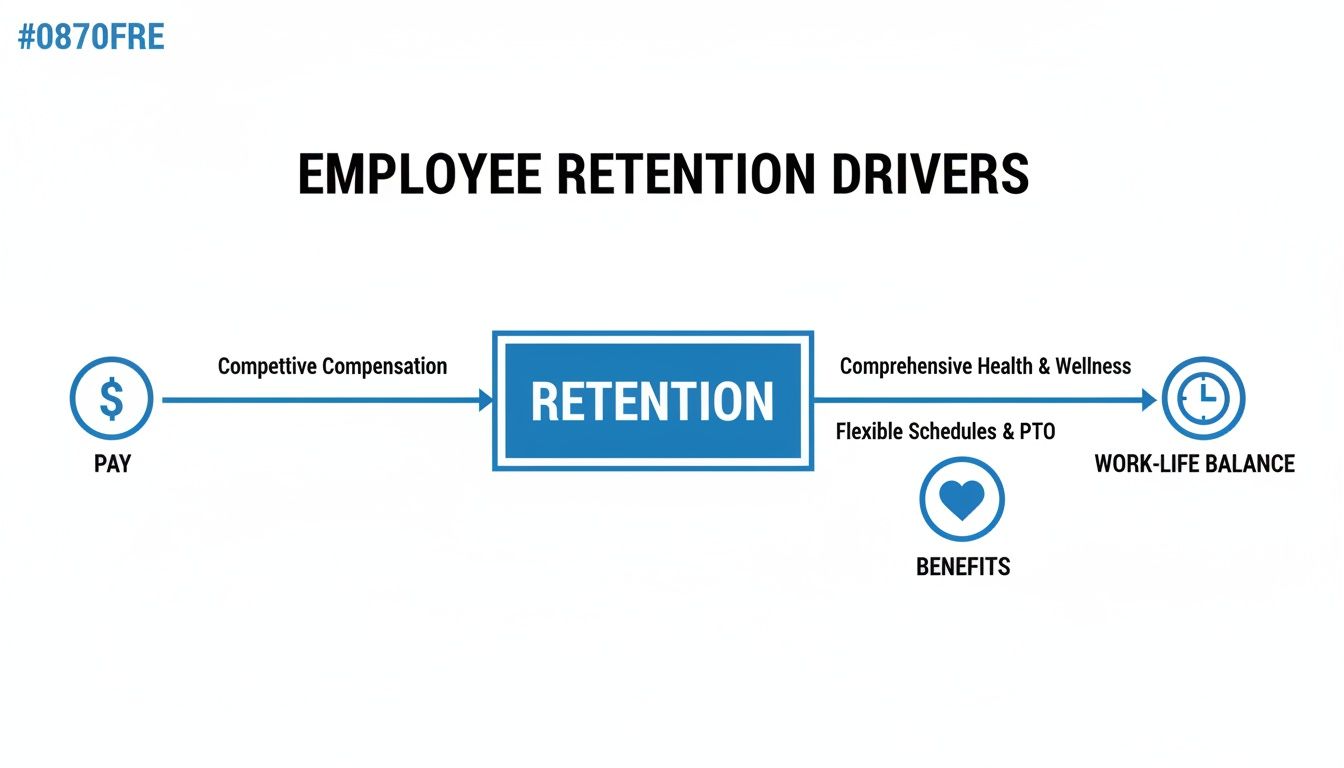
Compensation remains one of the most important factors influencing employee retention. Businesses that consistently underpay employees often struggle with long-term staffing stability.
Provide Competitive Pay Structures
Businesses should regularly compare wages against local market conditions and industry competitors.
Even modest compensation improvements can significantly improve employee loyalty when combined with strong workplace culture and supportive management.
Offer Meaningful Benefits
Benefits such as flexible scheduling, wellness support, paid time off, commuter assistance, or employee discounts improve workplace satisfaction.
Employees often evaluate total compensation packages rather than hourly pay alone.
Create Predictable Scheduling Practices
Unpredictable schedules are a major source of stress in industries such as retail, restaurants, and hospitality.
Posting schedules at least two weeks in advance allows employees to plan personal responsibilities more effectively while improving work-life balance.
Fair scheduling practices also reduce burnout and scheduling conflicts.
Build a Positive Workplace Culture
Workplace culture strongly influences whether employees feel emotionally connected to their jobs.
Positive cultures encourage teamwork, communication, inclusion, fairness, and mutual respect.
Create a Supportive Environment
Employees are more likely to remain loyal when they feel psychologically safe, respected, and supported by leadership and coworkers.
Supportive environments also encourage collaboration and stronger team relationships.
Promote Inclusion and Fairness
Businesses should maintain consistent policies regarding scheduling, promotions, discipline, and employee expectations.
Perceived favoritism or inconsistent treatment can quickly damage morale and increase turnover risk.
Encourage Team Building
Team lunches, recognition events, employee appreciation programs, and collaborative activities help strengthen workplace relationships.
Strong interpersonal connections often improve employee engagement and long-term retention.
Why Employee Recognition Matters
Employees who feel appreciated are generally more engaged and committed to their workplace.
Recognition does not always require large financial rewards. Simple acknowledgment of effort, achievements, or positive customer feedback can significantly improve morale.
Recognize Both Performance and Effort
Employees value recognition for meeting goals, helping coworkers, improving processes, and maintaining strong customer service standards.
Consistent appreciation helps employees feel their contributions matter.
Celebrate Milestones and Achievements
Work anniversaries, promotions, certifications, and performance milestones provide opportunities to reinforce employee value and loyalty.
Recognition additionally strengthens workplace culture by encouraging positivity and motivation.
Use Technology to Support Your Workforce
Technology helps businesses improve scheduling, communication, reporting, and workforce management efficiency.
Modern workforce management systems allow managers to monitor performance, identify staffing trends, and improve scheduling fairness.
Use Scheduling Software to Reduce Conflict
Scheduling tools help managers create balanced schedules while considering employee availability and workload distribution.
Fair scheduling reduces stress while improving operational consistency.
Track Performance and Engagement Metrics
Workforce analytics can help businesses identify retention risks before employees resign.
Performance trends, attendance patterns, and employee feedback often reveal underlying workplace issues early.
Improve Communication Through Digital Tools
Communication platforms improve coordination between teams, managers, and employees while reducing misunderstandings.
Clear communication systems help employees remain informed and engaged.
Future Trends in Employee Retention
Employee expectations continue evolving as workplace culture and workforce priorities change.
Flexibility, mental health support, career growth, and work-life balance are becoming increasingly important across nearly every industry.
Businesses that adapt to these changing expectations are generally more successful at retaining talent long term.
Technology will also continue shaping workforce management through AI-driven scheduling, predictive staffing analytics, automated onboarding systems, and employee engagement platforms.
Organizations that combine supportive leadership with modern operational tools will likely maintain stronger employee retention in increasingly competitive labor markets.
How Biyo Helps Businesses Manage Employees
Biyo POS helps businesses manage employees more efficiently through scheduling tools, workforce reporting, and operational insights designed to support growing teams.
The platform allows businesses to monitor staff performance, manage schedules fairly, track sales activity, and improve daily operational visibility.
With integrated workforce reporting and analytics, Biyo POS helps businesses identify operational inefficiencies while supporting stronger employee management practices.
Businesses looking to improve workforce organization and operational efficiency can explore how Biyo POS supports employee management across retail, restaurant, and service-based environments.
Frequently Asked Questions About Employee Turnover
What is considered a healthy employee turnover rate?
A healthy annual turnover rate is often around 10% depending on industry conditions. Retail, hospitality, and restaurant industries generally experience higher turnover compared to office-based industries.
Why do employees leave companies?
Common reasons include low compensation, poor management, lack of career growth, burnout, scheduling stress, limited recognition, and unhealthy workplace culture.
How expensive is employee turnover?
Replacing an employee can cost between 50% and 200% of the employee’s annual salary when recruiting, onboarding, training, and productivity losses are included.
How can businesses improve employee retention quickly?
Improving communication, recognizing employee contributions, reviewing compensation fairness, and creating predictable schedules are some of the fastest ways to improve retention.
Do employee recognition programs really help?
Yes. Employees who feel appreciated and recognized are generally more engaged, motivated, and loyal to their employers.
How important is onboarding for retention?
Strong onboarding helps employees feel supported and confident early in employment, significantly improving long-term retention rates.
Can technology help reduce employee turnover?
Yes. Workforce management systems improve scheduling, communication, reporting, and operational visibility, helping businesses identify workplace issues before they lead to resignations.
What role do managers play in employee retention?
Managers strongly influence workplace satisfaction through communication, leadership style, scheduling decisions, recognition practices, and overall team support.