Why Manual Reporting Is Holding Your Restaurant Back becomes painfully clear once daily operations start to feel harder instead of smarter. Many restaurant owners still rely on spreadsheets, handwritten logs, or manually compiled reports to understand performance. While this approach may feel familiar, it quietly limits growth, delays decisions, and increases costly mistakes.
In today’s competitive food service environment, speed and accuracy matter. When reporting depends on manual data entry, insights arrive late and often incomplete. Understanding why manual reporting is holding your restaurant back is the first step toward improving visibility, efficiency, and profitability.
Table of Contents
- Reporting Errors That Come From Manual Processes
- Delayed Insights That Slow Restaurant Decisions
- Labor Time Wasted on Manual Data Entry
- Lack of Real-Time Performance Visibility
- Why Manual Reporting Fails as Restaurants Grow
- How Biyo POS Eliminates Manual Reporting Problems
- Frequently Asked Questions
Reporting Errors That Come From Manual Processes
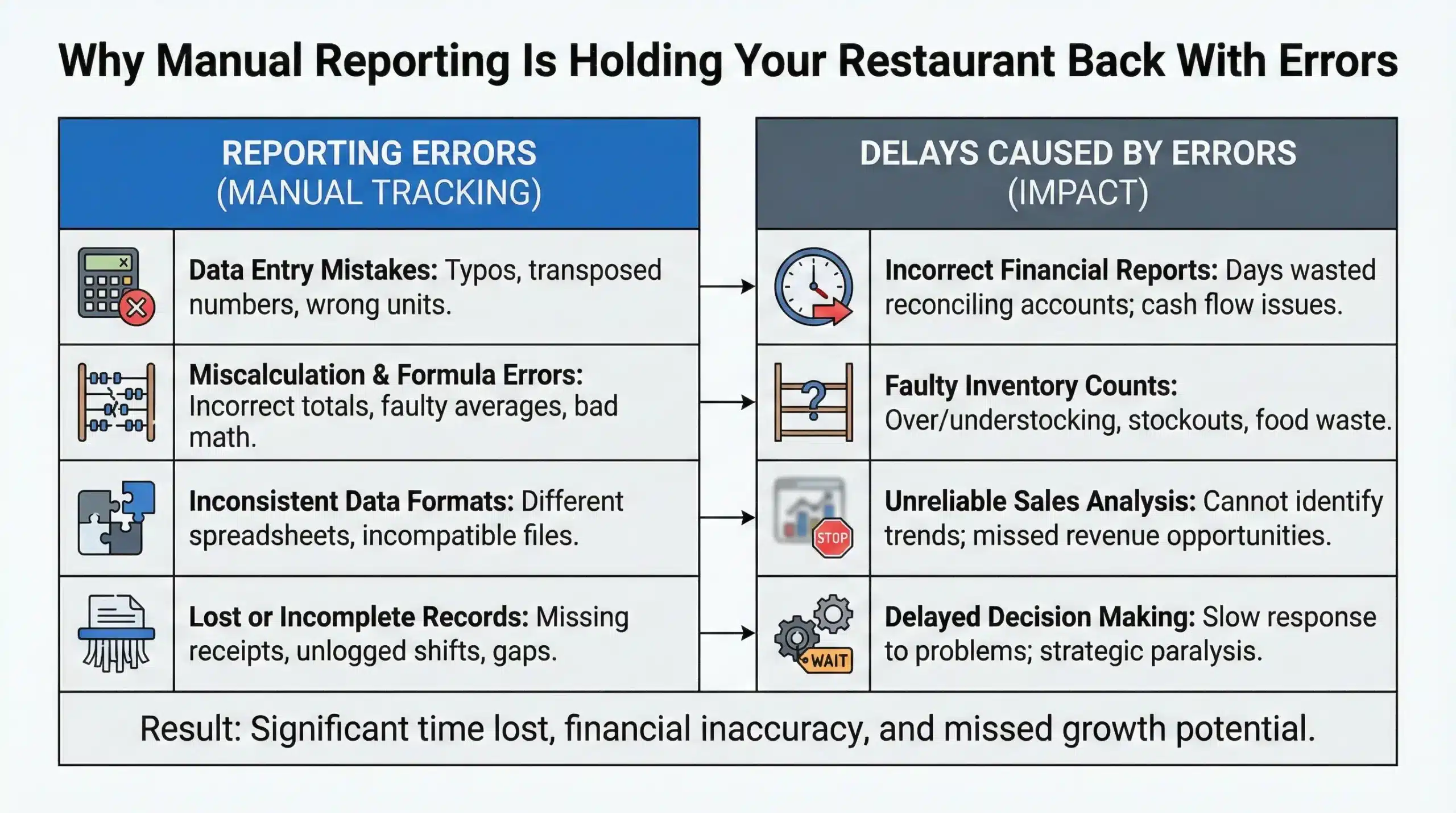
Errors are one of the clearest signs of why manual reporting is holding your restaurant back. Even experienced managers make mistakes when copying numbers across systems. These errors compound over time and distort performance data.
Human Error in Manual Data Entry
Manual data entry relies heavily on accuracy and focus. However, restaurant environments move fast, and distractions are constant. As a result, numbers are often entered incorrectly.
When sales, labor, or inventory data contains small errors, reports lose reliability. Owners make decisions based on flawed information without realizing it.
Over time, repeated entry mistakes reduce trust in reports. Teams stop relying on data and fall back on instinct.
Inconsistent data undermines confident decision-making.
Inconsistent Reporting Formats
Manual reporting often lacks standardization. Different managers may format reports differently or track metrics in unique ways.
This inconsistency makes it hard to compare performance across days, shifts, or locations. Patterns remain hidden.
Without consistent structure, reports lose strategic value. Insights become fragmented.
Standardization is essential for clarity.
Missed or Incomplete Data
Manual reporting depends on someone remembering to record everything. Busy shifts increase the chance that data gets skipped.
Missing entries create blind spots in performance tracking. Owners assume everything is fine.
Incomplete data hides problems until they grow larger.
What is not recorded cannot be improved.
 Delayed Insights That Slow Restaurant Decisions
 Delayed Insights That Slow Restaurant Decisions
Speed matters in restaurant management. One reason why manual reporting is holding your restaurant back is the time it takes to compile insights.
End-of-Day and End-of-Week Lag
Manual reports usually arrive after the fact. Managers gather data at the end of the day or week.
By the time reports are ready, the opportunity to act has passed. Problems linger.
Delayed insights lead to reactive management.
Late data limits impact.
Slow Response to Performance Issues
Sales dips, labor spikes, and inventory issues need quick responses. Manual reporting slows that response.
When owners discover issues days later, losses have already occurred.
Timely insight allows early intervention.
Speed protects margins.
Decision-Making Based on Outdated Information
Old data does not reflect current conditions. Customer behavior shifts quickly.
Manual reporting increases reliance on outdated numbers.
Decisions lose relevance when data lags.
Fresh insights drive smarter action.
Labor Time Wasted on Manual Data Entry
Another reason why manual reporting is holding your restaurant back is labor waste. Time spent on reports is time not spent on operations.
Managers Spending Hours on Reports
Managers often stay late to compile spreadsheets and summaries. This adds stress.
Those hours could be used for staff coaching or customer experience improvements.
Manual reporting shifts focus away from leadership.
Time is a limited resource.
Duplicate Work Across Systems
Manual processes often require entering the same data multiple times.
This duplication increases frustration and error risk.
Automated systems eliminate redundant tasks.
Efficiency improves morale.
Burnout From Administrative Overload
Administrative work contributes to burnout. Managers feel overwhelmed.
Manual reporting adds pressure during already busy days.
Burnout increases turnover.
Retention suffers.
Lack of Real-Time Performance Visibility
Real-time visibility is essential for modern restaurants. Why manual reporting is holding your restaurant back becomes obvious when visibility is missing.
No Live Sales Tracking
Without real-time data, owners cannot see how shifts perform as they happen.
Opportunities to adjust staffing or promotions get missed.
Live tracking supports agile management.
Visibility enables control.
Limited Insight Into Labor Performance
Labor costs change hourly. Manual reporting captures them too late.
Managers miss chances to adjust staffing levels.
Real-time labor visibility protects margins.
Proactive action matters.
Inventory Issues Detected Too Late
Manual inventory tracking delays alerts about shortages or waste.
Stockouts frustrate customers.
Real-time inventory prevents disruption.
Availability drives satisfaction.
Why Manual Reporting Fails as Restaurants Grow
Growth increases complexity. Why manual reporting is holding your restaurant back becomes clearer as operations expand.
Multi-Location Complexity
Multiple locations multiply reporting challenges.
Manual consolidation becomes unmanageable.
Centralized reporting simplifies oversight.
Scale demands systems.
Inconsistent Performance Tracking
Different locations may track metrics differently.
This inconsistency hides performance gaps.
Unified reporting creates alignment.
Consistency supports strategy.
Limited Strategic Planning Capability
Manual reporting focuses on the past.
Strategic planning requires forward-looking data.
Automation enables forecasting.
Planning drives growth.
How Biyo POS Eliminates Manual Reporting Problems
 How Biyo POS Eliminates Manual Reporting Problems
Biyo POS removes the reasons why manual reporting is holding your restaurant back by automating data collection and reporting. With real-time dashboards, owners gain immediate visibility into sales, labor, and inventory.
Biyo POS also reduces reporting errors, saves labor hours, and supports multi-location management from one platform. You can schedule a call to see how POS reporting automation works in practice, or sign up here to modernize your restaurant data tracking.
Frequently Asked Questions
Why is manual reporting a problem for restaurants?
Manual reporting creates errors, delays insights, and wastes valuable labor time.
How does automated reporting help restaurants?
Automation provides real-time insights and reduces human error.
Can manual reporting work for small restaurants?
It may work temporarily, but it limits growth and efficiency.
What reports matter most for restaurant owners?
Sales, labor, and inventory reports matter most.
Is Biyo POS suitable for growing restaurants?
Yes, Biyo POS is designed to scale with restaurant growth.