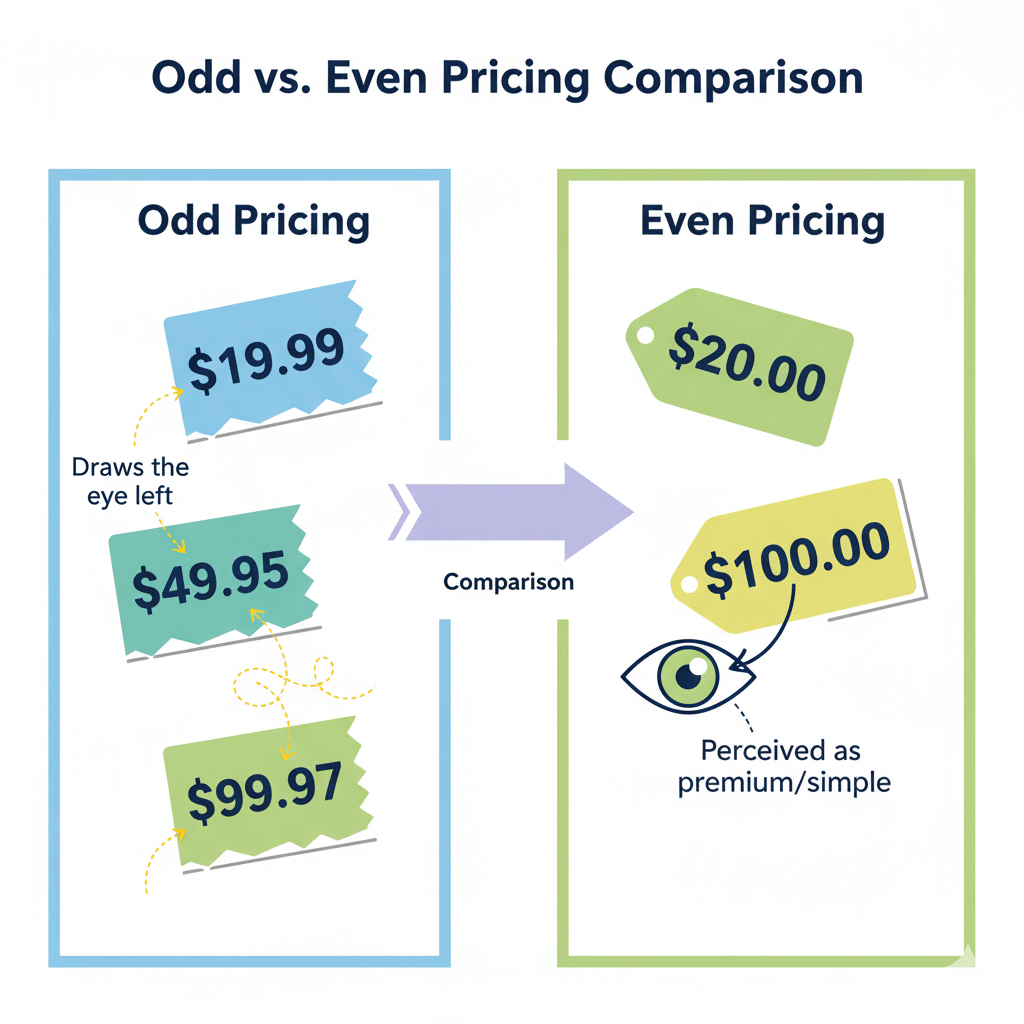

What is Odd-Even Pricing?
Odd-Even pricing refers to a strategy that uses the last digit of a product or service price to influence perception.
For example, prices ending in odd numerals like $1.99 or $78.25 follow an odd pricing strategy,
whereas prices like $200.00 or $18.50 follow an even pricing one.
Learn more about related pricing strategies.
History
Retailers originally used odd pricing to force cashiers to open the cash drawer and record sales.
By pricing an item at $4.75 or $49.95, the cashier needed to give change, which encouraged proper record-keeping.
Over time, this practice evolved into a psychological pricing strategy rather than a mere accounting tactic.
According to Harvard Business Review,
small pricing cues can strongly affect buyer behavior.
Psychological Effects
People often perceive prices just below a round number — such as $29.95 instead of $30.00 — as bargains.
They tend to focus more on the first digits and ignore the cents.
Therefore, odd pricing makes the price look lower even though the difference is very small.
Moreover, odd pricing suggests value, while even pricing tends to suggest premium quality or simplicity.
This aligns with insights in Investopedia’s guide on odd-even pricing.
Market Positioning
Businesses can choose odd-even pricing depending on their brand image.
If a company wants to present itself as budget-friendly or discount-oriented, it often adopts odd pricing.
On the other hand, if it wants to appear upscale or premium, it commonly uses round or even numbers.
Thus, your pricing strategy should align with your customers’ expectations and your retail positioning.
Retail Pricing Schedules & Examples
Some retailers use the final digit in pricing to signal discount levels. For example, one chain might follow this schedule:
- Prices ending in “6” or “8” influence further markdowns every few weeks.
- Prices ending in “4” often mark final clearance — the retailer won’t discount them further.
- Full-dollar pricing (even) tends to stay unchanged and suggest stable, premium pricing.
For example, if an item is originally priced at $39.99, the store may later reduce it to $38.99 or $28.99,
then finally when clearing, price it at $30.94 (end digit “4”) to signal final clearance.
For more on retail markdowns, see merchandising techniques.
When Odd-Even Pricing Works Best & Its Limitations
- It works best in retail environments where customers compare items frequently and price sensitivity is high.
- It becomes less effective when customers are very price-savvy, or when competitors use very similar pricing.
- It may create rounding issues or perception problems in international markets where currency conventions differ.
- Using odd pricing too aggressively can backfire if customers suspect manipulation or if the practice becomes too obvious.
Best Practices for Odd-Even Pricing
- Test different ending digits in small product ranges to see what resonates with your customers.
- Use odd pricing for promotional or value-oriented goods; reserve even or round pricing for premium items.
- Ensure your pricing displays clearly (e.g. online, in-store) so customers perceive the value correctly.
- Track sales, customer feedback, and competitor behavior regularly. Then adjust your strategy based on data.
For more insights, explore customer behavior.


