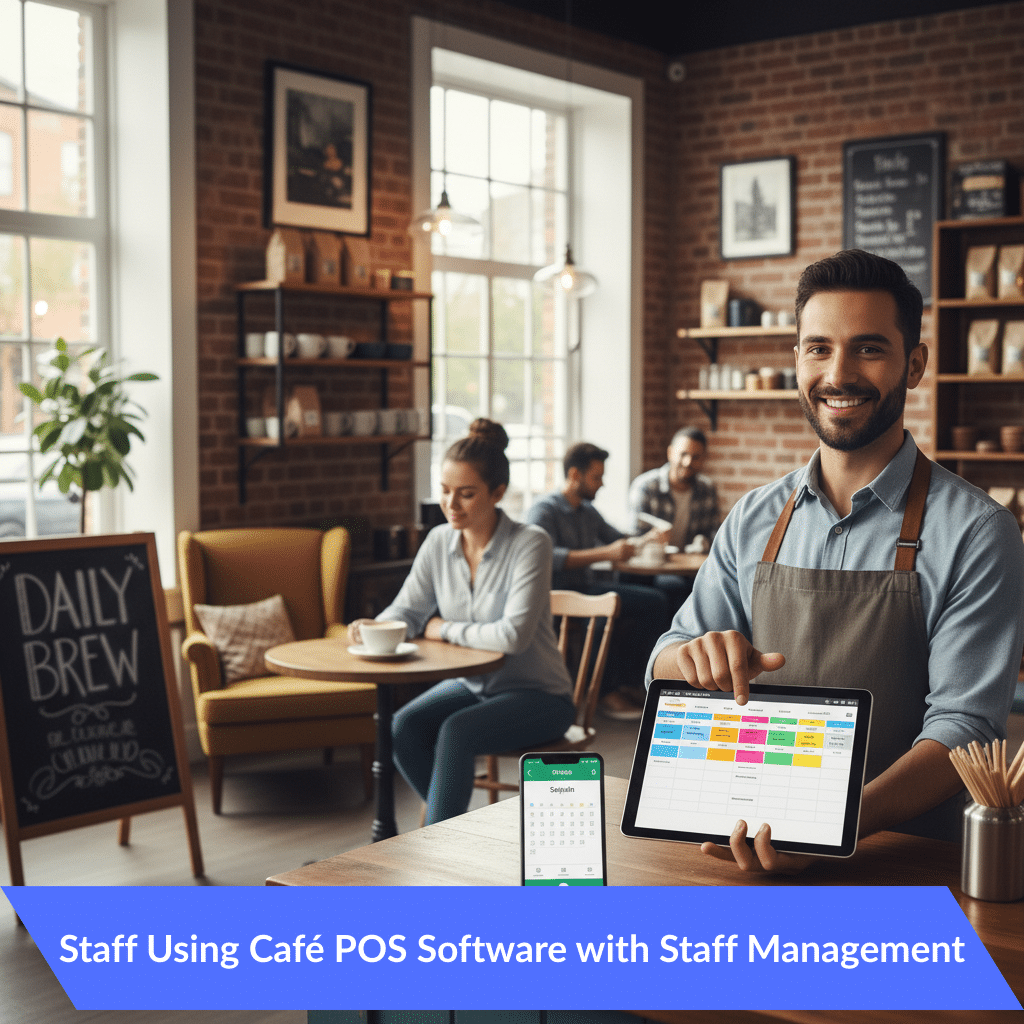

Running a café has always been about more than serving coffee. It is about operational precision, consistent service, and managing a workforce in a high-turnover industry. While customers see latte art and friendly service, owners face labor scheduling, payroll compliance, tip allocation, performance tracking, and cost control behind the scenes. This is where café POS software with staff management becomes not just helpful—but essential.
Labor typically represents 30% to 35% of total café operating expenses, making it the single largest controllable cost. Even small inefficiencies in scheduling, attendance tracking, or payroll processing can significantly erode margins. Integrated POS and staff management systems unify front-of-house transactions with workforce oversight, creating operational clarity, accountability, and measurable cost savings.
Instead of juggling spreadsheets, manual schedules, time clocks, and disconnected payroll tools, modern café operators rely on a single centralized platform. The result is improved labor optimization, reduced administrative burden, and better data-driven decision-making.
Table of Contents
- Why Staff Management Matters in a Café POS
- Key Features of Café POS Software with Staff Management
- Boosting Productivity and Efficiency with Staff Tools
- Integrating POS with Overall Business Operations
- Choosing the Right Café POS Software with Staff Management
Why Staff Management Matters in a Café POS
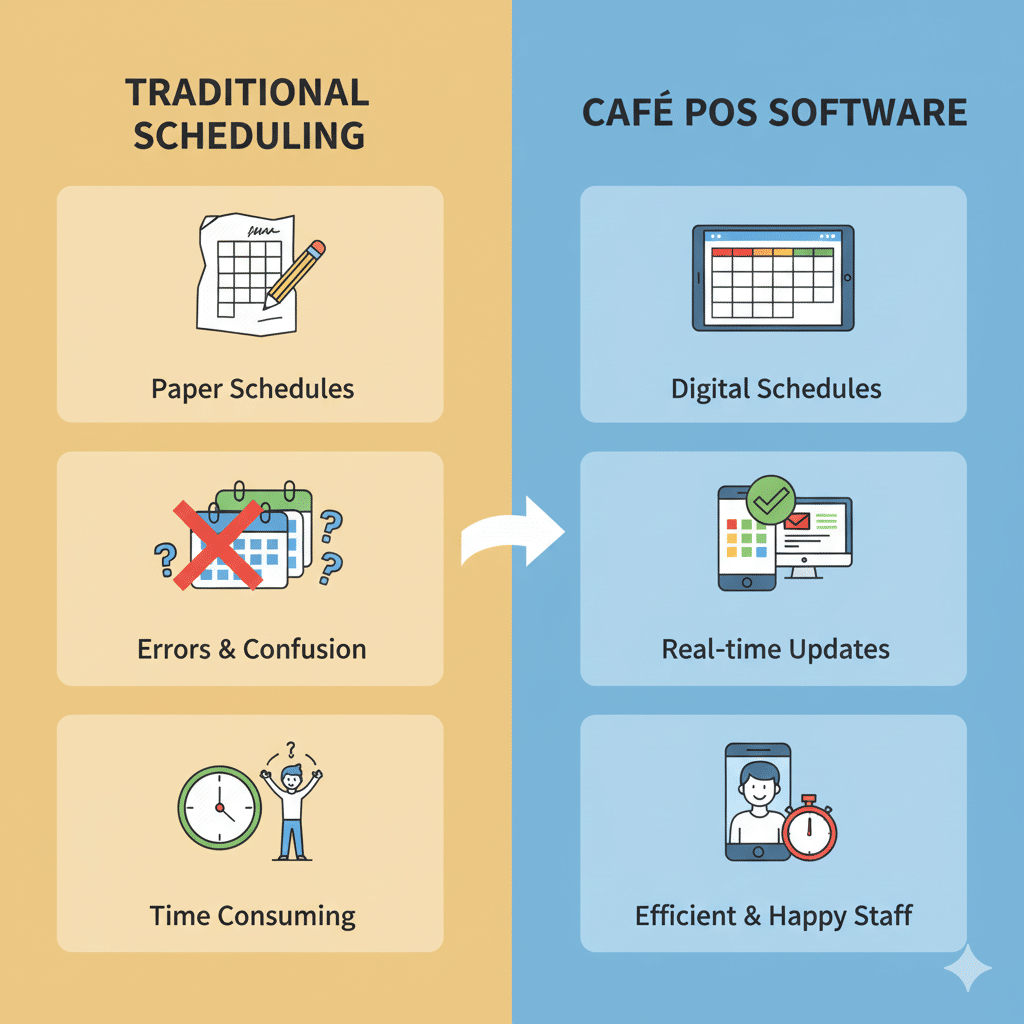
Cafés operate in a fast-paced environment where service speed, product consistency, and labor efficiency directly influence revenue. Without structured workforce tools, managers often overschedule during slow periods and understaff during peak hours. This leads to either wasted payroll or poor customer experience—both of which reduce profitability.
Integrating staff management within the POS system aligns workforce deployment with real-time sales data. That alignment turns reactive scheduling into predictive scheduling.
Reducing Labor Costs Through Efficient Scheduling
Labor misalignment is expensive. Consider a café generating $35,000 monthly revenue with labor costs at 34%:
$35,000 × 34% = $11,900 monthly labor expense
If optimized scheduling reduces labor by even 5%, that saves:
$11,900 × 5% = $595 per month
Annually: $7,140 in savings
Café POS software with staff management analyzes historical sales patterns to forecast demand. If data shows that weekday mornings spike between 7:30–9:30 AM but afternoons slow significantly, the system recommends staff distribution accordingly.
Real-world case studies show cafés reducing payroll by 8–12% after implementing integrated scheduling tools. These savings are not achieved through layoffs—but through precision staffing.
Beyond cost reduction, optimized scheduling improves employee morale. Predictable, transparent schedules reduce burnout and improve retention—critical in an industry where turnover rates often exceed 60% annually.
Tracking Attendance and Time Clock Integration
Manual time tracking introduces payroll inaccuracies, compliance risks, and fraud vulnerabilities such as “buddy punching.” Digital clock-in systems eliminate these risks by linking employee authentication directly to the POS.
Features often include:
- PIN-based login
- Biometric authentication
- Geofenced mobile clock-in
- Automatic overtime alerts
In regions with strict labor regulations—such as California—precise digital logs protect businesses from wage disputes and penalties. Integrated attendance tracking also prevents accidental overtime accumulation, which can inflate payroll significantly.
If a café unknowingly pays 10 hours of unnecessary overtime weekly at time-and-a-half:
10 hours × $18/hour × 0.5 premium = $90 extra per week
Annually: $4,680 lost to avoidable overtime.
Integrated alerts prevent that leakage.
Improving Staff Accountability with Role-Based Access
Role-based permissions are one of the most powerful—but underutilized—features in staff-enabled POS systems.
Cashiers can process sales. Baristas can adjust modifiers. Managers approve refunds. Owners access financial reports.
This structure ensures:
- Reduced internal fraud
- Controlled discount approvals
- Refund traceability
- Clear responsibility tracking
If void transactions exceed normal thresholds, managers can quickly identify patterns tied to specific employee logins. Accountability reduces shrinkage and strengthens operational integrity.
Key Features of Café POS Software with Staff Management
Payroll Management and Tip Handling
Payroll errors damage trust and consume administrative time. Automated payroll calculation based on real-time attendance data eliminates manual input errors.
Systems typically calculate:
- Hourly wages
- Overtime premiums
- Holiday pay
- Tip distribution
Tip handling is particularly sensitive. Transparent digital tip tracking prevents disputes and ensures regulatory compliance. Whether tips are pooled or distributed individually, POS systems can allocate proportionally by hours worked or by direct service.
Payroll automation reduces administrative hours. If managers spend 6 hours weekly processing payroll manually:
6 hours × $25/hour managerial cost = $150/week
Annually: $7,800 in administrative labor.
Automation cuts this dramatically.
Staff Performance Reporting
Integrated performance reporting transforms subjective evaluation into objective insight.
Managers can track:
- Sales per employee
- Average order value
- Upsell frequency
- Tip averages
If one barista averages $10 ticket value and another averages $8, across 1,000 transactions monthly that’s a $2,000 revenue difference. Identifying high performers enables targeted training and incentive design.
Data-driven coaching strengthens team performance and revenue consistency.
Shift Tracking and Task Assignment
Shift swapping and task ambiguity create operational friction. POS-integrated shift tools allow digital confirmations, automated notifications, and structured task lists.
Daily recurring tasks—such as equipment cleaning or stock checks—can be assigned and digitally confirmed. Managers gain visibility without micromanagement.
Clarity increases accountability and reduces service breakdowns during peak periods.
Boosting Productivity and Efficiency with Staff Tools
Using Real-Time Analytics for Decision Making
Traditional reporting is retrospective. Real-time analytics allow mid-shift adjustments.
Metrics monitored live include:
- Labor percentage of revenue
- Revenue per labor hour
- Peak-hour transaction velocity
- Staff productivity ratios
If labor exceeds 40% of hourly revenue mid-shift, managers can adjust staffing dynamically.
Predictive scheduling driven by historical POS data prevents service breakdown during high-volume events or seasonal promotions.
Controlling Labor Costs with Attendance Tracking
Integrated attendance eliminates payroll leakage and ensures compliance.
Example:
10 employees × 15 minutes daily unrecorded variance = 150 minutes/day
150 minutes = 2.5 hours × $16/hour = $40 daily leakage
Annually (300 days): $12,000 lost.
Digital precision prevents silent financial erosion.
Improving Staff Productivity Through Clear Communication
Internal communication inefficiency reduces service consistency.
Centralized POS notifications streamline:
- Shift confirmations
- Policy updates
- Task completion logs
- Performance alerts
Clarity enhances productivity and reduces avoidable disruptions.
Integrating POS with Overall Business Operations
Connecting Staff Management with Inventory Tracking
Labor deployment and inventory demand are interconnected.
If a seasonal promotion drives 25% higher latte sales, staffing must reflect increased preparation demand. POS integration aligns workforce and stock usage patterns.
Inventory tasks can be assigned digitally, and discrepancies tied to responsible staff members, improving shrinkage control.
Integrating Customer Loyalty Programs with Staff Efforts
Loyalty programs increase repeat purchase frequency. Staff engagement determines enrollment success.
POS systems can track loyalty signups per employee, enabling incentive programs tied to retention metrics.
Customer lifetime value increases when staff actively promote loyalty participation.
Enhancing Security with Secure Login Systems
Secure login systems prevent unauthorized access and protect sensitive data.
Every discount, void, refund, or override is tied to a staff login, increasing transparency and reducing internal fraud risk.
Layered permissions create operational discipline while maintaining ease of use.
Choosing the Right Café POS Software with Staff Management
Mobile and Cloud-Based POS Solutions
Cloud systems offer scalability and centralized control. Multi-location cafés benefit from unified dashboards tracking staff performance, payroll, and labor metrics across branches.
Mobile POS systems provide flexibility for small cafés or limited counter space environments.
Evaluating Staff Management Features
When selecting software, prioritize:
- Attendance automation
- Overtime alerts
- Integrated payroll support
- Role-based permissions
- Performance analytics
The best system balances simplicity for staff with powerful data for management.
Considering Integration with Other Business Tools
Modern cafés rely on accounting platforms, supplier systems, and marketing tools.
Strong POS platforms integrate via API or direct sync, eliminating duplicate data entry and reducing administrative overhead.
Interconnected systems improve forecasting, reporting accuracy, and strategic planning.
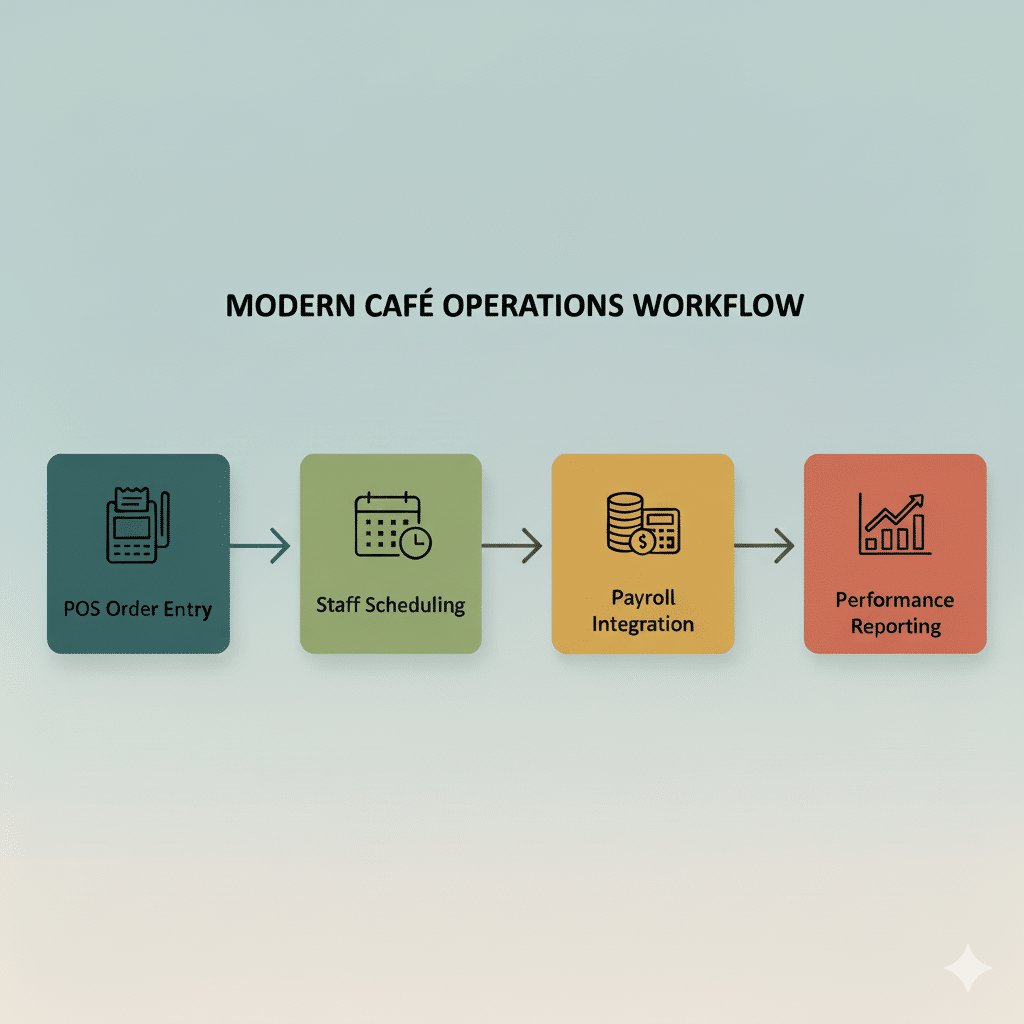
If you want an all-in-one solution that handles POS, payroll, scheduling, performance reporting, and analytics, Biyo POS provides an integrated system designed specifically for cafés. You can sign up here to explore how it can streamline operations and reduce labor inefficiencies.
FAQ
What is café POS software with staff management?
It is a unified platform combining sales transactions with workforce tools like scheduling, attendance tracking, payroll automation, and performance analytics.
How does staff management improve efficiency?
It aligns labor deployment with real-time demand, reduces scheduling errors, eliminates payroll inaccuracies, and improves accountability.
Can it reduce labor costs?
Yes. Through predictive scheduling, overtime alerts, and attendance precision, cafés often reduce payroll expenses by 5–12%.
Is cloud-based POS better?
Cloud-based systems offer scalability, remote access, automatic updates, and multi-location visibility, making them ideal for growth-focused cafés.
Does Biyo POS include staff management tools?
Yes. Biyo POS integrates scheduling, payroll, attendance tracking, tip management, and performance analytics within one cohesive system.