Running a restaurant profitably requires careful control of both food and labor costs. While food costs often receive the most attention, labor expenses represent the second-largest controllable cost in most restaurants. Monitoring your restaurant labor cost percentage is essential for maintaining financial stability, ensuring proper staffing levels, and protecting profit margins.
Your restaurant labor cost percentage tells you how much of your total sales you’re spending on your team. It bundles everything—wages, salaries, payroll taxes, insurance, and employee benefits—into a single percentage that reflects how efficiently staffing converts into revenue. For most restaurants, a labor cost percentage between 20% and 30% is generally considered healthy, although the ideal range varies depending on the type of restaurant and service model.
Understanding how to calculate, interpret, and optimize this metric allows restaurant operators to make smarter decisions about scheduling, menu design, and staffing strategies. When managed correctly, labor costs can become a powerful lever for improving profitability rather than a constant financial burden.
Table of Contents
- Understanding Restaurant Labor Cost Percentage
- How to Calculate Restaurant Labor Cost Percentage
- Why Restaurant Labor Costs Increase
- Strategies to Control Labor Costs Without Hurting Service
- Restaurant Labor Cost Benchmarks by Industry Segment
- Important Labor KPIs Every Restaurant Should Track
- How Biyo Helps Restaurants Monitor Labor Costs
- Frequently Asked Questions
Understanding Restaurant Labor Cost Percentage
Think of your labor cost percentage as a financial pulse check for your restaurant. It’s more than just a number—it represents how efficiently your workforce generates revenue.
This metric measures how many cents of every dollar earned are spent on employees. That includes everyone involved in restaurant operations, such as servers, kitchen staff, bartenders, managers, and support staff.
Labor expenses typically represent the second-largest operating cost for restaurants after food. According to industry reports, labor often accounts for 30% to 35% of total restaurant operating expenses. Because profit margins in restaurants average only 3% to 5%, even small changes in labor cost percentage can significantly impact profitability.
If labor costs climb too high, profits shrink quickly. However, reducing labor too aggressively can damage service quality, slow operations, and harm customer satisfaction.
The goal is balance—maintaining enough staff to provide excellent service while ensuring that labor expenses remain aligned with revenue.
The Basic Formula
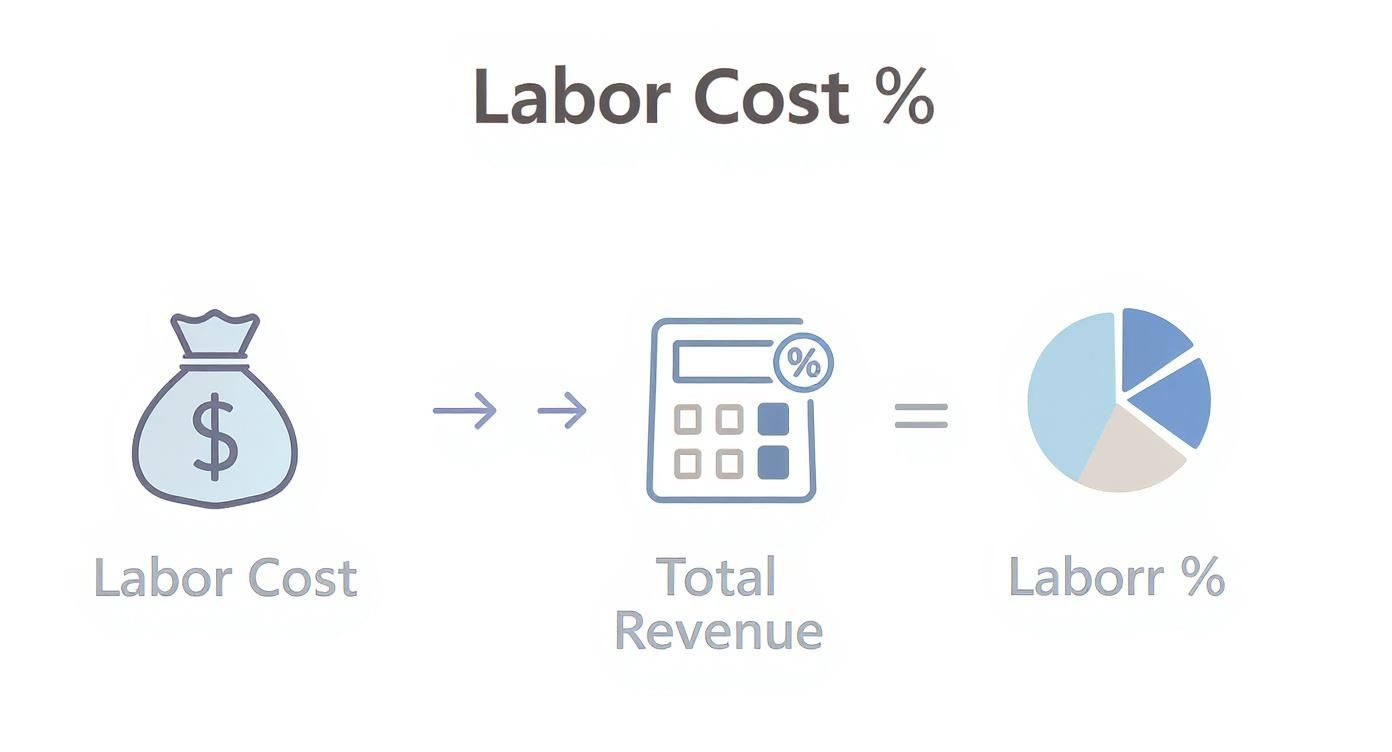
The calculation for restaurant labor cost percentage is simple:
(Total Labor Cost / Total Revenue) × 100 = Restaurant Labor Cost Percentage
This formula compares your total spending on employees with the revenue generated during the same period.
What Counts as Labor Cost?
Many restaurant owners mistakenly calculate labor costs using only wages and salaries. However, the true cost of employees includes several additional expenses.
Total labor cost should include:
- Hourly wages
- Manager and salaried employee compensation
- Overtime pay
- Payroll taxes
- Workers’ compensation insurance
- Health insurance and employee benefits
- Paid time off and sick leave
- Bonuses and incentives
Including these expenses ensures your labor percentage reflects the real cost of employing your staff.
Labor costs also play a critical role in calculating prime cost, which combines labor and food costs to determine overall operational efficiency. Restaurant operators interested in improving cost control can learn more about prime cost and its impact on restaurant profitability.
How to Calculate Restaurant Labor Cost Percentage
Calculating your restaurant’s labor cost percentage requires two key numbers: total labor expenses and total revenue.
Once these numbers are collected, applying the formula becomes straightforward.
Example: Weekly Calculation
Consider a small café reviewing its labor costs for the past week.
- Total revenue: $8,000
- Hourly wages: $1,800
- Overtime: $100
- Payroll taxes and benefits: $400
Total labor cost equals $2,300.
Applying the formula:
($2,300 ÷ $8,000) × 100 = 28.75%
This percentage falls within the acceptable range for many small restaurants.
Example: Monthly Calculation
A larger full-service restaurant might analyze labor costs monthly.
- Total revenue: $120,000
- Manager salaries: $10,000
- Hourly wages: $22,000
- Payroll taxes: $4,500
- Benefits and insurance: $3,000
- Bonuses: $500
Total labor cost equals $40,000.
($40,000 ÷ $120,000) × 100 = 33.3%
This percentage may be acceptable for a full-service restaurant but could indicate inefficiencies depending on the business model.
Why Restaurant Labor Costs Increase
If your labor cost percentage keeps rising, several factors may be contributing to the problem.
Inefficient Scheduling
Scheduling staff without analyzing customer traffic patterns can result in overstaffing during slow periods or understaffing during busy hours.
Overstaffing is particularly expensive because it increases labor hours without generating additional revenue.
Employee Turnover
The restaurant industry experiences one of the highest turnover rates among all industries.
Replacing employees involves significant hidden costs including:
- Recruitment and hiring
- Training new staff
- Reduced productivity during onboarding
- Management time spent supervising inexperienced workers
Industry research estimates that replacing a restaurant employee can cost several thousand dollars once training and productivity losses are included.
Rising Minimum Wage
Government wage regulations and labor shortages have pushed wages higher across the hospitality industry.
According to industry surveys, over 85% of restaurant operators report increasing labor costs due to wage pressure and staffing shortages.
Complex Menu Operations
Menus requiring extensive preparation, specialized cooking techniques, or highly skilled chefs naturally require more labor hours.
Restaurants with overly complex menus may unintentionally increase labor costs due to longer preparation times.
Strategies to Control Labor Costs Without Hurting Service

Reducing labor costs does not necessarily require cutting staff. Instead, improving operational efficiency can lower labor percentages while maintaining excellent service.
Use Data-Based Scheduling
Analyzing historical sales data allows managers to schedule staff according to expected demand.
For example, if Friday dinner service consistently generates the highest revenue, staffing levels should reflect that demand.
Cross-Train Employees
Cross-training employees allows staff members to perform multiple roles within the restaurant.
A server who can also host or a cook who can manage multiple kitchen stations increases operational flexibility and reduces the need for additional staff.
Optimize Menu Engineering
Menu engineering helps identify dishes that generate strong profits while requiring minimal labor.
Promoting these items can increase revenue without increasing staffing costs.
Restaurants can also streamline complex menu items that require excessive preparation time.
Use Technology to Improve Workforce Management
Modern restaurant management systems provide advanced scheduling tools, labor forecasting, and real-time reporting.
These systems allow managers to track labor costs throughout each shift and adjust staffing as needed.
Restaurants exploring operational improvements can review additional strategies in this guide on restaurant workforce management.
Restaurant Labor Cost Benchmarks by Industry Segment
Labor cost targets vary depending on the restaurant’s service style and operational complexity.
| Restaurant Type | Average Labor Cost Percentage | Operational Characteristics |
|---|---|---|
| Quick-Service Restaurants | 25% – 30% | High order volume, simplified menu preparation |
| Fast Casual | 28% – 32% | Customized orders and higher ingredient quality |
| Casual Dining | 30% – 35% | Full table service and larger front-of-house staff |
| Fine Dining | 35% – 40%+ | Premium service and highly skilled kitchen staff |
Understanding these benchmarks helps restaurant operators determine whether their labor costs align with industry expectations.
Important Labor KPIs Every Restaurant Should Track

In addition to labor cost percentage, restaurants should monitor several key performance indicators to evaluate workforce productivity.
Sales Per Labor Hour (SPLH)
This metric measures how much revenue each labor hour generates.
Total Sales ÷ Total Labor Hours = Sales Per Labor Hour
Higher SPLH values indicate stronger staff productivity.
Guests Served Per Labor Hour
This metric measures the number of customers served for every labor hour worked.
It is particularly useful for full-service restaurants evaluating front-of-house efficiency.
Real-Time Labor Cost Tracking
Modern POS systems allow managers to monitor labor cost percentage in real time, enabling adjustments during shifts if staffing levels become inefficient.
Restaurants looking to improve scheduling accuracy may benefit from using POS software with staff management tools.
How Biyo Helps Restaurants Monitor Labor Costs
Managing labor costs effectively requires accurate data and reliable analytics. Biyo POS provides restaurant operators with powerful tools that simplify workforce management, scheduling, and real-time labor tracking.
With Biyo’s integrated POS platform, restaurant owners can monitor labor costs alongside sales performance, helping managers adjust staffing levels throughout the day.
Restaurants interested in optimizing workforce efficiency can schedule a consultation with the Biyo team to explore how Biyo’s POS analytics help restaurants control labor expenses and improve profitability.
Businesses ready to implement advanced workforce analytics can also create a Biyo account and begin managing staff operations with integrated POS technology. By combining real-time reporting with scheduling tools, Biyo helps restaurants maintain ideal labor cost percentages while delivering excellent customer service.
Frequently Asked Questions
What is a good labor cost percentage for restaurants?
Most restaurants aim to keep labor costs between 20% and 30% of total revenue, although the exact target varies by restaurant type.
Why is labor cost important for restaurants?
Labor costs are one of the largest controllable expenses in restaurants. Managing them effectively protects profit margins and improves operational efficiency.
How often should restaurants calculate labor cost percentage?
Many restaurants calculate labor cost daily or weekly to monitor performance and make scheduling adjustments quickly.
Do manager salaries count toward labor costs?
Yes. All employee-related expenses—including manager salaries, benefits, and payroll taxes—should be included in total labor costs.
Can technology help reduce labor costs?
Yes. POS systems with scheduling and analytics tools help restaurants optimize staffing levels and monitor labor costs in real time.
Is high labor cost normal for new restaurants?
New restaurants often experience higher labor costs during their first few months due to training expenses and lower initial sales volumes.
What is the difference between labor cost and prime cost?
Labor cost refers specifically to employee-related expenses, while prime cost combines labor costs with food costs to measure overall operational efficiency.