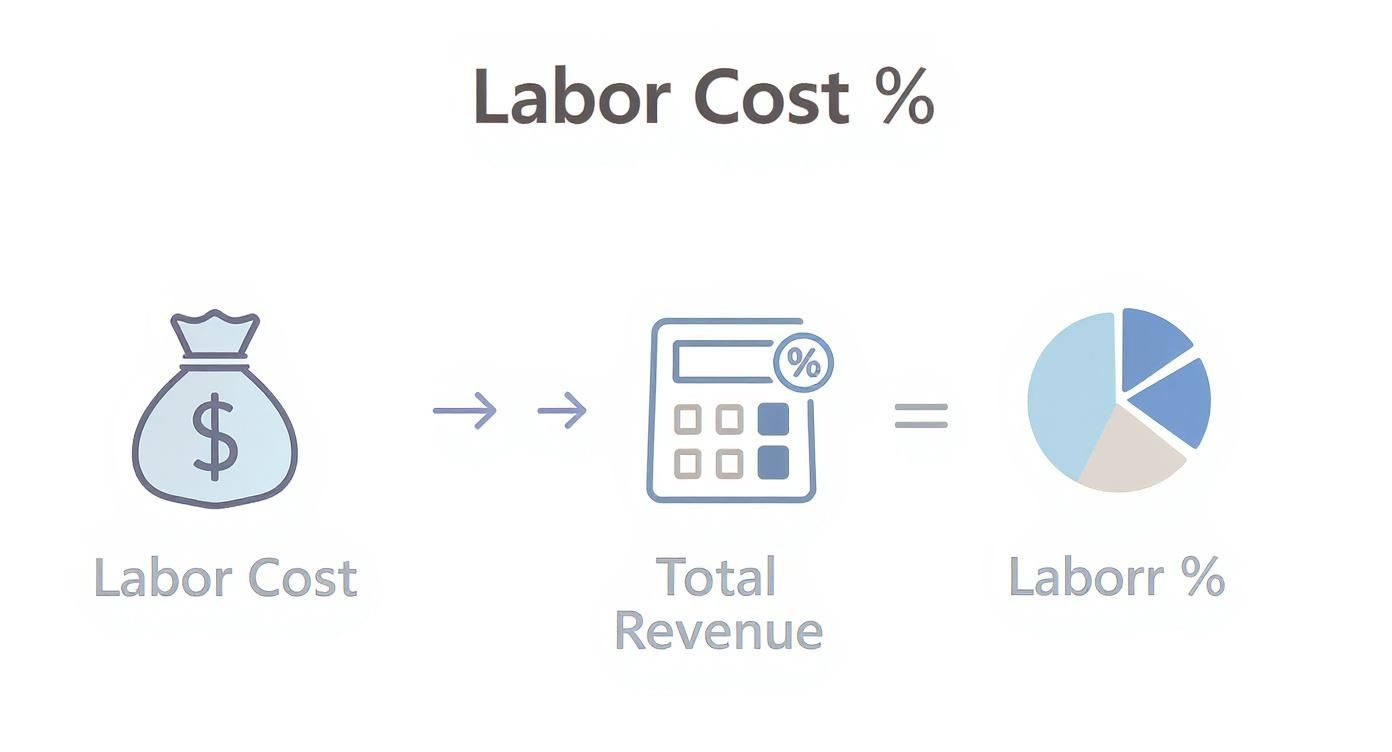
Your restaurant labor cost percentage tells you how much of your total sales you're spending on your team. It bundles up everything—wages, salaries, taxes, and benefits—and shows it as a percentage of your revenue. For most restaurants, hitting a sweet spot between 20% and 30% is the goal for staying profitable. It’s one of the most direct ways to see how efficiently you’re turning staffing into sales.
Understanding Restaurant Labor Cost Percentage
Think of your labor cost percentage as a financial pulse check for your restaurant. It's more than just a number on a spreadsheet; it’s a direct measure of your operational health and a massive piece of the profitability puzzle. This single metric reveals exactly how many cents of every dollar earned go toward paying your people, from the line cooks and servers to your managers and dish crew.
Getting a handle on this number is absolutely critical for protecting your margins. When labor costs creep too high, they can eat away at your profits, even on your busiest nights. On the flip side, if that percentage is too low, it could be a red flag for understaffing, which often leads to slow service, a stressed-out team, and unhappy guests who might not come back.
The Core Formula Explained
At its heart, the calculation is refreshingly simple. It gives you a clear snapshot of what you're spending on labor compared to what you're bringing in over the same timeframe.
(Total Labor Cost / Total Revenue) x 100 = Restaurant Labor Cost Percentage
Let’s quickly break down the two key pieces here:
- Total Labor Cost: This isn’t just about hourly wages. It’s the full picture—salaries, overtime, payroll taxes, health insurance premiums, vacation pay, and any other employee benefits.
- Total Revenue: This is the top-line number. It’s all the money your restaurant brought in from sales during that period before you subtract any expenses.
This formula is so powerful because it directly connects your biggest controllable expense (labor) to your sales performance. It's also a fundamental part of figuring out your restaurant's prime cost, which you get by adding your labor and food costs together. To dig deeper, check out our complete guide on what prime cost is and why it matters for restaurant owners.
Why This Metric Matters for Your Bottom Line
Keeping this percentage in a healthy range isn't just a suggestion—it's what successful operators do. According to industry reports, about 40% of restaurants globally keep labor costs between 20% and 25% of revenue. Another 26% land in the 26% to 30% range. This tells us that the most profitable businesses are the ones who watch this number like a hawk.
By consistently tracking your restaurant labor cost percentage, you can make smarter, data-backed decisions on everything from weekly schedules and staffing levels to menu prices. It’s the key to keeping your business financially strong and ready for whatever comes next.
Calculating Your Labor Cost Percentage Accurately
Ready to get a real handle on your labor expenses? To do that, we need to move beyond a simple back-of-the-napkin calculation and look at every single dollar you spend on your team. Nailing down your true restaurant labor cost percentage is one of the most powerful things you can do for your restaurant's financial health.
The core idea is simple. You're just comparing what you spend on labor to what you bring in through sales. The formula itself is straightforward: divide your total labor cost by your total revenue, then multiply by 100 to get a percentage.
This gives you a clear snapshot of how much of every dollar earned goes toward paying your staff. The real trick, though, is making sure that "Total Labor Cost" number is actually total.
What Really Goes into Total Labor Cost
This is where so many operators get it wrong. They just look at hourly wages and manager salaries and call it a day. But that’s not the whole story—not by a long shot. That approach misses huge chunks of spending that can quietly blow up your budget.
To get a number you can actually trust, you have to include every single related expense. Your true labor cost should always include:
- Gross Wages and Salaries: This is the big one—all hourly pay, salaried compensation, and any overtime you paid out.
- Payroll Taxes: Don't forget the employer's share. This includes your contributions to Social Security, Medicare, and unemployment insurance.
- Employee Benefits: Factor in what you spend on health insurance, paid time off (PTO), sick days, and any 401(k) matching or other retirement plans.
- Bonuses and Incentives: Did you pay out a performance bonus or run a sales contest? That's a labor cost.
- Workers' Compensation: Your insurance policy is a direct, labor-related expense that absolutely belongs in this calculation.
Adding all these pieces together gives you an honest, complete picture of what your workforce truly costs. No more unpleasant surprises at the end of the month—just a solid number you can use for effective budgeting.
Step-by-Step Calculation Examples
Let's put this into practice. Seeing the numbers in action makes it all click. Here are a couple of real-world scenarios for a small cafe and a larger bistro.
Example 1: A Weekly Check-In for "The Cozy Cafe"
Imagine you run a small cafe and want to see how you did on labor last week. First, you pull the numbers.
- Total Revenue: $8,000
- Hourly Wages: $1,800
- Overtime Pay: $100
- Payroll Taxes & Benefits: $400
Next, you add up all the labor-related costs: $1,800 + $100 + $400 = $2,300.
Now, you plug that into the formula: ($2,300 / $8,000) x 100 = 28.75%. Just like that, the owner has a clear snapshot of the cafe’s labor efficiency for the week.
Example 2: A Monthly Review for "The Bustling Bistro"
Now let’s look at a bigger, full-service spot calculating its labor for all of April.
They'll start by compiling all their labor expenses, which includes salaries for two managers, wages for 15 hourly team members, and all the associated taxes, benefits, and bonuses.
- Total Monthly Revenue: $120,000
- Manager Salaries: $10,000
- Hourly Wages: $22,000
- Payroll Taxes: $4,500
- Health Insurance & Benefits: $3,000
- Bonuses: $500
The bistro’s all-in labor cost comes out to: $10,000 + $22,000 + $4,500 + $3,000 + $500 = $40,000.
And the final calculation: ($40,000 / $120,000) x 100 = 33.3%. When you're calculating your percentage, having accurate sales data from documents like your end-of-day reports is key. You can check out various restaurant bill templates to see how sales information is structured. This monthly figure is a solid benchmark for making smarter decisions about staffing, scheduling, and even menu pricing down the road.
Why Your Restaurant Labor Costs Are So High
Even after running the numbers perfectly, you might see your restaurant labor cost percentage inching up, and it's rarely because of one single thing. More often than not, it’s a combination of daily habits and outside forces conspiring to bloat your biggest controllable expense.
Figuring out the "why" is the first step to getting things back on track. Once you look past the final number and dig into what’s really driving it, you can stop just tracking a problem and start actively solving it.
Inefficient Scheduling and Overstaffing
One of the most common culprits is a schedule that's out of sync with your actual sales. When you're just guessing at staffing levels, you almost always end up with too many people on the clock during slow periods or not enough when the rush hits. Both scenarios cost you money.
Having extra bodies on the floor when you don't have the customers to serve means you're just paying for unproductive time. This pushes your labor percentage up without any extra revenue to show for it. It's like trying to run a speedboat with the crew of a cruise ship—it gets slow and expensive, fast.
On the flip side, being understaffed leads to burned-out employees, sloppy service, and missed sales opportunities, which hurts your labor-to-revenue ratio just as badly. The sweet spot is matching your staffing to what you can realistically expect in sales, making every hour on the schedule count.
The High Cost of Employee Turnover
Employee turnover is a quiet killer of profitability. It's so much more than just the cost of a "Now Hiring" sign. Every time someone walks out the door for good, it triggers a chain reaction of hidden expenses that hit your labor budget hard.
Think about what really happens when you lose an employee:
- Recruitment Costs: You're spending time and money on job ads, sifting through applications, and conducting interviews.
- Training Expenses: Every hour your manager or veteran staff spends with a new hire is an hour they aren't running the floor or cooking on the line.
- Lost Productivity: New folks are always slower and make more mistakes. It takes time for them to get up to the speed and efficiency of your seasoned pros.
- Impact on Morale: When good people keep leaving, it can really drag down the morale of the team that stays, sometimes creating a domino effect.
Replacing just one hourly restaurant worker can set you back thousands of dollars once you add it all up. A stable, well-trained team isn't just a nice-to-have; it's one of your best defenses against sky-high labor costs.
External Market Pressures
Sometimes, the factors driving up your costs are completely out of your hands. The market and new laws can squeeze your budget, forcing you to find new ways to adapt.
For instance, when the labor market gets tight, you're suddenly competing with every other restaurant for good people. To attract and keep the best talent, you might have to bump up your wages or offer better benefits. In the same way, any increase to the minimum wage automatically raises your baseline payroll. These aren't just your problems; they're challenges for operators everywhere.
The data backs this up. A recent industry report found that 89% of restaurant operators have seen their staff expenses climb. This pressure has led many to make tough choices, like cutting back on operating hours or running shifts with a leaner crew just to keep costs in line. You can learn more about the restaurant industry's response to rising costs to see the bigger picture.
Lack of Cross-Training and Menu Complexity
A rigid team structure is another way costs can creep up. If your employees are stuck in single-role silos, you have zero flexibility when things go sideways. What happens if your star sauté cook calls out and nobody else can run that station? You're stuck paying overtime to cover the shift or watching service grind to a halt.
Cross-training builds a nimble, resilient crew. A server who can jump on the host stand or a line cook who also knows the grill gives you incredible scheduling power. It means you're not totally dependent on one or two key people to keep the wheels turning.
Finally, give your menu a good, hard look. Overly complicated dishes that require a ton of prep or niche skills put a huge strain on your kitchen team. This might mean you need to hire more specialized (and more expensive) chefs or schedule more prep hours—both of which directly inflate your restaurant labor cost percentage.
Actionable Strategies to Control Labor Costs
Knowing why your labor cost is high is one thing. Actually wrestling it back down is a whole different ballgame. Getting a grip on this critical number takes a hands-on approach that blends smart scheduling, team development, and the right technology.
These strategies aren't about cutting corners or letting service slide. Far from it. They’re about making every dollar you spend on your team work as hard as possible. Think of this as your playbook for turning labor from a reactive expense into a strategic advantage.
Master Your Schedule with Data
Guesswork is the arch-nemesis of an efficient schedule. The single biggest lever you can pull to control your restaurant labor cost percentage is to build schedules based on hard sales data, not just what you did last Tuesday. Your POS system is your secret weapon here.
Modern POS systems can spit out incredibly detailed sales forecasts, showing you revenue patterns by the hour, day, and week. Use that goldmine of information to pinpoint your true peaks and valleys. Your staffing should be a mirror image of that sales curve—bringing people in just before a rush hits and letting them go as the floor clears. This data-first approach stops you from burning cash on overstaffing during lulls and prevents you from getting caught shorthanded during a dinner rush.
The goal is simple: align every scheduled hour with revenue-generating activity. Stop paying for unproductive time and start building schedules that perfectly match customer traffic patterns, ensuring you have the right people in the right place at exactly the right time.
Build a Versatile and Cross-Trained Team
A team where everyone stays in their lane is a fragile—and expensive—team. What happens when your go-to bartender calls out sick on a Friday night? You're left scrambling, probably paying overtime or just suffering through painfully slow service. This is where cross-training becomes a financial game-changer.
When you invest time in teaching employees multiple roles, you build incredible flexibility into your operation. For example:
- Train servers on the host stand: They can greet and seat guests during a slow patch, keeping the front door covered without needing a dedicated host on a quiet shift.
- Teach line cooks multiple stations: A cook who can jump from grill to sauté to fry is worth their weight in gold, allowing you to run a leaner, more agile kitchen.
- Show dishwashers basic prep tasks: This helps the kitchen get ahead during quiet moments and gives that team member a clear path for growth.
A cross-trained team is a resilient one. It means you’re less dependent on any single person, covering call-outs becomes a breeze, and you can stop overstaffing "just in case."
Engineer Your Menu for Profit and Efficiency
Your menu is so much more than a list of food; it's a powerful tool for controlling your labor costs. Let's be honest, some dishes are just more work than others. That beautiful, complex plate requiring intricate knife work and multiple cooking steps from a top-tier chef drives up your labor cost with every single ticket.
Menu engineering is all about analyzing the profitability and the labor cost of each item. Find your "stars" (high profit, low labor) and make sure they shine. Then, take a hard look at your "puzzles" (high profit, high labor) and figure out if you can simplify the recipe or prep without killing what makes it special. You might also need to have a tough conversation about your "dogs" (low profit, high labor) that are draining your kitchen's time and your bank account.
By intentionally designing a menu that favors high-margin, low-effort dishes, you can dramatically reduce the strain on your kitchen and bring down your labor hours.
Embrace Technology to Automate and Optimize
In today's restaurant world, you can't afford to ignore technology. Your POS system should be doing much more than taking payments—it should be the command center for your workforce. Modern systems have built-in tools that track labor costs in real time, flag potential overtime before it happens, and show you your labor-to-sales ratio right in the middle of a shift. For a deeper dive, our guide to workforce management made easy offers key strategies to transform your business.
Beyond scheduling, technology can take over tedious tasks that bog down your team:
- Inventory Management: Automated systems can track stock and even generate purchase orders, freeing up your managers from hours of manual counting.
- Kitchen Display Systems (KDS): A KDS cleans up the communication between FOH and BOH, cutting down on mistakes and improving ticket times.
- Customer-Facing Tech: Things like self-ordering kiosks or tableside payment devices handle simple transactions, letting your servers focus on providing great hospitality.
For a broader look at operational improvements, you can find proven strategies to reduce operational costs that often go hand-in-hand with labor efficiency. By investing in the right tools, you help your team work smarter, not harder—and that has a direct, positive impact on your bottom line.
Benchmarking Your Performance Against Industry Standards
So, you’ve calculated your restaurant labor cost percentage. That's a huge step, but the number itself doesn't tell the whole story. Is your 32% a sign of a bloated payroll, or is it perfectly healthy for your type of restaurant? This is where benchmarking comes in.
Comparing your numbers to industry averages gives you crucial context. Without it, you’re flying blind. You have no real way of knowing if you're running a tight ship or if your labor costs are sinking your profits compared to the competition.
Typical Labor Cost Percentages by Restaurant Type
What’s considered a "good" labor cost percentage can swing wildly from one restaurant to another. A number that works for a grab-and-go sandwich shop would be a major red flag for a fine-dining steakhouse. It all comes down to the service model, menu complexity, and what your guests expect when they walk through the door.
For example, a QSR is all about speed and volume, which means fewer staff members are needed per customer. On the other hand, a full-service restaurant invests heavily in its team—from hosts and servers to highly trained chefs—to craft an exceptional dining experience.
Let’s look at how this plays out in the real world. Below is a table that breaks down the typical labor cost ranges for different restaurant types.
Restaurant Labor Cost Percentage Benchmarks by Segment
| Restaurant Segment | Average Labor Cost Percentage | Influencing Factors |
|---|---|---|
| Quick-Service (QSR) | 25% – 30% | Counter service, simple menus, high volume, and speed-focused operations keep labor needs lower. |
| Fast-Casual | 28% – 32% | More customized orders and higher-quality ingredients require more prep time than QSRs. |
| Full-Service Casual Dining | 30% – 35% | Table service, a larger front-of-house team, and a more complex menu naturally drive up labor needs. |
| Fine Dining | 35% – 40% (or higher) | Premium experience demands highly skilled chefs, sommeliers, and a high staff-to-guest ratio. |
As you can see, the definition of "normal" is all over the map. Use this table to find where your restaurant fits and get a realistic baseline for your own numbers.
Why Today's Benchmarks Look Different
It’s also critical to remember that these benchmarks aren't set in stone. They shift with the economy, new regulations, and the job market. The last few years, in particular, have put serious upward pressure on labor expenses for everyone in the industry.
Post-pandemic, restaurant labor costs have surged significantly. This spike is a direct result of rising minimum wages, intense competition for good employees, and the growing need to offer better benefits to keep talent from walking out the door.
Because of this trend, many operators are seeing their labor cost percentages climb higher than ever before, with plenty of full-service spots now consistently running above 30%. Knowing this helps you judge your own performance fairly. You can find more details on how inflation is impacting restaurants on barmetrix.com.
Ultimately, benchmarking helps you answer the most important question: are your labor costs actually too high for your specific business, or are you right where you need to be?
Putting Your POS to Work: Tracking the Labor Metrics That Matter
Relying only on your overall restaurant labor cost percentage is a bit like driving a car with just a fuel gauge. It tells you if you're about to run out of gas, but it doesn't tell you how efficiently you're driving. To truly get a handle on your staffing, you need a full dashboard of real-time metrics.
This is where your Point of Sale (POS) system becomes your command center. Instead of waiting for the weekly P&L to see if you hit your targets, a modern POS gives you a live look at your performance. It shifts labor management from a reactive guessing game to a proactive, data-driven strategy. When you track the right Key Performance Indicators (KPIs), you can make smart adjustments mid-shift, not just mid-month.
Essential Labor KPIs to Keep on Your Radar
Your POS system should be able to serve up several core metrics that go way beyond that basic percentage. These KPIs tell a much richer story about your team's productivity and efficiency.
Here are the numbers you should be watching like a hawk:
- Real-Time Labor Cost Percentage: This is your classic formula, but calculated on the fly. It shows you precisely how your labor spend is measuring up against your sales right now. This is what lets you confidently send a team member home early when things get unexpectedly quiet.
- Sales Per Labor Hour (SPLH): This number cuts right to the chase—how much revenue is each hour of paid labor actually generating? It's a fantastic indicator of pure productivity and helps you set clear, achievable performance goals for your team.
- Guests Served Per Labor Hour (GSPLH): Especially critical for full-service restaurants, this KPI tracks how many guests are being handled for every hour your staff is on the clock. It helps you dial in service efficiency and ensures you aren't cutting labor so deep that the guest experience starts to suffer.
The Math Behind the Metrics
While a good POS does all the number-crunching for you, it's vital to understand the simple logic behind these figures.
Sales Per Labor Hour (SPLH)
To get your SPLH, just divide your total sales for a given period by the total hours worked by your team during that same time.
Formula: Total Sales / Total Labor Hours = SPLH
Example: Your restaurant pulls in $5,000 during a dinner service, and your crew worked a combined 50 hours. Your SPLH for that shift is $100.
Guests Served Per Labor Hour (GSPLH)
The calculation is nearly identical, but you swap out sales revenue for your guest count.
Formula: Total Guests Served / Total Labor Hours = GSPLH
Example: You served 200 guests during that same service with 50 labor hours. Your GSPLH comes out to 4.
Keeping a close eye on these metrics gives you the hard data you need to make smarter staffing calls. The right system, like a cafe POS software with staff management tools, puts these powerful analytics right at your fingertips. By monitoring them daily, you can fine-tune your schedule, spot your most productive shifts, and ultimately protect your bottom line.
Your Top Labor Cost Questions, Answered
Wrestling with your restaurant's labor cost percentage always brings up a few tricky questions. Let's walk through some of the most common ones I hear from operators, so you can get a handle on your numbers.
How Often Should I Be Running These Numbers?
If you want to stay on top of labor, you need to look at it from a few different angles. Think of it like using both a microscope and a telescope.
- Daily or Even Per-Shift: This is your microscope. It gives you a real-time snapshot, letting your floor manager make smart calls on the fly, like sending someone home early when things unexpectedly slow down.
- Weekly and Monthly: This is your telescope view. These numbers are essential for the big-picture stuff—your financial reports, setting next month's budget, and spotting trends before they become problems.
Do Manager Salaries Count in My Labor Cost?
Yes, they absolutely have to. For your labor cost percentage to be accurate, you need to include every single dollar you spend on your people.
That means hourly wages for servers and line cooks, plus the fixed salaries for your general manager, head chef, and anyone else on payroll. If you leave out salaries, you're only fooling yourself with a number that looks better than it actually is.
My Restaurant Is New, Is a High Labor Cost Normal?
Don't sweat it if your labor percentage feels sky-high right out of the gate. It’s completely normal for a new spot to run high, sometimes even over 40%.
There are a few good reasons for this. You're investing heavily in training, you probably overstaffed a bit to be safe while you figure out your real customer flow, and your sales haven't hit their full stride yet.
For the first six months, your main focus should be on creating an amazing team and delivering flawless service. As your sales build and operations smooth out, you can start working that percentage down toward the industry average.
How Can I Lower Costs Without Slashing Hours?
Cutting hours is often a last resort because it can hurt morale and service quality. Instead, think about boosting efficiency.
Cross-training is your secret weapon here. A server who can jump behind the bar or a line cook who can handle prep gives you incredible scheduling flexibility. You can also lean on menu engineering—strategically promoting dishes that are both high-profit and quick for your kitchen to prepare. This way, you get more value out of every hour your team is on the clock.
Ready to stop guessing and start knowing? Biyo POS gives you the real-time labor analytics and scheduling tools to make data-backed decisions that grow your profits. Start your free 14-day trial today!