
Rising credit card processing fees continue to pressure merchants across retail, restaurants, and service businesses. Many owners hesitate to raise prices, yet absorbing fees quietly erodes margins. Dual Pricing & Cash Discount Programs offer a transparent way to address this challenge without surprising customers at checkout.
Instead of bundling card costs into every transaction, these pricing strategies separate payment methods clearly. Customers see how their payment choice affects the final price, while merchants regain control over processing expenses. When implemented correctly, this approach balances fairness, compliance, and long-term savings.
This guide explains how dual pricing and cash discount programs work, why merchants adopt them, and how modern POS systems support smooth execution.
Table of Contents
Understanding Dual Pricing and Cash Discount Models
Alternative pricing models help merchants manage payment costs more effectively. Both dual pricing and cash discount programs aim to separate processing fees without hiding costs from customers.
Although the goal is similar, the way pricing appears at checkout differs. Understanding each model helps merchants choose the best fit for their business.
How Dual Pricing Programs Work
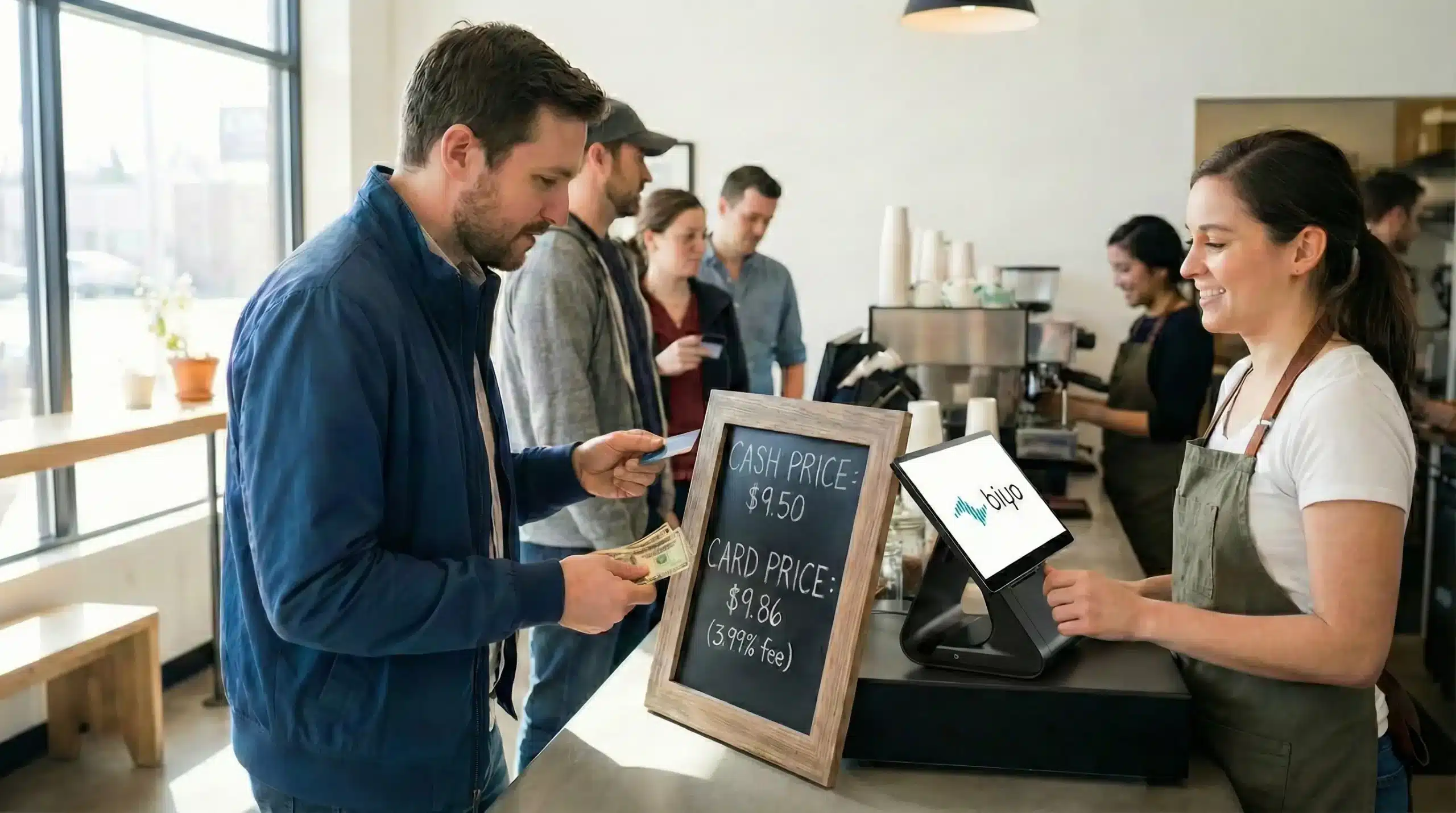
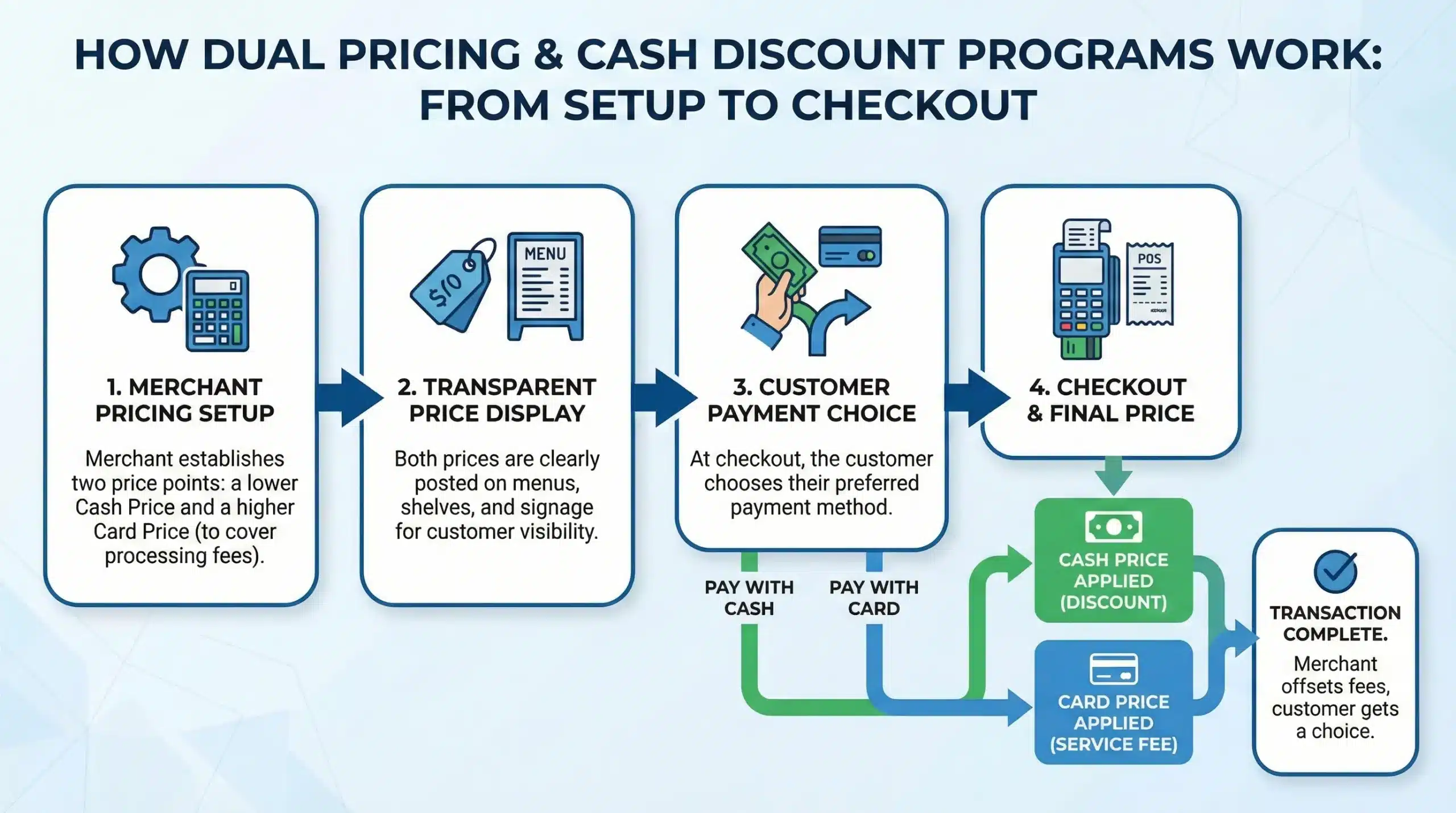
A dual pricing program displays two prices for the same item. One price applies to cash payments, while another applies to card payments.
Because card transactions incur processing fees, the card price reflects that cost. Cash-paying customers benefit from a lower listed price.
This structure keeps pricing transparent. Customers see the difference before paying, which reduces confusion.
How Cash Discount Programs Are Structured
A cash discount program posts a single price that assumes card payment. Customers who pay with cash receive a discount at checkout.
As a result, the business still recovers card fees from card users. Cash customers feel rewarded rather than penalized.
This framing often feels more positive to customers, especially in cash-friendly environments.
Dual Pricing vs Surcharging
Unlike surcharges, these programs do not add surprise fees at checkout. Pricing differences appear clearly upfront.
Therefore, customers feel informed rather than misled. Transparency improves acceptance.
Many merchants prefer these models because they reduce friction while remaining compliant.
 Why Merchants Use Alternative Pricing Strategies
 Why Merchants Use Alternative Pricing Strategies
Merchants adopt these programs for both financial and operational reasons. Payment costs affect nearly every transaction.
Separating those costs gives businesses more flexibility without raising base prices.
Reducing Credit Card Processing Fees
Processing fees add up quickly, especially for high-volume businesses. Shifting those costs back to card users protects margins.
As a result, merchants experience predictable monthly savings. Cash flow becomes easier to manage.
Even small percentage changes make a noticeable difference over time.
Maintaining Competitive Pricing
Raising prices across the board risks losing price-sensitive customers. Alternative pricing avoids that problem.
Cash prices remain competitive, while card prices reflect actual costs.
This balance helps merchants stay competitive without sacrificing profit.
Encouraging Payment Choice Transparency
Customers appreciate knowing why prices differ. Clear signage and receipts reinforce trust.
When customers understand payment costs, complaints decrease.
Transparency strengthens long-term customer relationships.
How These Programs Work in Daily Operations
Successful execution depends on consistency. Pricing rules must apply the same way across all terminals and locations.
Technology plays a major role in keeping operations smooth.
Point-of-Sale Configuration
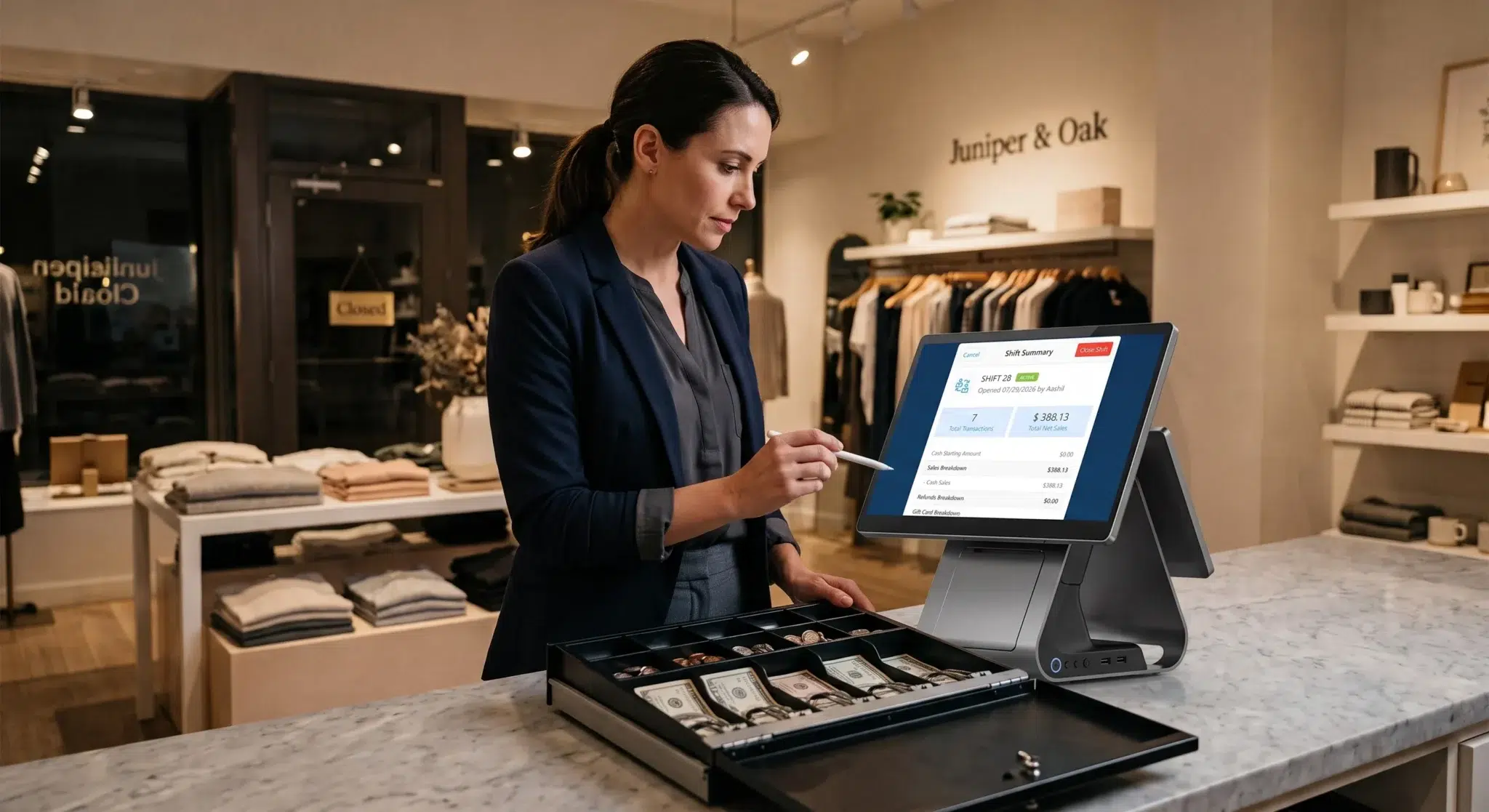
The POS system must automatically apply pricing based on payment type. Manual calculations lead to errors.
Automation ensures accuracy and speeds up checkout.
Staff can focus on service rather than explaining math.
Customer Communication at Checkout
Clear signage prepares customers before they pay. Simple explanations work best.
Meanwhile, trained staff can answer questions confidently.
Consistency builds acceptance quickly.
Impact on Sales and Payment Behavior
Some customers switch to cash when given the option. Others continue using cards.
Either way, the business recovers processing costs more effectively.
Over time, savings become predictable.
Compliance, Transparency, and Customer Trust
Compliance remains critical when using alternative pricing strategies. Rules vary by region and card network.
Clear disclosures protect both merchants and customers.
Proper Price Disclosure
Prices must appear clearly before checkout. Customers should never feel surprised.
Menus, shelves, and receipts should match the pricing model.
Consistency supports compliance.
Card Network and Local Guidelines
Payment networks provide rules for pricing practices. Merchants should follow those guidelines closely.
Local regulations may also apply.
Working with a knowledgeable provider reduces risk.
Training Staff for Compliance
Staff training ensures pricing rules are applied correctly. Confidence prevents mistakes.
Simple scripts help explain pricing when needed.
Prepared teams create smoother experiences.
Challenges When Implementing Pricing Programs
Even well-designed programs face challenges. Preparation helps avoid disruption.
Knowing common pitfalls makes implementation easier.
Customer Confusion Early On
Some customers need time to adjust. Clear signage speeds understanding.
Friendly explanations ease concerns.
Confusion fades quickly with consistency.
Incorrect POS Setup
Misconfigured systems create pricing errors. Testing before launch is essential.
Accurate setup protects trust.
Automation reduces risk.
Staff Adjustment Period
Change takes time. Training and support help staff adapt.
Once routines settle, operations normalize.
Long-term benefits outweigh early friction.
Why Businesses Choose Biyo POS
 Why Businesses Choose Biyo POS
Biyo POS helps merchants implement flexible pricing strategies without complexity. The system supports cash discount and dual pricing setups across multiple terminals and locations.
Because pricing rules apply automatically, businesses reduce errors and maintain transparency. Reporting tools help track payment processing savings over time.
If you want to explore how Biyo POS fits your pricing strategy, you can schedule a call with the Biyo POS team. Merchants ready to move forward can also sign up without long-term commitments.
FAQs
What are dual pricing and cash discount programs?
They separate pricing based on payment method to help merchants recover card processing costs.
Are these pricing strategies compliant?
Yes, when prices are clearly disclosed and network rules are followed.
Do customers accept these programs?
Most customers accept them when pricing is transparent.
Can POS software manage these programs?
Modern POS systems like Biyo POS handle pricing automatically.