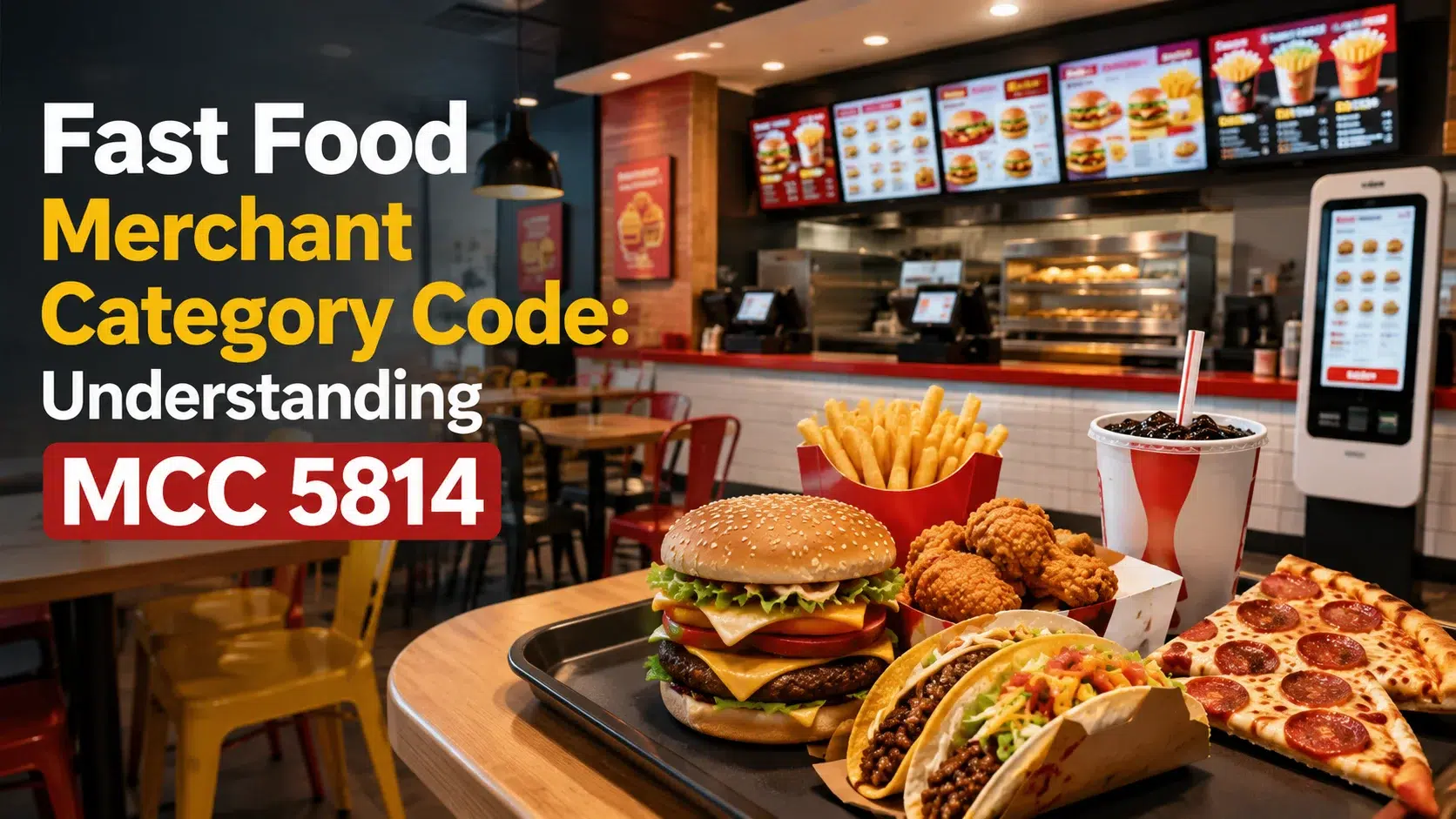

Speed is what defines a fast food restaurant. Customers expect quick ordering, fast preparation, and a seamless checkout experience. Behind those card payments, however, is a system most restaurant owners never think about—a four-digit Merchant Category Code (MCC) that tells payment processors what type of business they’re dealing with.
For many quick-service restaurants, that code is MCC 5814. While it isn’t something customers see on their receipts, it helps payment processors, banks, and card networks classify businesses accurately. It also supports merchant reporting, transaction monitoring, and, in some cases, determines whether customers earn dining rewards on their credit cards.
If you’re opening a fast food restaurant, reviewing your merchant account, or simply curious about how Merchant Category Codes work, understanding MCC 5814 is a good place to start. This guide explains what the code means, which businesses typically qualify, and how it differs from other restaurant-related Merchant Category Codes.
At a Glance: MCC 5814
| Category | Details |
|---|---|
| Merchant Category Code | 5814 |
| Category Name | Fast Food Restaurants |
| Industry | Quick-Service Restaurant (QSR) |
| Typical Businesses | Fast food restaurants, quick-service restaurants, burger chains, pizza carryout, sandwich shops, and similar establishments. |
| Assigned By | Payment processors and acquiring banks |
| Purpose | Classifies quick-service restaurants for payment processing and merchant reporting. |
Table of Contents
- What Is MCC 5814?
- Which Businesses Qualify for MCC 5814?
- Businesses That Usually Don’t Qualify
- Why Merchant Category Codes Matter
- How Payment Processors Use MCC 5814
- Benefits and Challenges of MCC 5814
- How to Verify Your Merchant Category Code
- MCC 5814 Compared to Similar Merchant Categories
- How Biyo Helps Fast Food Restaurants
- Frequently Asked Questions
What Is MCC 5814?
Understanding MCC 5814
MCC 5814 is the Merchant Category Code assigned to businesses that primarily operate as fast food or quick-service restaurants. Unlike traditional restaurants where table service is part of the dining experience, businesses in this category focus on preparing meals quickly and serving customers through counter service, drive-thrus, kiosks, or takeaway.
Although menus vary from one restaurant to another, the business model is remarkably similar. Customers place an order, pay before receiving their food, and expect a fast, convenient experience. That operating model is what separates MCC 5814 from other restaurant classifications.
Who Assigns MCC 5814?
When a restaurant applies for a merchant account, its payment processor or acquiring bank reviews the business before assigning the most appropriate Merchant Category Code. The decision isn’t based on the restaurant’s name or cuisine. Instead, it reflects how the business operates on a daily basis.
A burger restaurant, fried chicken franchise, taco shop, or sandwich chain may all receive MCC 5814 because they share the same quick-service approach. Their menus are different, but their customer experience follows a similar pattern.
Why Fast Food Restaurants Have Their Own Classification
Quick-service restaurants have become one of the largest segments of the food service industry. Their focus on speed, standardized operations, and high transaction volume makes them different from full-service restaurants, cafés, and catering businesses.
Having a dedicated Merchant Category Code allows payment providers to classify these businesses consistently. It also helps distinguish fast food restaurants from other food service merchants that operate under different business models.
 Which Businesses Qualify for MCC 5814?
 Which Businesses Qualify for MCC 5814?
Businesses Commonly Assigned MCC 5814
MCC 5814 is commonly assigned to restaurants where customers order at a counter, drive-thru, kiosk, or mobile app before receiving their food. The emphasis is on speed and efficiency rather than table service.
- Burger restaurants
- Pizza carryout and delivery chains
- Sandwich shops
- Chicken restaurants
- Taco restaurants
- Hot dog restaurants
- Quick-service cafés
- Fast casual restaurant chains
- Drive-thru restaurants
- Takeaway-focused restaurants
A Real-World Example
Imagine a customer stopping at a burger restaurant during lunch. They place their order using a self-service kiosk, pay with a credit card, collect their meal a few minutes later, and leave. That entire experience is designed around speed, which is exactly why businesses like this generally fall under MCC 5814.
The same principle applies to restaurants where most orders are placed through a mobile app or drive-thru. Even though the ordering method changes, the core business remains quick-service dining.
What Payment Providers Look For
Payment processors don’t classify businesses based on menu items alone. Instead, they evaluate the restaurant’s primary business model, customer experience, and main source of revenue.
For example, selling burgers doesn’t automatically place a restaurant under MCC 5814. A gourmet burger restaurant offering full table service may qualify for a different Merchant Category Code because customers receive a traditional dining experience instead of quick service.
Businesses That Usually Don’t Qualify
Restaurants with Different Merchant Category Codes
Although many food businesses prepare meals for immediate consumption, not all of them operate as quick-service restaurants. Payment processors assign different Merchant Category Codes to businesses whose primary operations differ from the fast food model.
- Full-service restaurants
- Catering companies
- Bars and taverns
- Coffee shops focused on sit-down service
- Grocery stores
- Retail bakeries
- Specialty food retailers
Understanding the Difference
A common misconception is that every restaurant belongs under the same Merchant Category Code. In reality, payment processors distinguish restaurants based on how customers are served rather than the type of food being prepared.
For instance, two restaurants might both sell pizza. One operates as a traditional sit-down restaurant with servers, while the other specializes in takeaway and delivery. Even though the menu is similar, their Merchant Category Codes may be different because their business models aren’t the same.
Why Business Models Matter
Merchant Category Codes are designed to reflect how a business earns its revenue. That’s why payment providers focus on the overall customer experience instead of individual menu items.
Understanding this approach makes it much easier to see why two restaurants serving similar food can receive different Merchant Category Codes.
Why Merchant Category Codes Matter
Creating Consistency Across Payment Networks
Every day, payment processors handle millions of transactions from businesses around the world. Merchant Category Codes provide a standardized way to identify merchants, ensuring transactions are categorized consistently regardless of which bank or payment provider is involved.
Without this shared classification system, organizing payment data across thousands of industries would be significantly more complicated.
Supporting Rewards and Reporting
Many credit card companies use Merchant Category Codes when determining whether purchases qualify for restaurant rewards or cashback offers. While each rewards program follows its own rules, MCC 5814 helps identify transactions processed by qualifying fast food restaurants.
Merchant Category Codes also improve reporting by allowing financial institutions to group similar businesses together for analysis, account management, and transaction reporting.
Helping Detect Suspicious Transactions
Fraud detection systems look at multiple pieces of information before flagging unusual activity, and Merchant Category Codes are one part of that process. Knowing the type of business involved provides useful context when evaluating payment patterns.
Although MCC 5814 doesn’t prevent fraud by itself, it supports the systems that payment providers use to monitor transaction activity more effectively.
How Payment Processors Use MCC 5814
Classifying Quick-Service Restaurants
Once a fast food restaurant begins accepting card payments, MCC 5814 becomes part of its merchant profile. Every transaction processed by the business carries this classification, helping payment processors immediately recognize the merchant as a quick-service restaurant.
This standardized approach keeps payment processing consistent across the industry. Whether a customer orders from a local sandwich shop or a national burger chain, the payment is categorized using the same Merchant Category Code, making transaction reporting and merchant management much more efficient.
Supporting Merchant Account Reviews
Merchant Category Codes help payment providers understand the businesses they work with. While MCC 5814 doesn’t determine processing rates by itself, it gives acquiring banks valuable context about how the business operates.
Other factors, including monthly processing volume, average ticket size, refund history, chargebacks, and overall account performance, are also considered when evaluating a merchant account. The Merchant Category Code simply forms one piece of the bigger picture.
Improving Reporting and Transaction Monitoring
Grouping similar businesses together makes reporting far more useful. Payment processors can analyze trends across the quick-service restaurant industry, while merchants receive organized transaction data that helps them better understand sales activity.
MCC 5814 also supports fraud monitoring by providing context about the type of business processing each payment. Combined with transaction history and purchasing patterns, this information helps payment providers identify activity that falls outside normal expectations.
Benefits and Challenges of MCC 5814
Benefits of Accurate Classification
Having the correct Merchant Category Code ensures your restaurant is grouped with businesses that operate in a similar way. This creates consistency across payment processors, banks, and card networks while making merchant reporting more accurate.
It also reduces confusion when discussing your merchant account with payment providers. Everyone involved understands your business model using the same industry classification, making communication much simpler.
Potential Challenges
The biggest challenge isn’t MCC 5814 itself but receiving an incorrect classification. A restaurant that’s assigned the wrong Merchant Category Code may encounter unnecessary confusion when reviewing merchant account information or discussing payment processing with its provider.
Business models can also evolve. A quick-service restaurant that expands into full-service dining or shifts its primary focus to catering may eventually require a different Merchant Category Code to better reflect its operations.
Best Practices for Restaurant Owners
Review your merchant account details from time to time to confirm they still reflect how your business operates. If you’ve introduced significant operational changes, it’s worth asking your payment processor whether your Merchant Category Code should be reviewed.
Keeping your merchant profile accurate helps ensure your payment provider understands your business correctly and supports smoother account management over time.
How to Verify Your Merchant Category Code
Check Your Merchant Documents
If you’re unsure whether your restaurant has been assigned MCC 5814, start by reviewing your merchant account paperwork. Many payment processors include the Merchant Category Code in onboarding documents, merchant statements, or online account dashboards.
If you can’t locate it, your payment processor’s support team can usually confirm the classification quickly.
Request a Merchant Category Code Review
If you believe your restaurant has been assigned the wrong Merchant Category Code, contact your payment provider and explain why another classification better reflects your business. They may request details about your operations, ordering process, or primary revenue source before completing the review.
The final decision follows payment network guidelines, ensuring businesses are classified consistently across the industry.
Know When Your Classification May Change
Merchant Category Codes aren’t permanent. As businesses grow and evolve, payment providers may update the assigned classification to match the merchant’s current business model.
For example, a restaurant that moves away from quick-service dining and introduces full table service could eventually qualify for a different Merchant Category Code.
MCC 5814 Compared to Similar Merchant Categories
 MCC 5814 Compared to Similar Merchant Categories
MCC 5814 vs. MCC 5812
Although both Merchant Category Codes apply to restaurants, the customer experience is usually what separates them. MCC 5814 is commonly associated with quick-service restaurants where customers order and pay before receiving their food. MCC 5812 generally applies to restaurants that provide a traditional dining experience, often including table service.
MCC 5814 vs. Other Food Service Businesses
Fast food restaurants aren’t the only businesses serving prepared meals. Caterers, bars, cafés, grocery stores, and bakeries all have different operating models, which is why payment processors classify them under separate Merchant Category Codes instead of grouping every food business together.
Comparison Table
| Merchant Category Code | Business Type | Primary Business Activity |
|---|---|---|
| 5814 | Fast Food Restaurants | Quick-service restaurants focused on speed, takeaway, and counter service. |
| 5812 | Eating Places & Restaurants | Full-service restaurants serving meals for immediate consumption. |
| 5811 | Caterers | Preparing and serving food for events and off-site functions. |
| 5813 | Bars, Taverns & Nightclubs | Businesses primarily serving alcoholic beverages. |
| 5411 | Grocery Stores & Supermarkets | Retail stores selling groceries and household food products. |
How Biyo Helps Fast Food Restaurants
Speed is everything in a quick-service restaurant. Biyo POS helps simplify daily operations by combining order management, inventory tracking, payment processing, and real-time reporting in one easy-to-use platform. Staff can process orders faster while managers gain better visibility into sales and inventory.
Whether you operate a single fast food location or a growing restaurant chain, Biyo gives you the tools to run your business more efficiently. Schedule a demo to see Biyo in action or create your account to explore the platform.
Frequently Asked Questions
What is MCC 5814?
MCC 5814 is the Merchant Category Code used to classify fast food and quick-service restaurants that primarily prepare and serve meals for immediate consumption.
Who assigns MCC 5814?
Payment processors and acquiring banks assign Merchant Category Codes when a business opens a merchant account. The assigned code reflects the merchant’s primary business activity.
What’s the difference between MCC 5812 and MCC 5814?
MCC 5812 generally applies to full-service restaurants, while MCC 5814 is commonly assigned to quick-service and fast food restaurants where customers typically order and pay before receiving their food.
Does MCC 5814 affect credit card rewards?
Many credit card issuers use Merchant Category Codes to determine whether purchases qualify for restaurant rewards or cashback offers. Eligibility depends on the card issuer and the terms of the rewards program.
How do I verify my Merchant Category Code?
You can verify your Merchant Category Code by reviewing your merchant account documents, checking your payment processor’s dashboard, or contacting your payment provider directly.
Can my Merchant Category Code change?
Yes. If your restaurant significantly changes its business model, your payment processor may review your account and assign a different Merchant Category Code that better reflects your primary business activity.