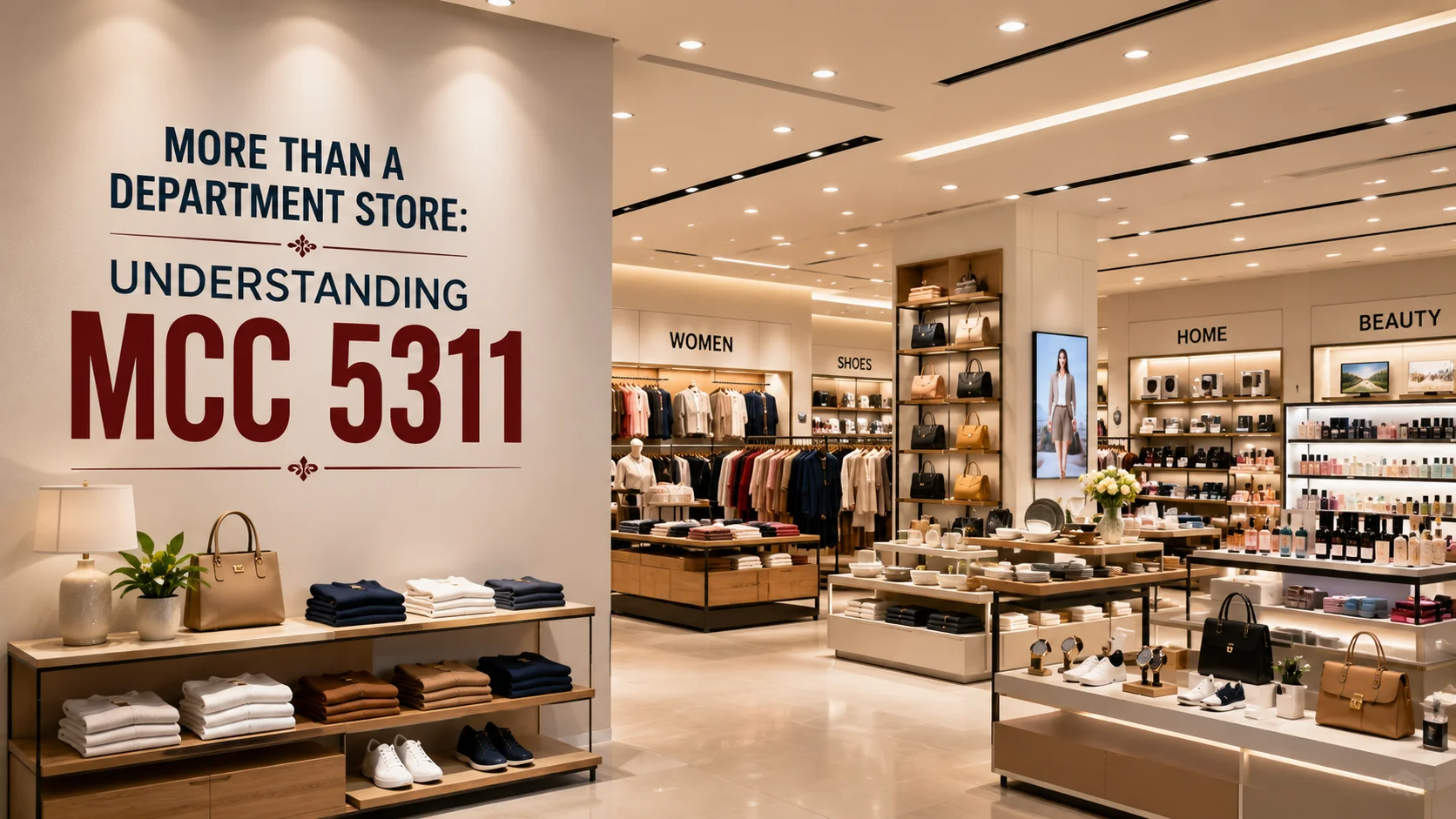

A department store isn’t defined by a single product—it’s defined by variety. A customer might walk in looking for a new jacket, then leave with cookware, cosmetics, children’s toys, and a set of bath towels. That ability to bring multiple retail categories together under one roof is what makes department stores unique, and it’s also why they have their own Merchant Category Code.
For many of these retailers, that classification is MCC 5311. This four-digit Merchant Category Code helps payment processors, banks, and card networks identify businesses that primarily operate as department stores. While shoppers never see the code during checkout, it plays an important role behind the scenes by supporting payment processing, merchant reporting, and business classification.
If you manage a department store or simply want to better understand how your merchant account works, learning about MCC 5311 provides valuable insight into how payment providers categorize large multi-department retailers and why that classification matters.
At a Glance: MCC 5311
| Category | Details |
|---|---|
| Merchant Category Code | 5311 |
| Category Name | Department Stores |
| Industry | General Merchandise Retail |
| Typical Businesses | Department stores, multi-category retailers, general merchandise stores, and large-format retail chains. |
| Assigned By | Payment processors and acquiring banks |
| Purpose | Classifies retailers that sell merchandise across multiple departments and product categories. |
Table of Contents
- What Is MCC 5311?
- Which Businesses Qualify for MCC 5311?
- Businesses That Usually Don’t Qualify
- Why Merchant Category Codes Matter
- How Payment Processors Use MCC 5311
- Benefits and Challenges of MCC 5311
- How to Verify Your Merchant Category Code
- MCC 5311 Compared to Similar Merchant Categories
- How Biyo Helps Department Stores
- Frequently Asked Questions
What Is MCC 5311?
Understanding MCC 5311
Department stores don’t specialize in one product category—they bring together clothing, footwear, cosmetics, home décor, electronics, kitchenware, toys, luggage, and countless other products in a single retail environment. Because this business model is different from specialty retail, payment providers classify these merchants under MCC 5311.
MCC 5311 is the Merchant Category Code assigned to businesses whose primary activity is operating a department store or another large general merchandise retailer offering products across multiple departments.
How Merchant Category Codes Are Assigned
When a retailer opens a merchant account, the acquiring bank or payment processor reviews the business before assigning the most appropriate Merchant Category Code. Rather than focusing on individual products, they evaluate the overall business model and determine what best represents the merchant’s primary activity.
A department store may generate significant sales from clothing one month and home furnishings the next, but because no single department defines the business, MCC 5311 remains the appropriate classification.
Why Department Stores Have Their Own Classification
Running a department store is very different from managing a specialty retailer. Inventory spans multiple categories, dozens of suppliers, and thousands—sometimes hundreds of thousands—of SKUs. Promotions often involve entire departments rather than individual products, and managers need visibility into sales across every section of the store.
Because these operations differ significantly from retailers focused on a single category, payment providers classify department stores separately to create more accurate merchant records.
 Which Businesses Qualify for MCC 5311?
 Which Businesses Qualify for MCC 5311?
Businesses Commonly Assigned MCC 5311
MCC 5311 generally applies to retailers that sell merchandise across several major product categories rather than concentrating on one specialty. Customers visit these stores expecting a broad selection instead of a narrow product range.
- Department stores
- General merchandise retailers
- Multi-department retail stores
- Large-format department retailers
- Discount department stores
- Regional department store chains
- Lifestyle department stores
- Family department stores
A Walk Through the Store
Imagine entering a department store to buy a dress shirt. Before reaching the checkout, you pass through cosmetics, handbags, footwear, furniture, kitchen appliances, children’s clothing, bedding, and seasonal décor. That variety isn’t an accident—it’s the foundation of the department store business model.
Since the retailer generates revenue from multiple departments instead of one specialized category, MCC 5311 accurately reflects how the business operates.
How Payment Providers Determine Eligibility
Payment processors evaluate the retailer’s primary business rather than its best-selling department. A store that offers clothing, home goods, electronics, beauty products, and accessories under one roof is generally a stronger fit for MCC 5311 than a retailer focused almost entirely on apparel or electronics.
The goal is to classify the merchant according to its overall retail model, ensuring the Merchant Category Code matches the business customers recognize.
Businesses That Usually Don’t Qualify
Retailers with Different Merchant Category Codes
Many stores carry a wide selection of products, but that doesn’t automatically make them department stores. Payment processors assign different Merchant Category Codes to retailers whose primary focus falls within a specific category or business model.
- Grocery stores
- Warehouse clubs
- Electronics stores
- Furniture stores
- Clothing stores
- Sporting goods retailers
- Home improvement stores
Understanding the Difference
Consider a large furniture showroom that also sells lamps, rugs, wall art, and home accessories. While the selection extends beyond furniture, customers still visit primarily for home furnishings. Likewise, an electronics retailer may stock gaming accessories, smart home devices, and office equipment, yet technology remains the core business.
Department stores differ because no single category dominates the customer experience. Their defining feature is the breadth of merchandise offered across many departments.
Why Business Models Matter
Merchant Category Codes reflect how a retailer operates rather than the size of its inventory. Two stores may sell the same coffee maker or winter coat, but one could be a department store while the other specializes in appliances or apparel. The products overlap, but the business model does not.
That’s why payment providers evaluate the entire retail operation before assigning a Merchant Category Code.
Why Merchant Category Codes Matter
Supporting a Standardized Payment System
Millions of retail transactions take place every day across thousands of industries. Merchant Category Codes give banks, payment processors, and card networks a standardized way to identify businesses, helping transactions move through the payment system efficiently.
Without consistent classifications, organizing merchant accounts and transaction data across such a diverse retail landscape would be far more complex.
Improving Reporting and Business Insights
Merchant Category Codes allow financial institutions to group similar retailers together, making reporting and merchant analysis more meaningful. For department stores, this standardized classification supports clearer reporting while helping payment providers better understand trends within the general merchandise sector.
Some credit card issuers also use Merchant Category Codes when determining eligibility for rewards or cashback, although every card program establishes its own qualification criteria.
Helping Monitor Transaction Activity
Merchant Category Codes provide valuable context for fraud detection systems by identifying the type of business processing each payment. Combined with transaction history and spending behavior, this information helps payment providers recognize activity that falls outside normal patterns for department stores.
Although MCC 5311 doesn’t directly prevent fraud, it contributes to the broader systems that support secure electronic payments.
How Payment Processors Use MCC 5311
Identifying Department Store Transactions
Once a department store begins accepting card payments, MCC 5311 becomes part of its merchant profile. Every eligible transaction processed by the business carries this classification, allowing payment processors to recognize the merchant as a multi-department retailer rather than a specialty store.
This consistent classification makes payment processing more efficient across banks, acquiring institutions, and card networks. Whether a customer purchases clothing, cookware, or home décor, the transaction is associated with the same Merchant Category Code because it reflects the retailer—not the individual product being purchased.
Supporting Merchant Account Management
Merchant Category Codes help payment providers understand how a business operates. While MCC 5311 doesn’t determine processing fees on its own, it provides important context when merchant accounts are reviewed, managed, or analyzed.
Payment processors also consider transaction volume, average ticket size, refund activity, chargeback history, and overall account performance. The Merchant Category Code works alongside these factors to provide a clearer picture of the merchant’s business.
Improving Reporting and Transaction Monitoring
Department stores process transactions across dozens of product categories every day. Merchant Category Codes help organize this activity by grouping similar retailers together, making industry reporting and merchant analysis more meaningful.
MCC 5311 also supports transaction monitoring. When payment providers understand the normal purchasing patterns associated with department stores, they can more effectively identify unusual activity that may require additional review.
Benefits and Challenges of MCC 5311
Benefits of Accurate Classification
An accurate Merchant Category Code ensures your business is grouped with retailers that share a similar operating model. This creates consistency throughout the payment ecosystem while making merchant reporting and payment analysis more reliable.
It also helps simplify communication with payment providers because your business is clearly identified as a department store from the beginning.
Potential Challenges
The most common challenge isn’t MCC 5311 itself but receiving an incorrect classification. If a multi-department retailer is categorized as a specialty store, it can create unnecessary confusion when reviewing merchant account information or discussing payment processing services.
Retail businesses also evolve. A retailer that narrows its focus to a single product category or changes its business model significantly may eventually require a different Merchant Category Code.
Best Practices for Department Store Operators
Review your merchant account information periodically to confirm your Merchant Category Code still reflects how your business operates today. If you’ve expanded into new retail formats or significantly changed your merchandising strategy, it’s worth discussing your classification with your payment processor.
Keeping your merchant profile accurate helps reduce misunderstandings and ensures your payment account continues to reflect your business correctly.
How to Verify Your Merchant Category Code
Review Your Merchant Account Information
If you’re unsure whether your business has been assigned MCC 5311, begin by reviewing your merchant account documentation. Many payment processors include the Merchant Category Code in onboarding paperwork, merchant statements, or online account dashboards.
If you can’t locate the information, your payment provider can usually verify your classification within a few minutes.
Request a Merchant Category Code Review
If you believe your department store has been assigned the wrong Merchant Category Code, contact your payment processor and request a review. They may ask about your product categories, business operations, website, or primary revenue sources before determining whether another classification is more appropriate.
The review focuses on your overall retail model rather than individual departments, helping ensure your Merchant Category Code accurately represents your business.
Know When Your Classification May Change
Merchant Category Codes aren’t permanent. If your business changes substantially over time, your payment processor may update the assigned classification to better reflect your current operations.
For example, if a department store transitions into a specialty apparel retailer or another focused retail format, a different Merchant Category Code may become more appropriate.
MCC 5311 Compared to Similar Merchant Categories
 MCC 5311 Compared to Similar Merchant Categories
MCC 5311 vs. Variety Stores and Specialty Retailers
Department stores are designed to offer multiple product categories under one roof, often with dedicated departments for apparel, beauty, home goods, electronics, and seasonal merchandise. Variety stores and specialty retailers typically operate with a narrower merchandise strategy, even if they carry a wide assortment of products.
MCC 5311 vs. Warehouse Clubs and General Merchandise Stores
Warehouse clubs and discount retailers may also sell products across multiple categories, but their membership models, merchandising strategies, or pricing structures often distinguish them from traditional department stores. Merchant Category Codes help payment providers recognize these operational differences.
Comparison Table
| Merchant Category Code | Business Type | Primary Business Activity |
|---|---|---|
| 5311 | Department Stores | Selling merchandise across multiple retail departments. |
| 5331 | Variety Stores | Retailing a broad assortment of low-cost everyday merchandise. |
| 5399 | Miscellaneous General Merchandise Stores | General merchandise retailers that don’t fit another specific category. |
| 5651 | Family Clothing Stores | Retail sale of clothing and apparel for the entire family. |
| 5732 | Electronics Stores | Retail sale of consumer electronics and technology products. |
How Biyo Helps Department Stores
Managing thousands of products across multiple departments requires more than a traditional cash register. Biyo POS helps department stores simplify inventory management, process transactions efficiently, and monitor sales across every department from a single platform.
Whether you operate one location or manage multiple stores, Biyo gives you the tools to track inventory in real time, generate detailed sales reports, and keep daily operations running smoothly. Schedule a demo to see Biyo in action or create your account to explore the platform.
Frequently Asked Questions
What is MCC 5311?
MCC 5311 is the Merchant Category Code assigned to department stores and other retailers that primarily sell merchandise across multiple product categories.
Who assigns MCC 5311?
Merchant Category Codes are assigned by payment processors or acquiring banks when a business opens a merchant account. The assigned code reflects the merchant’s primary business activity.
Can a specialty retailer use MCC 5311?
Generally, no. Retailers that primarily focus on a single category, such as clothing, electronics, or furniture, are usually assigned a Merchant Category Code that better reflects their specialty.
Does MCC 5311 affect credit card rewards?
Some credit card issuers use Merchant Category Codes when determining eligibility for cashback or rewards. Whether purchases qualify depends on the card issuer and the terms of its rewards program.
How do I verify my Merchant Category Code?
You can verify your Merchant Category Code by reviewing your merchant account documents, checking your payment processor’s online dashboard, or contacting your payment provider directly.
Can my Merchant Category Code change?
Yes. If your business changes significantly over time, your payment processor may review your account and assign a different Merchant Category Code that better reflects your current operations.