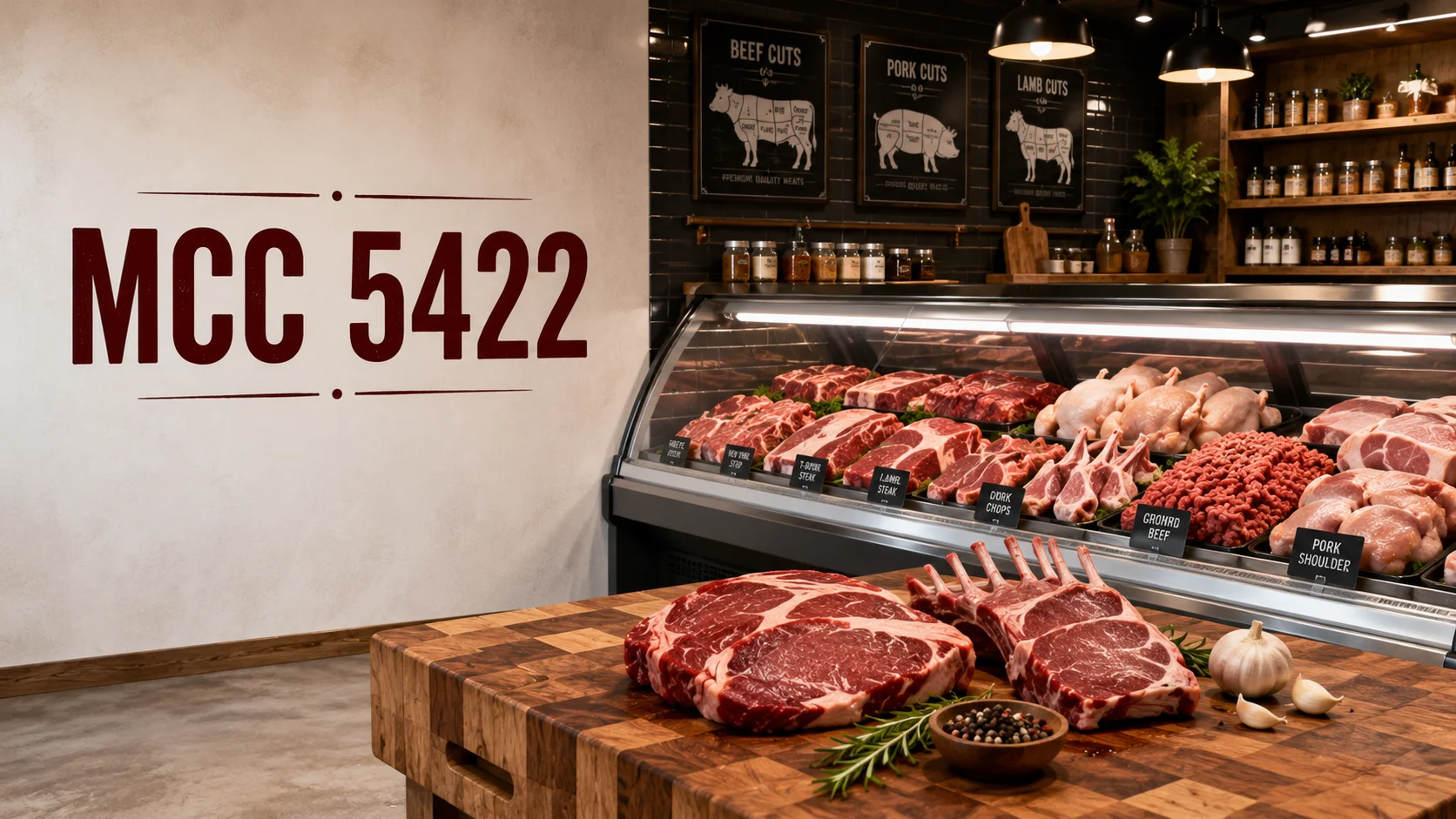

Whether it’s a neighborhood butcher shop, a fresh seafood market by the coast, or a specialty meat retailer known for premium cuts, these businesses have one thing in common—they focus on providing high-quality, fresh products that customers often can’t find elsewhere. While shoppers pay attention to freshness, selection, and customer service, every card payment made at the register is categorized behind the scenes using a Merchant Category Code (MCC).
For many meat and seafood retailers, that classification is MCC 5422. This four-digit Merchant Category Code helps payment processors, banks, and card networks identify businesses whose primary activity is selling fresh meat, poultry, seafood, and related products. Although most store owners rarely think about it, MCC 5422 plays an important role in merchant classification, payment processing, and transaction reporting.
If you operate a butcher shop, seafood market, or specialty meat store, understanding MCC 5422 can help you better understand how your business is categorized and why that classification matters when managing your merchant account.
At a Glance: MCC 5422
| Category | Details |
|---|---|
| Merchant Category Code | 5422 |
| Category Name | Freezer and Locker Meat Provisioners, Meat and Seafood Markets |
| Industry | Specialty Food Retail |
| Typical Businesses | Butcher shops, seafood markets, meat retailers, poultry stores, fish markets, specialty meat markets, and farm meat stores. |
| Assigned By | Payment processors and acquiring banks |
| Purpose | Classifies businesses that primarily sell fresh meat, poultry, seafood, and related products. |
Table of Contents
- What Is MCC 5422?
- Which Businesses Qualify for MCC 5422?
- Businesses That Usually Don’t Qualify
- Why Merchant Category Codes Matter
- How Payment Processors Use MCC 5422
- Benefits and Challenges of MCC 5422
- How to Verify Your Merchant Category Code
- MCC 5422 Compared to Similar Merchant Categories
- How Biyo Helps Meat and Seafood Markets
- Frequently Asked Questions
What Is MCC 5422?
Understanding MCC 5422
MCC 5422 is the Merchant Category Code assigned to businesses that primarily sell fresh meat, poultry, seafood, and related products directly to consumers. Unlike supermarkets that carry thousands of grocery items, these retailers focus on protein products that often require specialized handling, refrigeration, and knowledgeable customer service.
Many businesses in this category prepare custom cuts, grind meat to order, or offer locally sourced products that distinguish them from larger grocery chains. While each retailer has its own specialty, selling fresh meat and seafood remains the core of the business.
How Merchant Category Codes Are Assigned
When a business applies for a merchant account, its payment processor or acquiring bank reviews the merchant’s primary business activity before assigning a Merchant Category Code. The decision isn’t based on every product sold but on what generates most of the business’s revenue.
For example, a premium butcher shop specializing in dry-aged beef and a neighborhood seafood market selling fresh fish each morning may offer very different products. Even so, both businesses can qualify for MCC 5422 because fresh meat or seafood sales define their operations.
Why Meat and Seafood Markets Have Their Own Classification
Retailers in this industry operate differently from grocery stores or restaurants. Inventory is highly perishable, products are often sold by weight rather than by unit, and many customers request custom preparation, trimming, or portioning before completing a purchase.
These operational differences make meat and seafood retailers a distinct part of the food industry. Assigning a dedicated Merchant Category Code helps payment providers classify these businesses more accurately while improving consistency across the payment ecosystem.
 Which Businesses Qualify for MCC 5422?
 Which Businesses Qualify for MCC 5422?
Businesses Commonly Assigned MCC 5422
MCC 5422 generally applies to businesses whose primary source of revenue comes from selling fresh meat, seafood, poultry, or similar products. Some retailers also carry seasonings, marinades, frozen foods, or prepared items, but fresh protein products remain the primary focus.
- Independent butcher shops
- Fresh seafood markets
- Fish markets
- Halal meat stores
- Specialty butcher shops
- Poultry retailers
- Farm meat markets
- Game meat retailers
- Specialty seafood stores
- Local meat markets
A Day Inside a Neighborhood Butcher Shop
Picture a local butcher opening early each morning to prepare display cases with fresh beef, chicken, lamb, and house-made sausages. Throughout the day, customers request steaks cut to specific thicknesses, ask for advice on cooking different cuts, or order meat for weekend barbecues. Every purchase is weighed, priced, and processed at the counter.
That combination of fresh inventory, personalized service, and specialty products is exactly the type of business MCC 5422 is intended to classify.
How Payment Providers Determine Eligibility
Payment processors evaluate the merchant’s overall business model before assigning a Merchant Category Code. They consider where revenue comes from, how products are sold, and what customers primarily visit the business to purchase.
A supermarket may have a full-service butcher counter, but grocery sales usually remain the primary source of revenue. Likewise, a restaurant serving premium steaks doesn’t qualify simply because meat is a major ingredient. The classification always reflects the merchant’s primary business activity.
Businesses That Usually Don’t Qualify
Businesses with Different Merchant Category Codes
Many retailers sell meat or seafood products, but not all of them fall under MCC 5422. Payment processors use different Merchant Category Codes for businesses whose primary operations belong to another retail category.
- Grocery stores and supermarkets
- Restaurants
- Retail warehouse clubs
- Convenience stores
- Specialty food stores
- Retail bakeries
- General food markets
Understanding the Difference
A grocery store may employ skilled butchers and maintain a large meat department, but customers visit to buy everything from produce and dairy products to household supplies. Because groceries represent the overall business, the merchant is generally classified under a grocery-related Merchant Category Code.
A specialty butcher shop, on the other hand, exists almost entirely to sell fresh meat and provide expert service. That narrower focus is what separates it from broader food retailers.
Why Business Focus Matters
Merchant Category Codes aren’t assigned according to individual products—they’re assigned according to the merchant’s primary purpose. Two businesses may sell the same ribeye steak, yet receive different Merchant Category Codes because one operates as a supermarket while the other specializes exclusively in meat products.
That distinction helps payment providers maintain a more accurate and organized merchant classification system.
Why Merchant Category Codes Matter
Creating Consistency Across the Payments Industry
Every electronic payment moves through multiple financial institutions before it’s approved. Merchant Category Codes provide a common language that allows banks, card networks, and payment processors to classify businesses consistently, regardless of location or payment provider.
Without standardized classifications like MCC 5422, organizing millions of merchant transactions across thousands of industries would be considerably more difficult.
Supporting Reporting and Business Analysis
Merchant Category Codes help financial institutions organize retailers into meaningful industry categories, making reporting and merchant analysis more accurate. They also support certain credit card rewards programs, although eligibility depends on the specific policies established by each card issuer.
For merchants, consistent classification contributes to clearer reporting and better communication with payment providers.
Helping Monitor Transaction Activity
Merchant Category Codes also support fraud detection by providing additional context about the business processing each payment. Understanding what normal purchasing behavior looks like for a meat or seafood retailer helps payment providers identify unusual activity more effectively.
While MCC 5422 doesn’t prevent fraud by itself, it strengthens the systems that financial institutions use to monitor payment activity every day.
How Payment Processors Use MCC 5422
Recognizing Meat and Seafood Retailers
After a butcher shop or seafood market is approved for a merchant account, MCC 5422 becomes part of its merchant profile. Every eligible card transaction carries this classification, allowing payment processors to recognize the business as a specialty retailer focused on fresh meat, poultry, or seafood.
This standardized approach creates consistency throughout the payments industry. Whether a customer purchases fresh salmon from a seafood market or premium steaks from a local butcher, the transaction is categorized using the same Merchant Category Code.
Supporting Merchant Account Management
Merchant Category Codes give payment providers a better understanding of the businesses they support. While MCC 5422 isn’t the only factor considered during account reviews, it helps acquiring banks identify the merchant’s primary business activity and classify the account appropriately.
Payment processors also evaluate transaction volume, average ticket size, business history, and chargeback performance. The Merchant Category Code simply provides another layer of information that supports account management.
Improving Reporting and Transaction Monitoring
Grouping similar merchants together allows payment providers to analyze payment activity across the meat and seafood retail industry. Business owners also benefit from organized transaction records that simplify bookkeeping and make financial reporting easier.
MCC 5422 also supports fraud monitoring by helping financial institutions understand the normal purchasing patterns associated with specialty meat and seafood retailers. Combined with other security measures, this additional context improves transaction monitoring without affecting the checkout experience.
Benefits and Challenges of MCC 5422
Benefits of Accurate Classification
An accurate Merchant Category Code ensures your business is grouped with retailers that operate in a similar way. This creates greater consistency across payment networks while making merchant reporting more meaningful for both payment providers and business owners.
Correct classification also simplifies conversations with your payment processor because your business is clearly identified within the appropriate retail category from the beginning.
Potential Challenges
The most common issue isn’t MCC 5422 itself but receiving an inaccurate classification. If a specialty butcher or seafood retailer is categorized under another merchant type, it can create unnecessary confusion when reviewing merchant account information.
Businesses can also evolve over time. For example, a butcher shop that later expands into a full grocery market or restaurant may eventually require a different Merchant Category Code if its primary source of revenue changes.
Best Practices for Meat and Seafood Retailers
Review your merchant account periodically to confirm your Merchant Category Code still reflects how your business operates. If you’ve significantly expanded your services or product range, discuss your classification with your payment processor.
Maintaining accurate merchant information helps ensure smoother account management and keeps your payment profile aligned with your current business model.
How to Verify Your Merchant Category Code
Review Your Merchant Account Information
If you’re unsure whether your business has been assigned MCC 5422, start by checking your merchant account documentation. Many payment processors include the Merchant Category Code in onboarding documents, monthly statements, or online merchant dashboards.
If you can’t find the information, your payment provider can usually confirm your classification within a few minutes.
Request a Merchant Category Code Review
If you believe your business has been assigned the wrong Merchant Category Code, contact your payment processor and request a review. They may ask about your products, business operations, website, or primary source of revenue before determining whether another classification is more appropriate.
The review focuses on your overall business activity rather than individual products, helping ensure the Merchant Category Code accurately reflects how your business operates.
Know When Your Classification Can Change
Merchant Category Codes aren’t permanent. As your business grows or changes direction, your payment processor may update the assigned classification to better represent your current operations.
For example, if a seafood market expands into a full-service grocery store or a butcher shop becomes a restaurant, another Merchant Category Code may become a better fit.
MCC 5422 Compared to Similar Merchant Categories
 MCC 5422 Compared to Similar Merchant Categories
MCC 5422 vs. Grocery Stores and Food Markets
The biggest difference between MCC 5422 and grocery-related Merchant Category Codes is specialization. Meat and seafood retailers focus almost entirely on fresh protein products, while supermarkets and food markets offer a much broader selection that includes produce, dairy, packaged foods, and household essentials.
MCC 5422 vs. Other Specialty Food Retailers
Retail bakeries, dairy stores, confectionery shops, and specialty food retailers all focus on specific product categories. Payment processors assign different Merchant Category Codes to these businesses because each serves customers in a different way and generates revenue from different types of products.
Comparison Table
| Merchant Category Code | Business Type | Primary Business Activity |
|---|---|---|
| 5422 | Meat & Seafood Markets | Retail sale of fresh meat, poultry, seafood, and related products. |
| 5411 | Grocery Stores & Supermarkets | Retail sale of groceries and household food products. |
| 5451 | Dairy Product Stores | Retail sale of milk, cheese, butter, yogurt, and other dairy products. |
| 5462 | Retail Bakeries | Selling bread, cakes, pastries, cookies, and other baked goods. |
| 5499 | Specialty Food Stores | Retail sale of specialty and niche food products. |
How Biyo Helps Meat and Seafood Markets
Fresh inventory requires careful management. From weight-based pricing and custom cuts to monitoring stock that moves quickly, meat and seafood retailers need a POS system that keeps operations efficient. Biyo POS helps simplify inventory tracking, payment processing, and sales reporting, giving store owners better visibility into daily operations.
Whether you run a neighborhood butcher shop, a seafood market, or multiple specialty food stores, Biyo provides the tools to help you manage inventory, serve customers faster, and make informed business decisions. Schedule a demo to see Biyo in action or create your account to explore the platform.
Frequently Asked Questions
What is MCC 5422?
MCC 5422 is the Merchant Category Code assigned to businesses that primarily sell fresh meat, poultry, seafood, and related products directly to consumers.
Who assigns MCC 5422?
Merchant Category Codes are assigned by payment processors or acquiring banks when a business opens a merchant account. The assigned code reflects the merchant’s primary business activity.
Can a grocery store have MCC 5422?
Generally, no. Grocery stores are usually assigned a grocery-related Merchant Category Code because they sell a broad range of food and household products rather than specializing in meat and seafood.
Does MCC 5422 affect credit card rewards?
Some credit card issuers use Merchant Category Codes when determining whether purchases qualify for cashback or rewards. Eligibility depends on the specific card issuer and the terms of its rewards program.
How do I verify my Merchant Category Code?
You can verify your Merchant Category Code by reviewing your merchant account documents, checking your payment processor’s online dashboard, or contacting your payment provider directly.
Can my Merchant Category Code change?
Yes. If your business changes significantly over time, your payment processor may review your account and assign a different Merchant Category Code that better reflects your current operations.