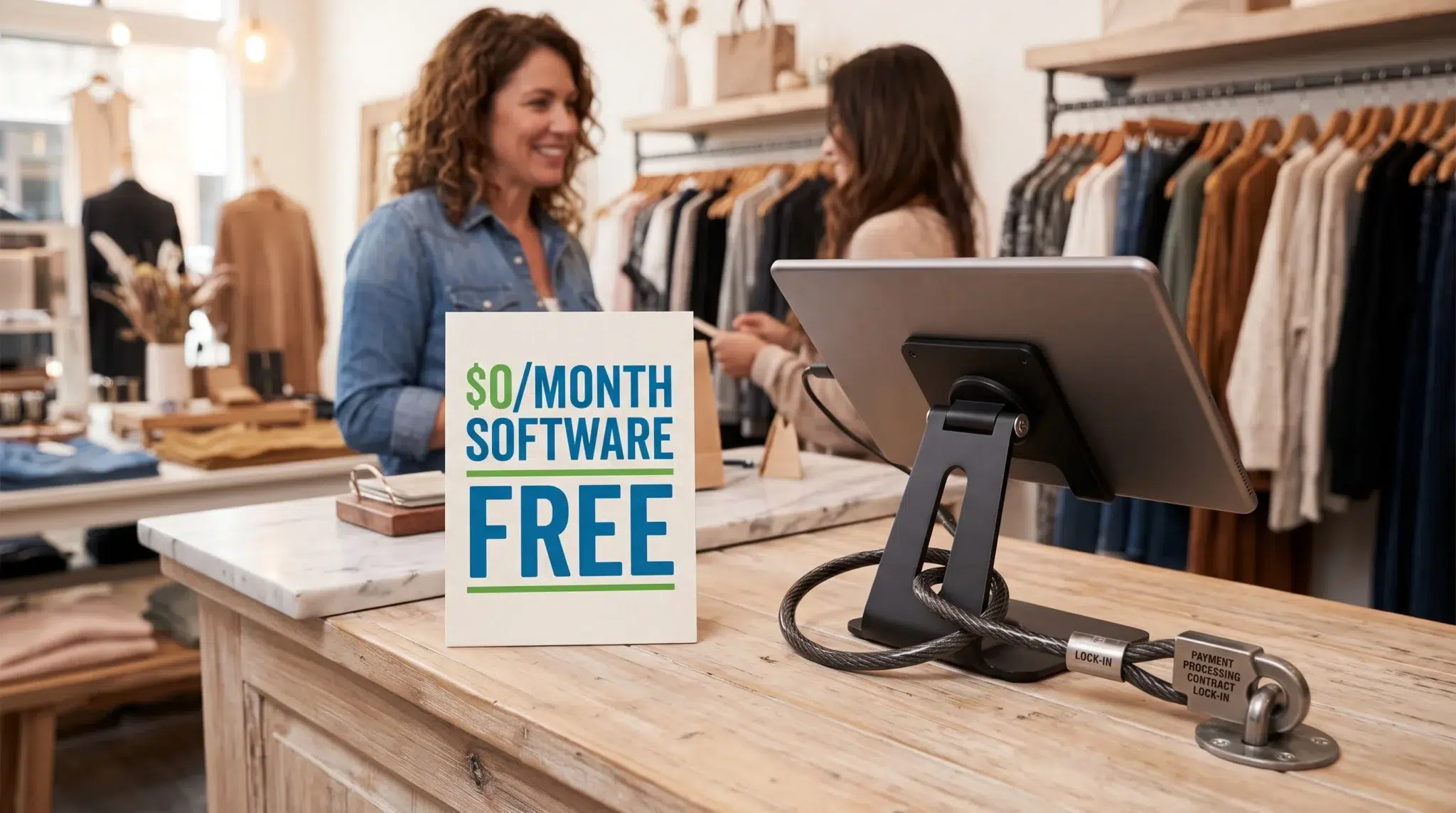

When searching for a checkout and management platform, boutique owners are constantly presented with the appeal of free POS systems for retail. Promising zero upfront software fees, no monthly subscriptions, and instant activation, these platforms position themselves as the ideal budget-friendly solution for growing apparel stores, gift shops, and specialty boutiques. However, in retail software architecture, there is no such thing as zero operational cost; instead, the expense is simply shifted into predatory fee structures and hidden markups.
Instead of charging a predictable monthly software subscription, providers of “free” point-of-sale software monetize by taking a cut of every single customer transaction through inflated payment processing rates. Additionally, they enforce strict hardware lock-in, restrict essential retail features behind high-tier paywalls, and lock merchants into restrictive long-term commitments. Consequently, boutique owners who believe they are saving money often end up paying hundreds—or even thousands—of dollars more each year than they would with a transparent, subscription-based system.
Therefore, understanding the true hidden costs of free POS software is essential for protecting your store’s bottom line and calculating an accurate POS total cost of ownership. This comprehensive guide breaks down how zero-dollar POS platforms monetize, analyzes the mathematics of processing markups, provides an exhaustive 36-month cost projection, and demonstrates how switching to a transparent platform can immediately optimize your operating margins.
Table of Contents
- The Illusion of the Zero-Dollar POS Software Model
- Payment Processing Markups: Where the Real Cost Hides
- Proprietary Hardware Lock-In and Forced Upgrades
- The Feature Paywall: Paying Extra for Essential Retail Tools
- Calculating Total Cost of Ownership Across 12, 24, and 36 Months
- Boutique Case Study: The Financial Reality of a $30,000/Month Store
- Contract Traps, Early Termination Fees, and Data Hostage Scenarios
- Side-by-Side Comparison
- How Biyo POS Eliminates the Hidden Cost Trap
- Frequently Asked Questions
The Illusion of the Zero-Dollar POS Software Model
The concept of a $0/month software package is an aggressive customer acquisition strategy engineered by payment aggregators and venture-funded fintech vendors. Rather than functioning as an open, merchant-first software developer, these vendors operate primarily as payment processors. By offering the software interface for free, they attract a steady volume of retail merchants who are sensitive to upfront capital expenditures.
As a result, the software functions as a loss leader designed to secure your store’s transaction flow. Once your boutique is onboarded, inputting inventory, and ringing up daily customer sales, migrating to a different platform becomes an operational challenge. The provider then monetizes this captive relationship through mandatory non-negotiable payment processing spreads, auxiliary software fees, and proprietary hardware ecosystems.
The “Software as a Loss Leader” Monetization Engine
Software engineering, cloud server infrastructure, customer support, and continuous development require substantial recurring capital. When a point of sale vendor charges $0 per month for their core platform, they must recoup those development and server maintenance costs through alternative channels.
Instead of generating revenue through a transparent subscription fee, these platforms embed their profit margins directly into your daily credit card sales. Every time a customer taps a credit card, inserts a chip, or buys an item through your digital storefront, the processor takes a premium cut that far exceeds the wholesale cost of interchange.
Why Small Boutiques Are the Primary Target
Independent retail boutiques, specialty gift shops, and emerging apparel retailers frequently operate with lean teams and tight cash reserves during their initial growth stages. When launching a storefront or outfitting a secondary location, spending $1,000 or more upfront on software and enterprise equipment can seem daunting.
Consequently, business owners gravitate toward “free” platforms to conserve capital for store buildouts and initial merchandise purchasing. Unfortunately, because retail boutiques often process a high volume of transactions with moderate-to-high average order values ($50 to $200+), the compounding cost of inflated transaction fees quickly eclipses any initial software savings within the first several months of operation.
The Escalating Cost Curve of Growing Retailers
In the early days of a retail store, when monthly sales may only sit at $3,000 to $5,000, paying a flat rate of 2.6% to 3.5% feels negligible in absolute dollar terms. However, retail point of sale systems should be built to scale alongside business expansion.
As your boutique expands its customer base, introduces new seasonal product lines, and scales to $20,000, $40,000, or $80,000 in monthly gross revenue, the processing fees paid under a “free” model escalate linearly. What started as a $120 monthly processing expense turns into an unsustainable $1,200 to $2,800 monthly drain on your operating cash flow.
 Payment Processing Markups: Where the Real Cost Hides
 Payment Processing Markups: Where the Real Cost Hides
The single largest hidden expense inside any zero-dollar POS platform is payment processing markup. To understand where this capital goes, boutique owners must understand the difference between the wholesale cost of payment processing—known as the interchange rate—and the bundled markup rates charged by flat-rate and tiered processors.
Whenever an electronic payment is processed, the card-issuing bank (such as Chase, Citi, or Bank of America) and the card networks (Visa, Mastercard, Discover, American Express) assess non-negotiable base fees called interchange and assessments. On average, regulated in-person wholesale interchange rates for standard consumer debit cards hover around 0.05% + 22¢, while standard credit cards average between 1.40% and 1.80%.
Flat-Rate vs. Interchange-Plus Pricing Structures
Free POS platforms generally force merchants into a rigid flat-rate pricing model. Under this model, the vendor charges a blanket rate—commonly between 2.6% + 10¢ and 3.5% + 15¢—regardless of the actual wholesale cost of the specific card used by the consumer.
When a customer pays with a low-cost debit card that carries a wholesale interchange fee of 0.05%, the flat-rate provider still charges the merchant 2.6% or higher. The provider absorbs the tiny wholesale fee and pockets the remaining 2.55% as pure corporate profit on the transaction. By contrast, true interchange-plus pricing passes the exact wholesale cost of the card directly through to the merchant, adding only a transparent, minimal markup (e.g., 0.20% to 0.40%).
Card-Not-Present and Keyed-In Rate Penalties
Modern retail boutiques rarely process sales exclusively through a physical checkout counter. Boutiques regularly accept phone orders, process remote deposits for trunk shows, issue digital invoices, and sell products via social commerce or an integrated online store.
Under “free” POS pricing models, Card-Not-Present (CNP), invoice, and keyed-in transactions incur steep rate hikes, often leaping to 3.5% + 30¢ or higher. If your boutique sells customized products, handles remote VIP client styling over the phone, or sells through an eCommerce catalog, these inflated CNP rates silently siphon a significant percentage of your gross product margins.
The Compounding Volume Penalty on Boutique Margins
Retail boutiques operate on gross product margins that must cover commercial rent, utility overhead, payroll, shrinkage, inventory carrying costs, and marketing. A payment processing surcharge of 1.0% to 1.5% above true wholesale interchange directly erodes your net profitability.
For example, if your retail boutique operates on a 15% net profit margin after all overhead, surrendering an unnecessary 1.5% of your gross top-line revenue to processing markups means you are surrendering 10% of your total net profit directly to your “free” POS vendor. Therefore, the software is not only far from free—it represents one of the most expensive ongoing service vendor contracts in your store.
Proprietary Hardware Lock-In and Forced Upgrades
Another foundational mechanism through which free POS vendors monetize is closed hardware architecture. When business owners register for a zero-dollar software account, they quickly discover that the software cannot be deployed on open, industry-standard commercial POS terminals. Instead, the merchant is required to purchase proprietary or locked terminal hardware directly from the software company at significant markups.
Furthermore, these proprietary terminals run encrypted, closed-source firmware. If you decide to cancel your software account or transition to a different payment processor, the hardware is completely locked. It cannot be reprogrammed, flashed, or transferred to another network, rendering thousands of dollars of register equipment useless e-waste.
Non-Transferable Terminals and Closed Ecosystems
Traditional, enterprise-grade retail POS hardware operates on open-platform protocols. Devices like standard Epson thermal printers, Honeywell barcode scanners, APG cash drawers, and unlocked Android-based or Windows-based registers can be reassigned between different platforms.
Free POS platforms, however, intentionally lock their hardware firmware to their exclusive merchant acquiring IDs. If your store purchases $1,800 worth of countertop displays, chip readers, and customer-facing screens from a proprietary provider, that hardware is rendered obsolete the moment you exit their processing ecosystem. This creates an intentional economic barrier to switching, forcing boutique owners to tolerate poor service and rising fees simply to avoid writing off their hardware investment.
Frequent Hardware Obsolescence Cycles
Proprietary POS hardware vendors frequently sunset older generations of their card readers and terminal stands. By pushing automated software updates that drop support for older models, merchants are pressured into regular hardware upgrade cycles every 24 to 36 months.
Consequently, boutique owners who signed up for “free” software find themselves periodically purchasing replacement registers, updated Bluetooth cradles, and new proprietary contactless readers to maintain basic checkout functionality.
Inflated Peripheral and Accessory Pricing
Beyond the primary register terminal, outfitting a high-end retail boutique requires a complete peripheral ecosystem: barcode label printers for tagging apparel, rapid-scan 2D hand scanners for inventory intake, electronic cash drawers, and customer-facing displays.
Because free POS platforms restrict peripheral compatibility to a narrow allowlist of supported hardware, they charge significant retail markups on basic peripherals. A standard USB receipt printer or basic Bluetooth barcode scanner that retails for $150 on the open commercial market is frequently priced at $300 to $450 in the vendor’s closed hardware store.
The Feature Paywall: Paying Extra for Essential Retail Tools
To advertise a POS system as “$0 per month,” providers strip their base software layer down to the most rudimentary checkout interface. While the free tier can handle basic transaction ringing and simple cash collection, it systematically lacks the specialized tools required to operate a profitable, professional retail business.
As your boutique grows, you inevitably need advanced variant tracking, employee timecards, custom barcode generation, gift card programs, purchase ordering, and customer loyalty workflows. Under a free POS model, every single one of these fundamental retail capabilities is locked behind paid add-on modules, app marketplace extensions, or compulsory “Pro” tiers.
Inventory Matrix and Variant Gating
Retail boutiques rarely sell simple, single-SKU products. An apparel store stocking a single dress style must manage variants across multiple sizes (XS, S, M, L, XL) and multiple colors (Navy, Olive, Rust), resulting in dozens of unique SKU variations for a single garment line.
Basic free POS tiers often lack native matrix inventory tools, forcing staff to enter variants as entirely separate products or purchase expensive third-party inventory add-ons ranging from $49 to $99 per month. Without these tools, inventory tracking breaks down, leading to stock discrepancies, mismatched size counts, and manual reconciliation errors.
Multi-Location and Backroom Tracking Upsells
As soon as a boutique opens a secondary location, secures warehouse storage, or implements a distinct separation between sales floor stock and backroom replenishment bins, free systems demand expensive plan upgrades.
Managing multi-location inventory, stock transfers, and automated replenishment alerts requires enterprise-tier subscriptions on these platforms, instantly adding $60 to $150 per location per month. What was advertised as a free tool quickly turns into an expensive software package that still carries the high payment processing fees of the basic tier.
Customer Loyalty, Gift Cards, and Marketing Paywalls
Customer retention is the lifeblood of specialty boutiques. Encouraging repeat foot traffic requires automated rewards, customized VIP customer tiers, promotional discount rules, and native physical or digital gift cards.
Under free POS software plans, these customer-engagement modules are treated as premium add-on services:
- Native Loyalty Programs: Typically billed at $45 to $90/month based on active customer profiles.
- Digital Gift Cards & Marketing Messaging: Billed at $30 to $60/month plus per-message SMS surcharges.
- Employee Management & Permissions: Advanced role-based permissions, commission tracking, and shift scheduling add another $20 to $40/month.
When boutique owners combine three or four essential add-on applications to match standard retail operations, their monthly recurring software bill quietly climbs to $150–$300+ per month, completely invalidating the premise of a “free” system.
Calculating Total Cost of Ownership Across 12, 24, and 36 Months
Evaluating POS investments requires a multi-year analysis of the Total Cost of Ownership (TCO) rather than focusing solely on upfront software subscription line items. A comprehensive TCO calculation incorporates four primary expenditure categories:
- Hardware Acquisition & Replacement: The initial investment in terminals, tablets, stands, printers, and scanners, plus amortized replacement costs over 3 years.
- Fixed Software Subscriptions & Add-Ons: The monthly cost of the core software license, combined with paid marketplace apps (loyalty, advanced inventory, multi-terminal licensing, employee permissions).
- Effective Payment Processing Volume Surcharge: The net difference between wholesale interchange-plus processing rates and inflated flat-rate processing fees multiplied by gross annual sales volume.
- Labor and Operational Friction: The payroll hours spent manually managing matrix inventory, reconciling mismatched payment batches, and handling offline connectivity errors.
The following analysis examines how these costs compound over 12, 24, and 36 months for an established retail boutique generating $30,000 in monthly sales ($360,000 annually) with a standard retail transaction mix (60% standard credit, 25% debit, 15% premium rewards/Amex/online orders).
12-Month Financial Horizon: The Initial Realization
During the first year, a merchant using a free POS platform might believe they saved roughly $600 to $1,000 on software licenses. However, the payment processing markups begin draining margin immediately:
- Software Subscription: $0 (Base) + $110/month (Basic inventory add-on + Loyalty app) = $1,320/year
- Hardware Outlay: Proprietary countertop station and scanner = $1,400
- Payment Processing (Flat 2.9% + 10¢ on $360k volume, 4,500 transactions): $10,890/year
- Total 1-Year Outlay on “Free” POS: $13,610
By comparison, on a modern SaaS POS model with transparent wholesale pricing (e.g., $49/mo flat software + Interchange-Plus averaging an effective 1.95% + 10¢):
- Software Subscription: $49/month (All retail features included) = $588/year
- Hardware Outlay: Unlocked commercial hardware bundle = $1,200
- Payment Processing (Effective 1.95% + 10¢ on $360k volume): $7,470/year
- Total 1-Year Outlay on Transparent POS: $9,258
Net First-Year Savings with Transparent SaaS: $4,352
24-Month Scaling Phase: The Gap Widens
By the second year, the upfront hardware expenses are fully paid off, but processing volume and retail operational requirements increase. If the boutique grows by a modest 15% to $414,000 in annual gross sales:
- “Free” POS Platform (Year 2): $1,320 (Software Add-ons) + $12,523 (Processing at 2.9% + 10¢) = $13,843
- Transparent SaaS POS (Year 2): $588 (Software) + $8,590 (Processing at 1.95% + 10¢) = $9,178
Cumulative 24-Month Savings: $9,017
36-Month Lifecycle Analysis: The True Cost of “Free”
Over a standard three-year retail technology lifecycle, proprietary “free” POS hardware often requires refresh components, and the cumulative processing markup gap becomes massive. Assuming steady $414,000 annual volume in Year 3 with a minor hardware replacement component ($400):
- 3-Year Total Outlay on “Free” POS: $13,610 (Yr 1) + $13,843 (Yr 2) + $14,243 (Yr 3) = $41,696
- 3-Year Total Outlay on Transparent SaaS POS: $9,258 (Yr 1) + $9,178 (Yr 2) + $9,178 (Yr 3) = $27,614
Ultimately, over 36 months, the boutique owner who chose the “free” software model paid $14,082 more in total operating cash than an owner who paid a consistent monthly software subscription from day one.
Boutique Case Study: The Financial Reality of a $30,000/Month Store
To understand how these calculations play out on a monthly operating ledger, let us examine an independent women’s apparel boutique located in a suburban commercial district. The boutique operates one primary countertop register, employs four part-time sales associates, utilizes an integrated online store for local pickup, and generates $30,000 in monthly gross revenue across roughly 400 customer transactions per week (1,600 monthly tickets, average ticket size of $18.75).
The boutique owner must decide between two system configurations:
- Option A: The Popular “Free POS” Aggregator Model ($0 software fee, flat 2.6% + 10¢ in-store, 3.5% + 30¢ online/keyed-in, paid add-on apps for inventory matrix and loyalty).
- Option B: Transparent All-in-One SaaS Platform (Biyo POS) ($49/month all-inclusive software, Interchange-Plus processing with an effective all-in rate of 1.85% + 10¢, native matrix inventory, and integrated loyalty).
Detailed Monthly Expense Breakdown: Option A (Aggregator Model)
In Option A, the business experiences the following monthly line items:
- Base Software Fee: $0.00
- Advanced Variant/Matrix Inventory Add-on: $49.00/month
- Customer Loyalty & SMS Marketing Add-on: $45.00/month
- In-Store Card Processing ($25,000 volume @ 2.6% + 10¢ across 1,350 transactions): $650.00 + $135.00 = $785.00
- Online Store & Phone Order Processing ($5,000 volume @ 3.5% + 30¢ across 250 transactions): $175.00 + $75.00 = $250.00
- Total Monthly Out-of-Pocket Expense: $1,129.00/month
Detailed Monthly Expense Breakdown: Option B (Biyo POS Model)
In Option B, the boutique operates with full feature access and transparent pass-through processing:
- Base Software Fee (Includes matrix inventory, loyalty, reporting): $49.00/month
- Add-on Software Fees: $0.00
- Total Omnichannel Card Processing ($30,000 blended volume @ effective 1.85% + 10¢ across 1,600 transactions): $555.00 + $160.00 = $715.00
- Total Monthly Out-of-Pocket Expense: $764.00/month
The Direct Margin Impact: $365 Monthly Net Savings
By moving away from the “free” platform, the boutique owner immediately reduces monthly operational overhead by $365.00 every month. Over a single business year, that represents $4,380 in direct net capital recaptured.
In a retail boutique environment, $4,380 is not just a bookkeeping statistic; it represents enough working capital to fund an entire seasonal product line purchase, hire a seasonal associate during holiday rushes, or sponsor significant digital marketing campaigns to acquire new foot traffic.
Contract Traps, Early Termination Fees, and Data Hostage Scenarios
 Contract Traps, Early Termination Fees, and Data Hostage Scenarios
When merchants realize that their free POS system is draining their operating margins, they frequently attempt to switch providers, only to run into intentionally constructed exit barriers. Free and legacy payment providers protect their revenue streams by implementing contractual restrictions, punitive termination fees, and technical obstacles that make data migration difficult.
Understanding these operational risks before selecting a software platform is essential for maintaining control over your business infrastructure.
Liquidated Damages and Early Termination Penalties (ETF)
While modern software platforms offer month-to-month subscriptions with no cancellation penalties, many legacy and zero-dollar POS platforms bundle their accounts with 24- to 48-month merchant processing agreements.
These contracts often contain liquidated damages clauses. If you cancel your merchant processing agreement before the end of the contract term, the vendor calculates their projected lost profit across the remaining months and bills your account directly for early termination fees that can range from $500 to several thousand dollars.
Proprietary Customer Data and Tokenized Card Hostage Scenarios
Customer profiles, historical sales records, loyalty balances, and tokenized card information represent the operational foundation of your store. When you attempt to migrate away from a proprietary ecosystem, you may discover that your store data cannot be exported cleanly.
Many free platforms restrict data exports to basic, unstructured CSV spreadsheets that strip out product matrix relationships, customer purchase histories, and gift card balances. Furthermore, customer credit card tokens stored on file for subscriptions or VIP accounts cannot be transferred out of their proprietary gateway, forcing you to manually recollect payment details from your regular customers.
Equipment Leasing Traps on Countertop Hardware
One of the most predatory practices associated with “free” retail software offerings is the third-party hardware lease. Sales representatives offering free software will frequently convince boutique owners to sign an equipment lease agreement for their terminal hardware rather than purchasing equipment outright.
These non-cancelable equipment leases routinely lock merchants into paying $50 to $90 per month for 48 months for hardware that costs less than $400 to manufacture. By the time the lease expires, the boutique owner has paid between $2,400 and $4,320 for a single terminal that is completely non-functional on any other processing network.
Side-by-Side Comparison
| Operational Category | “Free POS” Aggregator Model | Transparent SaaS Model (Biyo POS) |
|---|---|---|
| Monthly Base Software Cost | $0 / month (Advertised) | Transparent flat monthly subscription |
| Card Processing Fee Structure | Inflated flat-rate (2.6% + 10¢ to 3.5% + 30¢) | Interchange-Plus or Zero-Fee Surcharge Options |
| Matrix & Variant Inventory Tools | Locked behind paid tiers or $49–$99/mo apps | Fully included in core software architecture |
| Multi-Location & Shelf/Bin Tracking | Restricted to enterprise plans ($100+/mo) | Native multi-location, bin, and shelf mapping |
| Customer Loyalty & Marketing Tools | Paid add-on module ($45–$90/month extra) | Built-in loyalty rewards and customer profiles |
| Hardware Compatibility | Locked proprietary hardware (Single-use) | Open-architecture and industry-standard devices |
| Online Store & Omnichannel Sync | Third-party app fees + elevated CNP rates | Commission-free built-in online ordering & sync |
| Contractual Commitment | Multi-year contracts / Liquidated damages | Month-to-month flexibility; cancel anytime |
| Data Ownership & Exportability | Restricted/messy CSV export formats | Complete data ownership and full export access |
| Total 3-Year Cost of Ownership | Significantly higher ($35,000–$45,000+) | Significantly lower ($20,000–$28,000) |
How Biyo POS Eliminates the Hidden Cost Trap
Biyo POS is built on a straightforward business philosophy: retail merchants deserve complete software transparency, open hardware flexibility, and fair, transparent payment processing. Instead of trapping boutique owners behind high-markup flat rates and restricted features, Biyo delivers an enterprise-grade retail operating platform that includes everything you need in one unified ecosystem.
With Biyo, your store gains access to advanced matrix inventory management, real-time multi-location visibility, and granular shelf-and-bin organization without needing expensive third-party software add-ons. Whether you are managing hundreds of apparel size/color variants on your sales floor or managing inventory across backroom storage zones, Biyo’s mobile inventory scanning and automated replenishment workflows keep your catalog accurate in real time.
Furthermore, Biyo integrates your physical boutique counter with a built-in, commission-free online store, unified customer loyalty profiles, customer-facing display support, and reliable offline mode caching that keeps your checkout operational even during internet interruptions. Combined with transparent subscription pricing and flexible payment processing options—including interchange-plus pricing or compliant zero-fee processing programs—Biyo helps boutique owners protect their operating margins and take back control of their retail business.
To see how much your store can save by replacing a markup-heavy POS platform with a transparent solution, you can schedule a live demo with an onboarding specialist or get started directly through the Biyo signup page.
Frequently Asked Questions
Why do companies offer “free” POS software to retail stores?
Free POS software is used as a customer acquisition tool by payment processing aggregators. The providers offset the development and infrastructure costs by charging significantly higher payment processing rates on every transaction, selling locked proprietary hardware, and charging monthly fees for essential feature add-ons.
How does flat-rate processing compare to interchange-plus pricing?
Flat-rate processing charges a fixed, high percentage (e.g., 2.6% to 3.5%) across all transactions regardless of the card type. Interchange-plus pricing passes through the true wholesale interchange rate charged by the card network (averaging ~1.5% for credit, ~0.05% for debit) and adds a small, transparent markup, resulting in substantial processing savings for the merchant.
What happens to proprietary POS hardware if I switch software providers?
Proprietary hardware from closed ecosystems contains encrypted firmware that cannot be reprogrammed or used on other processing networks. If you cancel your account, the hardware must typically be discarded or sold at a significant loss, forcing you to purchase new equipment for your next system.
What retail features are typically locked behind paywalls in free POS apps?
Free POS platforms routinely restrict variant matrix management (size/color variations), multi-location tracking, automated purchase ordering, employee commission permissions, advanced sales analytics, and customer loyalty programs behind high-tier monthly subscription plans or paid app add-ons.
How much can an average retail boutique save by switching from a free POS to a transparent platform?
A retail boutique generating $30,000 in monthly sales typically saves between $300 and $400 per month ($3,600 to $4,800 annually) by switching from an aggregator flat-rate model to a transparent SaaS platform with fair payment processing rates.
Can a boutique retain its customer and catalog data when leaving a POS provider?
While reputable platforms provide direct, structured CSV export tools for all inventory variants, customer lists, and transaction histories, some closed providers export only unstructured data that requires manual cleanup. Always confirm data ownership terms before signing up with any POS vendor.