
Managing multi-location stock transfers effectively is what separates profitable retail chains from operations drowning in excess inventory and localized stockouts. Multi-unit retail operators face an infuriating paradox on a weekly basis. A flagship downtown boutique sells out of a trending linen jacket within forty-eight hours, turning away eager shoppers and losing full-margin revenue. Meanwhile, a suburban branch located twenty miles away sits on eight unsold units of the exact same style, watching them gather dust on display racks. When retail brands lack structured mechanisms to rebalance merchandise, their immediate reaction is issuing emergency purchase orders to suppliers.
Consequently, businesses tie up critical working capital in redundant safety stock while carrying costs compound across the enterprise. Furthermore, fragmented multi-store retailers often coordinate stock rebalancing through chaotic communication channels. Store managers swap inventory details via text messages, unstructured chat threads, and messy spreadsheets. Employees move merchandise in personal vehicles without official transfer manifests, leaving inventory counts corrupted across both locations. When corporate accounting audits the business, mysterious discrepancies emerge that take weeks of painful reconciliation to resolve.
Fortunately, scaling a multi-branch retail network does not require stockpiling safety stock or guessing product locations. By implementing standardized multi-location stock transfers, retail operators can systematically move inventory from overstocked branches to points of high consumer demand. A modern cloud-based transfer workflow provides complete visibility across request creation, in-transit virtual custody, and destination receiving. This comprehensive operational blueprint details the economic mechanics of stock rebalancing, breaks down the risks of informal inventory sharing, and explains how digital transfer protocols eliminate retail stockouts permanently.
Table of Contents
- The Financial Drain of Imbalanced Multi-Branch Inventory
- The Hidden Traps of Informal Trunk Transfers and Chat Logs
- Phase 1: Generating Digital Transfer Requests and Par Rebalancing
- Phase 2: Outbound Scan Verification and In-Transit Virtual Custody
- Phase 3: Destination Receiving, Blind Scanning, and Ledger Settlement
- Logistics Scheduling, Route Density, and Transit Protection
- Side-by-Side Comparison
- How Biyo POS Automates Multi-Location Stock Transfers
- Frequently Asked Questions
The Financial Drain of Imbalanced Multi-Branch Inventory
Inventory imbalances across physical store branches directly attack an enterprise’s bottom line. When one store suffers from empty shelves while sister locations hold surplus units of the same item, the business experiences artificial scarcity. Customer demand remains unfulfilled despite the enterprise already owning sufficient stock to capture the revenue.
As a result, this localized mismatch triggers severe financial penalties that drain liquidity and degrade gross margins. Understanding these hidden operational costs allows retail leadership to prioritize inventory rebalancing.
Trapping Working Capital in Redundant Vendor Orders
When a store manager notices depleted inventory on a high-velocity product, the standard administrative reaction is cutting a new Purchase Order to the vendor. However, buying additional wholesale units when nearby sister branches hold stagnant stock traps vital working capital. Instead of deploying liquid funds into fresh seasonal collections, marketing initiatives, or store improvements, the business locks its cash into redundant inventory.
Furthermore, wholesale purchasing incurs significant supplier lead times, minimum order quantities (MOQs), and freight fees. A wholesale reorder might require three to six weeks for delivery, causing the depleted branch to miss the peak sales window entirely. In contrast, moving existing merchandise across town frees trapped cash flow and satisfies immediate consumer demand in a matter of hours.
The Dual Margin Penalty of Stockouts and Forced Markdowns
Uncoordinated branch distribution forces a retail business to absorb two compounding financial hits simultaneously:
- Lost Full-Margin Sales: When walk-in shoppers find their specific size or color out of stock at a depleted branch, over thirty percent visit a competitor immediately. The store forfeits the full manufacturer’s suggested retail price (MSRP) and permanently damages shopper loyalty.
- Forced Clearance Markdowns: Simultaneously, the overstocked location fails to generate velocity on the stagnant units. As seasonal buying windows close, that branch must apply aggressive clearance markdowns of thirty, fifty, or seventy percent to liquidate remaining stock, completely destroying original gross margins.
Therefore, failing to execute timely multi-location stock transfers forces the enterprise to accept margin destruction on both sides of the retail ledger.
 The Hidden Traps of Informal Trunk Transfers and Chat Logs
 The Hidden Traps of Informal Trunk Transfers and Chat Logs
In fast-paced retail environments lacking integrated software, inter-store merchandise swaps frequently degenerate into informal communication. Store supervisors coordinate inventory shifts using phone calls, WhatsApp messages, or scribbled notes left on backroom clipboards. Employees transport merchandise in personal vehicle trunks during commute hours without formal documentation.
However, this uncontrolled approach introduces severe accounting black holes that compromise enterprise inventory integrity. Eliminating informal habits is mandatory for building an audit-ready multi-store operation.
The Accounting Black Hole of Unrecorded Store Swaps
Consider a typical manual swap scenario: Store Manager A calls Store Manager B requesting four units of an out-of-stock designer dress. Manager B packs the dresses into an open box, and an employee drives them across town after their shift. Neither employee logs into the inventory system to adjust unit counts.
Consequently, Store B’s point of sale continues to display those four dresses as available on-hand stock. If an online shopper attempts to purchase the dress via Buy-Online-Pick-Up-In-Store (BOPIS), store associates search empty racks, resulting in a canceled order and an irritated customer. Meanwhile, Store A sells the dresses without official receiving records, creating massive inventory variances that distort financial reporting.
Breakdown in Chain of Custody and Shrinkage Masking
When merchandise moves between physical storefronts without digital signatures or serialized manifests, operational accountability vanishes:
- Unverified Transit Shrinkage: If a package is misplaced, damaged by rain, or stolen during transit, neither branch accepts responsibility. Store A insists the shipment never arrived, while Store B insists it was dispatched.
- Masking Internal Theft: Dishonest employees easily exploit informal transfers to cover up theft. Stolen garments are routinely explained away as items lost during an off-the-books transfer to another branch.
- Wasted Store Payroll: Store associates spend dozens of non-productive hours every month texting back and forth, cross-referencing paper slips, and searching stockrooms for phantom inventory.
Phase 1: Generating Digital Transfer Requests and Par Rebalancing
To eliminate lost stock and administrative confusion, enterprise retailers must implement a disciplined 3-phase digital transfer protocol. The first stage of this architecture focuses on identifying stock imbalances and establishing electronic authorization before any product is physically moved.
Modern retail operations utilize two primary models to initiate multi-location stock transfers: Store-Initiated Pull Requests and Centralized Push Allocations.
Store-Initiated Pull Requests Driven by Local Par Triggers
A pull transfer occurs when a branch manager identifies an imminent stockout based on sales floor par levels:
- Automated Par Alerts: When an SKU’s on-hand count drops below its minimum safety threshold, the point-of-sale software flags the item as low stock.
- Network Inventory Visibility: The store manager accesses the POS terminal to inspect live inventory levels across all regional branches, instantly locating sister stores holding surplus quantities.
- Digital Transfer Request Creation: The manager generates an official electronic Transfer Request detailing the origin store, destination store, required variant SKUs, and requested quantities.
Once submitted, the request routes to a regional inventory controller or the source store manager for digital approval, ensuring that transfers align with broader corporate merchandising goals.
Centralized Push Rebalancing Using Enterprise Velocity Metrics
Rather than relying solely on individual store requests, multi-store retail directors execute centralized push rebalancing. By monitoring consolidated sales dashboards, inventory analysts evaluate sell-through rates, stock-to-sales ratios, and regional sales velocity across every branch.
For example, if historical sales telemetry shows that heavy winter outerwear sells four times faster in an urban streetfront location than in a suburban strip-center branch, corporate merchandisers generate batch push transfers. The system issues automated fulfillment orders instructing the suburban store to pack and dispatch twenty units to the urban flagship, optimizing full-price sell-through across the enterprise.
Phase 2: Outbound Scan Verification and In-Transit Virtual Custody
The most vulnerable operational phase occurs between the moment merchandise leaves Store A and when it arrives at Store B. Legacy point-of-sale platforms routinely fail here because they treat transfers as instantaneous database adjustments. If software deducts stock from Store A and immediately adds it to Store B, the system reports items as available at the destination while they are still in transit.
Robust retail management systems solve this problem by establishing an active **In-Transit Virtual Bucket** that safeguards chain of custody.
Pick-and-Pack Barcode Verification and Manifest Generation
When the source store receives an approved Transfer Order on their point-of-sale console:
- The fulfillment associate prints an optimized digital pick list arranged by stockroom aisle, shelf, and bin coordinates.
- The associate gathers the physical items from the sales floor or storage racks.
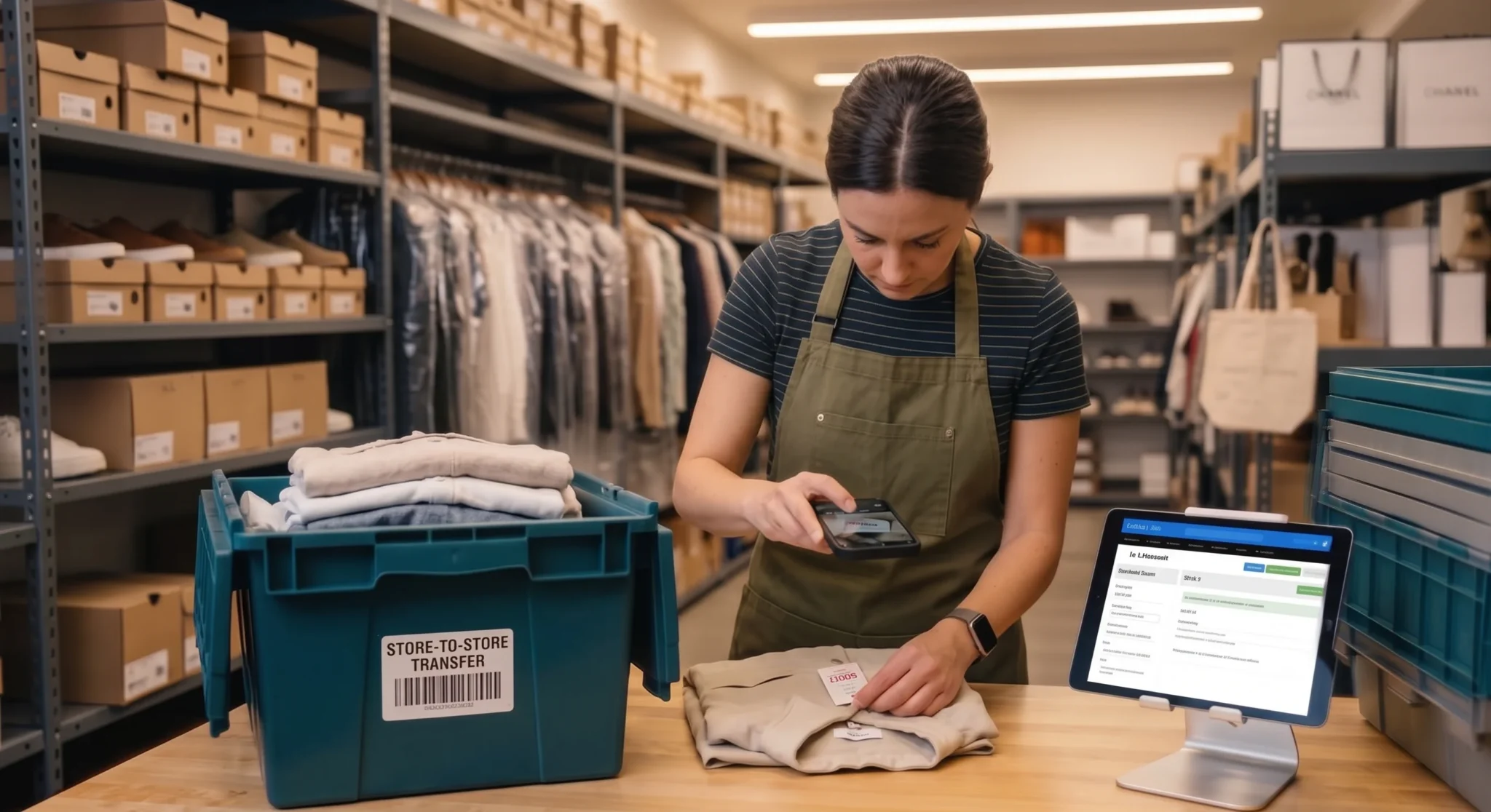
- Using a high-speed optical barcode scanner, the associate scans every unit barcode against the digital transfer manifest.
- The software actively verifies each scan, sounding an audible error alert if the associate scans an incorrect size, color, or style variant.
- Once all line items are validated, the associate seals the shipping carton and affixes a serialized Transfer Tracking Label containing a scannable master manifest barcode.
The Vital Accounting Role of the In-Transit Virtual Bucket
The moment the sending branch taps **Dispatch Shipment**, the cloud inventory engine executes an automated, intermediate accounting adjustment:
- The items are decremented immediately from Store A’s active, sellable on-hand inventory so they cannot be sold to walk-in customers.
- The items are not added to Store B’s sellable stock yet.
- Instead, the merchandise moves into an isolated virtual holding ledger designated as “In-Transit [Transfer #8042].”
This staging mechanism guarantees complete data integrity. Enterprise financial statements accurately reflect that the company owns the assets, but local registers and online storefronts cannot sell merchandise that is physically sitting inside a delivery van.
Phase 3: Destination Receiving, Blind Scanning, and Ledger Settlement
When the delivery courier reaches the receiving storefront, staff must verify that every dispatched unit is physically present before absorbing the items into active sales stock. Relying on quick visual estimates or simply checking off boxes on a paper manifest invites severe inventory drift.
Enforcing strict digital intake protocols ensures that multi-location stock transfers maintain complete audit accountability from end to end.
Blind Barcode Receiving Protocols vs. Visual Slip Checks
Traditional paper-based receiving represents a major point of operational failure. Staff glance at a printed packing slip, count the total number of cartons, sign the invoice, and shelve the products. If the sending branch accidentally packed a Medium instead of an Extra-Large, the error goes unnoticed until an inventory cycle count discovers the discrepancy weeks later.
Modern inventory platforms enforce **Blind Barcode Receiving**:
- The receiving associate opens the pending Transfer Order on their mobile scanner or POS register.
- The software displays the shipment metadata but conceals exact unit quantities, requiring the associate to physically scan each individual product barcode as the carton is unpacked.
- The scanning engine reconciles incoming items against the digital manifest in real time, incrementing received counts automatically.
Automated Ledger Reconciliation and Exception Handling
If an intake discrepancy occurs, the inventory software flags the exception immediately, preventing inaccurate data from corrupting store ledgers:
- Short Shipments: If five units were dispatched but only four are scanned, the associate logs a Short Receipt. The missing unit remains in an active investigation queue while the verified four units enter live stock.
- Damaged Merchandise: If an item arrives soiled or broken, the associate flags the unit as Damaged in Transit, attaches a quick photographic record, and routes the item to a return-to-vendor (RTV) or write-off ledger.
- Automated Settlement: Once the associate confirms the intake, the verified items clear the In-Transit bucket and populate Store B’s live on-hand inventory, becoming available instantly for in-store checkout and online order fulfillment.
Logistics Scheduling, Route Density, and Transit Protection
Physical merchandise transportation incurs real logistical costs. If branch managers dispatch on-demand couriers across town for individual garments, transportation fees will rapidly exceed the gross profit margin of the transferred items.
Establishing organized transportation routing ensures that stock transfers remain economically viable for growing retail enterprises.
Scheduled Batch Consolidation vs. Emergency Courier Thresholds
Multi-location retailers operating within a single metropolitan area must implement disciplined transit schedules to control shipping overhead:
- Consolidated Bi-Weekly Routes: Non-urgent stock rebalancing requests should be batched for dispatch on designated transfer days (such as Tuesday and Thursday mornings). Consolidating transfer items into unified totes minimizes courier mileage and labor expenses.
- Internal Shuttle Loops: Retailers operating four or more regional locations frequently operate a dedicated company van running a scheduled circular loop between stores, dropping off replenishment stock and picking up return totes.
- High-Margin Emergency Thresholds: On-demand third-party couriers should be reserved exclusively for high-value customer reservations or special orders where the gross margin comfortably absorbs the expedited delivery fee.
Standardized Reusable Totes and Tamper-Evident Security Seals
Never transport retail merchandise in unsealed cardboard boxes or open shopping bags. Multi-unit operations must standardize on heavy-duty, reusable plastic distribution totes with interlocking lids:
- Weatherproof plastic totes protect delicate apparel, luxury accessories, and packaged goods from moisture, dust, and transit friction.
- Serialized tamper-evident zip ties lock tote lids securely during transit, ensuring that containers cannot be opened between branches without breaking the physical seal.
- Color-coded container lids allow delivery drivers and stockroom teams to separate incoming transfer totes by destination store at a glance.
Side-by-Side Comparison
| Operational Dimension | Informal / Spreadsheet Transfers | Automated Cloud POS Transfers (Biyo POS) |
|---|---|---|
| Transfer Request Creation | Unstructured text messages, phone calls, and emails | Standardized digital Transfer Orders in central cloud |
| Pick-and-Pack Accuracy | Manual visual checks prone to variant mix-ups | High-speed barcode scan-out validation |
| In-Transit Stock Visibility | Zero tracking; stock vanishes into an accounting void | Virtual In-Transit bucket tracks custody in real time |
| Receiving Verification | Staff signs paper packing slip without counting | Enforced blind barcode scan-in against live manifest |
| Ledger Reconciliation Speed | Days or weeks of manual spreadsheet data entry | Instant automated cloud sync upon digital receiving |
| Discrepancy Management | Unresolved finger-pointing and unexplained shrinkage | Immediate exception logging for shortages and damages |
| Working Capital Efficiency | Poor (Over-purchasing safety stock to avoid stockouts) | High (Trapped inventory rebalanced across branches) |
| Audit Trail & Security | Lost in discarded paper notes and chat logs | Permanent digital timestamps tied to staff user PINs |
| Omnichannel BOPIS Accuracy | High cancellation rate from phantom store inventory | Real-time store stock prevents false online orders |
| Hardware Deployment Cost | Expensive proprietary industrial mobile terminals | Runs natively on existing iOS and Android mobile devices |
How Biyo POS Automates Multi-Location Stock Transfers
 How Biyo POS Automates Multi-Location Stock Transfers
Biyo POS delivers an enterprise-grade cloud retail operating system engineered specifically to eliminate multi-unit inventory friction. Operating natively inside the Google Chrome web browser on any standard PC, Mac, iPad, or Android tablet, Biyo provides retail operators with the centralized tools required to manage multi-branch inventory effortlessly without purchasing expensive server equipment or proprietary hardware.
Mobile Barcode Dispatch and Automated In-Transit Tracking
Executing multi-location stock transfers is completely seamless using Biyo’s integrated inventory platform. Store managers or central operations directors create electronic transfer manifests in seconds, designating target SKUs, matrix variants, and destination stores. Fulfillment teams download the Biyo POS Inventory Scanner app directly from the Apple App Store onto an iPhone or iPad to scan item barcodes directly from sales racks. Biyo validates every unit against the digital manifest in real time, preventing mismatched variants from leaving the building. Once dispatched, Biyo automatically moves the inventory into a secure In-Transit virtual state, giving corporate directors complete chain-of-custody tracking across all locations.
Instant Receiving Reconciliation, Matrix Sync, and Offline Resilience
When shipments arrive at their destination, receiving teams use Biyo’s mobile scanning tools to execute fast blind barcode intake. Biyo reconciles scanned units against the manifest instantly, logs shortages or transit damages, and releases verified stock into the store’s active inventory ledger. If your retail enterprise incorporates food, beverage, or coffee concepts within its locations, route kitchen tickets smoothly using the Biyo Kitchen Display (KDS) app available on Google Play or consolidate multi-station orders through Kitchen Hub. In addition, Biyo’s true offline transaction mode ensures that if a store’s internet connection drops, registers continue ringing up customer sales, processing transfers, and scanning stock without interruption, automatically syncing data to the cloud once network connectivity returns.
To discover how easily your growing retail enterprise can eliminate branch stockouts, protect gross margins, and streamline store transfers, you can schedule a live demo with a multi-store systems consultant or create your account today on the Biyo signup page.
Frequently Asked Questions
What are multi-location stock transfers in retail?
Multi-location stock transfers represent the operational process of physically and digitally moving merchandise between different retail storefronts or warehouses to rebalance stock levels without purchasing additional wholesale inventory.
What is an in-transit inventory bucket?
An in-transit inventory bucket is a temporary virtual holding status within cloud point-of-sale software that holds merchandise dispatched from a source store until it is officially scanned and accepted by the destination store, preventing either store from selling items while they are on delivery vehicles.
How do automated stock transfers stop inventory shrinkage?
Automated transfer systems require associates to scan product barcodes upon outbound dispatch and inbound receiving. This creates an indisputable digital chain of custody with exact employee PIN timestamps, eliminating lost boxes and pinpointing where inventory discrepancies happen.
What is blind barcode receiving?
Blind barcode receiving is an inventory intake protocol where store associates must physically scan every product barcode as shipments are unpacked, rather than simply checking boxes off a printed manifest, ensuring complete count and variant accuracy.
Can Biyo POS manage multi-location transfers across different cities?
Yes. Biyo POS is a 100% cloud-based retail platform, allowing business owners and inventory directors to track stock, initiate transfer manifests, and reconcile branch inventory across multiple cities and regional warehouses from any web browser in real time.
Do stores need expensive industrial barcode guns to manage transfers?
No. Store teams can process outbound pick-and-pack dispatches and inbound branch receiving using the Biyo POS Inventory Scanner app directly on standard Apple iOS smartphones and tablets, eliminating thousands of dollars in proprietary hardware expenses.