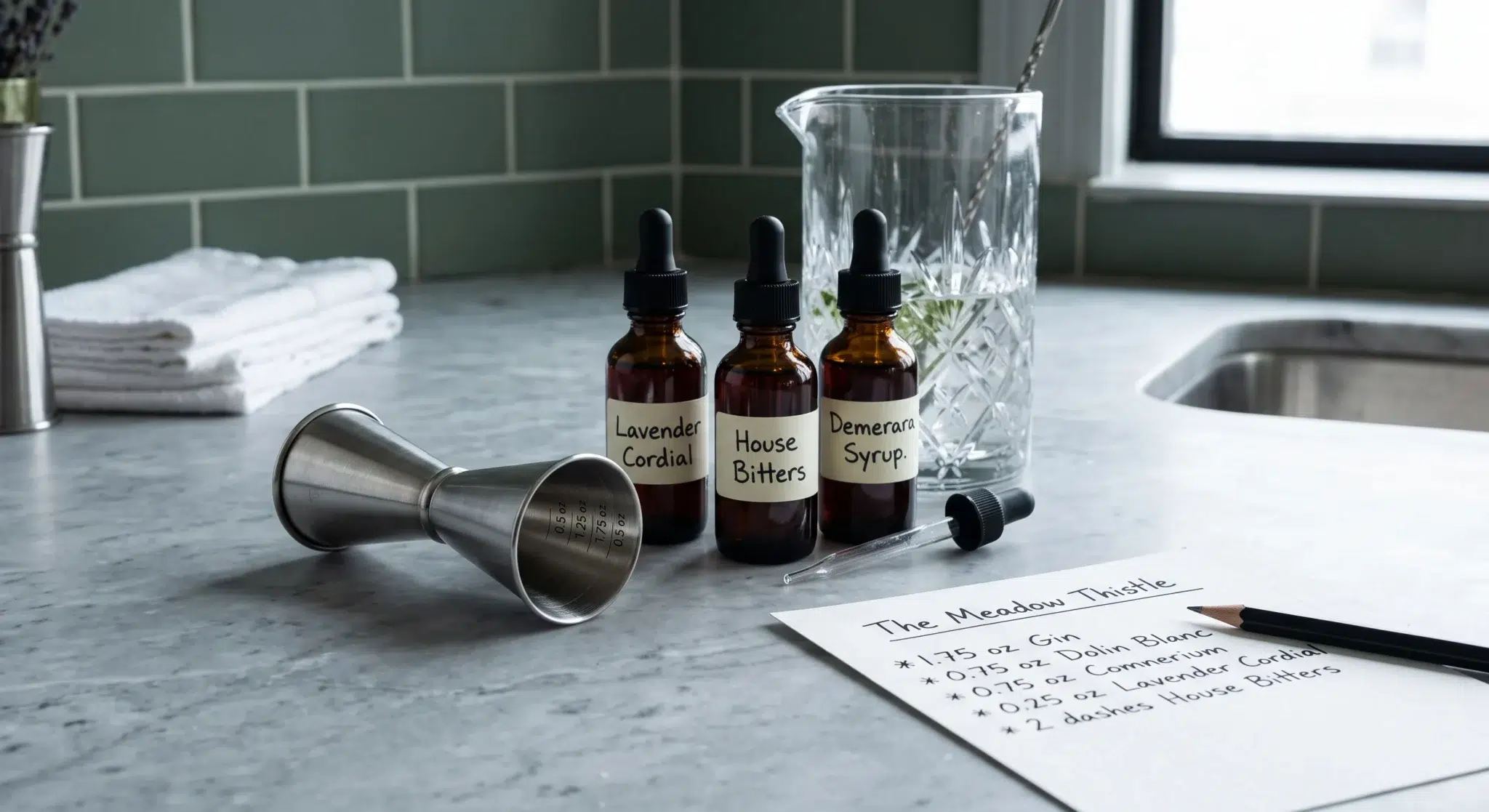

Mastering craft cocktail recipe costing is the foundational discipline required to operate a profitable modern bar, mixology lounge, or upscale restaurant. While standard beer and wine inventory operates on simple one-to-one unit tracking, craft cocktail programs manage hundreds of Raw Material variations, volatile spirit prices, fractional ounces, and house-made sub-recipes. When mixologists create complex signature drinks utilizing diverse spirit bases, artisanal syrups, and expensive bitters, unmetered pouring quickly erodes gross profit margins.
Traditionally, bar operators relied on vague mathematical averages to estimate beverage costs, applying a blanket markup across the entire spirits catalog. They assumed a standard pour cost (typically 18% to 24%) would naturally materialize by checking physical bottle levels at the end of the month. However, this bulk inventory method fails completely in a craft cocktail environment. If a bartender free-pours a 1.75-ounce gin modification instead of the costed 1.25-ounce recipe, the gross profit on that single ticket disappears instantly. Furthermore, when house-made batches of rich demarara syrup or lavender bitters expire unlogged, they become expensive operational waste rather than profitable inventory.
To maximize pour velocity and capture elite margins, bar operators must shift from retroactive box counting to real-time, fractional craft cocktail recipe costing. Modern cloud point of sale systems eliminate manual spreadsheet calculations by automatically linking every register button tap to exact ounce-level ingredient depletions. As cocktails are rung up, the software auto-deducts fractional spirit volumes, tracks batch yields for house-made modifiers, and calculates real-time pour cost variance. This comprehensive guide details the mathematics of fractional spirits costing, provides batching templates for sub-recipes, and explains how automated recipe depletion protects your bar’s unit economics.
Table of Contents
- The Hidden Drain: Why Bulk Counting Fails Craft Cocktail Operations
- The Mathematics of Fractional Spirits Costing: Grams vs. Fluid Ounces
- Sub-Recipe Architecture: Accurate Costing for House-Made Syrups, Bitters, and Clarifications
- Technique-Based Loss: Over-Portioning, Spillage, and the “Bartender Tax”
- Automated Real-Time Depletion: Linking POS Buttons to Liquor Inventory
- Theoretical vs. Actual Pour Costs: Conducting Frequency Audits
- 6-Step Blueprint to Master Craft Cocktail Recipe Costing
- Side-by-Side Comparison
- How Biyo POS Automates Craft Cocktail Costing
- Frequently Asked Questions
The Hidden Drain: Why Bulk Counting Fails Craft Cocktail Operations
Most independent bar operators treat inventory management as a monthly logistical chore. Managers walk through the back storeroom with a clipboard, counting full cases and estimating partially filled bottles in tenths (e.g., “0.7 full” on the well vodka). While this method provides a basic financial snapshot for bookkeeping, it creates a severe operational blind spot.
Bulk counting fails to answer the critical questions that drive bar profitability: *Why* are we missing five liters of premium gin? *Which* shift is responsible for the highest over-portioning variance? *How* many unrecorded staff “comps” are sliding across the bar? Modern operators require fractional visibility to protect their bottom line.
The 1.75-Ounce “Bartender Tax”
In a high-volume mixology bar, speed of service often overrides potioning discipline. When bartenders are rushed, they frequently rely on timed counts during free-pouring (e.g., a “four-count” pour supposed to yield 1.25 ounces). However, viscosity changes based on liquor temperature and bottle fullness, causing uncalibrated free-pours to fluctuate dramatically.
If a bartender averages a 1.75-ounce pour on a standard 1.25-ounce gin recipe, the bar loses exactly 0.5 fluid ounces of premium spirit on every single drink. Across 1,000 monthly cocktails using that gin, that tiny error wastes over five liters of expensive inventory. This invisible “bartender tax” quietly consumes gross profit margins before a single bottle is retroactively counted.
Modifier and Batch Spoilage Erosion
Gourmet cocktail menus rely heavily on house-made modifications—rich demarara syrups, citrus cordials, oleo saccharum, and infused spirits. These sub-recipes carry high raw ingredient and labor costs. Unlike commercial spirits, these fresh components have short refrigerated shelf lives (typically 5 to 14 days).
When a manager makes five liters of house-infused lavender gin, the recipe costing must account for both the raw gin volume and the premium lavender buds. If two liters spoil and are dumped down the drain without being logged in the POS, the entire batch’s profit margin is severely eroded. Mastering craft cocktail recipe costing requires precise yield tracking for all complex sub-recipes.
 The Mathematics of Fractional Spirits Costing: Grams vs. Fluid Ounces
 The Mathematics of Fractional Spirits Costing: Grams vs. Fluid Ounces
To establish absolute pour cost control, bar operators must move beyond vague bottle estimates and calculate spirit costs down to fractional ounces. Since all payment transaction data is captured electronically by the POS, you must translate every liquid menu item into precise volumetric deductions.
Understanding the conversion mathematics allows operators to calculate exact pour costs and true drink profitability.
Establishing the Fluid Ounce Baseline (750ml, 1L, 1.75L)
The primary unit of measure for cocktail costing in the United States is the fluid ounce (fl oz). All recipe deductions must be mapped to base fluid ounces to maintain accuracy. The standard metric-to-imperial conversions are:
- Standard Fifth Bottle (750ml): Contains **25.36 fluid ounces**.
- Standard Liter Bottle (1L): Contains **33.81 fluid ounces**.
- Handle Bottle (1.75L): Contains **59.18 fluid ounces**.
When conducting physical counts on partially filled bottles, utilizing a fast-response digital scale accurate to 0.1 grams is significantly faster and more accurate than visual tenths. The software automatically converts the weighed gram data back into fluid ounces based on the specific spirit’s density coefficient.
Calculating Fractional Spirit Portion Costs
To calculate the precise portion cost for any spirit fraction (e.g., 1.75 oz), apply this fundamental formula:
Spirits Fraction Cost = (Bottle Cost / Bottle Volume in fl oz) * Recipe Volume in fl oz
Reviewing a practical example highlights the financial impact of fractional pour tracking:
- Premium Gin (750ml / 25.36 fl oz): Costs $24.00 wholesale.
- Ounce Cost ($24.00 / 25.36 fl oz): $0.946 per fl oz.
- 1.25 fl oz Standard Pour (1.25 * $0.946): **$1.183 Portion Cost**.
- 1.75 fl oz modification (1.75 * $0.946): **$1.656 Portion Cost**.
This $0.473 cost difference may seem insignificant, but it consumes more than fifteen percent of the cocktail’s profit margin. Without fractional spirits costing, this margin bleed remains invisible until the monthly P&L statement shows lower-than-expected beverage COGS.
Sub-Recipe Architecture: Accurate Costing for House-Made Syrups, Bitters, and Clarifications
A defining characteristic of elite mixology programs is the extensive use of fresh, artisanal sub-recipes. Batching allows mixologists to deliver complex flavors quickly, but it presents a unique costing challenge. The cost of a house-made cordial includes raw sugar, fresh fruit, premium spirit bases, and specific labor time.
Modern craft cocktail recipe costing requires a relational database model that maps finished menu items to these internal batch creations.
The 3-Tier Multi-Batch Catalog Model
To cost complex cocktails accurately, structure your beverage catalog across three relational tiers:
- Tier 1: Master Raw Materials: Bulk ingredients purchased from suppliers (e.g., “Oat Milk Gallon”, “Demarara Sugar 10lb Bag”, “Ginseng Liqueur 750ml”, “Angostura Bitters 4oz”).
- Tier 2: Prepared Batches and Infusions: Batch recipes created by staff (e.g., “Lavender Gin 1-Liter Batch”, “Oleo Saccharum 500ml”, “Clarified Punch Keg”). The system tracks Tier 1 consumption and applies labor cost to calculate the precise yield cost per fluid ounce for Tier 2.
- Tier 3: Finished POS Menu Items: Customer-facing buttons (e.g., “Ginseng Lavender Gin & Tonic”). The recipe links back to specific ounce deductions from Tier 1 (Tonic Water fl oz) and Tier 2 (Lavender Gin fl oz).
Formula for Batch Sub-Recipe Yield Costing
To determine the fluid ounce cost of any house-made component, apply the Batch Yield formula:
Batch fl oz Cost = (Total Ingredient Cost + Labor Cost Buffer) / Actual Batch Yield in fl oz
For example, a 1-Liter batch of House Lavender-Infused Gin uses one 750ml bottle of gin ($24.00) and two ounces of premium dried lavender buds ($3.00).
- Total Ingredient Cost = $24.00 + $3.00 = $27.00
- Actual yielded volume (accounting for absorption) = 28 fluid ounces
- Yield fl oz Cost = $27.00 / 28 oz = $0.964 per fl oz
This $0.964 per fluid ounce becomes the Tier 2 base cost for any Tier 3 cocktail recipe that utilizes the infused spirit.
Technique-Based Loss: Over-Portioning, Spillage, and the “Bartender Tax”
Mastering fractional recipe mathematics is useless if technique-based loss remains high. Cocktail spillage is a complex variable in hospitality, occurring during double-straining, shaking, or accidental bottle drops. However, the primary source of technique-based loss remains human behavioral inconsistencies during peak volume.
Operators must enforce strict portion control protocols to ensure that theoretical recipes align with actual physical inventory consumption.
The Financial Risk of Timed Free-Pouring vs. Jigger Discipline
The gold standard for mixology precision is gravimetric dosing (using a tared digital scale for dry ingredients) and volumetric dosing using precision jiggers for liquids.
- Jigger Discipline: Requiring bartenders to use tared, marked Japanese jiggers (e.g., 1.25 fl oz, 1.5 fl oz, 1.75 fl oz) ensures every ingredient is measured exactly, reducing technique-based pour variance to less than two percent.
- Timed Free-Pouring: Relies on uncalibrated bartender muscle memory. During morning rushes or chaotic evening shifts, timed pours can easily fluctuate by 0.25 to 0.75 fluid ounces per component, dramatically damaging pour costs on high-margin ingredients like plant milks or signature spirits.
Enforcing mandatory jigger usage transforms your bar team into precise culinary technicians and protects drink integrity.
Calibrating Syrup Pumps and Handling Citrus Waste
Liquid modifiers present unique portioning challenges:
- Gourmet Syrup Pump Calibration: Standard cocktail syrup pumps are rarely calibrated at the factory. One full depression supposed to yield 0.5 fluid ounces (15ml) may actually dispense 0.7 fluid ounces. Operators must calibrate every new syrup pump upon opening, adjusting the dip tube length or using dynamic steppers on the register screen to account for actual yielded volume.
- Citrus Squeezing Variance and Spoilage: Fresh lime and lemon juice yields fluctuate based on fruit origin, seasonality, and mechanical juice press pressure. Managers must log the exact ounces generated during morning prep batches and set strict 24-hour spoilage windows for fresh citrus to ensure quality while accurately tracking waste.
Automated Real-Time Depletion: Linking POS Buttons to Liquor Inventory
Controlling beverage pour cost does not require micromanaging your staff or weighing every bottle during a chaotic shift. Instead, modern point of sale technology automates this tracking through automated real-time depletion triggers.
Understanding how this digital architecture connects front-of-house transactions to back-of-house liquor data is essential for modern risk mitigation.
Configuring Recipe Depletion Triggers on Finished SKUs
Achieving automated depletion requires meticulously mapping your Bill of Materials (BOM) to each customer-facing button tap:
1. Open your POS back-office dashboard in your Google Chrome browser.
2. Navigate to your **Finished Catalog > Specialty Cocktails > Ginseng Gin & Tonic**.
3. Attach the Recipe BOM mapping: 1.75 fl oz Master Gin (Tier 1), 0.5 fl oz House Lavender Cordial (Tier 2), 4.0 fl oz Fever-Tree Tonic (Tier 1).
4. Set automated depletion rules that force dynamic replacements when modifiers are selected.
When the bartender taps the ‘Ginseng Gin & Tonic’ button at the register or handheld tablet, the Biyo cloud server instantly parses the JSON order payload. It broadcasts weight-based depletion pulses across local WebSockets, decrementing the exact 1.75 fl oz of master gin, 0.5 fl oz of lavender cordial, and 4.0 fl oz of tonic simultaneously across all front-of-house registers, patio terminals, and mobile devices within milliseconds. Invalid digital orders are stopped before they disrupt kitchen flow or bar production.
Modifier and Sub-Item 86-ing and Cutoff Thresholds
Modern craft cocktail recipe costing software does not just track depletion—it prevents invalid sales entirely. Large vertical touchscreens or commission-free online ordering stores often hide critical information from guests.
Dynamic POS logic resolves this friction with granular modifier control:
- Component-Level 86-ing: If your bar runs out of fresh mint for Mojitos, tapping ‘Mojito’ on the POS display instantly gray’s out the item and displays a bold “SOLD OUT” badge overlay. Tapping the grayed-out item blocks addition and suggests pre-configured chef alternatives. Online diners browsing your web store see the Mojito marked as “Sold Out for Tonight” instantly.
- Automated Cutoff Thresholds: Set low-stock reorder thresholds. When the inventory pool for rich demarara syrup drops below ten ounces, the KDS flashes an orange alert banner, signaling mixologists to prepare the final plates or batches carefully.
Theoretical vs. Actual Pour Costs: Conducting Frequency Audits
The most powerful tool for protecting your beverage margins is the weekly theoretical variance audit. By comparing your theoretical pour costs (what your POS software calculates *should* have been used based on registered sales data) against your actual physical pour costs (what was *physically* consumed from your bottles), you can instantly isolate operational issues.
Applying standardized mathematical formulas provides CFOs and general managers with total financial clarity before purchasing hardware.
The Variance Identification Equation
To audit beverage performance, apply the fundamental variance identification formula to high-volume or premium ingredients:
Beverage COGS Variance (%) = ((Actual Consumption fl oz – Theoretical Consumption fl oz) / Theoretical Consumption fl oz) * 100
Worked Example: Tracking Gin Variance Over a 7-Day Shift Cycle
Reviewing a detailed scenario illustrates how variance auditing identifies invisible beverage loss:
- Specialty Gin (Shift Cycle: Monday–Sunday):
- Starting Physical Stock: 10 bottles (253.6 fl oz)
- Received Deliveries: 24 bottles (608.6 fl oz)
- Ending Physical Count (Weighed): 8.5 bottles (215.6 fl oz)
- Actual Consumption fl oz: 646.6 fl oz (25.5 bottles)
- POS Theoretical Sales Depletion (Recipe formula mapping): 420 Ginseng Gin & Tonics sold * 1.25 fl oz recipe = 525.0 fl oz
- Logged Calibration Spillage & QC: 15 fl oz (QC doses)
- Theoretical Consumption fl oz: 540.0 fl oz (21.3 bottles)
- Unaccounted Variance: -106.6 fl oz (-4.2 bottles / 19.7% Loss)
In this common scenario, the theoretical model (what the computer *expects*) matches the historical pour-cost targets. However, the actual physical inventory data reveals a massive 19.7% negative variance. Management must immediately investigate standard timed free-pouring inconsistencies, unrecorded drink comps, or fraudulent register “skimming” to prevent unrecoverable revenue loss. Enforcing jigger discipline or dynamic incremental authorizations will help minimize this risk.
6-Step Blueprint to Master Craft Cocktail Recipe Costing
Transitioning your bar from retro box-counting to real-time, fractional craft cocktail recipe costing requires a structured operational blueprint. When your management team follows this organized implementation plan, maximizing pour velocity and capturing elite margins becomes effortless.
Below is the proven 6-step operational blueprint to deploy automated fractional recipe costing.
Step 1: Standardize All Finished SKU Recipes and Batch Yields
1. Convene a meeting with your lead mixologist and beverage manager to finalize and document exact recipe cards for every finished cocktail SKU on your menu.
2. Define fractional spirit pour counts down to the exact 0.1 gram or 0.1 fluid ounce standard.
3. Calculate standard batch yield volumes for all house-made syrups, cordials, oleo saccharum, and clarifications, factoring in absorption loss.
4. Remove unmarked legacy pitchers and unmarked jiggers from the bar pass, replacing them with marked etched stainless tools to ensure compliance with volumetric dosing rules.
Step 2: Establish Master Unit of Measure Conversion Tables in POS
1. Open your cloud POS back-office dashboard in Google Chrome.
2. Navigate to **Catalog Management > Units of Measure (UOM)**.
3. Configure your automated conversion tables: Grams to Fluid Ounces (1g = coefficient fl oz), Milliliters to Fluid Ounces (1ml = 0.0338 fl oz), and Bottles to Ounces (750ml = 25.36 fl oz).
4. Standardizing conversion mathematics ensures seamless depletion across diverse packaging formats and spirit viscosities.
Step 3: Map Complex Multi-Component BOMs to Register SKU Buttons
1. Navigate to **Finished Catalog > Specialty Cocktails > Ginseng Gin & Tonic**.
2. Attach the Bill of Materials (BOM) mapping: 1.75 fl oz Master Gin (Tier 1), 0.5 fl oz House Lavender Cordial (Tier 2), and 4.0 fl oz Fever-Tree Tonic (Tier 1).
3. Input accurate wholesale supplier invoices to establish live base costs for every raw component.
4. Configure forced modifier groups that automatically swap spirit bases and apply dynamic incremental authorizations for modifier additions.
Step 4: Enforce Jigger Discipline and Gravimetric Calibration Protocols
1. Equip every mixology station with tared high-precision digital scales accurate to 0.1 grams.
2. Train all mixologists on tared portafilter dosing, tared jigger pouring, and gravimetric density calibration.
3. Conduct rapid order-entry simulation drills, testing complex customized orders against the new touchscreen interface.
4. Mandatory gravimetric calibration of timed electronic grinders will eliminate over-dosing waste. Enforce jigger discipline during high-volume training sessions to ensure compliance.
Step 5: Standardize Shift-Based Waste Logging at the POS Screen
1. Never discard spoiled fresh juices, scorched syrups, or infused spirits without logging the event.
2. Train staff to log all QC rejections, drop/spill events, and quality control rejects directly at the POS terminal via **Shift Actions > Log Waste**.
3. Require mandatory reason codes (e.g., “QC Rejection”, “Dropped/Spilled”, “Expired sour”, “Calibration Purge”) for all waste entries.
4. Digital shift waste logs eliminate unexplained variance discrepancies during frequency audits.
Step 6: Conduct Theoretical vs. Actual Pour-Cost Variance Audits
1. Establish mandatory Sunday evening cycle counts for all high-cost spirits and fresh alternative milks using mobile iOS scanner tools.
2. Conduct precision gram-based weighing audits on high-cost premium spirits to ensure accurate spirit density coefficient data.
3. Generate **Theoretical vs. Actual Variance Reports** delivered automatically to management email accounts.
4. Review variance trends weekly with shift leads to maintain accountability and celebrate food-cost optimization milestones.
Side-by-Side Comparison
| Operational Dimension | Informal Retro Bottle-Tenths Clipboard Methods | Automated Real-Time Fractional Costing (Biyo POS) |
|---|---|---|
| Tracking Granularity | Whole cases, handling handles, & visual tenths | Exact fractional grams, fluid ounces, & pump counts |
| Pour-Cost Accuracy (COGS) | retroactive (Discovered month-end) | Proactive (Measured per transaction) |
| Free-Pouring vs. Jigger Usage | Timed free-pouring (High variance risk) | Mandatory jigger discipline (Low variance) |
| Batch Sub-Recipe Costing | Vague estimates (Ingredients only) | Precise yield costing (Ingredients + labor) |
| Inventory Depletion Trigger | Manual physical counts & clipboard logs | Automated depletion upon POS button tap |
| Modifier 86-ing Speed | Slow (Requires manual manager intervention) | Instant 1-tap 86-ing across all channels |
| Variance Visibility | Invisible (Masked by bulk averages) | Transparent (Theoretical vs. Actual reports) |
| Chargeback Defense | Weak (No granular audit trail) | Ironclad (Exact itemized recipes per ticket) |
How Biyo POS Automates Craft Cocktail Costing
 How Biyo POS Automates Craft Cocktail Costing
Biyo POS delivers a specialized cloud point-of-sale and beverage management platform engineered specifically to maximize profitability for mixology bars, high-end cocktail lounges, and upscale restaurants. Operating natively inside the Google Chrome browser on any PC, Mac, iPad, or Android tablet, Biyo eliminates the need for expensive proprietary hardware contracts while providing enterprise-grade recipe costing tools.
With Biyo’s integrated Recipe Costing module, mastering craft cocktail recipe costing is fast and intuitive. Configure complex multi-tier Bill of Materials (BOMs) that link parent cocktail SKUs to exact ounce-level depletions of base spirits (Tier 1) and house-made batched sub-recipes (Tier 2). As bartenders ring up cocktails on the register or handheld tablets, Biyo automatically calculates the precise gross profit margin per drink, tracks batch yields, and auto-deducts master liquor bottle inventory in real time based on your defined recipe formulas.
Furthermore, Biyo synchronizes your beverage program with your entire hospitality enterprise. Route complex drink tickets to preparation stations via the **Biyo Kitchen Display (KDS) app available on Google Play**, perform rapid gram-based liquor inventory audits using the **Biyo Inventory Scanner app on the Apple App Store**, and consolidate sales data through Kitchen Hub. With Biyo’s true offline transaction mode, your bar registers continue opening tabs, printing chits, and tracking sales timestamps even during complete internet outages.
To discover how easily your bar can maximize cocktail margins, automate inventory depletions, and eliminate pour-cost variance, you can schedule a live demo with an onboarding specialist or get started today on the Biyo signup page.
Frequently Asked Questions
What is craft cocktail recipe costing?
Craft cocktail recipe costing is the process of calculating the exact wholesale cost of every liquid and solid ingredient within a cocktail down to the fractional ounce or gram to determine precise pour costs and maximum profit margins.
How do you calculate the cost of a spirit fraction?
To calculate the cost of a spirit fraction, divide the wholesale bottle cost by the total volume in fluid ounces (e.g., 25.36 fl oz for 750ml), then multiply that ounce cost by the exact volume used in the recipe.
Can you automate liquor inventory deductions in a POS?
Yes. Modern cloud POS platforms like Biyo POS allow operators to map recipe Bills of Materials (BOMs) to specific register buttons, triggering automated real-time inventory depletion upon every transaction.
How do you cost house-made syrups and bitters?
Cost house-made sub-recipes using the Batch Yield formula: divide the total cost of all raw ingredients and labor by the actual final yielded volume in fluid ounces.
What is theoretical vs. actual pour cost variance?
Theoretical pour cost is what your software calculates you *should* have consumed based on sales data, while actual pour cost is what you *physically* consumed from your bottles. The difference between these two numbers highlights operational loss or theft.
Does Biyo POS handle 86-ing at the modifier level?
Yes. Biyo POS includes dynamic modifier control, allowing chefs or bartenders to 86 specific components (like fresh mint or gluten-free crusts) in real time across all sales channels without disabling the parent entree.