
Picture a scene that plays out hundreds of times daily in retail stores across the country: a customer walks into a boutique footwear and lifestyle store, finds a display sneaker they love, and asks an associate for a size 10.5 in olive green. The clerk walks to the backroom stock area, searches the wire racks for three minutes, and returns with empty hands: “Sorry, we are completely out of size 10.5 here, but you can try ordering it on our website when you get home.”
Predictably, the customer nods, leaves the building, and never visits the website. By the time that customer reaches their car, the purchase impulse has dissolved. Even worse, the customer often opens a smartphone browser, searches for that exact shoe brand, and purchases it from an online marketplace or direct competitor. Consequently, your physical storefront absorbed the operational overhead of prime commercial rent, utility bills, visual merchandising, and associate payroll, only to hand a high-margin sale directly to a rival.
Fortunately, innovative merchants solve this recurring margin leak by deploying a disciplined endless aisle strategy. Rather than treating physical floor displays and remote warehouse inventory as isolated silos, an endless aisle workflow empowers floor staff to look up enterprise-wide inventory, collect payment on the spot, and route direct-to-consumer home shipments in a single transaction. This comprehensive operational guide breaks down the behavioral psychology of the stockout walkout, details the technical routing mechanics of counter dropshipping, establishes frontline commission structures, and illustrates how modern cloud point-of-sale systems ensure you never lose an in-store sale again.
Table of Contents
- The Anatomy of the Lost In-Store Sale: The Stockout Walkout Crisis
- What Is Endless Aisle Selling? Architectural & Operational Foundations
- The Frontline Associate Workflow: From Variant Inquiry to Checkout
- Side-by-Side Comparison: Traditional Walkouts vs. Endless Aisle Architecture
- Warehouse Routing Mechanics: Triggering Automated Direct-to-Consumer Dropshipping
- Staff Incentives and Commission Attribution: Defusing Frontline Resistance
- A 5-Step Operational Blueprint for Zero Lost Floor Sales
- How Biyo POS Powers Seamless Endless Aisle Selling
- Frequently Asked Questions
The Anatomy of the Lost In-Store Sale: The Stockout Walkout Crisis
Physical retail commands an unmatched commercial advantage: tangible sensory immersion. Customers step into your store to touch fabric textures, evaluate shoe weight, inspect stitching quality, and experience brand aesthetic firsthand. However, when physical stock runs out, that sensory enthusiasm turns instantly into frustration.
Understanding why customers walk away when shelf sizes run dry allows retail leadership to treat inventory availability as a core sales enablement metric.
The Immediate and Compounding Cost of Shelf-Level Stockouts
When a shopper experiences an out-of-stock event on the sales floor, the financial damage extends far beyond that single forfeited receipt. Retail research consistently demonstrates that when faced with a stockout:
- 31% of Shoppers Buy Elsewhere: Nearly a third of prospective buyers navigate to a competing retailer or marketplace immediately, permanently transferring customer lifetime value away from your brand.
- 21% Forego the Purchase Entirely: More than a fifth of shoppers abandon their purchase intent altogether, meaning that pent-up consumer demand vanishes without generating commerce.
- Brand Goodwill Deteriorates: When customers encounter empty shelves on recurring visits, they perceive the retailer as poorly managed, reducing their willingness to commute to your physical storefront in the future.
Furthermore, retail stores carry fixed overhead costs regardless of inventory velocity. Every square foot of showroom space carries occupancy expenses. When showroom stock runs dry, the sales-per-square-foot metric plunges, dragging down operating margins across the entire enterprise.
The Psychological Drop-Off: Why Customers Never Buy Later
Retailers often comfort themselves with the assumption that interested shoppers will simply purchase the missing size on the merchant’s e-commerce website later that evening. In practice, that assumption is a dangerous myth. Consumer buying intent is transient and heavily tied to physical proximity and emotional excitement.
The moment a shopper leaves your storefront, multiple friction points emerge:
- Distraction and Attention Fade: Commutes, family obligations, and work responsibilities interrupt the buying impulse within minutes of exiting your doors.
- Price Comparison Re-evaluation: When browsing online at home, the shopper is exposed to algorithmic digital ads, search engine discounts, and competing brand alternatives that dilute your initial advantage.
- Added Cart Friction: Requiring a shopper to re-search a SKU, select sizing, enter billing details, and input shipping addresses creates cognitive resistance that stalls conversion.
Therefore, closing the sale while the shopper stands in front of your sales associate is mandatory for maintaining high conversion rates.
 What Is Endless Aisle Selling? Architectural & Operational Foundations
 What Is Endless Aisle Selling? Architectural & Operational Foundations
An endless aisle strategy refers to a unified commerce capability that allows brick-and-mortar customers to browse, purchase, and arrange home delivery for products that are physically unavailable in the local storefront but remain in stock at a central warehouse, regional distribution center, or sister branch.
By bridging physical registers with enterprise supply chains, retailers decouple sales capacity from physical square footage.
Unified Multi-Location Inventory Visibility at the Sales Counter
Traditional retail operations operate on fragmented inventory silos. The physical store register only reports what rests inside the backroom stockroom, while the warehouse management system (WMS) tracks central fulfillment pallets independently. Under an endless aisle framework, the point of sale acts as a single pane of glass into enterprise-wide availability.
When an associate scans a display shoe hangtag, the POS terminal immediately reveals:
- Local Floor & Backroom Stock: Current on-hand quantity at the active storefront.
- Central Distribution Centers: Sellable units sitting in regional fulfillment hubs or central master warehouses.
- Sister Store Allocations: Available stock held across adjacent metropolitan branch locations that can fulfill orders.
- In-Transit Inbound Shipments: Incoming purchase orders currently on delivery trucks from manufacturers.
This total transparency eliminates guesswork, allowing associates to speak to customers with absolute inventory confidence.
Decoupling Physical Shelf Footprint from Brand Catalog Depth
Independent boutiques and urban retail storefronts face strict spatial constraints. Urban commercial rents make large backroom storage areas financially prohibitive. Consequently, merchants must curate shallow inventory runs—often carrying only one or two units per matrix size variant.
Adopting an endless aisle workflow transforms a boutique into a high-efficiency showroom:
- Showroom Merchandising: Display every style, cut, and colorway on the sales floor without needing deep backstock reserves for every variant.
- Expanded Catalog Offerings: Retailers can sell high-ticket specialty items, extended sizes (e.g., 3XL apparel or size 14 shoes), and custom finishes without dedicating physical storage bins to slow-moving SKUs.
- Higher Gross Margin Return on Space (GMROS): Retailers generate maximum sales volume from compact, premium footprints by converting display square footage into digital ordering hubs.
The Frontline Associate Workflow: From Variant Inquiry to Checkout
Executing endless aisle selling smoothly requires an intuitive, rapid checkout process. If ringing up an out-of-stock item requires five minutes of typing, complex menu navigation, and manager override codes, customers will decline and walk out.
Streamlining the transaction down to sixty seconds ensures that associates embrace the workflow on every shift.
Rapid Matrix Variant Lookups on Counter and Mobile Terminals
The endless aisle interaction begins the moment a customer inquires about an alternative variant:
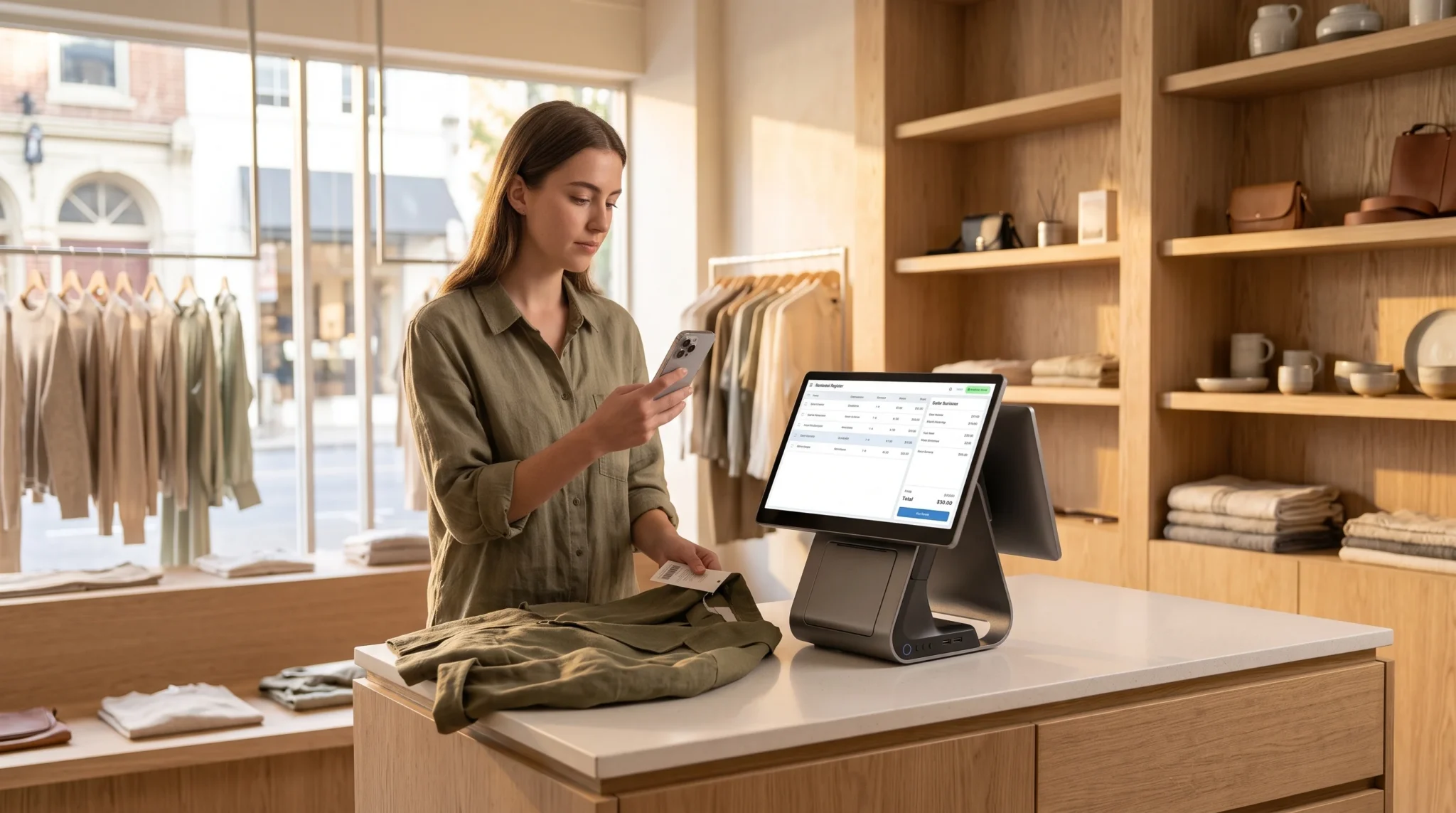
- Instant Optical Barcode Lookup: The associate scans the display item’s barcode tag using the counter register scanner or a handheld mobile inventory terminal.
- Matrix Variant Grid Display: The point-of-sale interface instantly launches the parent product matrix, presenting a clean size-and-color grid.
- Visual Inventory Indicators: Available units appear color-coded (e.g., Green for Local Stock, Blue for Warehouse Stock, Gray for Enterprise Sold Out).
- Immediate Warehouse Commitment: The associate taps the requested size (e.g., Size 10.5 – Warehouse Reserve), adding the item directly to the active transaction ticket as a “Ship-to-Home” line item.
Frictionless In-Person Payment and Address Capture at the Register
Once the line item is added, capturing customer fulfillment information must remain completely frictionless:
- Integrated Customer Profile Search: The associate asks for the customer’s mobile phone number or email. If the shopper belongs to your loyalty program, the system automatically auto-populates their saved shipping address.
- Rapid Address Validation: For new customers, the POS interface incorporates real-time postal address autocomplete. As the associate types the street number and name, the system validates the postal delivery route against carrier databases to eliminate shipping errors.
- Unified Split-Tender Checkout: The customer can purchase items they are carrying in their hands alongside the ship-to-home warehouse item in a single payment swipe. The register processes cash, credit card, or digital wallet tenders, calculates localized destination sales tax, and closes the sale cleanly.
Side-by-Side Comparison: Traditional Walkouts vs. Endless Aisle Architecture
Evaluating how traditional out-of-stock interactions compare to modern endless aisle infrastructure illustrates why forward-thinking retailers prioritize omnichannel floor routing.
The following comparative breakdown highlights the operational differences between disconnected retail counters and an integrated endless aisle strategy.
| Operational Dimension | Traditional Retail Stockout Walkout | Integrated Endless Aisle Strategy (Biyo POS) |
|---|---|---|
| Inventory Visibility | Limited strictly to local store backroom shelves | Real-time global visibility across warehouses & branches |
| Customer Transaction Outcome | Customer leaves empty-handed; zero revenue captured | Sale captured immediately at register; item shipped home |
| Revenue Retention | 100% loss of initial sale and future brand equity | 100% full-margin revenue retained at checkout |
| Checkout Duration | Clerk spends 3–5 minutes searching storage rooms | Clerk verifies stock and captures address in under 60s |
| Fulfillment Execution | Customer told to browse online at home | Automated warehouse dropship ticket dispatched instantly |
| Sales Tax Calculations | Manual tax overrides or untracked off-site shipping | Automated tax calculation based on delivery zip code |
| Staff Commission Incentives | Staff avoids out-of-stock items (No commission) | Store associate receives 100% sales attribution credit |
| Customer Delivery Tracking | Zero tracking; customer must handle online research | Instant automated SMS text with live carrier tracking link |
| Showroom Space Efficiency | Requires deep backroom stockrooms for every SKU | High-margin showroom displays backed by lean storage |
| Customer Retention & Lifetime Value | Compromised; shopper explores competitors online | Strengthened through white-glove, attentive service |
Warehouse Routing Mechanics: Triggering Automated Direct-to-Consumer Dropshipping
The true power of an endless aisle engine lies in what happens behind the scenes the moment payment clears. Without automated order routing, store managers must manually copy customer addresses into third-party shipping portals, creating administrative bottlenecks and human data entry mistakes.
Modern unified commerce architecture routes orders dynamically from the retail counter directly to warehouse picking queues.
Automated Order Splitting and Virtual Distribution Routing
When a transaction contains both carry-out goods and ship-to-home merchandise, the point of sale executes an automated order split:
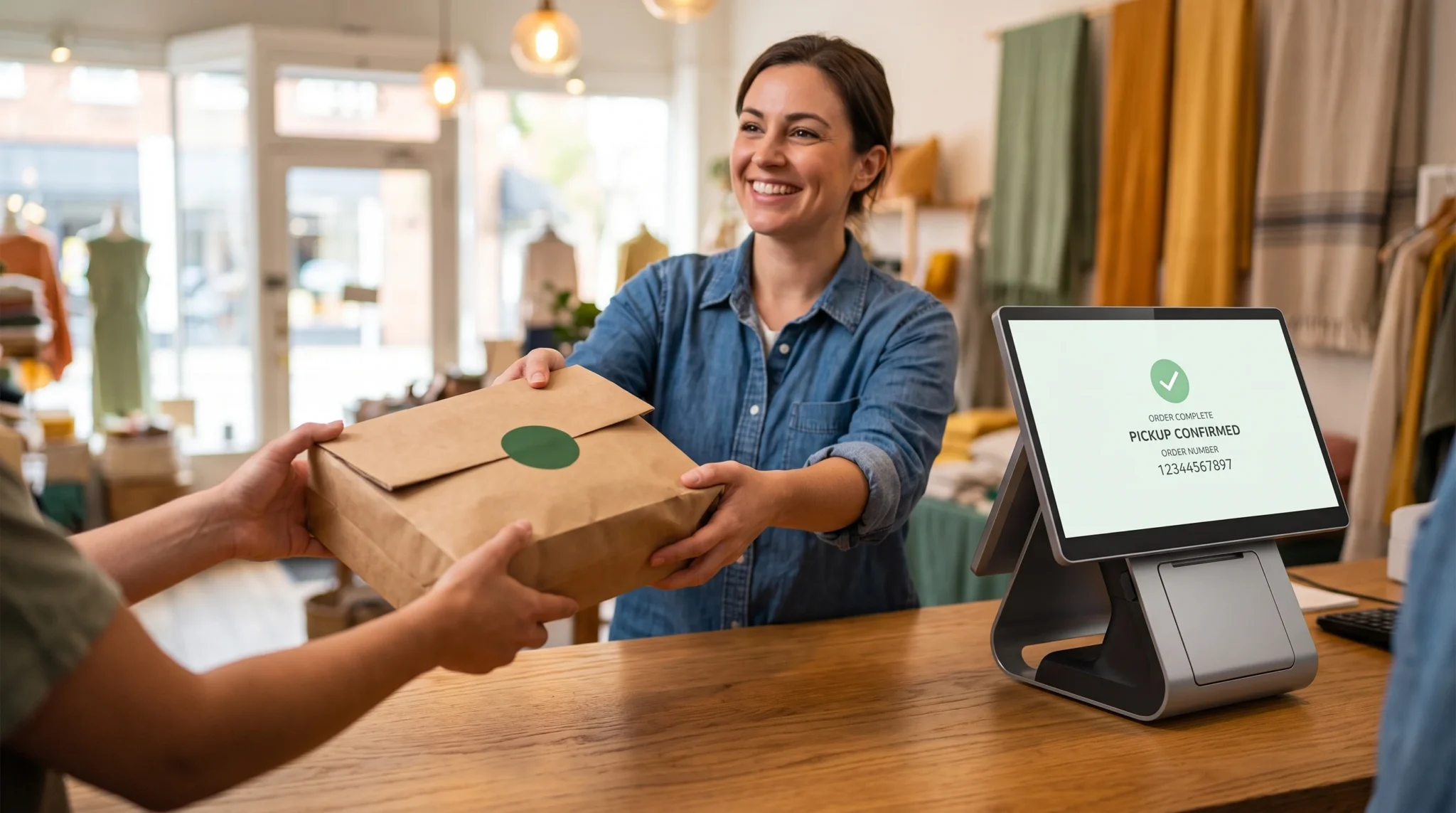
- Line-Item Segregation: The carry-out goods decrement immediately from the local store’s active inventory ledger, and the receipt printer issues an in-store pickup confirmation.
- Fulfillment Order Generation: The ship-to-home line item generates an independent fulfillment payload tagged with the customer’s validated shipping address and selected delivery speed.
- Intelligent Node Selection: The cloud routing engine evaluates available inventory across fulfillment nodes, directing the pick request to the distribution center or sister branch closest to the customer’s delivery address to minimize transit time and shipping expenses.
- Real-Time Warehouse Injection: The fulfillment ticket injects directly into the warehouse management queue or warehouse packing bench terminal without human data re-entry.
Real-Time Carrier Rate Quoting, Label Generation, and SMS Tracking
A robust endless aisle pipeline eliminates unexpected shipping charges by pulling dynamic carrier rates directly into the counter register:
- Dynamic Carrier Integration: The POS pulls real-time commercial rates from shipping carriers (such as USPS, UPS, and FedEx), allowing the associate to offer the customer standard ground shipping or expedited air delivery.
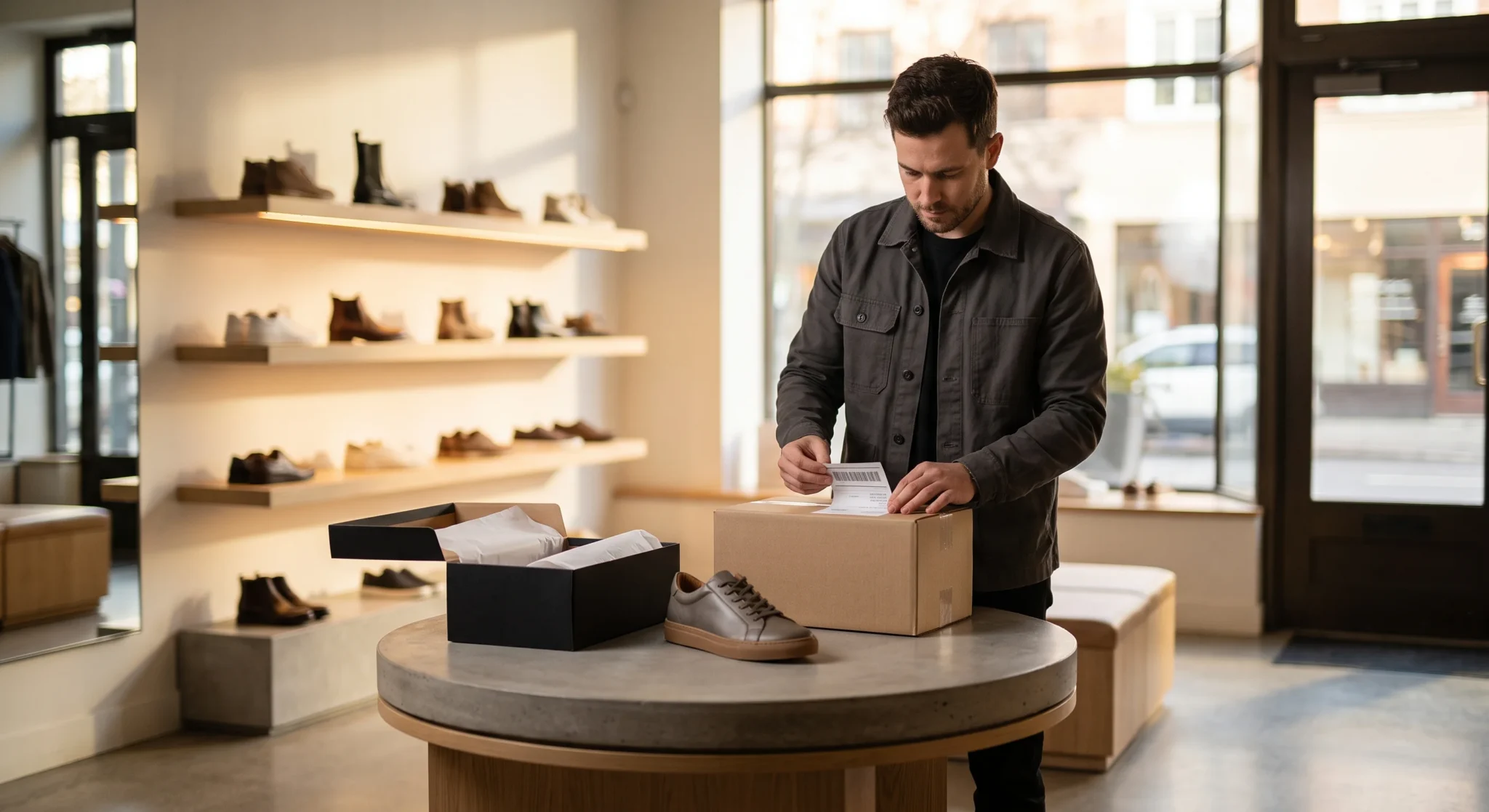
- Automated Packing Bench Processing: At the central warehouse, pickers scan the digital manifest, verify the SKU with an optical barcode scanner, and print the pre-paid carrier shipping label.
- Branded SMS Fulfillment Alerts: The millisecond the carrier scans the package onto the delivery truck, the system dispatches an automated SMS alert directly to the shopper’s smartphone:
“Hi David! Your footwear order #4092 from our Downtown Boutique is on its way via UPS. Track your package delivery here: [Tracking Link]”
Staff Incentives and Commission Attribution: Defusing Frontline Resistance
Even the most sophisticated software architecture will fail if frontline sales associates refuse to use it. In many retail environments, associates work under sales quotas or commission structures. If a clerk only earns commission on items pulled from local store shelves, they have zero incentive to spend time ordering items from a central warehouse.
Aligning staff compensation models with omnichannel selling ensures active participation across your entire frontline team.
Resolving Channel Conflict with In-Store Revenue Attribution
Channel conflict occurs when physical retail staff view their company’s e-commerce and warehouse channels as competitors stealing their sales. Retailers eliminate this friction by establishing omnichannel sales credit:
- 100% Store-Level Sales Credit: When an associate rings up an endless aisle shipment, that revenue must count fully toward that physical store’s daily sales targets.
- Individual Associate Commission Attribution: The transaction records the logged-in employee ID, ensuring that the associate earns their standard commission rate exactly as if they had pulled the item from the backroom shelf.
- Zero Margin Penalties for Shipping: Store operational profit reports should isolate warehouse fulfillment costs centrally rather than deducting carrier shipping fees from the store’s local margin performance.
Scripting the Conversion: Transforming Stockout Apologies into White-Glove Service
Frontline associates must be trained to stop apologizing for empty shelves and start presenting the endless aisle as a premium service.
Equipping staff with disciplined verbal scripts transforms a potential disappointment into a memorable brand touchpoint:
- The Outdated Script: “Sorry, we don’t have that size back there. You can try looking on our website later.”
- The Endless Aisle Script: “We don’t have that exact size on our showroom floor today, but I see our central warehouse has six pairs available. I can ring those up for you right now, cover the shipping, and have them delivered directly to your doorstep in two days. Let’s get that set up!”
This proactive phrasing shifts the perception from an operational failure to a high-touch, white-glove concierge experience.
A 5-Step Operational Blueprint for Zero Lost Floor Sales
Transitioning your retail operations from disconnected counter checkout to an active endless aisle fulfillment model requires structured technical and procedural execution.
Following this 5-step operational blueprint guarantees that your stores implement an endless aisle strategy without creating fulfillment bottlenecks or inventory errors.
Phase 1 & 2: Inventory Ledger Consolidation and Carrier Integration
1. Unify the Enterprise Catalog: Cleanse your master inventory database to ensure that every SKU, size variant, and barcode string matches identically across your physical registers, central warehouses, and e-commerce channels.
2. Integrate Real-Time Carrier Shipping APIs: Connect your point-of-sale platform with commercial shipping carrier APIs to automate address validation, rate calculation, and serialized tracking generation directly at the checkout counter.
Phase 3 to 5: Register Screen Configuration, Staff Training, and Reverse Logistics
1. Configure Endless Aisle Register Toggles: Enable ship-to-home order routing inside your central point-of-sale management console, ensuring registers display multi-location stock availability during standard barcode lookups.
2. Conduct Frontline Sales Training and Roleplay: Train all sales clerks on address entry workflows, split-tender processing, and white-glove customer conversion scripts, aligning commission structures to reward warehouse order completion.
3. Establish Standardized Return Policies for Shipped Goods: Create clear operational guidelines for handling returns. If a customer receives a shipped endless aisle item and needs a different size, ensure floor associates can accept the return at the counter and initiate a secondary replacement shipment instantly.
How Biyo POS Powers Seamless Endless Aisle Selling
 How Biyo POS Powers Seamless Endless Aisle Selling
Biyo POS delivers a cloud-native commerce operating system running directly inside the Google Chrome browser on any PC, Mac, iPad, or Android tablet—including dedicated all-in-one desktop terminals like the Landi C20 Pro—empowering independent retailers to execute an enterprise-grade endless aisle strategy without deploying complex enterprise resource software. The exact moment an associate scans an out-of-stock display item, Biyo’s multi-location inventory switchboard displays real-time stock balances across all regional warehouses and sister branches, allowing cashiers to add ship-to-home line items, validate delivery addresses, and process unified split-tender payments in seconds. Warehouse teams can process shipments rapidly using the Biyo Inventory Scanner app on the Apple App Store, while hybrid retail locations route beverage or food orders smoothly using the Biyo Kitchen Display (KDS) app on Google Play or Kitchen Hub. Backed by true offline transaction caching that keeps registers ringing sales and opening 24V cash drawers even during broadband outages before automatically re-syncing to the cloud, Biyo ensures retail stores never lose an in-store sale—inviting you to schedule a live demo or register today on the Biyo signup page.
Frequently Asked Questions
What is an endless aisle strategy in retail?
An endless aisle strategy is a retail fulfillment model that allows brick-and-mortar customers to purchase products that are physically out of stock in the local store and have them shipped directly to their home from a central warehouse or another branch.
How does endless aisle selling prevent lost retail revenue?
Instead of turning away shoppers when specific sizes or colors run out on display shelves, associates ring up the sale immediately at the register, capturing full-margin revenue before the customer leaves to visit a competitor.
How does an associate process an endless aisle order at checkout?
The associate scans the display item barcode, selects the customer’s size from a multi-location inventory grid, adds it to the cart as a ship-to-home item, verifies the customer’s delivery address, and completes tender settlement in a single transaction.
Can a customer buy an in-store item and an endless aisle item on the same receipt?
Yes. Modern cloud point-of-sale systems support split-order processing, allowing a shopper to pay for carry-out goods and warehouse ship-to-home items together while calculating accurate destination sales tax.
How should retailers handle staff commissions on endless aisle sales?
To avoid channel conflict, retailers should award 100% sales credit and normal commission percentages to the frontline associate who initiates the warehouse dropship transaction at the register.
Can Biyo POS route orders to a central warehouse automatically?
Yes. Biyo POS features native multi-location inventory routing that automatically generates warehouse fulfillment tickets and decrements central stock the moment an endless aisle transaction clears at the counter.