At its core, calculating your food cost percentage is straightforward: divide your total food cost by your total food sales. But don’t let the simple math fool you. This single number is one of the most powerful indicators of your restaurant’s financial health, telling you exactly how much of every pound earned goes right back out the door for ingredients.
In an industry where average pre-tax profit margins typically sit between 3% and 5%, even a small shift in food cost percentage can dramatically impact your bottom line. If you want to run a sustainable business, getting this calculation right isn’t optional — it’s essential.
Why Food Cost Percentage Is a Critical Health Metric
Think of your food cost percentage as a financial pulse check for your cafe or restaurant. It’s not just another number on a spreadsheet — it directly reflects kitchen efficiency, purchasing discipline, portion control, and pricing accuracy.
A low percentage signals healthy margins. A high percentage is a warning sign that ingredient costs are consuming too much of your revenue.
Without tracking this consistently, you’re operating blind. A restaurant can generate £50,000 in monthly revenue and still struggle financially if food costs creep from 30% to 35%. That 5% shift equals £2,500 in lost monthly profit — £30,000 annually.
The Foundation of Profitability
This metric forms the bedrock of menu engineering and pricing strategy. You cannot build a profitable menu without understanding ingredient costs. Knowing how to build a profitable coffee menu starts with disciplined cost analysis.
Tracking food cost percentage helps answer critical questions:
- Are menu prices high enough to maintain healthy margins?
- Which dishes generate the strongest contribution margins?
- Are supplier increases quietly eroding profitability?
- Is food waste inflating actual costs beyond theoretical targets?
Operators who calculate food cost monthly react. Operators who calculate it weekly control outcomes.
Industry Benchmarks and Context
Most restaurants aim for a food cost percentage between 28% and 35%. Historically, 30% was considered optimal in many UK and US markets.
However, inflation and supply chain volatility have pushed ingredient costs upward in recent years. Many operators have had to adjust menu pricing by 10–25% simply to maintain stable margins.
The key isn’t blindly hitting 30%. The key is aligning food cost with your overall profit model.
—
Getting to Grips with the Food Cost Formulas
There are two calculations every operator must master:
- Food cost for a single dish
- Overall food cost percentage (COGS method)
Calculating Food Cost for a Single Dish
This calculation tells you exactly what it costs in raw ingredients to produce one plate.
- List every ingredient
- Calculate cost per gram or millilitre
- Multiply by portion size
- Add totals
Example: Spaghetti Aglio e Olio
| Ingredient | Bulk Cost | Portion | Cost Per Dish |
|---|---|---|---|
| Spaghetti | £5 per 1kg | 120g | £0.60 |
| Garlic | £2.50 per 250g | 15g | £0.15 |
| Olive Oil | £12 per litre | 30ml | £0.36 |
| Chili Flakes | £3 per 50g | 2g | £0.12 |
| Parsley | £1.50 per bunch | 5g | £0.25 |
| Salt | £4 per 250g | 1g | £0.02 |
| Total | £1.50 |
If menu price is £10:
(£1.50 ÷ £10) × 100 = 15%
This is a highly profitable dish. Now compare that to a premium steak costing £9 to produce and selling at £24:
(£9 ÷ £24) × 100 = 37.5%
Both can work — but one drives stronger margin leverage.
—
Calculating Overall Food Cost Percentage (COGS)
Formula:
Beginning Inventory + Purchases – Ending Inventory = Cost of Goods Sold
Example:
- Beginning Inventory: £5,000
- Purchases: £3,000
- Ending Inventory: £4,500
COGS = £3,500
If total food sales = £11,000:
(£3,500 ÷ £11,000) × 100 = 31.8%
This falls within industry benchmarks.
For deeper understanding, explore how to master Cost of Goods Sold (COGS) for long-term profitability.
—
Getting Your Food Costing Dialed In: Beyond Basic Math
Ingredient Yield Matters
If you buy 5kg of beef tenderloin for £100 and trim it to 3.5kg usable meat:
Yield = 70%
True cost per kg = £100 ÷ 3.5kg = £28.57
Ignoring yield underestimates dish cost and destroys margin accuracy.
Waste and Spoilage Impact
Even 2% waste on £25,000 monthly inventory equals £500 lost monthly — £6,000 annually.
Waste sources include:
- Spoilage
- Over-preparation
- Returned dishes
- Improper storage
Inconsistent Portioning
If fries cost £3/kg and portion standard is 150g (£0.45), but staff serve 180g (£0.54), you lose £0.09 per portion.
200 portions/day × £0.09 = £18 daily leakage → £5,400 annually.
Precision equals profit.
—
Setting Benchmarks and Interpreting Results
Concept-Based Targets
- Fine Dining: 35–40%
- Casual Dining: 28–35%
- Quick Service: 20–30%
- Pizzerias: 15–25%
The correct target is the one that supports total operating profitability after labor (25–35%), rent (6–10%), and overhead.
—
Fixing Common Food Cost Mistakes
- Not updating supplier price increases
- Ignoring small ingredients
- Failing to track waste
- Inventory miscounts
- Over-serving portions
Most high food cost problems are cumulative small leaks — not one catastrophic mistake.
—
Using Technology to Automate and Track Food Costs
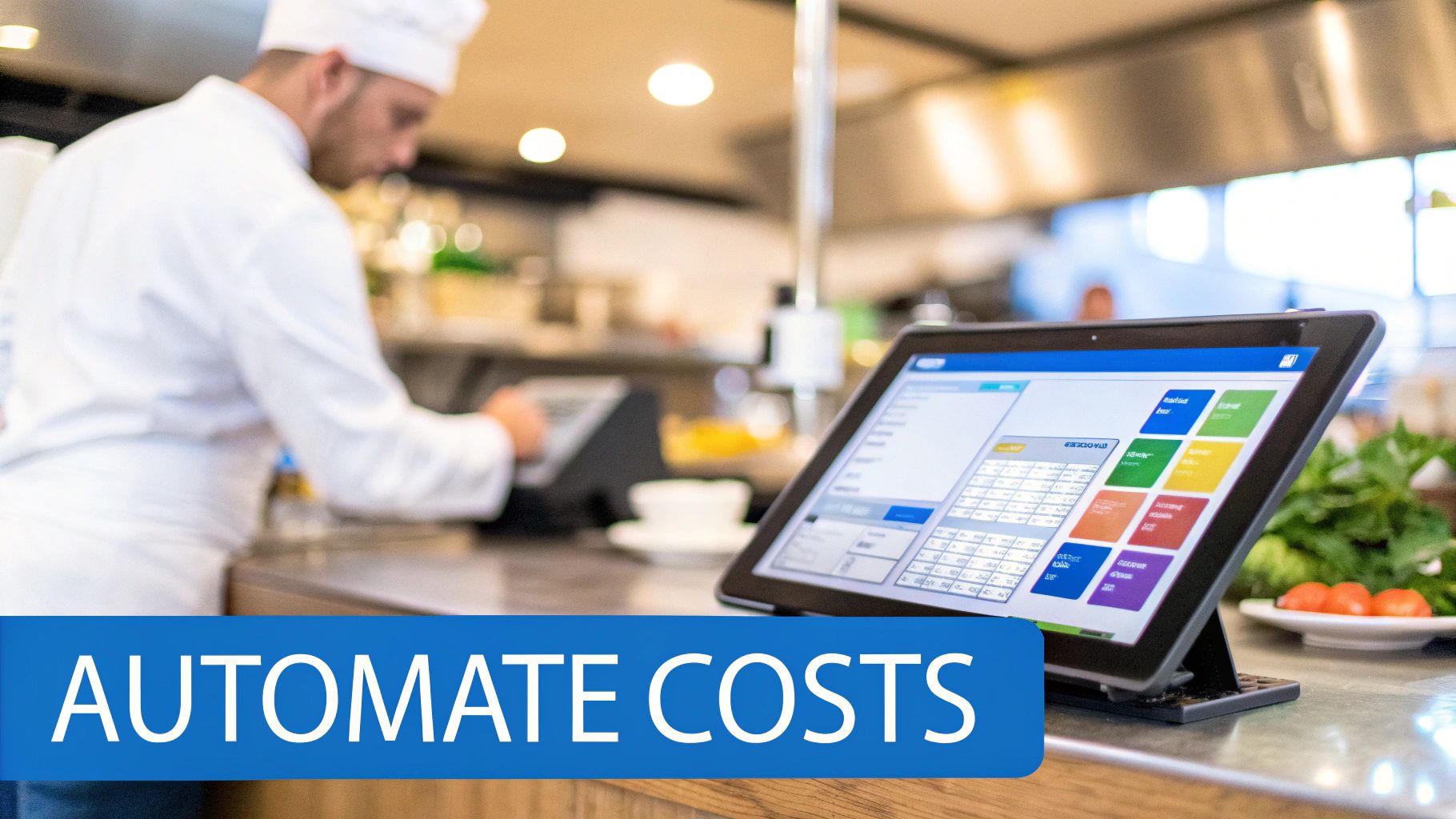
Modern POS systems automate:
- Recipe costing
- Real-time inventory deduction
- COGS calculation
- Variance analysis
In a 5% net margin model, reducing food cost from 33% to 31% can increase net profit by over 30%.
Automation moves you from reactive analysis to proactive control.
—
How can POS software improve food cost control?
POS systems automate inventory tracking, recipe costing, and sales-to-usage comparison, providing real-time visibility into margin performance.
Mastering food cost percentage is the most powerful lever you have to protect your margins. Instead of wrestling with spreadsheets, let Biyo POS automate real-time inventory tracking and instant cost reporting.
Ready to take control of your profitability? Start your free trial at Biyo POS today.
Frequently Asked Questions About Food Cost Percentage
What is food cost percentage?
Food cost percentage measures how much of your total food sales revenue is spent on ingredients. It is calculated by dividing Cost of Goods Sold by total food sales and multiplying by 100.
What is a good food cost percentage?
Most restaurants aim for 28–35%, but acceptable ranges vary by concept and pricing model.
How often should food cost be calculated?
At minimum monthly. Best practice weekly. High-volume operations may track theoretical food cost daily.
Does food waste affect food cost percentage?
Yes. Spoilage, overproduction, and untracked waste inflate COGS and reduce profitability.
Should promotions and staff meals be included?
Yes. Include ingredient cost in COGS, but exclude promotional revenue if items are free.