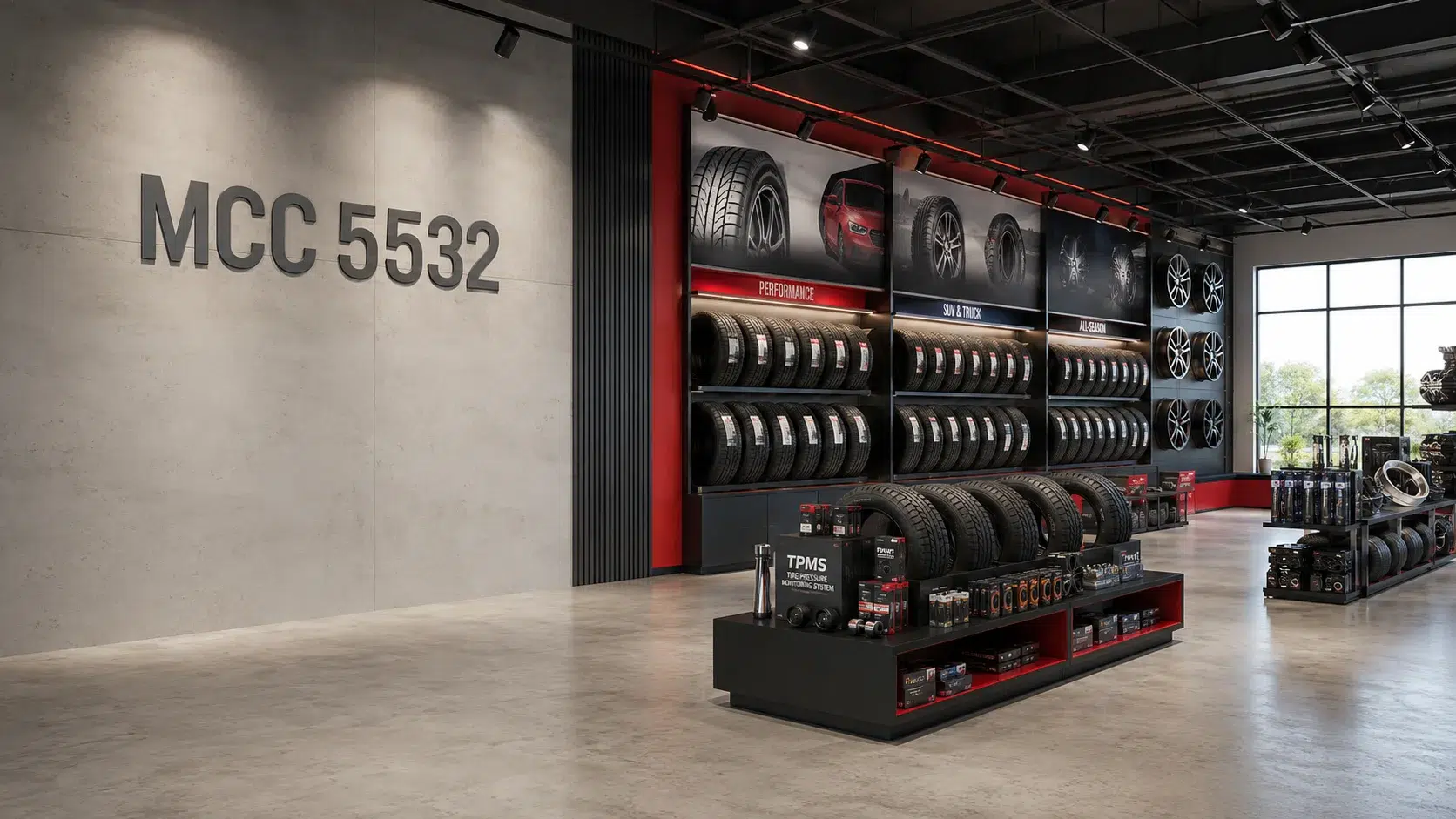

Merchant Category Codes (MCCs) help payment processors, card networks, and financial institutions classify businesses based on the products and services they primarily provide. These four-digit codes play an important role in payment processing, interchange fee calculations, merchant reporting, fraud prevention, and certain credit card rewards programs. Businesses that primarily sell tires and related automotive products are generally classified under MCC 5532.
MCC 5532 applies to automotive tire retailers that specialize in selling passenger vehicle, light truck, SUV, commercial, and specialty tires. Many of these businesses also provide installation, balancing, rotation, alignment referrals, flat tire repair, and other tire-related services while selling wheels, tire accessories, and maintenance products. Understanding how MCC 5532 works helps tire retailers ensure accurate merchant classification while helping payment providers correctly identify their primary business activities.
- Understanding MCC 5532
- Businesses Classified Under MCC 5532
- Products and Services Offered by MCC 5532 Businesses
- Why MCC 5532 Matters
- MCC 5532 Compared to Similar Merchant Categories
- How Automotive Tire Stores Operate
- Inventory and Operational Challenges
- Industry Trends
- How Biyo Helps Automotive Tire Stores
- Frequently Asked Questions
Understanding MCC 5532
What Is MCC 5532?
MCC 5532 is the Merchant Category Code assigned to businesses that primarily sell automotive tires and related tire products. These retailers serve individual drivers, commercial fleets, and automotive service providers by offering tires for a wide range of vehicles. While many stores also provide installation and maintenance services, their primary business activity centers on tire sales.
How Businesses Receive This Classification
When an automotive tire retailer opens a merchant account, the payment processor reviews its primary business activities before assigning a Merchant Category Code. Businesses whose core operations focus on selling new tires, wheels, tire accessories, and related services are generally classified under MCC 5532. If a business primarily performs automotive repairs rather than tire sales, it may be assigned a different automotive-related MCC.
Common Transactions Processed Under MCC 5532
Transactions processed under MCC 5532 commonly include purchases of passenger tires, truck tires, SUV tires, performance tires, winter tires, all-season tires, off-road tires, wheel and tire packages, tire installation, balancing, flat tire repair, tire rotation, valve stem replacement, and tire pressure monitoring system (TPMS) services.
 Businesses Classified Under MCC 5532
 Businesses Classified Under MCC 5532
Automotive Tire Retailers
The primary businesses classified under MCC 5532 are dedicated tire stores that carry products from multiple tire manufacturers. These retailers help customers choose tires based on vehicle type, driving conditions, performance requirements, and budget while offering professional installation and maintenance services.
Commercial Tire Dealers
Many businesses specializing in commercial truck, fleet, agricultural, industrial, and heavy-duty vehicle tires also fall under MCC 5532. These retailers often provide higher-capacity tires, fleet replacement programs, roadside tire assistance, and scheduled maintenance services for commercial customers.
Tire and Wheel Centers
Some automotive retailers combine tire sales with aftermarket wheels, rims, TPMS components, lug nuts, wheel accessories, and related installation services. As long as tire sales remain the primary business activity, these businesses are generally classified under MCC 5532.
Products and Services Offered by MCC 5532 Businesses
Automotive Tires for Every Vehicle
Businesses classified under MCC 5532 sell tires for passenger cars, pickup trucks, SUVs, vans, sports cars, commercial vehicles, trailers, and specialty vehicles. Their inventory often includes all-season, summer, winter, touring, performance, mud-terrain, all-terrain, and run-flat tire options from leading manufacturers.
Tire Installation and Maintenance Services
Most tire retailers offer installation, computer balancing, tire rotation, flat repairs, valve stem replacement, tire pressure checks, TPMS servicing, and seasonal tire changeovers. These services help customers maximize tire life while improving vehicle safety and driving performance.
Wheels and Tire Accessories
In addition to tires, many retailers sell aftermarket wheels, rims, wheel locks, lug nuts, tire inflators, pressure gauges, repair kits, air compressors, and other tire maintenance accessories. These complementary products provide additional revenue while helping customers maintain their vehicles.
Why MCC 5532 Matters
Supports Accurate Merchant Classification
Using MCC 5532 allows payment processors to accurately identify automotive tire retailers based on their primary business activity. Proper classification supports efficient payment processing, merchant account management, and accurate transaction reporting.
Improves Financial Reporting
Merchant Category Codes provide valuable transaction data that supports accounting, fraud monitoring, payment analytics, and business reporting. Accurate classification also helps financial institutions correctly categorize purchases made at tire retailers.
Supports Automotive Retail Operations
Automotive tire stores frequently process high-value purchases, installation services, fleet accounts, warranties, and seasonal promotions. Accurate merchant classification helps ensure these transactions are processed consistently while supporting business reporting and payment management.
MCC 5532 Compared to Similar Merchant Categories
| Merchant Category Code | Primary Business Type | Typical Products and Services |
|---|---|---|
| MCC 5532 | Automotive Tire Stores | Tires, wheel packages, tire installation, balancing, repairs |
| MCC 5533 | Automotive Parts and Accessories Stores | Auto parts, batteries, filters, tools, accessories |
| MCC 7542 | Car Washes | Vehicle washing and detailing services |
| MCC 7538 | Automotive Repair Shops | Mechanical repairs, diagnostics, maintenance services |
How Automotive Tire Stores Operate
Helping Customers Choose the Right Tires
Automotive tire stores begin the sales process by identifying the customer’s vehicle, driving habits, budget, and local road conditions. Sales associates recommend tires based on manufacturer specifications, tire size, seasonal performance, tread life, fuel efficiency, and warranty coverage. Many retailers use digital vehicle lookup systems that quickly identify compatible tire options, allowing customers to compare brands, features, and prices before making a purchase.
Providing Professional Installation Services
Most tire retailers offer complete installation services after a sale. Technicians remove old tires, mount and balance new ones, inspect wheels, replace valve stems when needed, and verify proper tire pressure before returning the vehicle to the customer. Many stores also provide tire rotations, flat repairs, TPMS diagnostics, and seasonal tire changeovers to help customers maximize tire life and maintain safe driving performance.
Serving Both Individual Drivers and Commercial Fleets
While individual vehicle owners make up a significant portion of customers, many tire stores also serve commercial fleets, delivery companies, government agencies, agricultural businesses, and construction contractors. Fleet customers often require scheduled tire inspections, bulk purchasing agreements, roadside assistance, and proactive replacement programs to reduce vehicle downtime and improve operational efficiency.
Inventory and Operational Challenges
Managing Large and Diverse Inventory
Tire retailers stock hundreds or even thousands of SKUs covering different sizes, load ratings, speed ratings, tread patterns, and vehicle applications. Maintaining the right inventory mix is challenging because customer demand varies by season, vehicle trends, and regional weather conditions. Effective inventory management helps prevent stock shortages while reducing the cost of storing slow-moving products.
Handling Seasonal Demand Fluctuations
Demand for tires often increases before winter weather, during spring maintenance seasons, and ahead of major travel periods. Retailers must forecast inventory accurately, schedule additional technicians during busy periods, and coordinate with suppliers to ensure popular tire models remain available when demand peaks.
Maintaining Efficient Service Operations
Installation bays, balancing equipment, tire machines, and trained technicians must work together efficiently to minimize customer wait times. Delays caused by equipment maintenance, staffing shortages, or unexpected service requests can reduce productivity and customer satisfaction. Streamlined scheduling and organized workflows help businesses complete more installations while maintaining consistent service quality.
Industry Trends
Growth of Online Tire Shopping
More consumers now research and purchase tires online before scheduling installation at a local store. Many retailers offer online vehicle fitment tools, digital price comparisons, appointment scheduling, and click-and-collect services that combine the convenience of eCommerce with professional in-store installation.
Increasing Demand for Premium and Specialty Tires
Demand continues to grow for premium all-season tires, electric vehicle (EV) tires, run-flat tires, performance tires, and all-terrain products designed for specific driving conditions. Retailers that carry a broad selection of specialized tires are better positioned to serve diverse customer needs while improving average transaction values.
Technology Improving Tire Service
Modern tire stores increasingly rely on digital inventory systems, TPMS diagnostic tools, computerized balancing equipment, automated appointment scheduling, and cloud-based business management software. These technologies improve inventory accuracy, speed up service, reduce administrative work, and provide better visibility into sales performance and inventory levels.
How Biyo Helps Automotive Tire Stores
 How Biyo Helps Automotive Tire Stores
Automotive tire stores manage large inventories, installation services, fleet accounts, and retail sales every day. Biyo POS helps simplify these operations with real-time inventory tracking, barcode scanning, integrated payment processing, and cloud-based reporting. Business owners gain better visibility into tire inventory, wheel accessories, sales performance, and stock levels, making it easier to replenish popular products and reduce inventory errors.
Whether you operate a single tire shop or multiple retail locations, Biyo provides the tools needed to streamline checkout, improve inventory accuracy, and support day-to-day operations. You can sign up for Biyo POS or schedule a personalized demo to see how Biyo can help your automotive tire business grow.
Frequently Asked Questions
What is MCC 5532?
MCC 5532 is the Merchant Category Code assigned to businesses that primarily sell automotive tires and provide tire-related products and services.
Which businesses qualify for MCC 5532?
Dedicated tire retailers, commercial tire dealers, tire and wheel centers, and businesses whose primary revenue comes from tire sales generally qualify under MCC 5532.
What products and services are commonly offered under MCC 5532?
Businesses classified under MCC 5532 commonly sell passenger, truck, SUV, commercial, and specialty tires while offering installation, balancing, tire rotation, flat repairs, TPMS services, wheels, and tire accessories.
Does MCC 5532 affect credit card rewards?
Yes. Some credit card issuers use Merchant Category Codes to determine cashback categories and rewards eligibility. Depending on the issuer, purchases made at businesses classified under MCC 5532 may qualify for automotive-related rewards.
Why is MCC 5532 important?
MCC 5532 helps payment processors accurately classify automotive tire retailers for payment processing, merchant account management, financial reporting, and fraud monitoring while ensuring transactions are categorized correctly.
How can automotive tire stores improve operational efficiency?
Tire retailers can improve efficiency by using integrated POS systems, inventory management software, barcode scanning, appointment scheduling, and real-time reporting to better manage inventory, installations, fleet customers, and daily sales.