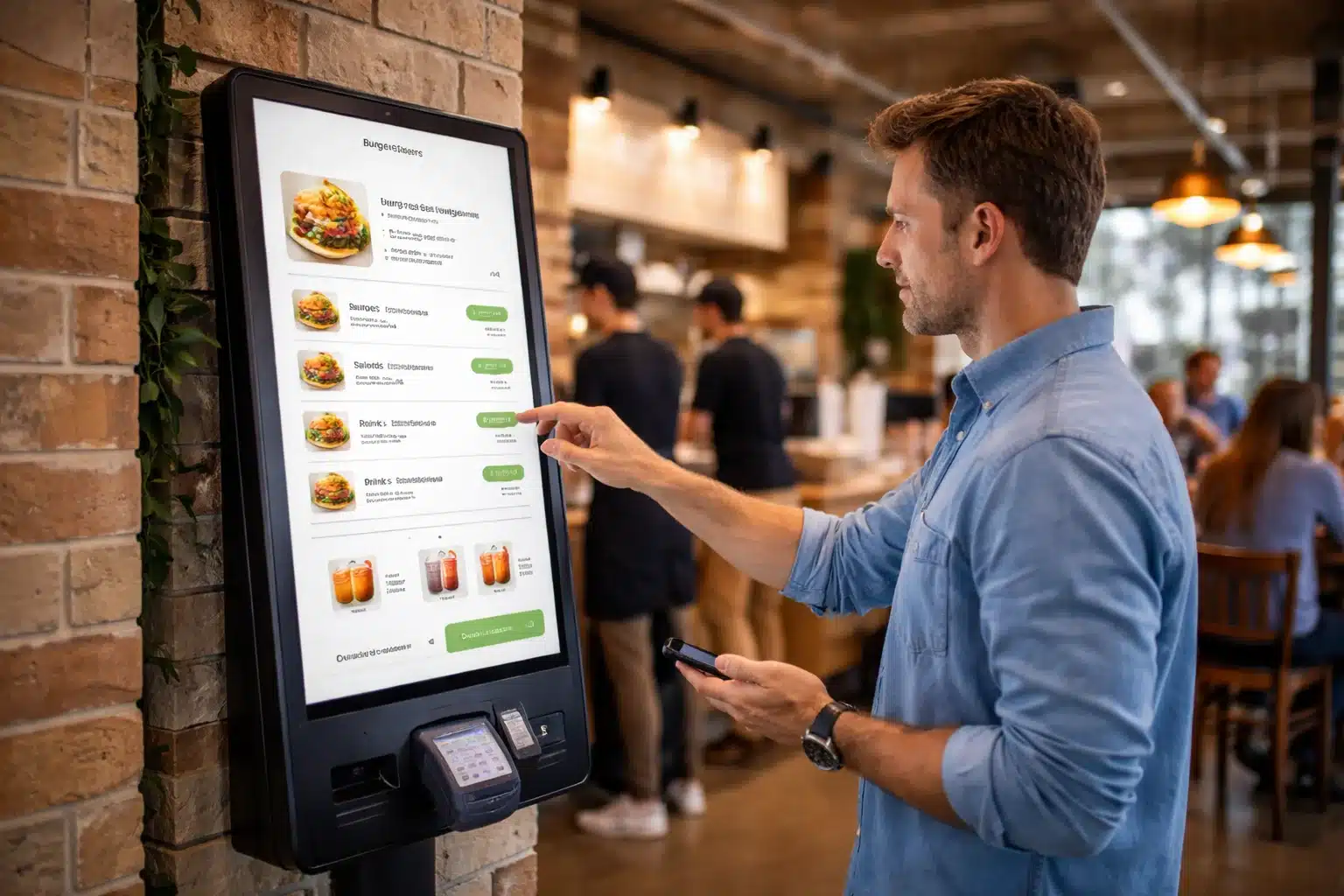
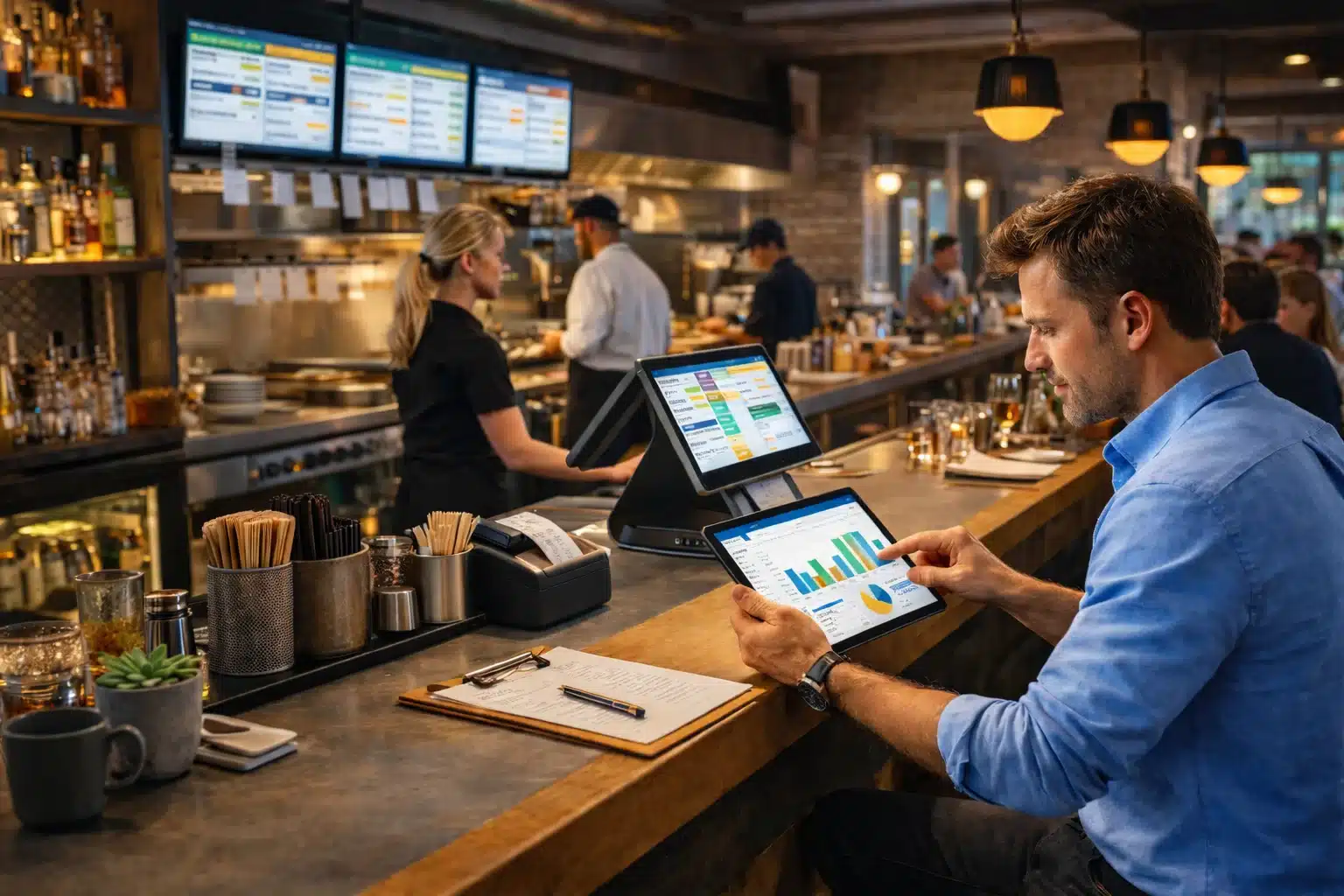
Think of a mobile credit card machine as your entire checkout counter—cash register and payment terminal included—shrunk down to fit in your pocket. It's a small, portable gadget that connects to your smartphone or tablet, letting you take credit and debit card payments from literally anywhere.
For any business that isn't permanently bolted to the floor, this little device is a huge deal. It gives you the power to process sales securely and get paid on the spot, without being chained to a physical shop.
How Do Mobile Credit Card Machines Work?
Let's break it down. At a traditional store, a customer pays at a fixed terminal that's wired into the wall for power and an internet connection. A mobile credit card machine does the exact same job, but wirelessly. It uses your phone's Wi-Fi or cellular data to act as the secure link between your customer's card and your bank account.
This simple setup has completely changed the game for countless small and medium-sized businesses. Whether you're running a food truck at a festival, working as a plumber in a client's home, or just trying to bust long lines in your retail store, taking payments on the fly is no longer just a convenience—it's a necessity.
To get a clearer picture, this table breaks down the core components and what they do during a transaction.
How a Mobile Credit Card Machine Works
| Component | Function | How It Works |
|---|---|---|
| Mobile Card Reader | Captures payment data | Reads the card via swipe, chip (dip), or NFC (tap) for contactless payments. |
| Smartphone/Tablet | Runs the payment app | The device you already own provides the screen, software, and internet connection. |
| Payment App | Manages the transaction | Encrypts the card data and sends it securely to the payment processor. |
| Payment Processor | Authorizes the sale | Communicates with the customer's bank to approve or decline the transaction in seconds. |
Essentially, these pieces work together to create a secure and efficient point of sale system that you can carry with you.
From Tap to Transaction: The Payment Journey
When a customer is ready to buy, the whole process is incredibly quick and smooth. They simply present their card, and the reader takes over. It can accept payment in a few different ways:
- Swiping the classic magnetic stripe.
- Dipping the more secure EMV chip.
- Tapping a contactless card or a digital wallet.
Once the reader grabs the card info, the payment app on your phone instantly encrypts it and sends it off to the payment processor over the internet.
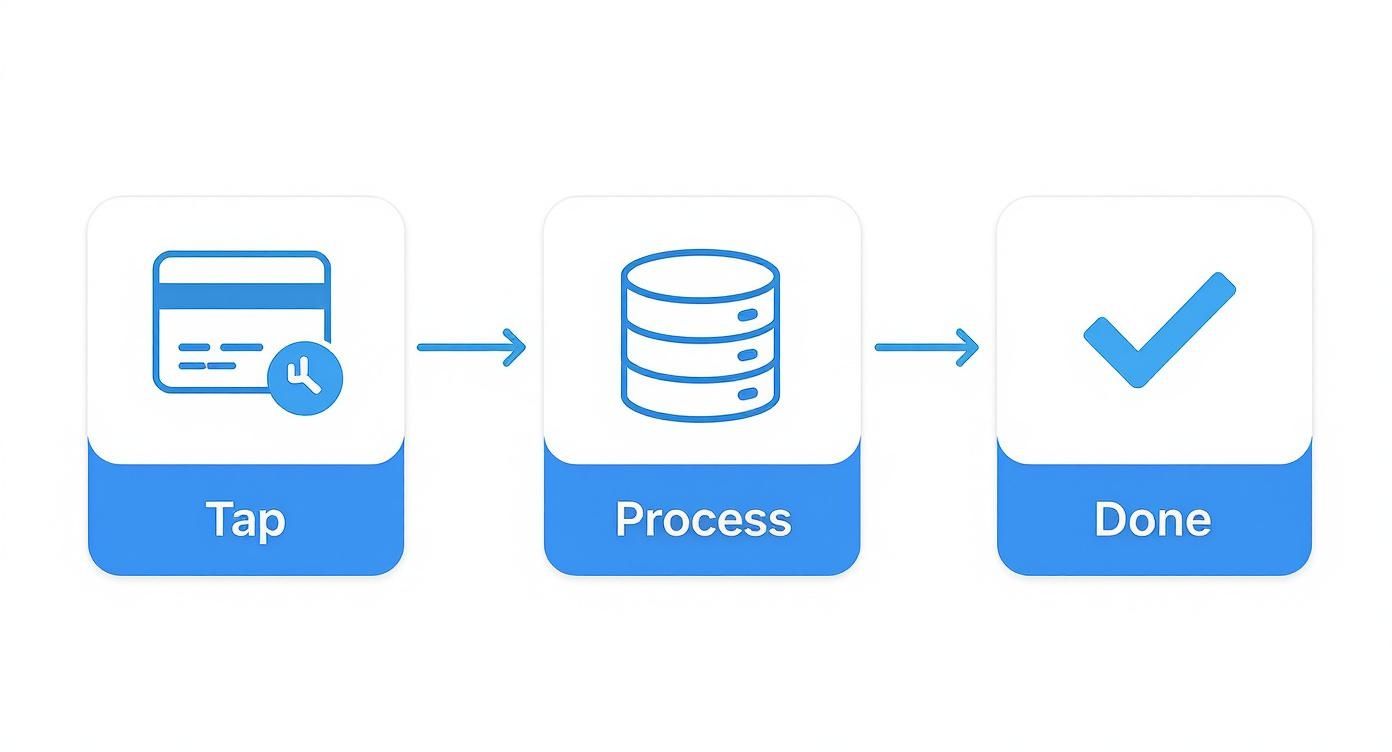
What feels like a simple tap is actually a rapid, secure conversation happening behind the scenes.
In just a couple of seconds, the processor talks to the customer's bank to check for funds and get the green light. The approval (or decline) zips back to your phone, and the sale is complete.
Why This Technology Is So Important Today
Let's face it, we're quickly becoming a cashless society. This shift has made mobile card readers more than just a nice-to-have; they're essential. The market is booming, thanks to everyone having a smartphone and preferring the convenience of digital payments.
The global mobile card reader market was valued at around $14.76 billion and is expected to jump to $17.66 billion—that’s nearly a 20% increase in just one year.
This trend tells a clear story: businesses that can't take cards are going to get left behind. Customers today simply expect to be able to pay with a card wherever they are. A mobile reader not only meets that expectation but also makes your business look more professional and keeps cash flowing by getting you paid immediately.
What to Look For in a Modern Card Reader
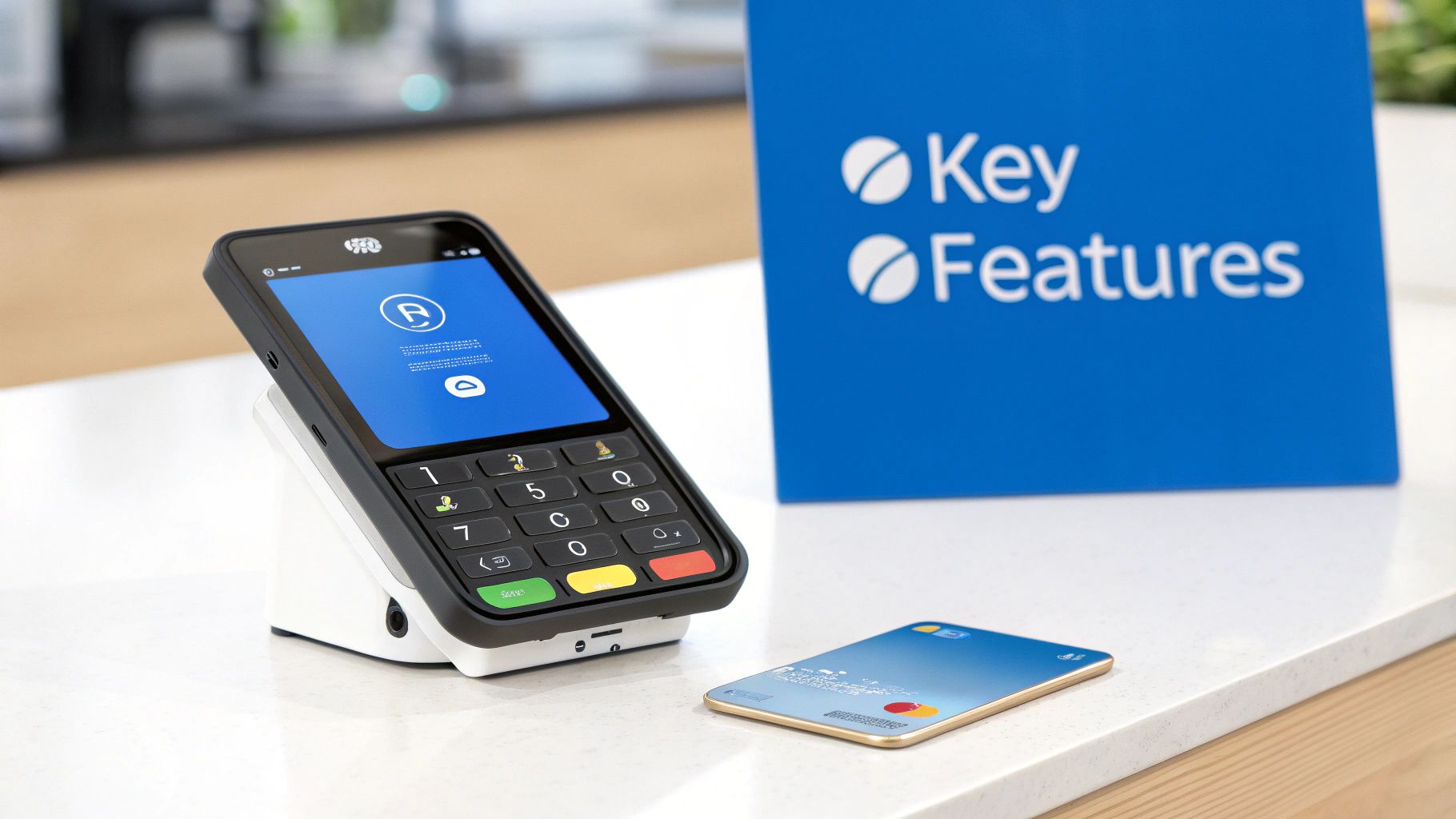
When you're choosing a mobile credit card machine, you’re not just buying a piece of hardware. You’re picking a partner for your business, a tool that needs to work flawlessly day in and day out without giving you a single headache. Investing in the right device means understanding what really matters under the hood.
Not all readers are created equal, and the small differences can have a huge impact on your operations. From how it connects to the internet to the way it protects customer data, every feature is critical. Let's break down the non-negotiables every business owner should be looking for.
Connectivity Options for Any Environment
Without a solid connection, a mobile card reader is just a paperweight. Think of connectivity as the invisible highway that sends payment data from the customer's card to the bank for approval. The best option for you depends entirely on where you do business.
Run a food truck that bounces between festivals and farmers' markets? You can't bet on finding a reliable Wi-Fi signal everywhere you go. This is where cellular (4G/5G) connectivity is a lifesaver, using the same network as your smartphone to process payments just about anywhere.
On the flip side, if you're running a cozy coffee shop with a great internet connection, a Wi-Fi-enabled reader is a fantastic, cost-effective choice. It’s fast, stable, and doesn't eat into your mobile data plan.
Many of today's best devices also offer Bluetooth. This lets you pair the reader directly to your phone or tablet, piggybacking off its internet connection to run the transaction. It's a super flexible setup that works great for businesses that split their time between a physical storefront and pop-up events.
Security and Compliance Demystified
Taking a customer's payment means you're responsible for their sensitive financial information. Good security isn't just a "nice-to-have"—it's a must. Two terms you’ll hear a lot are PCI compliance and data encryption, and they’re simpler than they sound.
PCI DSS (Payment Card Industry Data Security Standard) is basically the rulebook for handling card payments. Any business that accepts cards has to follow these rules. Using a compliant card reader keeps you on the right side of those regulations and protects you from massive fines if a data breach ever happens.
Modern readers have some seriously smart tech built-in to keep every transaction safe:
- End-to-End Encryption: The moment a card is swiped, dipped, or tapped, this feature scrambles the data, making it completely unreadable to fraudsters.
- Tokenization: After that first transaction, the system swaps the real card number for a unique, one-time code (a "token"). This token is what's used for any future payments, so the customer's actual card details are never exposed again.
These security layers work in tandem to create an ironclad payment process, giving you and your customers total peace of mind.
Battery Life and Durability for Long Days
For a business on the move, a dead battery means dead sales. Simple as that. The battery life and sheer toughness of your card reader are critical, especially if you’re putting in long hours or working in less-than-ideal conditions. A good machine should easily last a full shift on a single charge.
Picture a vendor at an all-day street fair. They need a device that can process hundreds of payments from open to close without ever needing to find an outlet. A long-lasting battery isn't a luxury; it's essential.
Durability is just as important. Your reader is going to get dropped, bumped, and maybe even splashed with a little rain. Look for a device with a rugged build that can handle the reality of a busy workday. It's an investment that needs to last.
Modern Receipt Options for Every Customer
The final handshake of any sale is the receipt. Today’s customers expect options, and your card machine needs to deliver. The two main choices are pretty straightforward: digital or printed.
Digital receipts, sent via email or text, are a win-win. They’re eco-friendly, super convenient for the customer, and a great way for you to build an email list for future marketing. They’re a perfect fit for modern shops and service providers looking to cut down on paper.
Still, some people just want that physical receipt in their hand. For businesses like restaurants, where customers often need a paper copy for expense reports, having a reader with a built-in printer (or one that connects to a portable one) is key. Offering both shows you're ready to provide a professional, complete experience for every single sale.
How Mobile Payments Are Changing the Game in Different Industries
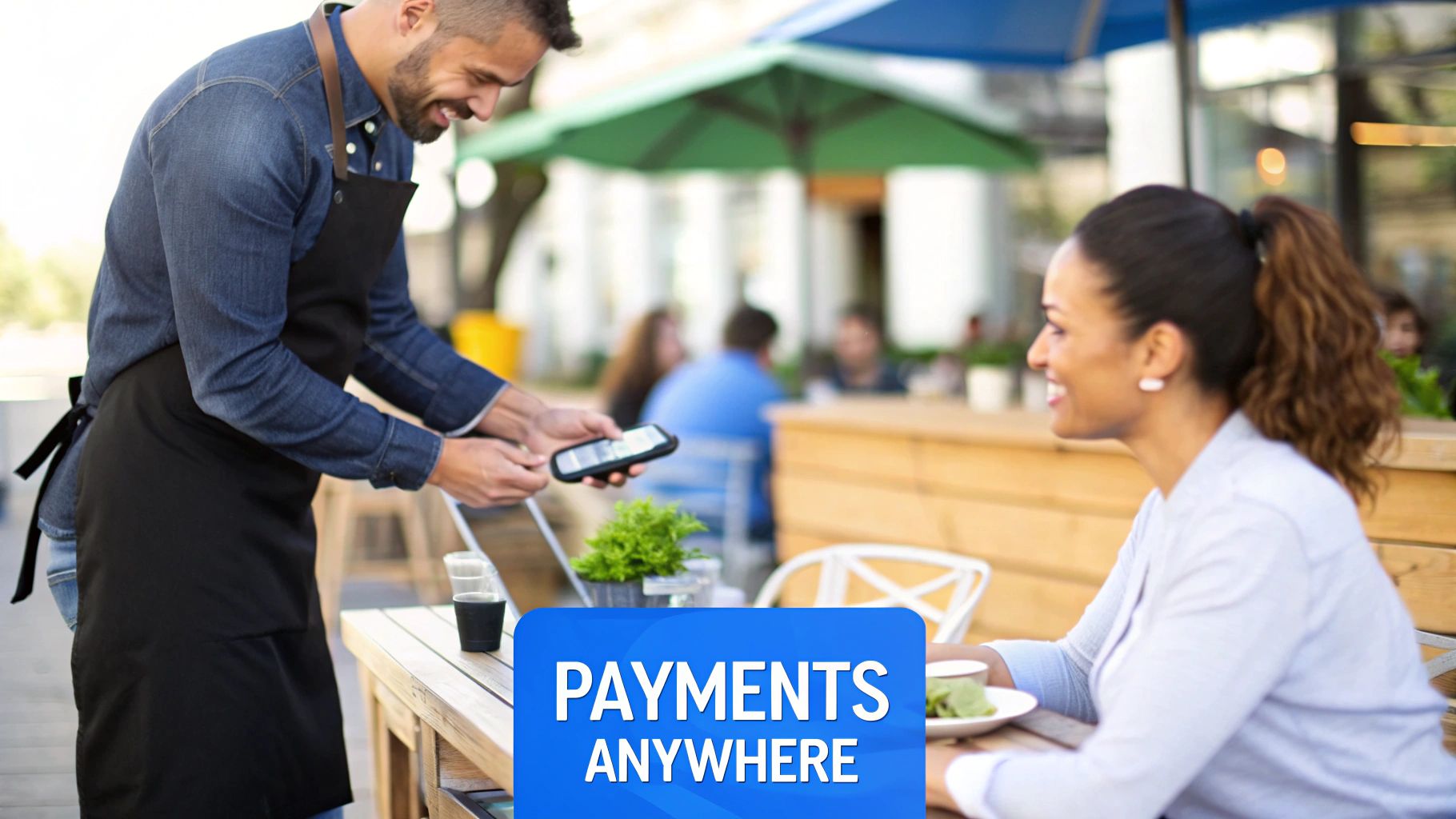
The real magic of a mobile credit card machine isn't the device itself—it’s how it completely transforms the customer experience. When you're no longer chained to a checkout counter, you can meet customers exactly where they are, making every transaction smoother, faster, and more personal.
This isn’t just a minor tweak; it's a fundamental shift in how business gets done. You can see this change in the numbers. The global payment processing industry is massive, with transaction volumes hitting an estimated $157 trillion worldwide. Digital wallets, which pair perfectly with mobile readers, already account for about 30% of all point-of-sale transactions in major markets. Clearly, customers are embracing portable payments.
So, let's break down how this technology actually works in the real world for different types of businesses.
Revolutionizing the Restaurant Experience
In the fast-paced world of dining, every second counts. A mobile credit card machine is a true game-changer for restaurants, solving one of the most common service headaches: paying the bill.
Think about the old, clunky process. A server drops off the check, leaves, comes back for the card, walks to a stationary terminal, runs the payment, and finally returns with the receipt. That whole back-and-forth can easily eat up five or ten minutes, leaving guests antsy and tying up a table that could be earning you money.
Now, imagine this instead:
- The server brings a sleek mobile reader right to the table.
- The customer taps, dips, or swipes their card on the spot.
- The transaction is done in seconds, and they get an instant email receipt.
It’s more than just convenience. This efficiency leads to faster table turnover, which means a restaurant can serve more people during a busy night. For a popular spot, turning just a handful of extra tables each evening can seriously boost the bottom line over a year.
Transforming Retail with Line-Busting
Nothing kills a sale faster than a long checkout line. During peak shopping seasons like Black Friday or the holidays, a customer who sees a queue snaking through the store is likely to just drop their items and leave.
This is where a mobile credit card machine becomes a retailer's secret weapon for line-busting. Instead of funneling everyone to a few fixed registers, employees can walk the floor with mobile readers and check people out wherever they're standing. It completely changes the dynamic of the store.
By taking the payment directly to the shopper, associates can engage with them, answer a last-minute question, and close the sale before the customer has a chance to second-guess their purchase. It helps capture those impulse buys and prevents cart abandonment right at the finish line.
This approach keeps foot traffic flowing, cuts down on customer frustration, and makes sure you don't lose hard-won sales in the final moments. A point of friction becomes a seamless, helpful interaction.
Elevating Service Professionals
For independent professionals—plumbers, electricians, landscapers, designers—getting paid has always been a bit of a hassle. The old way of doing a job and then sending an invoice meant waiting weeks, chasing down payments, and dealing with cash flow headaches.
A mobile credit card machine makes that whole process far more professional. As soon as the work is done, the pro can take payment right then and there. This simple change has a huge impact:
- Immediate Cash Flow: The money is in your account right away, no more waiting on checks.
- Enhanced Professionalism: It shows clients you're modern, efficient, and trustworthy.
- Guaranteed Payment: You eliminate the risk of forgotten invoices or payment disputes.
Whether you're a freelance designer finishing a consultation or a plumber who just fixed an emergency leak, accepting a card on the spot closes the loop. It solidifies your credibility and ensures you get paid for your expertise without delay, freeing you up to focus on the next client instead of chasing old payments.
Choosing the Right Mobile Card Reader for Your Business
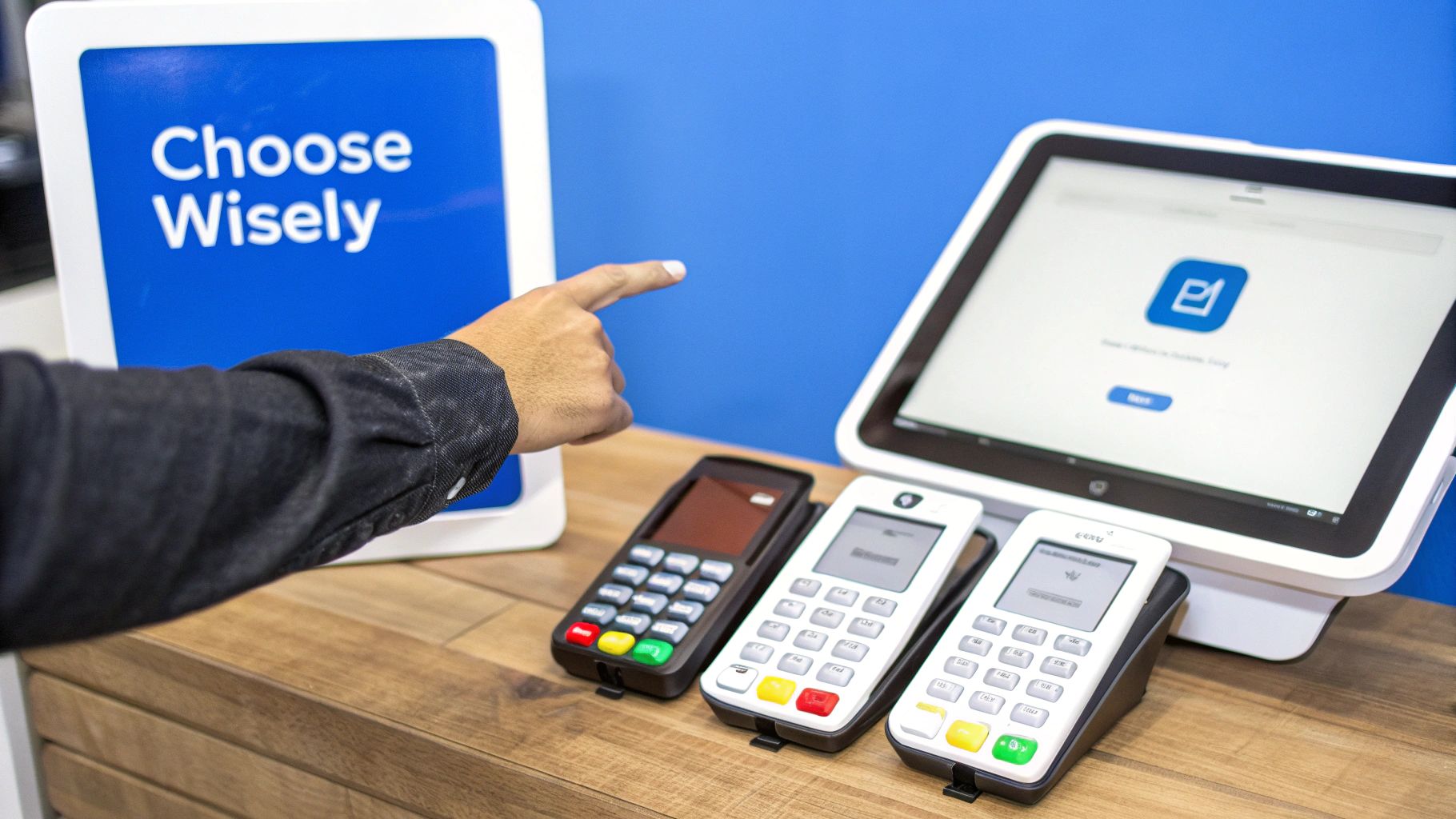
Picking a mobile credit card machine is a big deal, and it should be. This one device touches every dollar you earn, interacts with every customer, and reflects your brand's professionalism. With so many options out there, it’s easy to get overwhelmed, but if you focus on your specific business needs, the right choice will become clear.
Think of it less like buying a new gadget and more like hiring a key employee. You need something reliable, efficient, and that fits right into your daily workflow. Let's walk through the essential things to consider to make sure you find the perfect match.
Assess Your Transaction Volume
First thing's first: how busy are you, really? A solo artist at a weekend market has completely different needs than a bustling coffee shop with staff pulling shots and swiping cards all day long. Your daily and monthly transaction count is the starting point that will guide your hardware and software decisions.
A low-volume business can get by just fine with a simple, compact reader that connects to a smartphone. But if you’re handling a high volume of sales, you’ll need a more rugged solution—maybe even multiple devices or an all-in-one terminal—that can keep up without skipping a beat. Thinking about your current sales and your future growth will keep you from outgrowing your new system in six months.
Prioritize Accepted Payment Types
In today's world, payment flexibility is king. If you can't take how a customer wants to pay, you might lose the sale right there at the counter. A modern mobile card reader has to be ready for everything.
Your non-negotiable checklist should include:
- EMV Chip Cards: This is the gold standard for secure, in-person payments. "Dipping the chip" is muscle memory for most shoppers now.
- Contactless NFC: Tap-to-pay with digital wallets and contactless cards is exploding. It's fast, convenient, and what many customers expect.
- Magstripe: While it's on its way out, the good old magnetic stripe is still a crucial backup for older cards or visitors from abroad.
Covering all these bases means you can say "yes" to every customer, creating a smooth checkout that leaves no one frustrated.
Demand Seamless Software Integration
A mobile card reader by itself just takes money. But when it’s connected to a powerful Point of Sale (POS) system, it becomes the nerve center of your whole operation. This is where the magic really happens.
Think of software integration as the brain that tells the hardware what to do with the information it collects. A good integration automatically updates your inventory, generates sales reports, and even builds customer profiles with every purchase.
This kind of automation frees you up from hours of boring admin work, slashes the risk of human error, and gives you the hard data you need to make smarter business decisions. It turns a simple payment device into an engine for growth.
Understand Costs and Processing Fees
Alright, let's talk about the bottom line. The price tag on the hardware is just the beginning. The ongoing processing fees are where you need to pay close attention, as this is what you’ll be paying for as long as you use the device.
There are a few different pricing models out there, and they can seem confusing at first. But understanding how they work is the key to finding a solution that won't hit you with surprise charges down the road.
This move to mobile payments isn't just a small trend; it's a massive global shift. The mobile payments market, currently valued at $116.14 billion, is on track to explode to nearly $1.72 trillion, with North America and the Asia-Pacific region leading the charge. As more businesses get on board, finding a provider with clear, transparent fees becomes more important than ever. You can learn more about the exponential growth of mobile payments and what it means for businesses like yours.
Comparing Mobile Card Reader Pricing Models
To help you navigate the costs, here’s a quick breakdown of the most common fee structures you'll encounter.
| Pricing Model | Best For | Pros | Cons |
|---|---|---|---|
| Flat-Rate | Businesses with low to medium volume and smaller average transaction sizes. | Predictable, simple fees. Easy to budget for. | Can be more expensive for high-volume businesses. |
| Interchange-Plus | High-volume businesses with larger average transaction sizes. | Highly transparent. Potentially the lowest overall cost. | More complex; fees can fluctuate month to month. |
| Tiered | Businesses with a very consistent type of card transaction. | Can be simple to understand at a glance. | Often the least transparent and most expensive model. |
| Subscription | Businesses that want all-in-one hardware, software, and processing. | Bundled services and hardware. Predictable monthly cost. | Can lead to higher long-term costs and hardware leasing. |
Ultimately, the right pricing model depends entirely on your sales patterns. Take a look at your past sales data to figure out which structure will save you the most money over the long haul.
Unlocking Your Full Potential with POS Integration
A mobile credit card machine is a fantastic tool for taking payments on the go. But on its own, it’s just one piece of the puzzle. The real magic happens when you connect it to a powerful Point of Sale (POS) system. This integration is what elevates a simple payment device into a true command center for your entire business.
Think of it this way: the mobile reader is like your hands—it does the essential work of accepting the money. Your POS system is the brain. It takes the information from every single transaction, makes sense of it all, and helps you make smarter, more profitable decisions.
When they work together, every sale becomes a source of valuable business intelligence, automating tedious tasks and giving you a clear view of your operations.
The Power of a Unified System
Integrating your mobile reader with a POS like Biyo creates a smooth, automatic flow of information. Gone are the days of manually entering sales into spreadsheets or trying to reconcile your inventory at the end of a long day. Every tap, dip, or swipe instantly updates everything.
This gives you a complete, real-time snapshot of your business's health. You can see which products are flying off the shelves, pinpoint your peak hours, and even track staff performance, all from one central dashboard. This isn't just data; it's the insight you need to make strategic moves that actually grow your business.
A fully integrated system doesn’t just process payments; it creates a feedback loop. Every transaction provides data that helps you refine your inventory, improve your customer service, and boost your profitability.
And it doesn't have to stop there. For businesses looking to build deeper customer relationships, you can unlock growth by integrating CRM with payment solutions like Paystack, turning transaction data into long-term loyalty.
Game-Changing Features Enabled by Integration
When your mobile reader and POS are in sync, they enable features that solve some of the most common—and frustrating—operational headaches.
A perfect example is Offline Mode. If you’re a vendor at a festival with spotty Wi-Fi or a food truck in a dead zone, losing your internet connection can bring sales to a screeching halt. A quality POS integration lets you keep accepting payments securely. The system queues them up and processes them automatically the moment you're back online. It’s a lifesaver.
Another key feature is Multi-Mode Support. Modern businesses are rarely one-size-fits-all. A café might need to handle table service, counter orders, and online pickups simultaneously. An integrated system like Biyo POS can switch between different modes—like restaurant, retail, or quick service—on the fly, adapting the workflow to exactly what you need for each transaction.
Seamless Hardware Compatibility and Setup
When choosing a POS, look for one with broad Hardware Compatibility. This is crucial for a pain-free setup. The last thing you need is to find out your brand-new card reader won't talk to your existing cash drawer or receipt printer.
A system built with compatibility in mind ensures all your devices work together from day one, saving you time, money, and a whole lot of frustration. Instead of troubleshooting tech issues, you can get back to what matters.
For a deeper dive into how different platforms can connect, check out our guide on platform integration. Ultimately, this seamless connection is what turns your mobile payment setup into a powerful engine for success.
Got Questions About Mobile Card Readers? We’ve Got Answers.
Jumping into mobile payments can bring up a lot of "what ifs." You're busy running your business, and the last thing you need is a tech headache. Let's walk through some of the most common questions business owners have, so you can feel confident you're making the right move.
We’ll cover everything from security to what to do when your battery inevitably dies, making sure you’re prepared for anything.
Just How Secure Are These Things, Really?
This is usually the first question on everyone's mind, and for good reason. The short answer? Modern mobile card readers are incredibly secure, often just as safe—if not safer—than the clunky old terminals you're used to.
Here’s why: from the moment a customer taps or inserts their card, their information is locked down with end-to-end encryption. Think of it like putting the data into a digital armored truck. The information is instantly scrambled into a secret code that’s unreadable to anyone trying to intercept it.
On top of that, every legitimate payment system has to follow strict industry regulations. To get a better handle on these crucial security rules, check out our guide on what PCI compliance means for your business. Following these standards isn't optional; it's the bedrock of protecting you and your customers from fraud.
Do I Really Need a Separate Business Bank Account?
When you're just starting out, it’s tempting to mix business and personal funds. But trust me on this one: opening a separate business bank account is one of the smartest things you can do.
For one, it makes bookkeeping a thousand times easier. You can see exactly what’s coming in and what’s going out, which is a lifesaver when you're trying to manage cash flow. Come tax season, you’ll be patting yourself on the back.
A dedicated business account just looks more professional. It signals to banks, vendors, and even customers that you're a legitimate operation, which can be a huge help when you're ready to grow or need a loan.
What if My Reader or Phone Dies Mid-Sale?
A dead battery can feel like a show-stopper, especially in the middle of a rush. But this is one problem that’s easily solved with a little foresight. The easiest fix? A portable power bank.
These things are lifesavers. They’re small, cheap, and can charge your phone and card reader multiple times over. Just toss a fully charged one in your bag or work truck, and you’ll never have to turn away a customer because you’re at 1% battery life.
Another simple trick is to make charging your gear part of your daily routine. Treat it like counting the cash drawer at the start of your day. A full charge at the beginning of a shift prevents most power emergencies from ever happening.
Can I Take Payments if I'm Traveling Internationally?
Taking your business global is exciting, but using your mobile card reader abroad isn't always a simple plug-and-play situation. Whether you can accept payments in another country comes down to one thing: your payment processor.
Most processors tie your account to the country where your business is registered. They do this because of different banking laws, currency conversion headaches, and fraud prevention rules. If you try to run a card outside your approved zone, the transaction will almost certainly be declined.
Before you pack your bags, call your provider and ask about their policy on cross-border payments. Some might offer an international package, while others will tell you to find a local payment partner where you're going. Getting this sorted out ahead of time will save you from a world of frustration.
Ready to streamline your payments and unlock powerful business insights? Biyo POS offers an all-in-one solution with a user-friendly mobile credit card machine that integrates seamlessly with our robust point-of-sale system. Start your free trial today and see how easy it is to manage and grow your business at https://biyopos.com.