A Guide to Credit Card Preauthorization for Businesses

A Guide to Credit Card Preauthorization for Businesses

Ever seen a "pending" charge on your credit card statement after booking a hotel or renting a car? That’s a credit card preauthorization in action. It's essentially a temporary hold a business places on your card to make sure it's valid and has enough funds to cover a potential purchase.

It's not an actual charge. Think of it as a temporary earmark on your available credit, reserving a specific amount until the final transaction goes through.

Unlocking the Value of Credit Card Preauthorization

A preauthorization is like an insurance policy for a sale you haven't finalized yet. It works much like a hotel reservation. You haven't paid for the room, but the hotel has confirmed your card can handle the bill by placing a temporary hold on the funds. This simple step verifies everything upfront without actually taking any money.

This temporary hold is a critical safety net for businesses, especially in hospitality, rentals, or any service where the final total isn't known right away. It acts as a financial placeholder, securing your future revenue and dramatically cutting down the risk of getting a dreaded "payment declined" message later.

Why Preauthorization Is a Business Essential

At its core, preauthorization is all about managing risk. It gives you the confidence that you’ll actually get paid for the products or services you’re providing. This is particularly crucial in a few common situations:

  • Verifying Payment Methods: It’s an instant check to confirm a customer's card is active and has the available credit. This weeds out invalid or maxed-out cards before you’ve invested any time or service.
  • Securing Future Payments: For hotels or car rental agencies, it guarantees the funds are there to cover the final bill, including any surprise charges for damages or mini-bar raids.
  • Preventing Fraud: A successful preauthorization is a strong first sign that the card is legitimate. It helps you spot and stop potential fraud before it ever hits your books.

This kind of security is more important than ever. With global credit card transaction volume projected to hit $3.843 trillion by 2025, robust payment practices are non-negotiable. It's all about reducing chargebacks. In fact, 78% of card issuers now use advanced fraud detection, which has led to a 44% reduction in fraud in sectors where preauthorization is standard. You can find more data on how preauthorization aids in fraud prevention and its impact on e-commerce and service industries.

By placing a temporary hold, a business can operate with far greater financial certainty. It’s a proactive step that protects your revenue and saves you from the operational nightmare of failed payments and customer disputes.

A Clear Comparison

To really grasp the concept, it helps to see exactly how a preauthorization stacks up against a final sale. They're two parts of the same transaction, but they serve completely different functions.

Let's break down the key differences between that initial hold and the final payment capture.

Preauthorization vs Final Sale at a Glance

Feature Credit Card Preauthorization Final Sale (Capture)
Purpose To verify funds and temporarily hold an amount. To permanently transfer funds from customer to merchant.
Customer's Account Reduces available credit; appears as a "pending" charge. Appears as a posted, final transaction on the statement.
Duration Temporary, typically lasting a few days (e.g., 3-7 days). Permanent; funds are transferred and the transaction is complete.
Merchant's Action Merchant can capture, void, or let the hold expire. Merchant has received the money. The transaction is settled.
Flexibility High. The final amount can be adjusted before capture. Low. Once captured, changes require a refund or new charge.

Understanding this distinction is vital. A preauthorization is just a temporary hold, a "maybe." A final sale is the permanent transfer of funds—the "done deal." Getting this right is crucial for accurate accounting and keeping your customers in the loop.

How a Credit Card Transaction Actually Works

To really get why preauthorization is so useful, you first need to understand the journey a payment takes from your customer to your bank account. It might look instant, but there's a three-step dance happening behind the scenes for every single transaction.

Think of it as a lifecycle: Authorization, Capture, and Settlement. A preauthorization is just a smarter way of handling that very first step.
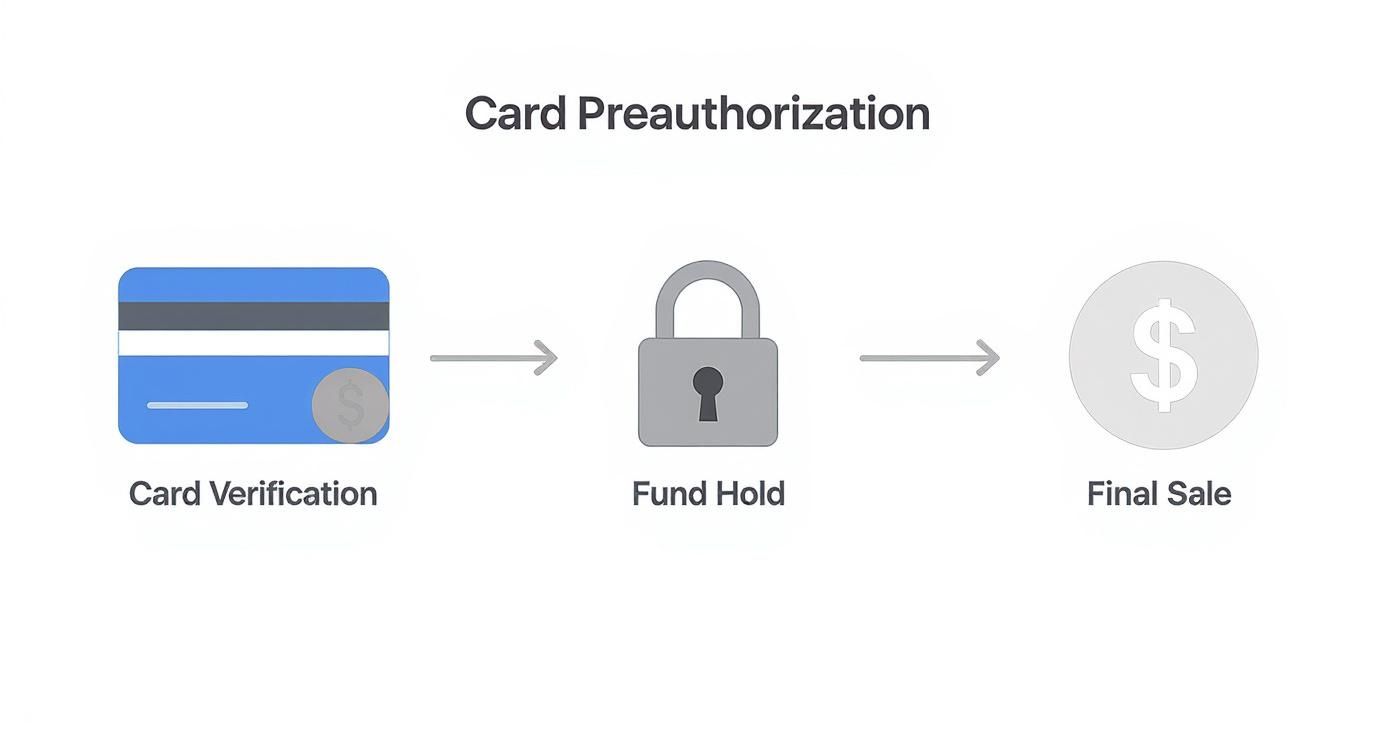
This diagram gives a great high-level view of the flow.

Diagram illustrating credit card preauthorization: Card Verification leads to Fund Hold, then to Final Sale.

As you can see, it's all about verifying the card, holding the funds, and then finalizing the sale once everything is said and done.

Stage 1: Authorization – The Initial Handshake

The moment a customer hands over their card, your POS system is doing a quick, digital handshake with their bank. It zips a request over the payment network that basically asks, "Hey, is this card legit, and does the owner have enough credit to cover this amount?"

The bank’s response is a simple yes or no, and it comes back in seconds.

  • Approval: If everything checks out, the bank gives a thumbs-up and issues an authorization code. More importantly, it puts a temporary hold on the funds in the customer's account. This is the preauthorization. It doesn’t take the money, it just fences it off so it can't be spent elsewhere.
  • Decline: If the card is over its limit, has been reported stolen, or triggers a fraud alert, the bank will shut the transaction down right there.

This back-and-forth is the bedrock of a secure payment. For a deeper dive into the mechanics of this step, check out our guide on payment authorization and how it keeps your business safe.

Stage 2: Capture – Claiming What You're Owed

An authorization just reserves the money; it doesn't actually move it. Capture is the step where you tell your payment processor, "Okay, the job is done, go get the money."

This is where the magic of flexibility comes in. A restaurant can preauthorize a card for the expected bill, then capture the final amount plus the tip the customer adds later. Capturing the funds is what turns that temporary hold into a real charge on the customer's statement.

A credit card preauthorization is your green light. It confirms the funds are available before you provide a service, letting you capture the exact, final amount when you're ready.

Stage 3: Settlement – The Money Comes Home

Once you capture a transaction, it enters the final stage: settlement. This is where the money actually makes its journey from the customer's bank, through the card networks (like Visa and Mastercard), and finally into your merchant account.

This process usually happens in daily batches behind the scenes. The lifecycle is officially complete when the funds—minus any processing fees—land in your business bank account.

So, when you break it down into Authorize, Capture, and Settle, you can see that a credit card preauthorization isn't some strange, separate process. It's simply the critical first move that secures the funds and makes the rest of the payment journey smooth and safe for everyone.

Where Preauthorizations Shine in Everyday Business

The concept behind a credit card preauthorization is pretty simple, but its true value really clicks when you see it in action. Think of it as a flexible tool that elegantly solves the very common business headache of payment uncertainty. Let's walk through a few real-world scenarios where preauthorization isn't just a nice-to-have, but a core part of running the business smoothly.

A blue sign reading 'Preauth uses' next to car keys and documents on a wooden desk.

As more and more customers reach for their cards, having a way to manage transaction risk is more critical than ever. In the United States alone, the quarterly volume of credit card payments has skyrocketed past $1 trillion. We saw it jump from $787 billion in Q2 2021 to a staggering $1.21 trillion by the end of 2024. In fact, by early 2025, credit cards made up 35% of all payments. That’s a huge shift, and it’s why tools like preauthorization are so vital.

Securing Reservations in Hospitality

Hotels are the classic example of preauthorization in the wild. When a guest checks in, their final bill is still a question mark. Will they raid the mini-bar? Order late-night room service? Enjoy a pay-per-view movie?

To cover these "what ifs," the hotel preauthorizes the guest's card for the full room cost, plus an estimated amount for any extras.

  • The Problem: A hotel needs to be sure it can collect payment for services and items that haven't even been used yet.
  • The Solution: The preauthorization hold locks in the estimated total, guaranteeing the funds will be there at checkout. If the guest doesn't rack up any extra charges, the hotel just captures the base room rate and the rest of the hold is released.

It's a simple move that protects the hotel from unpaid bills and makes checkout a breeze for everyone involved.

Managing Deposits for Rentals

Car rental agencies face a similar dilemma, but the stakes are much higher. It’s not about an unpaid bag of peanuts; it’s about potential damage to a car worth thousands of dollars.

When you go to rent a car, the agency will place a pretty hefty preauthorization hold on your card. This isn't just for the rental fee—it acts as a security deposit, creating a buffer for potential fuel surcharges, unpaid tolls, or dings and scratches.

This preauthorization is a financial safeguard. It verifies that the renter has the financial capacity to cover unforeseen costs, drastically reducing the rental agency's risk.

Once the car is returned safe and sound, the hold is released after all final charges are settled. It’s the agency's insurance policy for the entire rental period.

Simplifying Tabs at Bars and Restaurants

Ever "opened a tab" at a bar? You've experienced a credit card preauthorization. In a packed bar or restaurant, speed and efficiency are everything.

Instead of running a separate transaction every time someone orders another round, the bartender swipes the card once at the start of the night. This typically places a very small hold—often just $1.00—purely to confirm the card is active and valid.

  • The Problem: Ringing up every single drink on a running tab is slow, clunky, and a recipe for mistakes during a rush.
  • The Solution: Preauthorizing the card gives the green light upfront. At the end of the night, the bartender can close out the tab by capturing the final total, including the tip, in one quick transaction.

This keeps the drinks flowing and protects the business from someone walking out on their bill.

Fueling Up at the Gas Pump

Automated gas pumps are another place you'll see preauthorization every day. When you slide your card into the reader, the system has no idea if you need $20 of gas or a full $100 tank.

To solve this, the pump instantly preauthorizes your card for a fixed amount, say $75 or $125. This hold confirms you have enough available credit to pay for a tank of gas.

As soon as you hang up the nozzle, the system finalizes the charge for the actual amount of fuel you purchased, and the rest of the hold is immediately released. It's what makes "pay-at-the-pump" so fast and secure, protecting the station from drive-offs.

Managing Authorization Holds and Customer Communication

Using a credit card preauthorization effectively is about more than just the technical step of placing a hold. The real secret lies in managing customer expectations with clear, proactive communication.

Let’s be honest: nobody likes seeing an unexpected pending charge on their bank statement. It immediately triggers anxiety and can quickly sour an otherwise great customer experience. This confusion often leads to panicked phone calls to your support line or, even worse, unnecessary chargeback disputes.

That’s where you come in. By explaining the process upfront, you can transform a moment of potential confusion into an opportunity to build trust. A little transparency goes a long, long way.

Setting Clear Expectations on Hold Durations

One of the biggest friction points for customers is the mystery of how long a preauthorization hold will stick around on their account. They see the pending amount, and they want to know when their funds will be freed up.

It’s crucial to explain that the hold duration is set by the customer's card-issuing bank, not by you, the merchant. For most standard purchases, a hold might last 5 to 7 business days. But this can change dramatically depending on the business type.

Key Takeaway: Communicating these timelines isn't just good service—it's a critical defense against disputes. A customer who understands the "why" and "how long" is far less likely to call their bank to complain.

To give you and your customers a better idea of what to expect, here’s a quick look at typical hold times across different industries.

Typical Preauthorization Hold Durations by Industry

This table summarizes standard hold times that customers can expect across different types of businesses.

Industry Common Hold Duration Reason for Hold
Hotels & Lodging Duration of stay + 3-7 days Covers the room rate, taxes, and potential incidentals like mini-bar or damages.
Car Rentals Rental period + 5-10 days Secures the estimated rental cost plus a security deposit for fuel, tolls, or potential damage.
Restaurants & Bars 1-5 hours (for tabs) Keeps a tab open and ensures funds are available for the final bill.
Gas Stations (Pay at Pump) 1-4 days A fixed amount is held to ensure the card is valid before pumping begins; it's adjusted to the final amount later.
General Retail 1-5 business days Verifies funds for a purchase, especially for online orders before they are shipped.

As you can see, the context of the purchase plays a huge role. Making sure your team can explain these timelines is a simple but powerful way to keep customers happy.

Simple Scripts for Effective Communication

You don't need to give a lecture on payment processing to be effective. A few well-chosen, reassuring words at the right moment can make all the difference. The goal is to be transparent without being overly technical.

Feel free to adapt these simple scripts for your team:

  • For Retail or Quick Service: "Just to let you know, we're placing a temporary hold on your card to verify the funds. You'll only be charged for what you buy today, and your bank will release the hold in a few days."
  • For Restaurants Opening a Tab: "We'll preauthorize your card to get a tab started for you. It's just a temporary hold, not the final charge. We'll settle up with you when you're ready to close out."
  • For Hotels or Rentals: "We place a temporary authorization hold for your estimated total plus a security deposit. This isn't a final charge, and the hold will be removed by your bank within 5-7 business days after you check out."

This kind of straightforward communication demystifies the credit card preauthorization process. It shows customers you're on their side, which is foundational for building a relationship that lasts long after the transaction is complete.

How Preauthorization Slashes Chargebacks and Risk

A credit card preauthorization isn't just a technical step in a transaction—it's one of your best lines of defense for managing risk. Think of it as a financial security check that protects your revenue right from the get-go. Its biggest job? To drastically cut down on payment disputes and costly chargebacks.

When you preauthorize a card, you're getting instant confirmation that the customer actually has the funds available. This simple check knocks out one of the most frequent reasons a sale falls through later: insufficient funds. By making sure the money is there upfront, you secure the payment before you hand over any products or lock in a service.

Building a Stronger Case Against Disputes

Beyond a simple funds check, a successful preauthorization creates a much more solid transaction record. This digital paper trail is gold if you're ever hit with a payment dispute, especially in those tricky "friendly fraud" situations where a customer disputes a charge they actually made.

Having that valid authorization code proves the cardholder's bank gave the transaction a green light at the time of purchase. This single piece of evidence makes it significantly harder for someone to later claim the charge wasn't authorized. It shows you did everything by the book.

By verifying the transaction from the start, you’re building a much stronger argument against any potential disputes down the road. That initial approval can be the key to winning a chargeback case and keeping your hard-earned money.

For businesses that want to really tighten up their defenses, it pays to know the ins and outs of the dispute process. You can learn more about fighting chargebacks to see how a solid preauthorization fits into your overall protection strategy.

Protecting Your Business in a Card-First World

This risk management strategy is becoming more important every day as the world continues to shift towards card payments. We’re looking at a 43% jump in global card usage by 2029, with the total number of transactions nearing an astronomical 1.11 trillion per year. That sheer volume tells you just how vital secure payment processing has become for every single merchant.

With card use exploding, tools like preauthorization are essential for keeping your merchant account in good standing. Too many chargebacks can trigger higher processing fees or, in worst-case scenarios, get your account shut down. Preauthorizing helps you maintain a clean record by filtering out risky payments before they can ever turn into problems.

Weaving Preauthorization into a Complete Strategy

Of course, great risk management is more than just one move. Preauthorization works best as part of a complete game plan to protect your business. This means staying on top of PCI compliance to keep card data safe and using clear, direct communication to prevent customer mix-ups that often lead to disputes.

It also means stopping bad orders before they even start. For example, tactics like blocking non-compliant orders before checkout can prevent fraudulent or impossible-to-fulfill orders from ever hitting the payment stage. When you combine all these practices, you create a powerful shield against fraud and financial loss.

Getting Preauthorization Set Up on Your POS System

So, you're ready to start using credit card preauthorization? Fantastic. The good news is that most modern point-of-sale (POS) systems are already built to handle it. Getting this feature up and running in your business is usually pretty straightforward, often just a matter of tweaking a few settings.

A woman in a blue shirt and black apron operates a POS system at a counter with a 'Pos Setup' sign.

Your first move is to jump into your POS system’s payment settings. Look for an option labeled something like "Preauthorization," "Auth Only," or "Card Verification." Once you flip that switch, you should see a new button or option pop up on your payment screen. This gives your team the power to place a temporary hold on a card instead of charging the final sale right away. For those interested in the nitty-gritty, understanding the technical side of payment provider integration for financial services platforms is key to making sure everything connects and works smoothly.

Training Your Team Is Non-Negotiable

With the feature enabled, your next—and most important—step is training. Your staff needs to know the difference between authorizing a card and actually capturing the payment. It's not just about learning which button to press; it's about understanding why they're pressing it.

Your training should walk them through real-world situations, like:

  • Starting a Tab: How to run a pre-auth for a small amount when a customer wants to open a tab at the bar.
  • Holding a Reservation: The right way to place a hold to secure a future booking or a service appointment.
  • Taking a Deposit: How to authorize a larger amount for a security deposit on a rental or a big-ticket item.

The single most critical concept for your team to grasp is that an authorization is just a placeholder. No money has actually moved yet. Getting this right is fundamental to smooth operations and clear customer communication.

A well-trained team is the bridge between a powerful POS feature and a seamless customer experience. They need the confidence to not only use the function correctly but also explain it clearly to customers who may have questions.

Managing Open Authorizations: From Hold to Final Sale

Once you start using preauthorizations, you’ll have a new daily task: managing your open holds. Your POS system should give you a dashboard or report showing all active authorizations, making it easy to see what needs to be done to finalize each one.

You'll find yourself performing a few common actions:

  1. Adjusting and Capturing: This will be your most common workflow. Think of a restaurant tab: you'll adjust the initial hold amount to add the final bill plus the tip, and then you'll capture the final payment.
  2. Voiding an Authorization: If a customer cancels their reservation or changes their mind, you'll need to void the hold. This sends an immediate signal to their bank to release the funds, which is way faster and better for the customer than just letting the hold expire on its own.
  3. Reconciliation: Your end-of-day reporting needs to separate captured funds from still-open authorizations. Checking these reports daily ensures every dollar is tracked correctly, from the initial hold all the way to the final deposit in your bank account.

By getting a handle on these functions, you can be sure every transaction is processed accurately. This kind of attention to detail prevents revenue from slipping through the cracks and keeps your books clean. For a full breakdown of the payment lifecycle, check out our guide on how to process a credit card payment.

Got Questions? We’ve Got Answers.

Even after you get the hang of preauthorizations, some common questions always pop up. Let's tackle the most frequent sticking points for both merchants and customers to clear up any confusion.

What Happens If a Preauthorization Expires?

If you don't capture or void a preauthorization within the typical 5-7 day window, it simply expires. The customer's bank automatically releases the temporary hold on the funds.

That means the money is back in the customer’s available balance, and you've lost your window to capture that specific transaction. If you still need to charge them, you’ll have to start a completely new transaction from scratch.

Can a Customer See a Preauthorization Hold?

Yes, and this is a huge source of customer questions. On their online banking or credit card statement, a preauthorization will almost always appear as a "pending" or "processing" transaction. Many customers will assume they've already been charged.

Proactive communication is everything here. Simply explaining that the pending item is a temporary hold to verify funds, not the final charge, can prevent a lot of headaches and potential chargebacks.

Can a Preauthorization Be Canceled?

Absolutely. If a customer cancels their booking or you no longer need the hold, you can—and should—void the preauthorization right away. This sends an immediate signal to the customer's bank to release the funds, which is much quicker than letting the hold expire on its own.

Taking this step is great for customer service. It shows you respect their money and helps them get their available credit back much faster, often within 24 hours.

Is Preauthorization the Same as a Prepayment?

Not at all. They serve very different purposes.

A credit card preauthorization is just a temporary hold. No money actually leaves the customer's account and moves into yours until you capture the charge.

A prepayment, on the other hand, is a real charge. You are collecting a portion (or all) of the payment upfront, before the service is completed. The money is transferred to your merchant account immediately, just like any other sale.


Ready to take the guesswork out of payment holds and protect your business? Biyo POS makes managing preauthorizations straightforward, giving you the control you need to cut down on risk and keep customers happy. Discover how Biyo POS can transform your business.

Related Posts