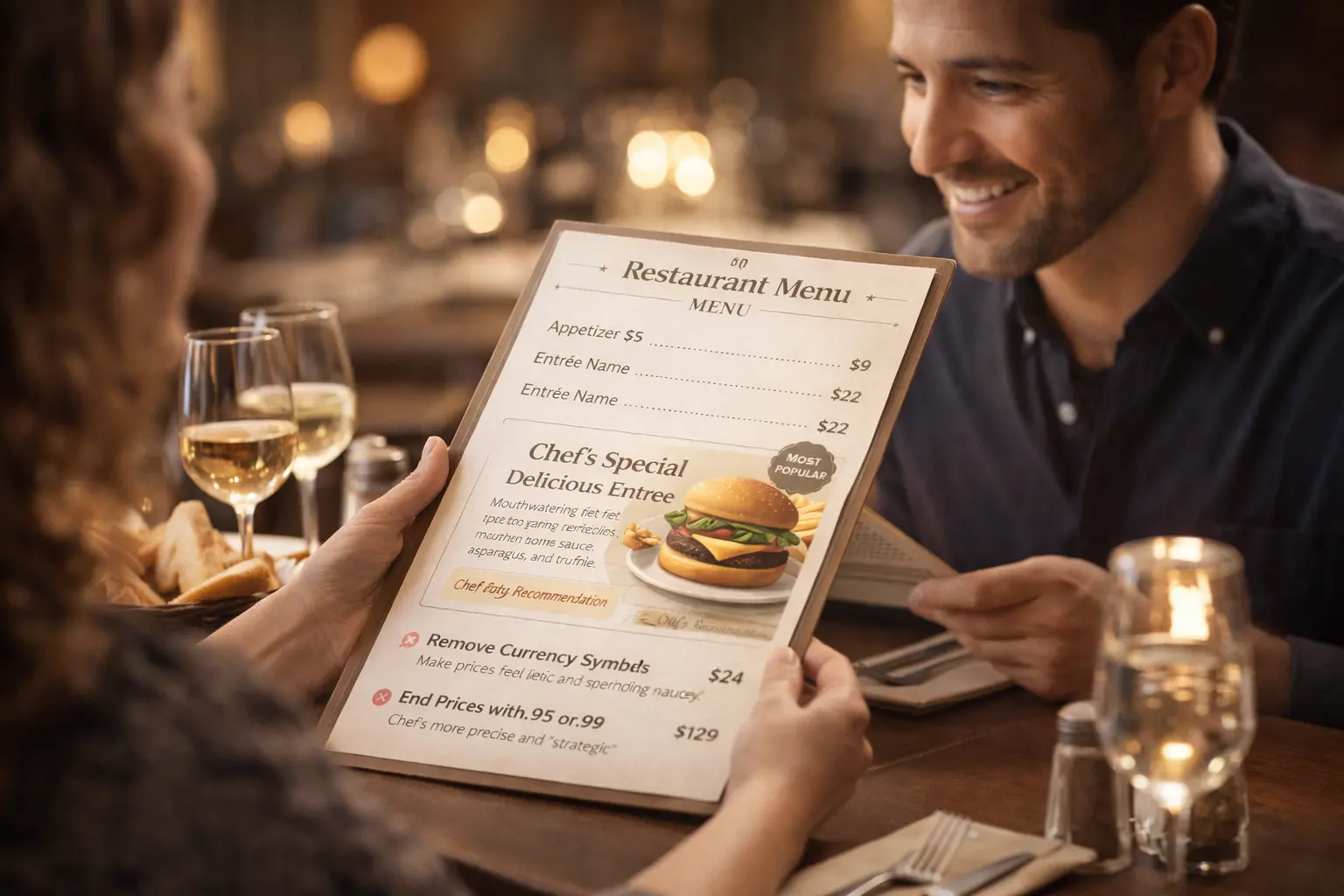

Restaurant menu design that sells is not about decoration, it is about guiding customer decisions and increasing profit. A restaurant menu does far more than list food and prices. It shapes perception, directs attention, and quietly influences how much guests spend. That is why focusing on restaurant menu design that sells is one of the smartest moves a restaurant owner can make.
When done correctly, a menu becomes a silent salesperson that works every hour of the day. Instead of pushing discounts or increasing prices, it increases revenue by influencing how customers choose.
This guide goes beyond theory and shows how to actually design a menu that improves profitability.
Table of Contents
- Understanding the Psychology Behind a Profitable Menu
- Structuring a Restaurant Menu Layout for Sales
- Using Menu Engineering to Boost Profits
- Applying Pricing Psychology Without Hurting Trust
- Optimizing Menu Item Placement and Visual Hierarchy
- Menu Optimization Strategy (What to Do First)
- Common Menu Design Mistakes to Avoid
- Real-World Example
- How Biyo POS Supports Smarter Menu Decisions
- FAQs
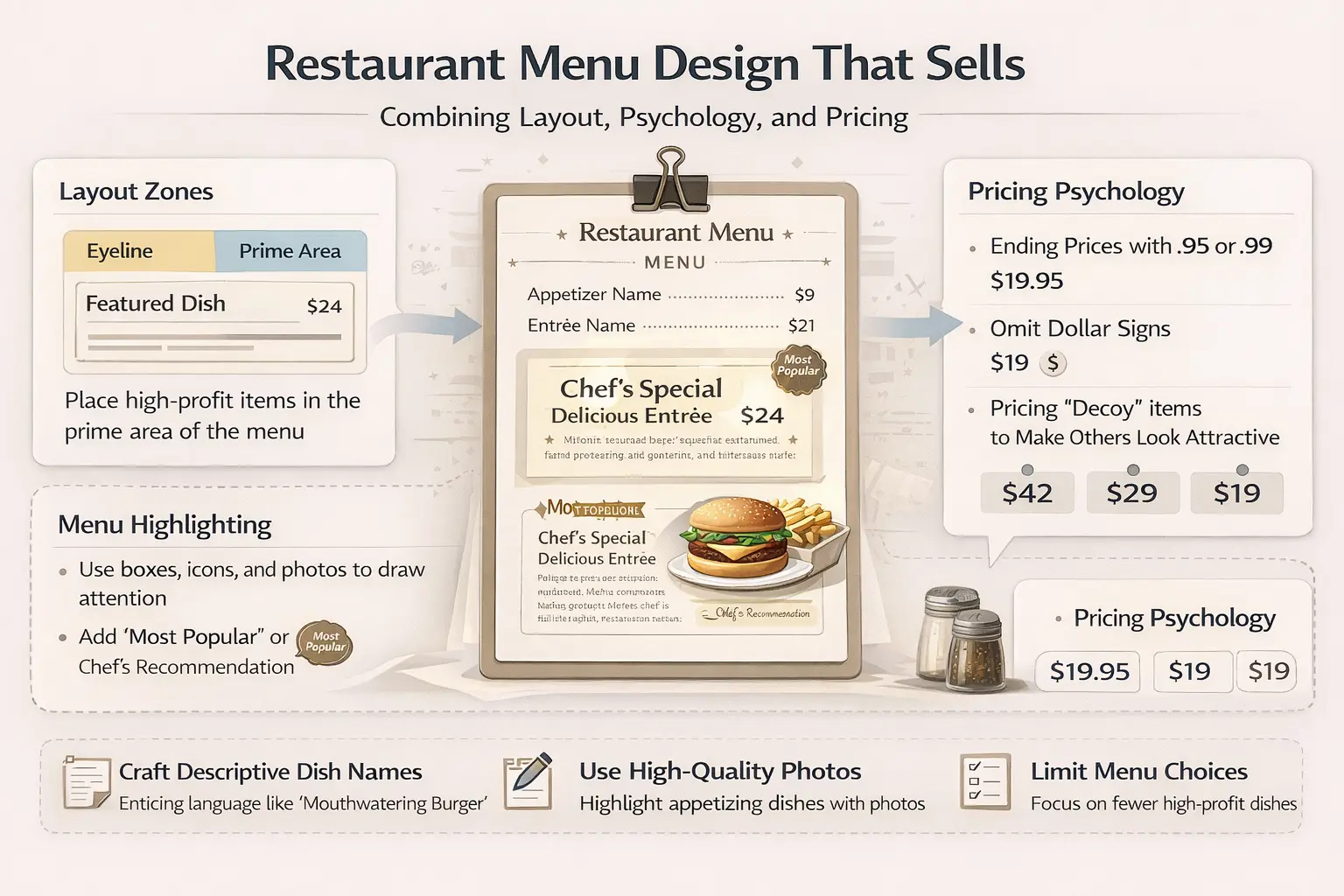 Understanding the Psychology Behind a Profitable Menu
Most customers do not carefully read menus. They scan them. This means your menu should guide attention instead of presenting equal importance to every item.
How Guests Actually Choose
Customers look for familiar, highlighted, or easy-to-understand items. If your menu is cluttered, they default to safe choices—which are often not your most profitable items.
Design should reduce effort, not increase it.
Emotional Triggers That Increase Sales
Words influence perception before the food arrives. Descriptions such as “signature,” “slow-cooked,” or “chef’s special” increase perceived value.
This allows you to sell at higher margins without changing the product itself.
Why Simplicity Outperforms Variety
More options do not mean more sales. They create hesitation. A focused menu leads to faster decisions and higher confidence.
Confidence directly impacts spending.
Structuring a Restaurant Menu Layout for Sales
Layout determines how easily customers move through your menu and what they notice first.
Choosing the Right Format
Single-page menus work best for speed and clarity. Multi-page menus suit larger operations but must remain structured.
Too much content reduces effectiveness.
Category Placement Strategy
Items placed early get more attention. High-margin dishes should appear in top sections, not buried at the bottom.
Ordering categories strategically increases visibility without aggressive promotion.
Using White Space Effectively
Spacing highlights important items. Without it, everything competes equally—and nothing stands out.
 Using Menu Engineering to Boost Profits
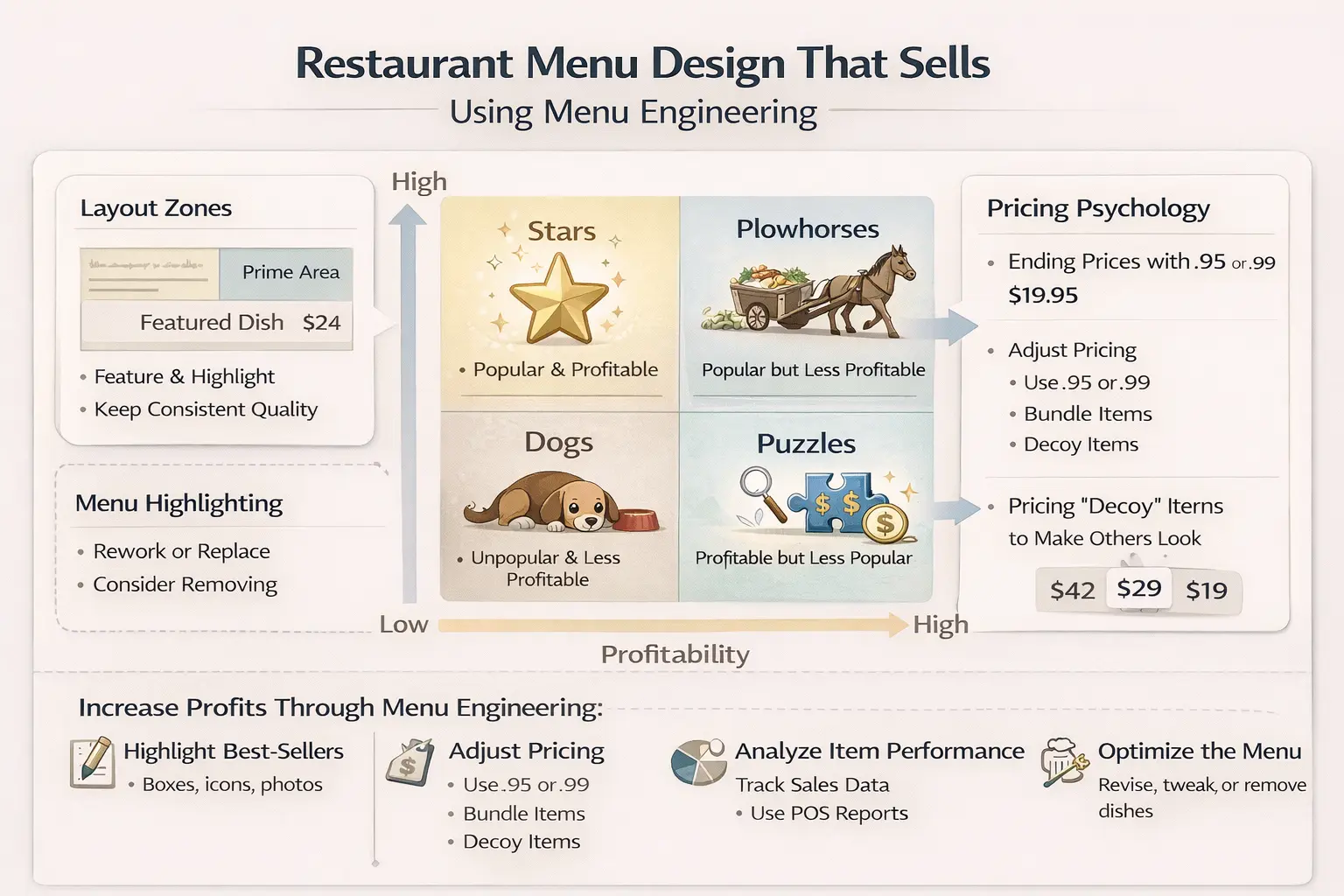 Using Menu Engineering to Boost Profits
Menu engineering is where most restaurants fail—not because it’s complex, but because they don’t apply it.
The Menu Engineering Formula
Each item should be evaluated using:
- Contribution Margin = Selling Price – Food Cost
- Popularity = Number of times sold
Example:
Burger: $12 price – $5 cost = $7 margin
Once calculated, classify items:
- Stars → high profit + high demand
- Puzzles → high profit + low demand
- Plowhorses → low profit + high demand
- Dogs → low profit + low demand
What to Actually Do (Important)
- Promote Stars
- Reposition Puzzles
- Adjust pricing for Plowhorses
- Remove or redesign Dogs
This is where profit increases—not by adding items, but by optimizing them.
Applying Pricing Psychology Without Hurting Trust
Pricing influences perception more than most owners realize.
Decision Framework (Use This)
- Want higher average orders → use anchoring
- Want faster decisions → simplify pricing
- Want premium positioning → remove symbols + clean formatting
What to Avoid
- Overusing discounts
- Inconsistent pricing formats
- Prices that feel manipulative
Trust always comes first.
Optimizing Menu Item Placement and Visual Hierarchy
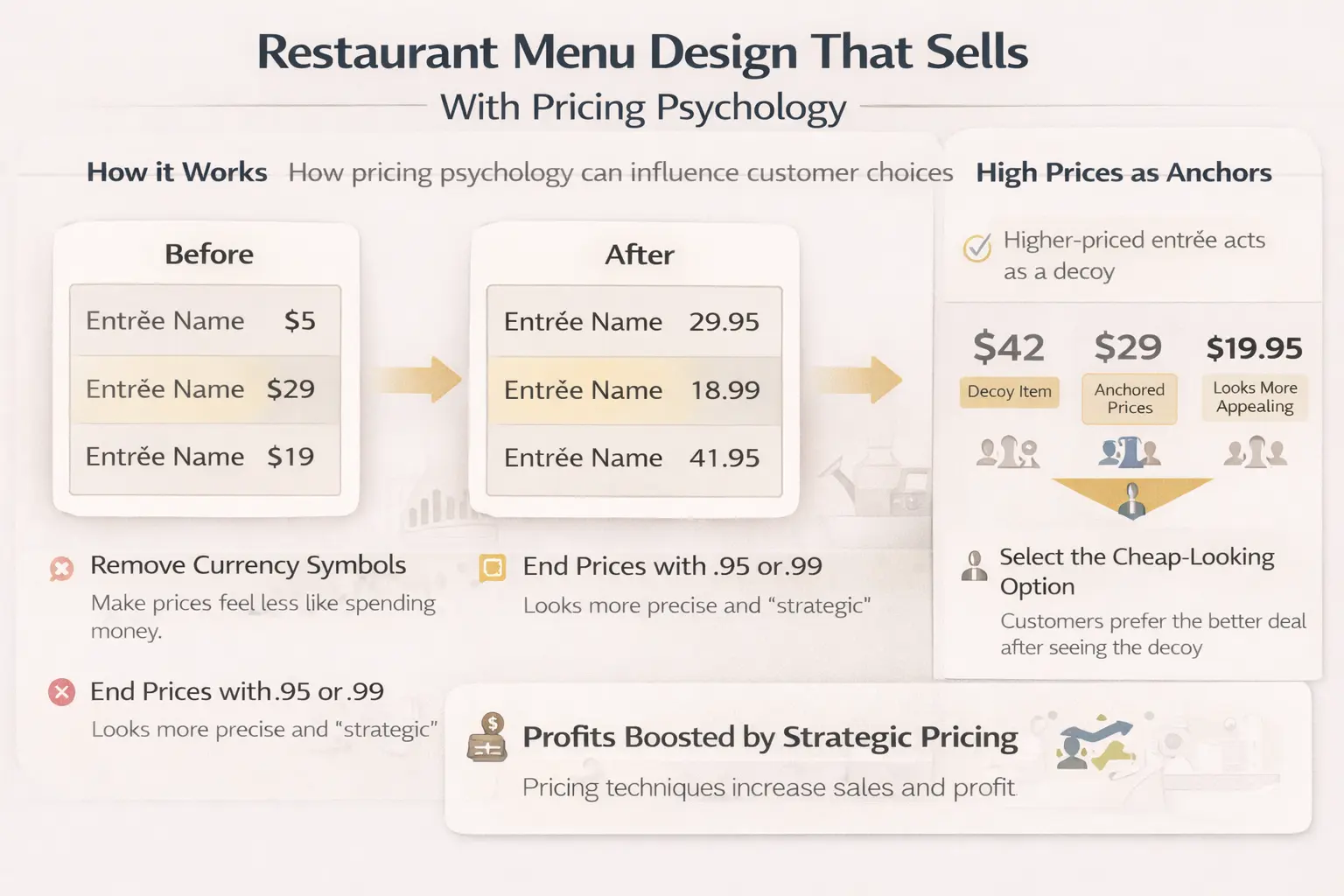 Optimizing Menu Item Placement and Visual Hierarchy
Placement determines visibility. Visibility determines sales.
High-Attention Zones
Top-right and center areas get the most attention. These areas should feature high-margin items.
Typography Strategy
Use size and weight to guide focus—but stay consistent. Too much variation reduces clarity.
Selective Highlighting
Highlight only key items. Over-highlighting makes everything look unimportant.
Menu Optimization Strategy (What to Do First)
Most restaurants fail because they try to redesign everything at once.
Follow this order:
- Step 1: Analyze sales data
- Step 2: Identify high-margin items
- Step 3: Fix layout and placement
- Step 4: Apply pricing strategy
- Step 5: Simplify the menu
This structured approach produces results quickly.
Common Menu Design Mistakes to Avoid
- Too many menu items
- Ignoring data
- Poor layout structure
- Overcomplicated pricing
- Highlighting everything
These mistakes reduce effectiveness even if the design looks good.
Real-World Example
A restaurant reduced its menu from 60 items to 35.
Before:
- Confused customers
- Slow ordering
- Low-margin sales
After optimization:
- Faster decisions
- Higher average order value
- Improved profitability
No price increase—just better structure.
How Biyo POS Supports Smarter Menu Decisions
Biyo POS connects menu design with real performance data. Instead of guessing, you see exactly which items drive profit.
With sales tracking, pricing insights, and inventory control, it allows continuous optimization.
You can schedule a call or sign up here to start using data-driven menu strategies.
FAQs
How often should menus be updated?
Every 6–12 months based on performance data.
Does menu design really increase revenue?
Yes, by influencing choices and increasing average order value.
Should I reduce menu size?
In most cases, yes. Simpler menus perform better.