
POS integrations for growing businesses are no longer optional. As operations expand, disconnected systems begin to slow everything down—reporting becomes unreliable, workflows break, and teams spend more time fixing errors than serving customers. Growth increases complexity, and without connected systems, that complexity quickly turns into inefficiency.
At an early stage, businesses can operate with separate tools for accounting, inventory, and customer management. However, as transaction volume increases, these tools stop working in sync. Data inconsistencies appear, manual processes multiply, and decision-making becomes slower. This is where POS integrations shift from being a convenience to a necessity.
When systems communicate in real time, businesses gain clarity. Sales, inventory, and financial data align automatically, allowing owners to make faster and more confident decisions. Instead of reacting to problems, they operate with control.
Table of Contents
- Why POS Integrations Become Critical During Growth
- Core POS Integrations That Drive Business Performance
- How Integrated Systems Improve Daily Operations
- How Automation Reduces Errors and Saves Time
- How to Choose the Right POS Integrations
- How Biyo POS Supports Seamless Integrations
- Frequently Asked Questions
Why POS Integrations Become Critical During Growth
Growth introduces complexity across every part of a business. More transactions, more staff, and higher demand create pressure on systems that were originally built for smaller operations. Without integration, these systems start to break down.
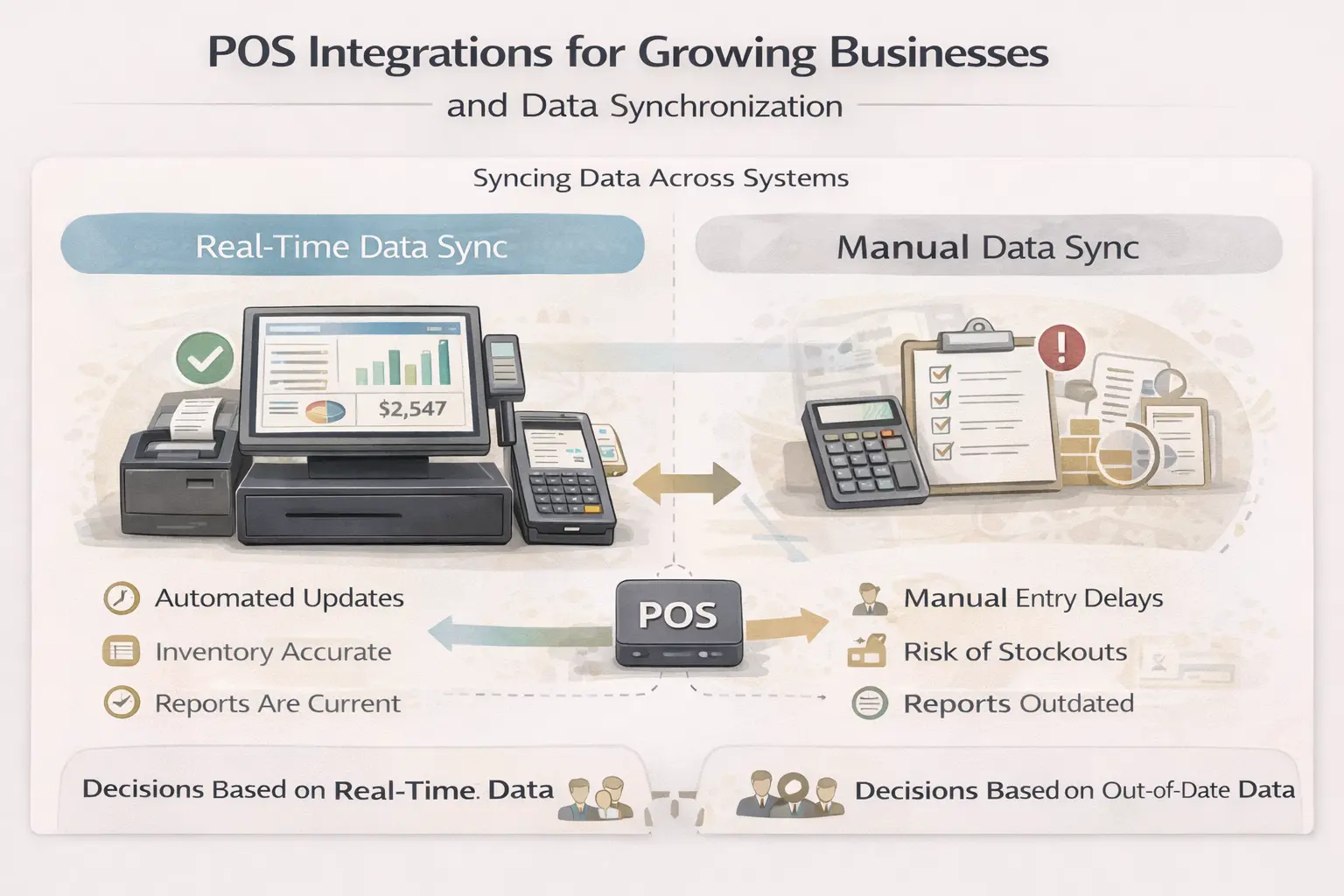
Disconnected tools force teams to manually transfer data between platforms. Sales records may not match accounting reports, and inventory numbers may lag behind actual stock levels. These inconsistencies reduce trust in data, making it harder to make informed decisions.
POS integrations eliminate these gaps by creating a unified flow of information. Instead of relying on multiple sources, businesses operate with a single, consistent dataset. This clarity becomes essential as operations scale.
Another major challenge during growth is the cost of manual processes. Tasks that once took minutes begin to consume hours. Staff spend time updating spreadsheets, correcting errors, and reconciling mismatched data. This not only reduces efficiency but also increases the risk of costly mistakes.
Real-time data becomes critical at this stage. Businesses need to know what is happening now, not what happened yesterday. Integrated POS systems provide this visibility, allowing owners to respond quickly to changes in demand, inventory levels, and customer behavior.
Core POS Integrations That Drive Business Performance
Not all integrations deliver the same value. Some connections have a direct and immediate impact on operations, especially for growing businesses.
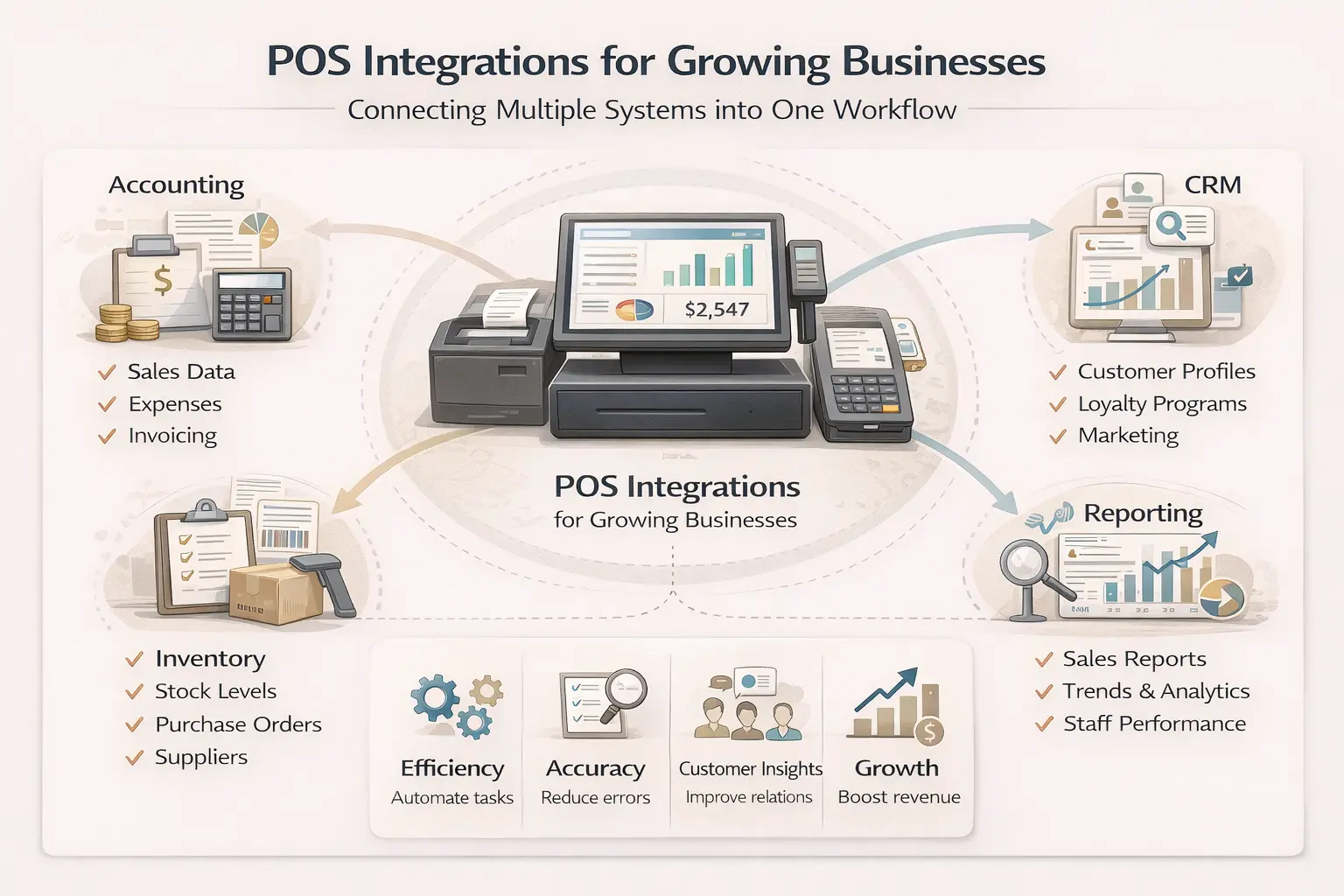
Accounting integrations are among the most important. When sales data automatically syncs with financial systems, businesses eliminate the need for manual reconciliation. Reports become more accurate, and financial insights become available faster. This allows owners to track performance without delay.
Inventory integrations are equally critical. Every transaction updates stock levels in real time, ensuring that inventory data reflects actual availability. This prevents overstocking and reduces the risk of stockouts, both of which can impact profitability.
Customer relationship management (CRM) integrations connect transaction data with customer profiles. This creates a clearer picture of purchasing behavior, enabling businesses to personalize marketing efforts and improve retention. Instead of guessing what customers want, businesses can act on real data.
How Integrated Systems Improve Daily Operations
Beyond strategy, integrations directly improve daily workflows. When systems are connected, processes become smoother and more predictable.
Staff no longer need to switch between multiple platforms to complete a single task. Orders, payments, and inventory updates happen within a unified system. This reduces confusion and allows employees to focus on service rather than system management.
Team coordination also improves. When every department works with the same data, communication becomes clearer. Sales, finance, and operations teams align naturally, reducing internal friction and improving decision-making.
This alignment extends to the customer experience. Faster processing times, fewer errors, and consistent service create a more reliable experience for customers. Over time, this consistency builds trust and loyalty.
How Automation Reduces Errors and Saves Time
Automation is one of the most valuable outcomes of POS integrations. It removes repetitive tasks and ensures that data flows accurately between systems.
Manual data entry is one of the biggest sources of error in growing businesses. Each time data is entered twice, the risk of mismatch increases. Automation eliminates this problem by syncing data automatically across platforms.
Reporting also becomes more reliable. Instead of pulling data from multiple sources, businesses can rely on a single, integrated system. This consistency improves accuracy and makes it easier to identify trends and opportunities.
Perhaps most importantly, automation frees up time. Staff can focus on higher-value activities such as customer service and business strategy instead of administrative work. This shift not only improves productivity but also supports long-term growth.
How to Choose the Right POS Integrations
Selecting the right integrations requires a clear understanding of business needs. Not every integration adds value, and unnecessary connections can create complexity instead of solving problems.
The first step is identifying pain points. Businesses should focus on areas where inefficiencies are most visible, such as inventory management or financial reporting. Integrations should directly address these issues.
Compatibility is another critical factor. Systems must work together smoothly, without requiring constant adjustments. Poor compatibility can create more problems than it solves.
Scalability also matters. As the business grows, its systems must be able to handle increased demand without requiring a complete overhaul. Choosing scalable integrations ensures that the system remains effective over time.
Support and security should not be overlooked. Reliable support ensures that issues are resolved quickly, while strong security protects sensitive business data. Together, these factors determine whether an integration system is sustainable in the long term.
How Biyo POS Supports Seamless Integrations
Biyo POS is built with integration in mind. It connects sales, inventory, and reporting into a unified system, allowing businesses to manage operations without relying on disconnected tools.
By integrating essential functions, Biyo reduces manual work and improves data accuracy. Business owners gain real-time insights into performance, enabling faster and more informed decisions.
For growing businesses, this level of integration supports both efficiency and scalability. Instead of adapting workflows to fit disconnected systems, the system adapts to the business.
If you want to build a more connected operation, you can schedule a call to explore integration options or get started through the signup page.
Frequently Asked Questions
What are POS integrations?
POS integrations connect a point-of-sale system with other business tools, allowing data to flow automatically between systems.
Why are POS integrations important for growing businesses?
They reduce manual work, improve accuracy, and provide real-time visibility, all of which are essential for scaling operations.
Do POS integrations reduce operational costs?
Yes, by automating processes and minimizing errors, integrated systems often lower long-term operational costs.