The catering industry thrives on efficiency, customer satisfaction, and financial stability. While food and service take center stage, the financial backbone of any successful catering operation lies in how payments are managed. Outdated methods like manual invoicing or check deposits create delays, increase risks, and frustrate clients. By contrast, integrated payment processing for catering unites invoicing, billing, and transactions into one streamlined system. This not only improves cash flow but also enhances the customer experience with modern conveniences like mobile payments, online invoicing, and real-time reporting. In this article, we’ll explore the importance of integrated payment systems, the technology behind them, and why they are essential for catering businesses looking to grow.
Table of Contents
- Why Integrated Payment Processing Matters in Catering
- Key Features of Integrated Payment Systems for Caterers
- Benefits of Integrated Payment Processing for Catering Businesses
- Technology Behind Seamless Payment Processing
- How to Choose the Right Integrated Payment Solution
- Why Biyo POS is the Best Choice for Caterers
- FAQ: Integrated Payment Processing for Catering
Why Integrated Payment Processing Matters in Catering
Catering events often involve multiple payments, last-minute changes, and the need for flexibility. Traditional systems like paper invoices and delayed check deposits no longer meet client expectations. Integrated payment processing for catering provides businesses with the tools to manage deposits, track balances, and process payments quickly while ensuring accuracy and transparency. This section explores why these systems are indispensable for modern caterers.
Meeting Client Expectations for Convenience
Clients today are accustomed to quick, digital transactions in nearly every aspect of their lives. They use digital wallets at the grocery store, pay bills with mobile apps, and expect the same level of convenience from service providers like caterers. Offering multiple payment options such as credit card processing, ACH transfers, and mobile payments signals professionalism and reliability. For instance, imagine a corporate client booking catering for a 500-person gala. They may want to pay the deposit via ACH, allow their finance team to use a corporate card for the balance, and still offer mobile wallet options for on-site beverage purchases. Without an integrated system, this would require juggling multiple platforms, which increases complexity and errors.
The convenience factor also plays into client loyalty. If a bride planning her wedding can pay her deposit through a secure online portal, receive automated receipts, and later adjust her balance payment with just a few clicks, she’s more likely to recommend that caterer to friends. Conversely, if she has to fax documents, wait on phone confirmations, or write physical checks, she may view the experience as outdated. Convenience isn’t just a perk; it’s a business driver in today’s competitive market.
When a payment experience mirrors the simplicity of online shopping, clients perceive the catering company as modern and trustworthy. This can directly influence repeat bookings and referrals, both of which are critical in a business that relies heavily on word-of-mouth and reputation.
Reducing Administrative Work
From a business owner’s perspective, manual invoicing and billing consume valuable hours that could be spent on customer service, menu planning, or event execution. Chasing down unpaid invoices, reconciling spreadsheets, and managing contract adjustments manually can quickly become overwhelming, especially during peak seasons. Integrated payment processing for catering automates these tasks by generating invoices, processing recurring billing, and linking directly to deposit tracking. This reduces human error and saves countless hours of administrative labor.
For example, a catering company that handles 20 events per month can lose dozens of staff hours to manual payment tracking. By automating this with a system that issues invoices, tracks payment statuses in real time, and sends reminders for overdue balances, those hours are freed up for high-value tasks. This not only reduces payroll costs but also ensures no invoice slips through the cracks.
Moreover, automation enhances customer experience. Clients no longer need to call and confirm whether their payments went through. Automated receipts and status updates create peace of mind while projecting a professional image. In industries where referrals are vital, eliminating friction from administrative processes gives caterers a significant competitive edge.
Improving Cash Flow and Security
Catering businesses face high upfront costs. From sourcing premium ingredients to securing staff and equipment rentals, expenses can pile up long before the event. Waiting weeks for payments to clear can create cash flow bottlenecks. With integrated systems, funds often settle within 24–48 hours, giving caterers quicker access to working capital. This immediate availability is critical for covering expenses without relying on credit or draining reserves.
Equally important is security. Handling sensitive financial data exposes businesses to fraud and compliance risks. Secure transactions, encryption, and fraud prevention tools safeguard both the caterer and the client. For instance, tokenization ensures that actual credit card details are never stored, minimizing liability in case of a breach. This kind of infrastructure reassures clients who might otherwise hesitate to pay large sums online.
Cash flow reliability paired with strong fraud prevention creates stability for catering operations. A company that knows payments are secure and timely can confidently scale operations, invest in new equipment, and accept larger contracts. Without such systems, businesses may find themselves unable to grow despite strong demand.
Key Features of Integrated Payment Systems for Caterers
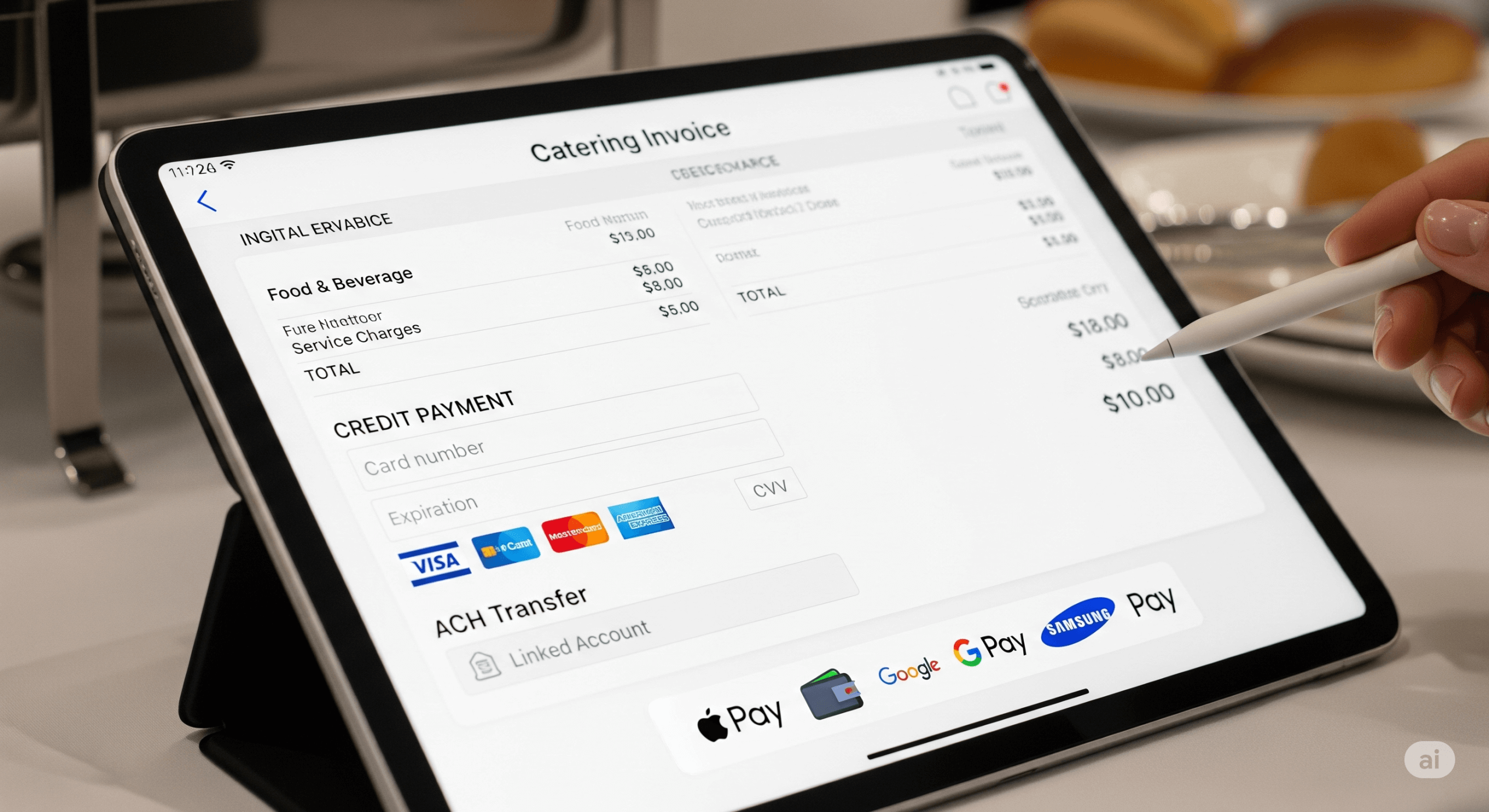
Not all payment solutions are designed with the unique needs of caterers in mind. While generic systems handle basic transactions, catering businesses benefit from specialized features that address event complexity, customer diversity, and dynamic billing needs. Here are the most important features to look for in an integrated payment processing for catering solution.
Online Invoicing and Event Billing
Paper invoices are outdated, often delayed, and prone to errors. Online invoicing provides a fast, transparent, and professional way to bill clients. Event billing ensures that every line item—from menu customizations to rental equipment—is clearly listed. This level of transparency not only reduces disputes but also fosters client trust. Automated receipts further confirm payment completion in real time, eliminating ambiguity.
Consider a catering company managing a destination wedding. Guests may request last-minute menu upgrades or additional services like a late-night snack station. With online invoicing, the caterer can instantly update the bill and send it to the client, who can approve and pay the difference immediately. This agility ensures that changes do not disrupt the financial process, keeping both parties satisfied.
Event billing also provides historical data that is invaluable for financial forecasting. If recurring add-ons or upgrades are noticed, caterers can adjust base pricing or offer package deals. In this way, invoicing becomes not just a financial record but also a tool for strategic planning.
POS Integration and Real-Time Reporting
On-site sales—such as bar tabs or additional guest meals—are common in catering. Without POS integration, these transactions may not sync with the main financial system, causing discrepancies. Integrated POS ensures that every payment, whether online or at the event, is captured in real time. This synchronization eliminates manual data entry and ensures accuracy across all accounts.
Real-time reporting transforms raw transaction data into actionable insights. Caterers can track revenue streams, identify top-selling items, and monitor outstanding balances at any given moment. For instance, a caterer may discover that plated dinners generate higher margins than buffets, prompting adjustments in future proposals. Reports can also reveal seasonal trends, such as increased beverage sales during summer weddings.
In addition to operational insights, real-time reporting provides critical financial control. Owners can quickly spot overdue balances and take proactive steps, such as sending automated reminders. This level of oversight ensures that businesses maintain steady cash flow and minimize financial surprises.
Multi-Currency and Payment Flexibility
In an increasingly global market, caterers often serve international clients or handle destination events. Multi-currency support allows businesses to accept payments in different currencies without confusion or excessive conversion fees. For a destination wedding in Italy, for example, a U.S.-based couple could pay in dollars while local vendors settle in euros, all within the same integrated system.
Flexibility extends beyond currency. Features like split payments let multiple stakeholders share costs easily. A corporate retreat might require payments from both the company’s HR department and its marketing division. Split payment functionality prevents delays by enabling both parties to contribute independently. Contactless and digital wallet payments further enhance flexibility by catering to tech-savvy clients who value convenience above all.
By offering a variety of payment options, caterers reduce friction at checkout. Clients who might otherwise hesitate due to limited options are more likely to finalize their bookings promptly. Flexibility in payment methods directly translates into higher conversion rates and improved customer satisfaction.
Benefits of Integrated Payment Processing for Catering Businesses
While features define what a payment system can do, the real value comes from the benefits those features provide. Integrated payment processing for catering doesn’t just simplify transactions; it transforms the way caterers manage their finances, interact with clients, and grow their business. From financial management to customer satisfaction, these benefits extend into every aspect of catering operations.
Streamlined Financial Management
One of the greatest challenges caterers face is juggling multiple events, each with its own payment schedules, deposits, and balances. Without a centralized system, this can quickly spiral into financial disarray. Integrated payment processing creates a unified hub where all financial activities are tracked and managed. Deposits, recurring billing, and event-specific charges are automatically logged and reconciled, leaving little room for human error. This reduces the administrative burden and ensures financial accuracy, even when managing dozens of events simultaneously.
For example, a catering company managing three weddings, two corporate luncheons, and a private anniversary party in a single week can easily lose track of outstanding balances without a unified system. With integration, every payment is connected to the respective event contract, making it clear what has been paid and what remains due. This eliminates confusion for both the caterer and the client, ensuring transparency at every step. Such efficiency allows caterers to operate with confidence, knowing that their financial records are reliable and up to date.
The impact of streamlined management also extends to tax preparation and compliance. By maintaining accurate, automated records, caterers minimize the stress of audits and end-of-year reporting. Financial professionals can access clean, well-organized data that reduces preparation time and potential mistakes, ultimately saving the business both time and money.
Enhanced Customer Experience
Client experience doesn’t end with the meal—it extends to every interaction, including how payments are handled. A smooth, professional payment process demonstrates that a caterer values both efficiency and client convenience. From online invoicing to automated receipts, integrated systems deliver a polished experience that clients notice and appreciate. This professionalism creates confidence and strengthens client relationships, encouraging repeat business and referrals.
Imagine a bride booking a wedding caterer. She receives a digital invoice that outlines every detail of the service, along with clear payment options such as credit card, ACH transfer, or digital wallet. When she makes a deposit, she instantly receives an automated receipt, giving her peace of mind. Later, when last-minute changes add to the bill, she can log in, view the updated invoice, and make a quick online payment without the stress of back-and-forth communication. This level of simplicity makes her overall experience enjoyable, even beyond the event itself.
Positive payment experiences also create a reputation for reliability. Event planners, who often work with multiple vendors, prefer caterers who simplify processes. By offering seamless, integrated payment options, caterers stand out as professional partners who understand the complexities of event management. This reputation can become a key differentiator in a competitive market.
Data-Driven Business Growth
Every transaction processed through an integrated system generates valuable data. This includes not only the amount and date of payment but also insights into client behavior, preferences, and spending patterns. With real-time reporting and analytics, caterers can turn this data into actionable strategies that drive growth. For instance, identifying high-margin menu items or frequently requested add-ons allows caterers to refine their offerings for maximum profitability.
Data also supports better financial forecasting. By reviewing seasonal payment patterns, a catering company may discover that summer weddings consistently generate higher beverage sales, while corporate holiday parties produce larger dessert orders. This allows businesses to prepare inventory and staffing accordingly, reducing waste while increasing customer satisfaction. Insights from recurring billing and multi-currency transactions can further reveal which client segments generate the most consistent revenue streams.
In addition, data-driven insights empower targeted marketing. If the system shows that a significant portion of clients pays with digital wallets, a caterer can emphasize this feature in advertising to attract tech-savvy clients. By leveraging payment data, catering businesses can make informed decisions that directly enhance revenue, client loyalty, and long-term stability.
Technology Behind Seamless Payment Processing
Behind the convenience of integrated payment processing for catering lies sophisticated technology that ensures speed, security, and accuracy. Understanding how these systems work helps caterers choose the right solutions and builds confidence in both clients and staff. This section explores the technical foundations that power seamless payments, from gateways to mobile technology.
Payment Gateways and Fraud Prevention
Payment gateways are the backbone of modern payment systems. They securely transmit payment data between the client’s bank and the caterer’s account, ensuring every transaction is authorized and completed correctly. Advanced gateways use encryption protocols to protect sensitive information like credit card numbers. This is essential in catering, where high-value transactions are common and the stakes are particularly high.
Fraud prevention tools embedded in payment gateways add another layer of protection. Features like real-time monitoring, address verification, and two-factor authentication reduce the risk of unauthorized transactions. For example, a system might flag a suspicious transaction if a card typically used in one country suddenly attempts a large payment in another. Such proactive measures protect both the caterer and the client, avoiding chargebacks that could damage profitability and trust.
Clients value security. When a catering company can confidently explain that their system is PCI-compliant and equipped with state-of-the-art fraud prevention, it reassures customers that their data and funds are safe. This confidence can be the deciding factor when clients choose between two otherwise similar vendors.
Mobile Payments and Contactless Technology
Mobile and contactless payments have transformed the way customers interact with businesses. For caterers, adopting these technologies is not just about keeping up with trends—it’s about providing speed and flexibility at events where efficiency is critical. Mobile POS devices allow staff to process payments directly at tables, food stations, or event entrances, eliminating long lines and delays. This improves both service flow and guest satisfaction.
Contactless technology, including NFC (near-field communication), has gained massive popularity in recent years. Guests can pay for additional drinks, upgrades, or late-night snack services with a quick tap of their smartphone or card. This not only reduces transaction times but also minimizes physical contact, an increasingly important consideration in a post-pandemic world. For busy events like festivals or conferences, the ability to process payments quickly keeps revenue flowing and guests happy.
From a business perspective, offering mobile and contactless payments signals adaptability. Clients see the caterer as forward-thinking and technologically advanced, qualities that are particularly attractive to younger, tech-savvy customers. This adaptability can directly influence a client’s decision to book, especially when comparing multiple vendors.
Integration with Catering Business Software
The most powerful systems are those that integrate directly with catering business software. This means contracts, invoices, customer records, and financial transactions all connect within a single ecosystem. When a client signs a digital contract that includes payment terms, the system automatically generates the invoice and updates the payment schedule. Any adjustments to the contract instantly reflect in the billing system, eliminating the need for manual updates.
This level of integration reduces the risk of errors and saves time for staff. Instead of re-entering data across multiple platforms, everything flows seamlessly from one process to the next. For example, if a client requests a menu change that increases costs, the system updates the invoice, sends a notification, and allows the client to pay online—all without manual intervention. This creates a flawless workflow that enhances efficiency and client satisfaction.
Integration also strengthens long-term financial management. By combining customer databases with payment histories, caterers can create detailed profiles for each client. These profiles reveal preferences, spending patterns, and potential upselling opportunities. In this way, technology not only simplifies day-to-day operations but also drives strategic growth.
How to Choose the Right Integrated Payment Solution
With so many providers on the market, choosing the right system for integrated payment processing for catering can feel overwhelming. The best choice depends on a business’s size, client base, and long-term goals. Careful evaluation of security, features, and costs ensures that caterers select a system that delivers lasting value. Here are the most critical factors to consider.
Prioritizing Security and Compliance
Security should never be an afterthought. Catering businesses often process high-value transactions, making them attractive targets for fraud. Choosing a provider that complies with PCI DSS (Payment Card Industry Data Security Standard) is essential. Compliance ensures that sensitive information is protected with encryption, tokenization, and secure storage practices. Without these safeguards, businesses risk both financial losses and reputational damage.
Beyond compliance, advanced fraud prevention features provide peace of mind. These include identity verification, risk scoring, and automated alerts for suspicious activity. For example, if a payment attempt comes from an unusual IP address or involves an unusually high amount, the system may require additional verification before approval. This protects caterers from chargebacks, which can be costly and time-consuming to resolve.
Clients also notice when a provider prioritizes security. Being able to explain your system’s compliance and fraud protection features builds trust and confidence, often tipping the scale in your favor when clients compare vendors.
Evaluating Features and Flexibility
Not all caterers require the same features. A small boutique caterer may prioritize simple invoicing and low transaction fees, while a large operation managing dozens of events simultaneously may need advanced tools like recurring billing, contract management, and multi-currency support. Evaluating features against business needs ensures that the chosen system adds real value rather than unnecessary complexity.
Flexibility is equally important. A good payment system should scale as the business grows, supporting more transactions, multiple event types, and even international clients. For example, a caterer that primarily handles local weddings today may expand into corporate events or destination weddings tomorrow. Choosing a flexible system ensures that the business doesn’t outgrow its technology, avoiding costly migrations later on.
When comparing systems, it’s wise to think ahead. Ask whether the platform integrates with catering-specific software, whether it supports mobile and contactless payments, and whether it can adapt to future changes in client preferences. Flexibility ensures longevity, making the investment worthwhile.
Balancing Costs and Value
Price often plays a major role in decision-making, but focusing solely on fees can be short-sighted. Low-cost systems may save money upfront but lack essential features like fraud prevention, real-time reporting, or responsive customer support. These shortcomings can create hidden costs in the form of errors, chargebacks, and lost clients. Instead of choosing the cheapest option, caterers should evaluate the overall value delivered by the system.
For instance, a system that charges slightly higher transaction fees but provides instant deposits and automated invoicing may ultimately save more money by improving cash flow and reducing administrative labor. Similarly, strong analytics tools can help increase revenue by identifying growth opportunities. When viewed through this lens, value often outweighs raw cost.
Balancing costs with features ensures that the system not only fits the budget but also contributes directly to business growth. This approach prevents underinvestment in tools that are critical to long-term success.

Why Biyo POS is the Best Choice for Caterers
For catering businesses seeking a robust, reliable, and feature-rich solution, Biyo POS offers everything needed to succeed. Designed specifically with foodservice businesses in mind, Biyo POS provides integrated payment processing that covers online invoicing, deposit tracking, and event billing. It also includes advanced features like real-time reporting, customer database management, and fraud prevention tools that are tailored for catering’s unique challenges.
Biyo POS goes beyond payment processing by seamlessly integrating with POS systems and catering management tools. This creates a complete ecosystem where contracts, invoices, and transactions flow together without manual input. Staff can focus on delivering exceptional service while the system handles financial accuracy in the background. With support for mobile and contactless payments, Biyo POS ensures clients enjoy the convenience they expect in today’s market.
By choosing Biyo POS, caterers gain more than just a payment processor—they gain a partner in growth. Whether managing intimate gatherings or large corporate functions, Biyo POS delivers the tools, flexibility, and reliability that catering businesses need to thrive in a competitive industry.
FAQ: Integrated Payment Processing for Catering
What is integrated payment processing for catering?
It’s a system that combines invoicing, billing, and secure payment handling into one platform. This allows caterers to manage deposits, track balances, and process payments efficiently while offering clients multiple payment options such as credit cards, ACH transfers, and digital wallets.
Why do caterers need integrated payment processing?
Caterers deal with complex financial workflows that include deposits, last-minute changes, and shared costs between multiple stakeholders. Integrated systems simplify these processes, reduce errors, and improve cash flow. They also enhance client satisfaction by offering seamless, modern payment options that match today’s expectations.
Which payment methods are most important for catering businesses?
The most important methods include credit card processing, ACH transfers, mobile and contactless payments, and digital wallets like Apple Pay and Google Pay. Split payments and multi-currency support are also critical for destination events and international clients.
Is integrated payment processing secure?
Yes. Reputable providers are PCI-compliant and use encryption, tokenization, and fraud prevention tools to protect transactions. These measures reduce liability for caterers and reassure clients that their data is safe, which is essential when handling high-value payments.
How does Biyo POS help with catering payments?
Biyo POS provides a catering-focused platform with features like deposit tracking, online invoicing, contract management, and real-time reporting. Its integrated payment processing system ensures fast, secure, and flexible transactions, making it one of the most effective solutions for modern caterers.