
Implementing dual pricing credit card processing canada programs allows independent business owners to protect their operating margins from escalating transaction fees. Every time a customer taps a rewards credit card or waves a smartphone over a payment terminal, a slice of revenue vanishes. Between interchange rates, card network assessments, and processor markups, Canadian retailers and restaurateurs routinely surrender 2.5% to 3.5% of gross sales to payment providers. On standard retail margins of 8% to 15%, payment processing overhead consumes up to a third of total net profit. Consequently, absorbing these expenses as an unavoidable cost of doing business is no longer sustainable.
For decades, retail fuel stations across North America relied on a transparent pricing model. By displaying two distinct prices—one for physical cash and one for credit cards—gas stations demonstrated that payment convenience carries overhead. Today, that identical framework is expanding into main-street storefronts, casual dining rooms, and specialty service counters across Canada. Adopting a structured dual pricing payment processing model allows business owners to offset merchant service fees completely. Customers who choose electronic convenience cover the cost of card acceptance, while patrons who tender cash or Interac debit enjoy immediate savings.
However, operating a fee-recovery program in Canada requires careful attention to provincial consumer protection statutes, federal competition guidelines, and card network operating regulations. While credit card surcharging faces strict restrictions across specific provinces, dual pricing offers a reliable, legally compliant alternative nationwide. This comprehensive merchant guide breaks down the legal mechanics, point-of-sale software configurations, and financial models required to implement dual pricing successfully across Canadian retail and hospitality environments.
Table of Contents
- The Reality of Credit Card Processing Fees for Canadian Small Businesses
- What Is Dual Pricing and How Does It Work on POS Terminals?
- Dual Pricing vs. Surcharging: Provincial Compliance and Quebec Laws
- POS Hardware and Terminal Software: Native Setups vs. Third-Party Apps
- Financial Impact Analysis: A $30,000 Monthly Volume ROI Breakdown
- Five Operational Rules for Running Dual Pricing in Canada
- Side-by-Side Comparison
- How Biyo POS Automates Compliant Dual Pricing for Canadian Merchants
- Frequently Asked Questions
The Reality of Credit Card Processing Fees for Canadian Small Businesses
Navigating merchant account statements in Canada can be confusing for independent business owners. When you review your monthly merchant processing statement, the total deduction rarely reflects a simple flat percentage. Instead, Canadian merchant service providers bundle wholesale card fees, processor margins, and network assessments into opaque billing summaries.
Consequently, failing to understand your underlying rate structure makes it difficult to control operating expenses. Analyzing wholesale payment costs reveals why transaction overhead continues to rise for Canadian storefronts.
Interchange-Plus Pricing and the Hidden Drain on Merchant Margins
Most established Canadian businesses process payments under an interchange-plus pricing canada schedule. Under this transparent framework, your merchant service provider (MSP) passes wholesale interchange and network assessment costs directly to your business, adding a fixed contractual markup. While interchange-plus pricing provides transparent billing, wholesale costs vary significantly depending on the specific card presented at your terminal:
- Standard Consumer Credit Cards: Basic, non-rewards Visa and Mastercard transactions carry modest wholesale interchange rates averaging 1.20% to 1.50%.
- Premium and Travel Rewards Cards: Cards featuring premium cash-back points or travel rewards carry wholesale interchange rates reaching 2.00% to 2.45%.
- Corporate and Commercial Cards: Corporate cards used by business clients frequently exceed 2.60% in base interchange costs.
- Card-Not-Present Transactions: Invoicing, online checkout, and phone orders carry higher fraud risk tiers, pushing card-not-present interchange rates above 2.70%.
- Network Brand Assessments: Visa and Mastercard assess separate card brand fees (currently 0.09% to 0.11%) on every transaction volume dollar.
- Interac Debit Processing Fees: In contrast to percentage-based credit cards, interac debit processing fees operate on flat, low-cost per-transaction fees (typically $0.03 to $0.12 per tap).
When you combine these variable components, your effective processing rate often climbs toward 3.0%. For an independent retail shop operating on thin margins, these transaction fees silently erode profitability.
The Federal Interchange Fee Reductions and CFIB Eligibility Caps
To address rising merchant complaints, the Canadian federal government and the Canadian Federation of Independent Business (CFIB) negotiated landmark fee relief agreements with Visa and Mastercard. Under these federal agreements, the payment networks agreed to reduce weighted average in-store interchange rates to 0.95% for eligible small enterprises.
However, these federal fee caps include strict qualification boundaries:
- Volume Threshold Restrictions: The reduced interchange caps apply exclusively to independent businesses generating less than $300,000 in annual Visa sales volume and under $175,000 in annual Mastercard sales volume.
- Exclusion of Growing Businesses: Once your annual card volume crosses these thresholds, your business graduates out of the preferential rate tier, exposing your margins to full commercial interchange rates.
- E-Commerce Exclusions: Online and card-not-present transactions carry a higher weighted average cap of approximately 1.07%, leaving digital merchants with elevated baseline costs.
- Processor Margin Retention: Non-qualifying corporate charge cards and ultra-premium cards remain exempt from the lowest caps, allowing overall processing costs to stay elevated.
Because government-negotiated relief excludes many mid-sized merchants, independent owners need a reliable method for how to eliminate credit card processing fees canada permanently. Structured dual pricing delivers that margin defense.
 What Is Dual Pricing and How Does It Work on POS Terminals?
 What Is Dual Pricing and How Does It Work on POS Terminals?
A dual pricing program is an operational billing framework where a merchant displays two distinct prices for every product or service: a standard card price and a discounted cash or debit price. Rather than absorbing credit card processing fees as an unbudgeted loss, the merchant builds card acceptance costs directly into the regular posted price. When a customer tenders physical cash or Interac debit, the system applies an automatic, visible discount.
Therefore, understanding how does dual pricing work on pos terminals ensures that your business can deploy split pricing without slowing down customer lines.
Mathematical Blueprint: Offsetting Processing Overhead Transparently
To understand how dual pricing protects merchant margins, consider a standard retail transaction in an Ontario boutique. In a traditional pricing scenario, the boutique sells an artisan jacket for $100.00 CAD. When the customer pays with a premium credit card carrying a 3.0% effective rate, the merchant surrenders $3.00 to the payment processor, netting only $97.00.
Under an optimized dual pricing architecture, the financial mechanics operate with total margin protection:
- Target Cash Margin: The business establishes its baseline target revenue for the item ($100.00).
- Posted Card Price Calibration: The regular price across all physical shelf tags and catalog listings is set at $104.00 (reflecting a 4.0% card processing buffer).
- Electronic Card Execution: When a customer pays with a credit card, the register charges the regular posted price of $104.00. The built-in buffer absorbs the $3.64 processing fee, and the boutique nets its full $100.36 margin target.
- Cash or Interac Tender Execution: When the customer pays with physical cash or Interac debit, the POS terminal software automatically deducts the 3.85% line-item concession (-$4.00), billing the customer exactly $100.00.
Consequently, your gross profit remains perfectly stable across every transaction, transferring electronic processing overhead entirely away from your operating balance sheet.
Dual Pricing vs. Traditional Cash Discount Programs
While practitioners frequently use the terms interchangeably, examining dual pricing vs cash discount differences reveals distinct presentation workflows:
- Standard Cash Discounting: The business displays a single regular price across physical shelf tags, menus, and online storefronts. Under network operating regulations, this posted price must always represent the higher card price. When the shopper reaches the cash register and tenders cash, the terminal software calculates an automatic line-item discount on the final printed receipt.
- Side-by-Side Dual Pricing: The merchant explicitly presents both prices side by side across every customer touchpoint. Menu boards, clothing tags, and digital customer displays explicitly show: “Cash/Debit: $25.00 | Credit Card: $26.00.” Shoppers see the exact price for each payment tender before reaching the checkout counter, creating absolute transparency.
By presenting both payment rates side by side, dual pricing eliminates checkout surprises and builds customer trust.
Dual Pricing vs. Surcharging: Provincial Compliance and Quebec Laws
Understanding the difference between dual pricing vs surcharging is critical for Canadian business owners. While both strategies aim to recover transaction overhead, their legal standing, card network rules, and provincial consumer protection requirements differ dramatically.
Confusing these two pricing frameworks can expose your business to severe regulatory penalties and customer friction.
The 2.4% Surcharge Settlement and Quebec Consumer Protection Act Restrictions
In October 2022, a multi-million-dollar class-action settlement between Canadian merchants, Visa, and Mastercard took effect across Canada. This landmark settlement eliminated the payment networks’ historical “No-Surcharge Rule,” permitting Canadian merchants to add a surcharge to credit card payments.
However, credit card surcharging remains tightly bound by complex provincial and network restrictions:
- The 2.4% Visa/Mastercard Cap: Under established credit card surcharging rules visa mastercard canada, merchants can never assess a surcharge higher than 2.4%, or their actual cost of card acceptance, whichever is lower. If your effective rate is 2.8%, you cannot legally surcharge the remaining 0.4%.
- Mandatory 30-Day Network Notice: Merchants must submit formal written notification to their payment processor and the card brands at least 30 days before initiating surcharges.
- Quebec Surcharge Prohibition: Surcharging is effectively prohibited in Quebec. Under Section 224(c) of the Quebec Consumer Protection Act (Loi sur la protection du consommateur), merchants cannot demand a price higher than the advertised price. Because a surcharge adds a fee at the cash register, Quebec courts consider surcharges an unlawful price increase.
- Dual Pricing Compliance in Quebec: Conversely, is dual pricing legal in canada and Quebec? Yes. Dual pricing and cash discount programs are 100% legal in Quebec and all other provinces. Because the regular advertised price reflects the card price (or both prices are posted side by side), the merchant never demands more than the advertised price. Offering an immediate discount for cash or Interac complies fully with Quebec consumer protection laws.
Federal Drip Pricing Rules Under the Canadian Competition Act
In addition to provincial statutes, Canadian business owners must comply with strict federal competition rules. Recent legislative amendments to the federal Competition Act explicitly outlaw “drip pricing” across Canada.
Drip pricing involves advertising an unattainable headline price and tacking on mandatory or unexpected fees as the transaction progresses:
- Surcharge Audit Vulnerability: If a merchant displays a retail product for $20.00 but appends a 2.4% fee at the register without clear prior disclosure, the merchant risks violating civil and criminal drip pricing statutes.
- The Dual Pricing Safe Harbor: Dual pricing eliminates drip pricing exposure. Because the highest possible price (the card price) is clearly stated upfront, no hidden fees are added at checkout. Customers are presented with an honest choice: pay the regular posted card price or take advantage of an instant cash discount.
Adopting dual pricing ensures complete compliance across the Competition Bureau, provincial ministries, and payment card brand audit teams.
POS Hardware and Terminal Software: Native Setups vs. Third-Party Apps
Executing dual pricing smoothly requires modern point-of-sale technology. If your sales associates have to calculate discounts manually or tap complex manager override keys, checkout lines will stall, and reconciliation errors will multiply.
Evaluating your hardware setup helps you determine whether your POS handles split pricing natively or requires complicated third-party add-ons.
Comparing Proprietary Terminal Workflows Across Canadian Providers
Many legacy Canadian payment terminals struggle to manage dynamic split pricing without friction:
- Moneris and Global Payments Standalone Terminals: Traditional standalone payment terminals supplied by major Canadian acquirers often require manual keying of surcharge percentages or separate flat fees. These setups create reconciliation headaches during daily end-of-day batch balancing.
- Clover POS Systems: Clover supports dual pricing and cash discounting, but the native register software lacks built-in split pricing. Merchants must install paid third-party applications from the Clover App Market, introducing recurring monthly software fees.
- Square Terminal and Standalone Gateways: Square permits credit card surcharging in eligible provinces up to the 2.4% cap, but it does not support native automated dual pricing with customer-facing split displays out of the box. Merchants must create cumbersome manual discount buttons to reward cash transactions.
- Lightspeed Retail and Restaurant: Lightspeed handles cash discounting through manual discount structures or specialized payment gateway integrations, but configuring dynamic side-by-side terminal prompts often requires custom technical setup.
Configuring Automated Split Pricing on Open Cloud POS Software
Modern cloud point-of-sale platforms eliminate terminal friction by engineering dual pricing directly into the checkout software core. With advanced payment terminal dual pricing software, the master inventory catalog stores both pricing tiers automatically.
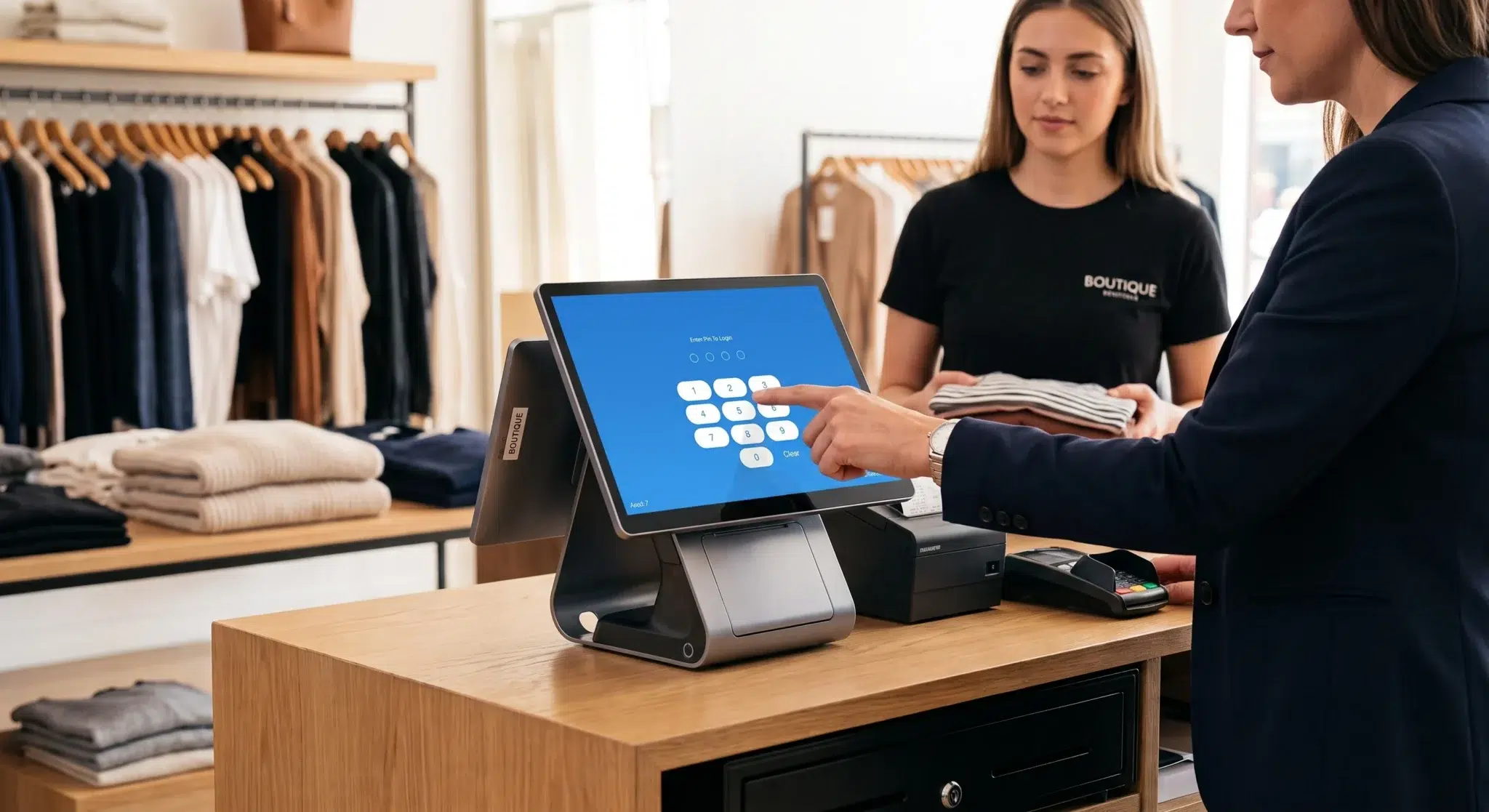
When an employee scans a barcode or selects an item from the touchscreen, the register software calculates both totals instantly. Customer-facing displays present the split totals in real time: “Cash/Debit: $45.00 | Card: $46.80.” When the associate selects the payment method, the software routes the transaction correctly without cashier calculations. Furthermore, the receipt printer generates a compliant, itemized sales slip documenting the exact cash discount, ensuring clean bookkeeping for Canadian sales taxes (GST/PST/HST).
Financial Impact Analysis: A $30,000 Monthly Volume ROI Breakdown
To understand why small businesses are shifting away from traditional fee absorption, examine the real-world economics of payment processing. Credit card fees represent an ongoing drain on operating capital that grows larger with every dollar of gross sales.
Examining a standard Canadian business scenario highlights the substantial savings delivered by a dual pricing program.
Baseline Processing Cost Audit for a Canadian Retailer or Restaurant
Consider an independent retail store or casual restaurant in Calgary generating $40,000 CAD in total monthly sales. The store collects $10,000 in physical cash and Interac debit, and $30,000 across various credit cards:
- Gross Credit Card Processing Volume: $30,000 CAD per month.
- Wholesale Interchange Fees: Blended average interchange of 1.75% across standard, rewards, and corporate cards ($525.00).
- Card Brand Assessment Fees: Visa and Mastercard network assessments of 0.10% ($30.00).
- Processor Markups and Gateway Fees: Standard MSP markup of 0.35% plus $0.10 per transaction ($135.00).
- PCI Compliance and Statement Charges: Monthly account maintenance, regulatory compliance, and terminal rental charges ($75.00).
- Total Monthly Processing Overhead: $765.00 CAD (an effective rate of 2.55%).
Under this traditional arrangement, the business owner surrenders more than $9,180 CAD in hard profits every single year strictly for processing card transactions.
Net Margin Recovery and Annual Cash Flow Optimization
When this same business transitions to a modern dual pricing program, the monthly financial picture transforms immediately:
- Adjusted Posted Pricing Structure: The merchant adjusts posted catalog prices by 3.5% to absorb electronic card processing costs.
- Cardholder Processing Contribution: Customers who choose to pay with credit cards pay the regular posted price, fully absorbing the $765.00 monthly processing expense.
- Cash and Debit Customer Savings: Customers who tender cash or Interac debit receive an automatic 3.5% discount at checkout, rewarding them for utilizing lower-cost payment instruments.
- Net Monthly Capital Recovered: The merchant recovers approximately $700.00 to $765.00 CAD per month in operating profit.
- Annual Profit Reinvestment: Over a twelve-month operating cycle, the business retains between $8,400.00 and $9,180.00 CAD in net revenue.
This recovered cash flow can be reinvested into employee wages, store renovations, inventory expansion, or local marketing campaigns.
Five Operational Rules for Running Dual Pricing in Canada
To maintain compliance with consumer protection agencies, card networks, and federal regulations, merchants must manage their pricing programs with complete transparency.
Enforcing these five operational guardrails ensures that your dual pricing program operates legally and preserves customer goodwill.
Posted Price Transparency and Mandatory Countertop Disclosures
Customer transparency begins before a transaction ever takes place:
- Rule 1 (The Advertised Price Standard): Your posted or advertised price must always be the credit card price, or you must display both cash and card prices side by side. Never display a low cash price on shelf tags and tack on an unexpected fee at checkout. In Quebec, displaying only the cash price and charging more at the counter directly violates the Consumer Protection Act.
- Rule 2 (Prominent Entry and Countertop Signage): Install clear, professional signage at all store entrances and checkout stations. Disclosures must be placed within direct view of the payment terminal, stating: “All posted prices reflect our standard payment card price. As an incentive to our valued patrons, an instant discount is applied to all purchases completed with physical cash or Interac debit.”
Receipt Line-Item Clarity and Interac Debit Card Treatment
Backend software mechanics must maintain equal precision:
- Rule 3 (Itemized Sales Receipts): The customer receipt must explicitly detail the transaction math. When cash or debit is tendered, the receipt must print the regular item price, display a clear line item labeled CASH DISCOUNT with the subtracted dollar amount, and print the final net total paid. The discount must never appear as a positive “technology fee” or “service surcharge.”
- Rule 4 (Strict Interac Debit Protection): Under the Code of Conduct for the Credit and Debit Card Industry in Canada, debit cards must be treated with care. In Canada, merchants cannot apply credit card surcharges to Interac debit cards. Under dual pricing, Interac debit should either qualify for the discounted cash price or process at the baseline regular price without added fees.
- Rule 5 (Card Network Non-Discrimination): Your pricing policy must apply equally across all credit card brands. A merchant cannot offer a cash discount against Visa while disallowing it for Mastercard or American Express. All payment networks must be treated consistently under your posted pricing rules.
Side-by-Side Comparison
| Operational & Compliance Metric | Traditional Fee Absorption | Credit Card Surcharging (2.4% Cap) | Compliant Dual Pricing (Biyo POS) |
|---|---|---|---|
| Monthly Processing Fee Impact | 2.5% to 3.5% drained from gross margins | Partially recovered (capped at 2.4% maximum) | 100% neutralized through card price calibration |
| Quebec Legal Compliance | Fully legal | Prohibited under Consumer Protection Act § 224 | 100% Legal across Quebec and all Canadian provinces |
| Federal Competition Act (Drip Pricing) | Zero compliance risk | High audit risk if fees are added unexpectedly | Fully compliant (card price is clearly displayed upfront) |
| Card Brand Surcharge Restrictions | Not applicable | Strict 2.4% cap; requires 30-day network notice | No card network caps apply to discount programs |
| Interac Debit Card Compliance | Fully compliant | Surcharging debit violates Canadian Code of Conduct | Fully compliant (debit receives cash discount or regular rate) |
| Customer-Facing Display Setup | Single standard price | Terminal adds fee percentage at final prompt | Customer screen dynamically displays Cash and Card totals |
| Point-of-Sale Hardware Flexibility | Standard terminals | Requires custom terminal surcharge injection | Runs natively on open hardware, tablets, and Chrome |
| Customer Perception & Psychology | Neutral, but merchant absorbs all costs | Negative (customer feels penalized for card use) | Positive (customer feels rewarded for cash/debit savings) |
How Biyo POS Automates Compliant Dual Pricing for Canadian Merchants
 How Biyo POS Automates Compliant Dual Pricing for Canadian Merchants
Biyo POS delivers a specialized cloud point-of-sale and retail management operating system engineered specifically to help Canadian business owners eliminate card processing overhead legally and transparently. Operating natively inside the Google Chrome web browser on any standard PC, Mac, iPad, or Android tablet, Biyo provides enterprise-grade dual pricing automation without locking merchants into expensive proprietary hardware contracts.
Native Dual-Price Engine and Dynamic Customer Displays
With Biyo’s automated dual pricing engine, mastering cash discount program for small businesses canada workflows is simple. Operators enter catalog pricing once, and Biyo automatically maintains both cash and credit card rates across your entire inventory. When a sales associate scans merchandise, customer-facing screens dynamically present both totals side by side in real time, creating absolute checkout transparency. When cash or Interac tender is selected, Biyo applies the exact line-item discount automatically, prints a compliant itemized receipt, and triggers the cash drawer without requiring manual staff calculations.
Hardware Freedom, Mobile Scanning, and Offline Reliability
Furthermore, Biyo synchronizes your checkout counter with a comprehensive suite of modern store management tools. Retail teams can utilize the Biyo Inventory Scanner app on the Apple App Store to conduct high-speed barcode inventory audits and print dual-price shelf labels directly on the sales floor. If your venue includes restaurant, cafe, or bakery operations, route kitchen orders smoothly using the Biyo Kitchen Display (KDS) app available on Google Play, or consolidate multi-station channels through Kitchen Hub. Best of all, Biyo’s true offline transaction mode ensures that even during unexpected internet service disruptions, your registers continue ringing up customer sales, applying automated discounts, and printing compliant receipts without missing a beat.
To discover how easily your Canadian business can eliminate payment processing fees and deploy compliant dual pricing, you can schedule a live demo with a point-of-sale specialist or create your account today on the Biyo signup page.
Frequently Asked Questions
Is dual pricing legal across all Canadian provinces?
Yes. Dual pricing and cash discounting are 100% legal across all Canadian provinces and territories, including Quebec, because the posted regular price reflects the card price and cash/debit payers receive an immediate discount.
Why is credit card surcharging restricted in Quebec while dual pricing is allowed?
Quebec’s Consumer Protection Act (Section 224c) prohibits merchants from demanding a price higher than the advertised price, making checkout surcharges illegal; dual pricing complies because the advertised price is the maximum card price, and cash payers pay less.
How does dual pricing differ from credit card surcharging in Canada?
Surcharging adds an extra fee (capped at 2.4%) onto an existing cash price when a credit card is used, whereas dual pricing establishes the regular price at the card rate and provides a discount for cash or Interac debit payments.
Can Canadian merchants apply dual pricing to Interac debit transactions?
Yes. Under Canadian card brand regulations and the Code of Conduct, merchants cannot surcharge Interac debit, but they are fully permitted to include Interac debit alongside cash as an eligible discounted payment tender under a dual pricing structure.
What are the Canadian federal interchange fee caps for small businesses?
The Canadian government agreement caps weighted average in-store interchange fees at 0.95% for eligible small businesses generating under $300,000 in annual Visa volume and under $175,000 in annual Mastercard volume.
How does Biyo POS handle sales taxes with dual pricing in Canada?
Biyo POS calculates Canadian sales taxes (GST, PST, or HST) automatically based on the final discounted sale amount, ensuring complete tax compliance and accurate bookkeeping on itemized customer receipts.