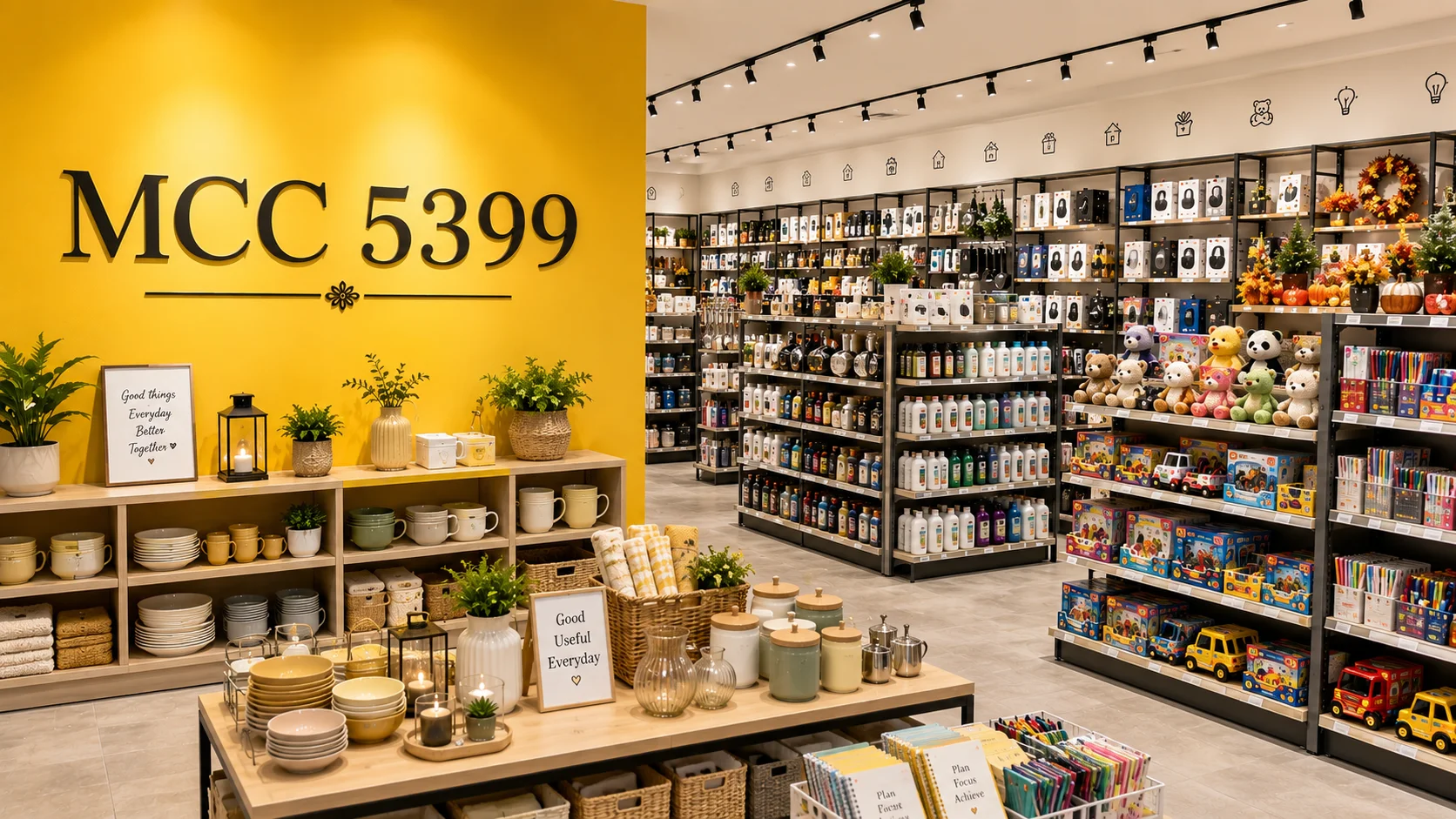

Not every retailer fits neatly into a traditional retail category. Some businesses offer an eclectic mix of products designed to meet a wide variety of customer needs, making them difficult to classify as department stores, specialty retailers, or convenience shops. These merchants often attract shoppers looking for practical household goods, seasonal merchandise, gifts, personal accessories, and other everyday products—all under one roof.
Businesses in this category are commonly classified under Merchant Category Code (MCC) 5399. Payment processors, acquiring banks, and major card networks use this Merchant Category Code to identify merchants whose primary business involves selling miscellaneous general merchandise that does not fall within another specific retail classification. Although shoppers rarely see these codes, they play an important role in payment processing, merchant reporting, transaction categorization, and certain credit card rewards programs.
This guide explains what MCC 5399 covers, the types of businesses that qualify, the products commonly sold, why proper merchant classification matters, and how modern retail technology helps miscellaneous general merchandise retailers operate efficiently in today’s competitive marketplace.
Table of Contents
Understanding MCC 5399
What Is Merchant Category Code 5399?
MCC 5399 is the Merchant Category Code assigned to miscellaneous general merchandise stores that primarily sell a broad assortment of products but do not fit into a more specialized retail category. Rather than focusing on a single product line, these merchants typically stock merchandise across multiple departments, allowing customers to purchase a variety of everyday items during a single shopping trip.
This category often includes independent retailers and specialty general merchandise businesses whose inventory spans several product groups without being dominated by one particular category.
How Payment Networks Use MCC 5399
Whenever a customer pays with a credit or debit card, the transaction includes a Merchant Category Code that identifies the merchant’s primary business activity. Card networks, acquiring banks, and payment processors use MCC 5399 to classify miscellaneous general merchandise retailers, helping organize transaction reporting, support fraud monitoring, improve merchant analytics, and determine eligibility for certain credit card reward programs.
Although this classification operates behind the scenes, it contributes to more consistent payment processing across the retail industry.
Why Correct Merchant Classification Matters
Businesses should always be classified according to their primary business activity. A retailer selling a broad mix of general merchandise may qualify under MCC 5399, while businesses specializing in apparel, electronics, books, groceries, or home furnishings are typically assigned different Merchant Category Codes. Accurate classification supports reliable reporting and helps payment providers maintain consistent merchant records.
 Businesses Classified Under MCC 5399
 Businesses Classified Under MCC 5399
Independent General Merchandise Stores
Many independent retailers fall under MCC 5399 because they sell products across several retail categories rather than specializing in one. Their inventory may include household goods, seasonal decorations, cleaning supplies, gifts, kitchen accessories, storage solutions, personal care products, and other everyday merchandise selected to serve local communities.
Neighborhood General Retailers
Some neighborhood retailers operate as community shopping destinations by offering practical merchandise for homes, families, and small businesses. Rather than maintaining extensive departments like large department stores, they provide carefully selected products that appeal to a broad customer base while remaining flexible enough to respond to changing local demand.
Specialty Mixed Merchandise Shops
Certain retailers combine multiple complementary product categories within a single store. These businesses may sell home organization products, decorative accessories, seasonal merchandise, gifts, kitchen essentials, office supplies, small household items, and lifestyle products without focusing heavily on any one category, making MCC 5399 an appropriate classification in many cases.
Products Commonly Sold
Household Essentials
General merchandise retailers frequently stock cleaning products, kitchen accessories, storage containers, organizers, laundry supplies, home maintenance items, and everyday household necessities that customers purchase regularly.
Seasonal and Lifestyle Merchandise
Many stores continuously update their inventory with seasonal decorations, holiday merchandise, outdoor accessories, school supplies, travel essentials, gift items, party supplies, and trend-driven products that reflect changing customer preferences throughout the year.
General Consumer Goods
Businesses operating under MCC 5399 often sell personal care items, stationery, small electronics accessories, pet accessories, reusable shopping products, home décor, organizers, and various impulse-buy products positioned throughout the store to encourage additional purchases.
Why MCC 5399 Matters
Supports Accurate Payment Processing
Merchant Category Codes help payment processors identify the type of merchant accepting each transaction. Using MCC 5399 allows miscellaneous general merchandise stores to be categorized consistently across payment networks while supporting efficient payment processing and standardized reporting.
Creates More Organized Business Reporting
Accurate merchant classification helps organize accounting records, payment analytics, financial reporting, and transaction summaries. Consistent categorization benefits both merchants and payment providers by improving the quality of operational reporting.
May Influence Credit Card Rewards
Some credit card issuers use Merchant Category Codes when determining cashback or bonus reward eligibility. Depending on the specific rewards program, purchases made at merchants classified under MCC 5399 may earn different rewards than purchases made in other retail categories.
MCC 5399 Comparison Table
| Category | MCC 5399 Miscellaneous General Merchandise Stores |
|---|---|
| Primary Business | Retail sale of diverse general merchandise across multiple product categories |
| Typical Customers | Households, families, local shoppers, offices, and everyday consumers |
| Common Products | Household goods, seasonal items, gifts, organizers, personal care products, and lifestyle merchandise |
| Sales Channels | Physical retail stores, neighborhood shops, and online retail platforms |
| Inventory Characteristics | Broad assortment with frequent seasonal updates and varied product categories |
| Peak Seasons | Back-to-school, holidays, spring cleaning, and seasonal promotions |
| Operational Priorities | Inventory accuracy, merchandising, product assortment, and customer convenience |
Industry Operations
Managing a Diverse Product Mix
Unlike specialty retailers that focus on a single product category, miscellaneous general merchandise stores must successfully manage inventory across a broad range of merchandise. A single store may carry household essentials, seasonal décor, storage solutions, office supplies, personal care products, kitchen accessories, and gift items. Maintaining the right balance between these categories requires careful planning, regular sales analysis, and an understanding of changing customer demand.
Because inventory spans multiple departments, retailers often rely on organized merchandising strategies to make stores easy to navigate while encouraging customers to discover complementary products throughout their shopping experience.
Responding Quickly to Consumer Demand
General merchandise retailers operate in a fast-moving environment where customer preferences can shift rapidly. New product trends, local buying habits, seasonal events, and promotional opportunities all influence purchasing decisions. Successful businesses continuously evaluate sales performance, replace slow-moving inventory, and introduce new merchandise that reflects current market demand.
This flexibility allows retailers to remain competitive while keeping their product assortment fresh and relevant throughout the year.
Serving Multiple Types of Shoppers
Customers visit miscellaneous general merchandise stores for many different reasons. Some are looking for everyday household necessities, while others need seasonal decorations, practical gifts, organizational products, or last-minute purchases. Meeting these diverse shopping needs requires knowledgeable staff, efficient checkout processes, and well-organized product displays that help customers quickly locate what they need.
Inventory and Operational Challenges
Maintaining Inventory Accuracy Across Categories
Managing thousands of products across multiple departments presents significant inventory challenges. Overstocking one category while running out of another can negatively impact profitability and customer satisfaction. Accurate inventory tracking, regular cycle counts, and automated stock monitoring help retailers maintain appropriate inventory levels across their entire product range.
Balancing Seasonal Merchandise
Many miscellaneous general merchandise stores experience strong seasonal demand during holidays, back-to-school periods, spring cleaning, and other annual shopping events. Retailers must accurately forecast demand, introduce seasonal products at the right time, and efficiently clear remaining inventory once each season ends to make room for new merchandise.
Managing Supplier Relationships
Because these businesses often purchase products from numerous suppliers, managing purchase orders, delivery schedules, pricing changes, and product availability can become increasingly complex. Building reliable supplier relationships while maintaining purchasing flexibility helps retailers keep shelves stocked and respond quickly to changing customer demand.
Industry Trends
Customers Expect Convenient One-Stop Shopping
Modern consumers increasingly value retailers that allow them to purchase multiple everyday items during a single visit. General merchandise stores continue expanding their product selections to provide greater convenience while reducing the need for customers to shop at multiple locations.
Data-Driven Merchandising Is Becoming Essential
Retailers are using sales analytics and inventory data to better understand purchasing patterns and optimize product assortments. By identifying best-selling items, monitoring seasonal demand, and evaluating inventory turnover, businesses can make more informed purchasing decisions while reducing excess stock.
Technology Is Transforming General Merchandise Retail
Cloud-based POS systems, barcode scanning, real-time inventory management, integrated eCommerce platforms, and advanced reporting tools are helping miscellaneous general merchandise stores improve efficiency across every aspect of their operations. These technologies simplify inventory management, support faster checkout, improve purchasing decisions, and provide valuable insights that help retailers adapt to changing consumer behavior.
How Biyo Helps Miscellaneous General Merchandise Stores
 How Biyo Helps Miscellaneous General Merchandise Stores
Managing a miscellaneous general merchandise store means keeping track of a wide variety of products while delivering a fast and convenient shopping experience. From household essentials and seasonal merchandise to gifts, organizers, and everyday consumer goods, retailers often manage thousands of SKUs across multiple categories. Biyo POS helps simplify these complex operations by bringing inventory, sales, and reporting together in one cloud-based platform.
With real-time inventory tracking, every transaction automatically updates stock levels, giving store owners and employees immediate visibility into product availability. Barcode scanning speeds up receiving, checkout, and inventory counts while reducing manual entry errors. This helps ensure shelves remain stocked with popular products and minimizes the risk of overselling or unexpected stock shortages.
For businesses selling through both physical stores and online channels, Biyo synchronizes inventory across every sales platform, allowing retailers to maintain accurate stock information regardless of where purchases occur. Multi-location businesses can monitor inventory, transfer products between stores, compare sales performance, and manage operations from a centralized dashboard, making expansion easier to oversee.
Built-in reporting provides valuable insights into top-selling products, seasonal purchasing trends, inventory turnover, and customer buying behavior. These analytics help retailers refine product assortments, improve merchandising decisions, reduce excess inventory, and identify new opportunities for growth throughout the year.
Whether you operate an independent general merchandise store or a growing multi-location retail business, Biyo provides the technology needed to improve operational efficiency and enhance the customer experience. You can sign up for Biyo POS or schedule a personalized demo to see how the platform can support your retail business.
Frequently Asked Questions
What is MCC 5399?
MCC 5399 is the Merchant Category Code assigned to miscellaneous general merchandise stores that primarily sell a broad assortment of products but do not fit into another specific retail category. Payment processors use this code to classify merchants for transaction processing and reporting.
Which businesses qualify for MCC 5399?
Independent general merchandise stores, neighborhood retailers, and mixed merchandise shops that sell products across multiple categories without specializing in a single product line commonly qualify under MCC 5399.
What products are commonly sold under MCC 5399?
Businesses classified under MCC 5399 often sell household goods, seasonal merchandise, personal care items, kitchen accessories, storage products, gifts, organizers, office supplies, and other everyday consumer goods.
Does MCC 5399 affect credit card rewards?
It may. Some credit card issuers use Merchant Category Codes to determine cashback or bonus reward eligibility. Whether purchases qualify depends on the card issuer and the specific rewards program.
Why is Merchant Category Code 5399 important?
MCC 5399 helps banks, payment processors, and card networks accurately classify miscellaneous general merchandise retailers. It supports payment processing, merchant reporting, transaction categorization, fraud monitoring, and financial analytics.
How can miscellaneous general merchandise stores improve inventory management?
Modern POS systems with real-time inventory tracking, barcode scanning, cloud reporting, and multi-channel inventory synchronization help retailers maintain accurate stock levels, optimize purchasing decisions, improve merchandising, and provide better customer service.