
Flooring does far more than complete the appearance of a room. It influences comfort, durability, maintenance, safety, and even the long-term value of a property. Whether renovating a home, outfitting a commercial office, or constructing a new building, customers carefully evaluate flooring materials based on appearance, performance, budget, and installation requirements. This makes floor covering retailers an essential part of both the home improvement and construction industries.
Businesses specializing in flooring products are commonly classified under Merchant Category Code (MCC) 5713. Payment processors, acquiring banks, and major card networks use this Merchant Category Code to identify merchants whose primary business involves selling floor coverings and related products. Although most customers never see these classifications, they play an important role in payment processing, merchant reporting, transaction categorization, fraud monitoring, and certain credit card rewards programs.
This guide explains what MCC 5713 covers, the businesses that typically qualify, the products commonly sold, why proper merchant classification matters, and how modern retail technology helps flooring retailers manage inventory, improve customer service, and support complex purchasing decisions.
Table of Contents
Understanding MCC 5713
What Is Merchant Category Code 5713?
MCC 5713 is the Merchant Category Code assigned to businesses that primarily sell floor coverings and related flooring products. These retailers specialize in materials designed for residential, commercial, and institutional spaces, offering customers a wide selection of flooring solutions that balance appearance, durability, functionality, and budget.
Unlike general home improvement retailers or furniture stores, businesses operating under MCC 5713 focus specifically on flooring products and the accessories required for successful installation and maintenance. Their expertise often extends beyond product sales to helping customers compare materials, estimate quantities, and select flooring that matches the demands of a particular environment.
How Payment Networks Use MCC 5713
Every electronic payment includes a Merchant Category Code that identifies the merchant’s primary business activity. Payment processors, acquiring banks, and card networks use MCC 5713 to classify floor covering retailers for payment routing, transaction reporting, merchant analytics, fraud prevention, and certain cardholder reward programs.
This standardized classification allows financial institutions to process transactions consistently while maintaining accurate records across thousands of merchants operating within the flooring industry.
Why Correct Merchant Classification Matters
Proper merchant classification helps ensure businesses are accurately represented within payment systems. Retailers whose primary business involves selling carpets, hardwood flooring, laminate, vinyl, tile, rugs, and other floor coverings generally qualify under MCC 5713, while businesses focused primarily on furniture, home décor, or building materials are classified under different Merchant Category Codes.
 Businesses Classified Under MCC 5713
 Businesses Classified Under MCC 5713
Flooring Showrooms
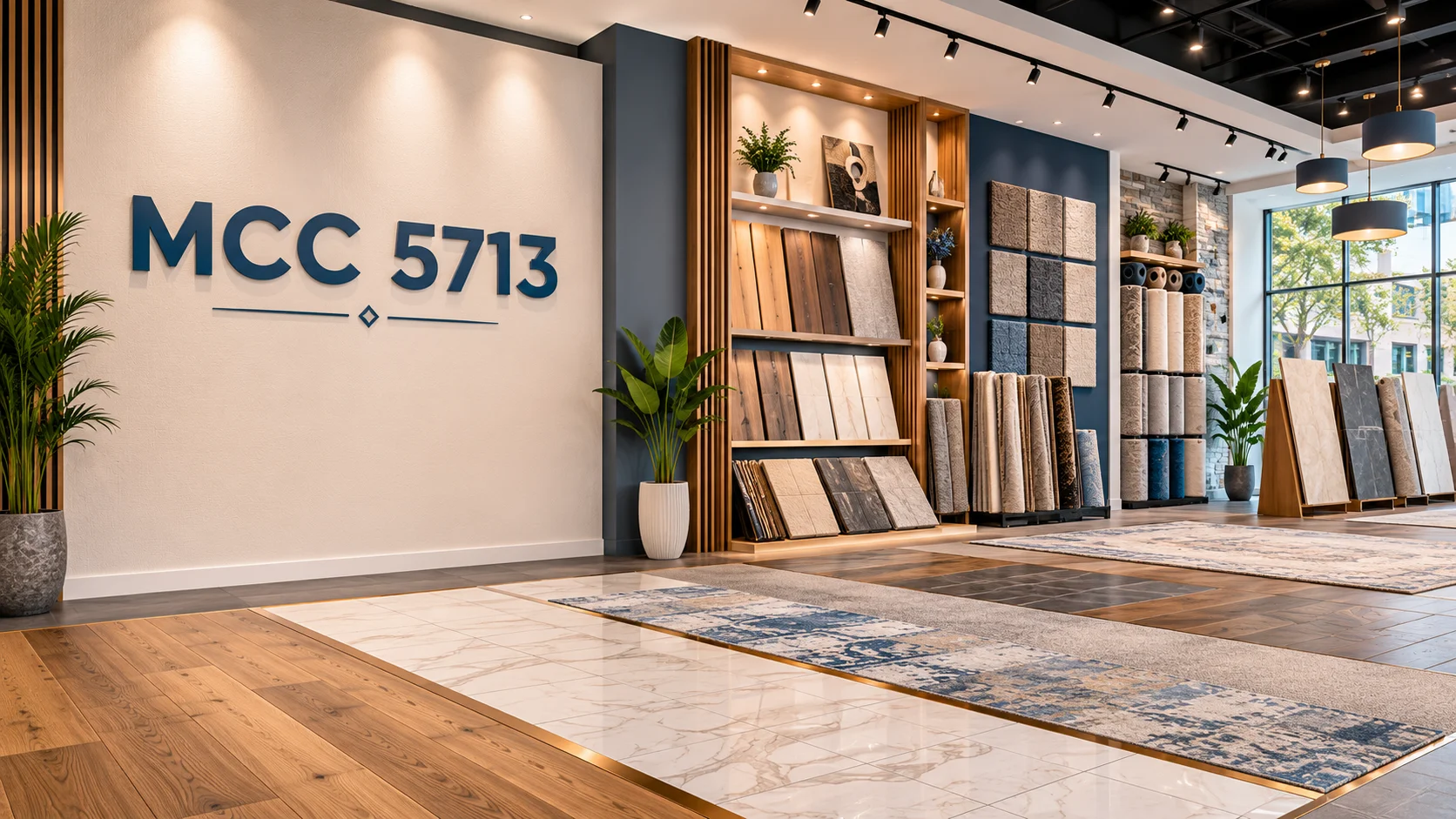
Many businesses classified under MCC 5713 operate dedicated flooring showrooms where customers can compare materials, textures, colors, and finishes before making a purchase. These retailers typically display full-size product samples that help homeowners, designers, contractors, and commercial buyers visualize how different flooring options will perform in real spaces.
Carpet and Rug Retailers
Specialty carpet stores and area rug retailers also commonly fall within MCC 5713. Their inventory may include wall-to-wall carpeting, custom-cut carpet, decorative rugs, runners, carpet padding, and related accessories for residential and commercial applications. Many of these businesses also coordinate professional measurement and installation services through in-house teams or trusted contractors.
Hard Surface Flooring Specialists
Retailers specializing in hardwood, laminate, luxury vinyl plank (LVP), engineered wood, ceramic tile, porcelain tile, and stone flooring frequently qualify under MCC 5713. These businesses often work closely with homeowners, remodeling professionals, interior designers, and construction companies to recommend flooring solutions based on durability, maintenance requirements, moisture resistance, and overall project goals.
Products Commonly Sold
Residential and Commercial Flooring Materials
Businesses operating under MCC 5713 typically offer a broad selection of flooring materials, including carpet, hardwood, laminate, luxury vinyl, sheet vinyl, ceramic tile, porcelain tile, natural stone, bamboo, cork, and engineered flooring. Product recommendations often depend on room usage, expected foot traffic, moisture exposure, and customer budget.
Installation Supplies and Accessories
In addition to flooring products, many retailers sell installation materials such as underlayment, adhesives, grout, trim pieces, transition strips, stair nosings, moisture barriers, leveling compounds, carpet padding, and finishing accessories. These products help ensure proper installation while improving the long-term performance of finished floors.
Floor Care and Maintenance Products
Many floor covering stores also carry specialized cleaning solutions, protective coatings, floor repair kits, maintenance tools, and furniture pads designed to preserve the appearance and lifespan of different flooring materials. Offering these complementary products allows retailers to support customers well beyond the initial purchase.
Why MCC 5713 Matters
Supports Accurate Payment Processing
Merchant Category Codes help payment processors consistently identify the type of business accepting each transaction. Using MCC 5713 ensures floor covering retailers are accurately classified within payment networks, contributing to reliable transaction processing and standardized merchant reporting.
Improves Financial Reporting
Accurate merchant classification supports organized accounting, transaction categorization, business reporting, and payment analytics. This consistency benefits both retailers and financial institutions by improving data quality and simplifying financial management across payment systems.
May Influence Credit Card Rewards
Some credit card issuers use Merchant Category Codes when determining cashback categories or bonus reward eligibility. Depending on the card issuer’s program, purchases made at merchants classified under MCC 5713 may qualify differently than purchases made at businesses operating under other home improvement or retail categories.
MCC 5713 Comparison Table
| Category | MCC 5713 Floor Covering Stores |
|---|---|
| Primary Business | Retail sale of flooring materials and related products |
| Typical Customers | Homeowners, contractors, designers, builders, and commercial property managers |
| Common Products | Carpet, hardwood, laminate, luxury vinyl, tile, rugs, underlayment, and installation supplies |
| Sales Channels | Flooring showrooms, specialty retail stores, and online flooring retailers |
| Inventory Characteristics | Large-format products, sample collections, installation accessories, and project-based purchasing |
| Peak Seasons | Spring renovations, summer construction projects, and year-end remodeling |
| Operational Priorities | Inventory planning, supplier coordination, project estimation, and customer consultation |
Industry Operations
Guiding Customers Through Complex Purchasing Decisions
Buying flooring is rarely an impulse purchase. Customers typically compare multiple materials, finishes, durability ratings, maintenance requirements, and installation methods before making a decision. Unlike many retail products, flooring is expected to remain in place for years, making performance just as important as appearance. Successful floor covering stores invest time in educating customers, presenting product samples, explaining material differences, and recommending flooring that matches each project’s requirements.
Whether assisting a homeowner renovating a single room or a contractor managing a large commercial project, knowledgeable product guidance is often one of a flooring retailer’s greatest competitive advantages.
Coordinating Project-Based Sales
Many flooring purchases are tied to renovation or construction projects rather than routine shopping. Retailers frequently coordinate with builders, interior designers, remodeling companies, and installation professionals to ensure materials arrive on schedule. Product availability, delivery timelines, and accurate quantity estimates are critical because delays can interrupt entire construction schedules and increase project costs.
To support these projects, many businesses maintain dedicated showroom displays, organize product samples by material type, and work closely with suppliers to secure inventory for large residential and commercial orders.
Managing Showrooms and Warehouse Inventory
Unlike traditional retailers that display most of their inventory on sales shelves, floor covering stores often separate customer showrooms from warehouse operations. Showrooms feature sample boards, display panels, and finished-room installations, while the bulk inventory remains stored in warehouses due to its size and weight. Maintaining accurate records between showroom samples, warehouse stock, and supplier availability is essential for efficient order fulfillment.
Inventory and Operational Challenges
Handling Large and Heavy Inventory
Flooring products require significantly more storage space than many other retail categories. Carpet rolls, hardwood planks, tile pallets, and vinyl flooring occupy substantial warehouse capacity and often require specialized equipment for transportation and handling. Retailers must carefully organize inventory to reduce damage, improve accessibility, and support efficient loading for customer pickups and deliveries.
Managing Product Variations and Dye Lots
Many flooring materials are produced in different colors, textures, finishes, dimensions, and manufacturing batches. Carpet dye lots, wood grain variations, and tile production runs can differ slightly from one shipment to another. Retailers must carefully track these variations to ensure customers receive consistent materials throughout a single installation project, particularly for large residential or commercial spaces.
Balancing Stock with Supplier Lead Times
Because flooring represents a significant financial investment, retailers cannot afford to overstock every material or finish. At the same time, relying entirely on supplier inventory can create delays when popular products become unavailable. Successful businesses continuously balance warehouse stock with supplier lead times, historical demand, and seasonal construction activity to maintain product availability while controlling inventory costs.
Industry Trends
Luxury Vinyl Flooring Continues to Expand
Luxury vinyl plank (LVP) and luxury vinyl tile (LVT) have become some of the fastest-growing flooring categories due to their durability, water resistance, realistic appearance, and relatively simple installation. Both residential and commercial customers increasingly choose these products as an alternative to traditional hardwood or ceramic flooring.
Sustainability Is Influencing Material Selection
Consumers are paying closer attention to environmentally responsible flooring materials. Products made from recycled content, sustainably harvested wood, low-emission adhesives, bamboo, cork, and other renewable resources continue to gain popularity among homeowners and commercial buyers seeking greener construction solutions.
Digital Visualization Is Improving Customer Confidence
Many flooring retailers now use digital visualization tools that allow customers to preview different flooring materials inside their own homes before purchasing. Combined with cloud-based POS systems, inventory management software, and digital project estimates, these technologies simplify the buying process while helping retailers deliver a more informed and personalized customer experience.
How Biyo Helps Floor Covering Stores
 How Biyo Helps Floor Covering Stores
Floor covering retailers manage large inventories, project-based orders, and thousands of product variations. Biyo POS helps simplify these operations with real-time inventory tracking, barcode scanning, and centralized reporting, making it easier to monitor stock levels and manage day-to-day sales.
Whether customers shop in-store or businesses operate multiple locations, Biyo keeps inventory synchronized while providing insights into bestselling products, inventory movement, and sales performance. You can sign up for Biyo POS or schedule a personalized demo to see how it can support your flooring retail business.
Frequently Asked Questions
What is MCC 5713?
MCC 5713 is the Merchant Category Code assigned to businesses that primarily sell floor coverings and related flooring products, including carpet, hardwood, laminate, vinyl, tile, and area rugs.
Which businesses qualify for MCC 5713?
Flooring showrooms, carpet retailers, rug stores, hardwood flooring specialists, tile retailers, and businesses whose primary activity is selling floor covering products generally qualify under MCC 5713.
What products are commonly sold under MCC 5713?
Businesses classified under MCC 5713 typically sell carpet, hardwood flooring, laminate, luxury vinyl, ceramic tile, porcelain tile, area rugs, underlayment, adhesives, trim pieces, and floor maintenance products.
Does MCC 5713 affect credit card rewards?
It may. Some credit card issuers use Merchant Category Codes to determine cashback categories or bonus rewards. Whether purchases qualify depends on the issuer’s specific rewards program.
Why is Merchant Category Code 5713 important?
MCC 5713 helps payment processors, banks, and card networks accurately classify floor covering retailers for payment processing, merchant reporting, fraud monitoring, transaction categorization, and financial analytics.
How can floor covering stores improve inventory management?
Modern POS systems with real-time inventory tracking, barcode scanning, inventory reporting, and multi-location management help flooring retailers maintain accurate stock levels, manage product variations, and make better purchasing decisions.