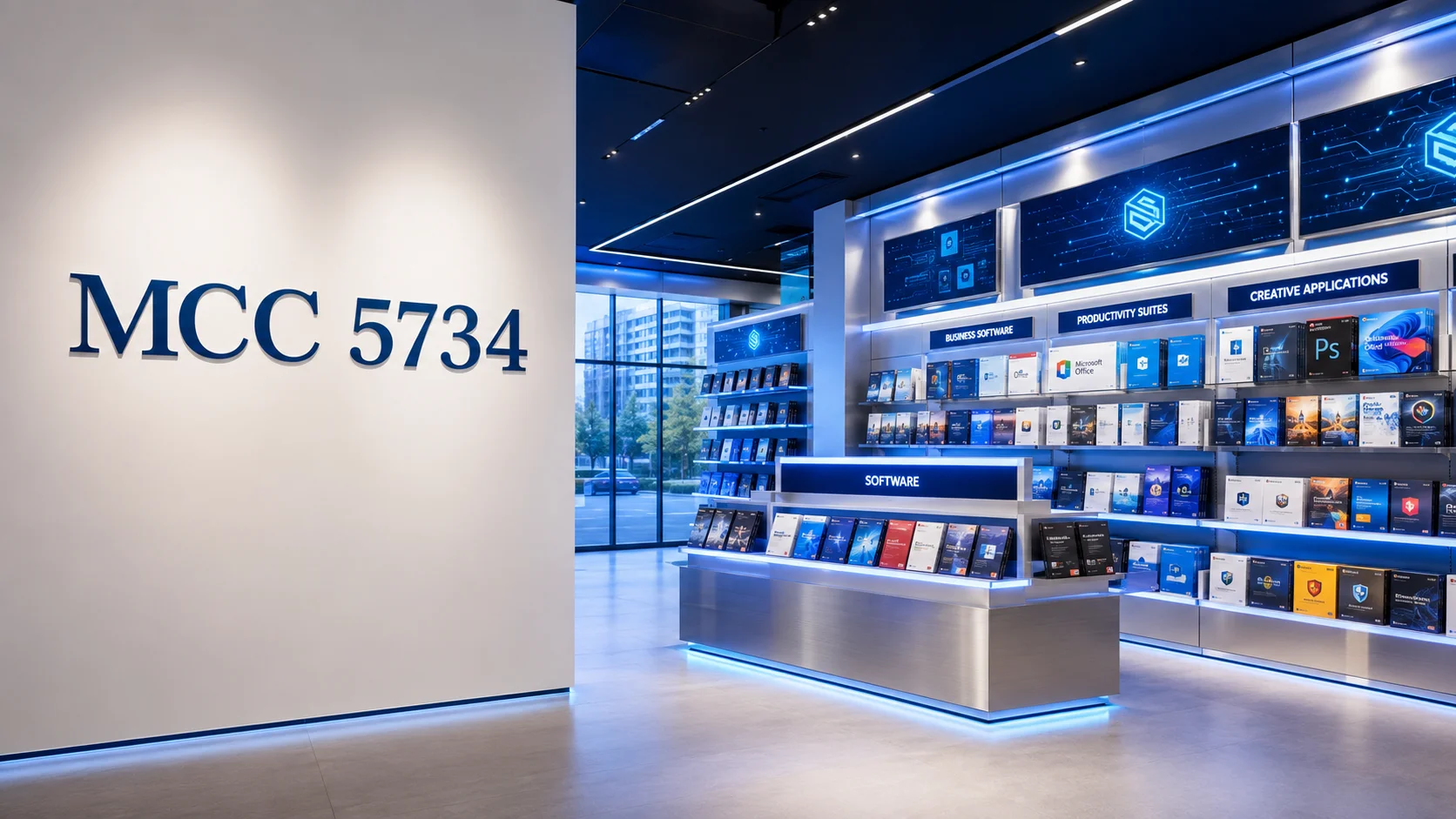

Software has become an essential part of modern life, powering everything from personal productivity and creative projects to business operations, cybersecurity, education, and entertainment. Whether customers are purchasing accounting software for a growing business, graphic design applications for creative work, antivirus protection for home computers, or cloud-based productivity suites, software retailers help individuals and organizations find solutions that meet their digital needs.
Businesses specializing in software sales are commonly classified under Merchant Category Code (MCC) 5734. Payment processors, acquiring banks, and major card networks use this Merchant Category Code to identify merchants whose primary business involves selling computer software, software licenses, digital applications, subscriptions, and related software products. Although customers rarely notice this classification during a purchase, it plays an important role in payment processing, merchant reporting, transaction categorization, fraud monitoring, and certain credit card rewards programs.
This guide explains what MCC 5734 covers, the businesses that typically qualify, the software products commonly sold, why proper merchant classification matters, and how modern retail technology helps software retailers manage inventory, digital licensing, customer relationships, and sales across both physical and online channels.
Table of Contents
Understanding MCC 5734
What Is Merchant Category Code 5734?
MCC 5734 is the Merchant Category Code assigned to businesses that primarily sell computer software and related digital products. These merchants may offer boxed software, downloadable applications, software subscriptions, cloud-based services, software licenses, and activation keys for both consumer and business users.
Unlike electronics retailers that focus on selling hardware, businesses classified under MCC 5734 specialize in software solutions that improve productivity, security, creativity, communication, education, and business management.
How Payment Networks Use MCC 5734
Whenever a customer purchases software using a debit or credit card, the transaction includes a Merchant Category Code identifying the merchant’s primary business activity. Payment processors, banks, and card networks use MCC 5734 to classify software retailers for transaction processing, merchant reporting, fraud detection, payment analytics, and certain rewards program classifications.
This standardized coding system helps maintain consistency across millions of electronic transactions while simplifying financial reporting throughout the payments ecosystem.
Why Correct Merchant Classification Matters
Accurate Merchant Category Codes ensure businesses are categorized according to their primary commercial activity. Retailers primarily selling software licenses, subscriptions, and digital applications generally qualify under MCC 5734, while businesses focused on computer hardware, office equipment, or consumer electronics are classified under different Merchant Category Codes.
 Businesses Classified Under MCC 5734
 Businesses Classified Under MCC 5734
Software Retail Stores
Traditional software retailers sell applications designed for home users, professionals, educational institutions, and businesses. Their product catalogs often include operating systems, office productivity suites, accounting software, tax preparation programs, security applications, multimedia software, and professional development tools.
Digital Software Resellers
Many businesses operating under MCC 5734 specialize in digital software distribution. Rather than selling boxed products, these merchants provide downloadable applications, license keys, subscription activations, cloud service access, and software renewals through online storefronts or digital marketplaces.
Business Software Solution Providers
Some merchants focus primarily on business customers by offering enterprise productivity software, customer relationship management platforms, accounting solutions, cybersecurity software, project management tools, database applications, and industry-specific software packages. These retailers often provide licensing guidance, implementation support, and ongoing subscription management.
Products Commonly Sold
Productivity and Business Software
Businesses classified under MCC 5734 commonly sell office productivity suites, accounting software, payroll applications, project management platforms, communication tools, scheduling software, document management systems, and customer relationship management solutions that help organizations improve efficiency.
Security and Utility Applications
Security software represents another major category within MCC 5734. Retailers frequently offer antivirus software, endpoint protection, firewall applications, password management tools, VPN services, backup solutions, system optimization software, and privacy applications for both individual users and businesses.
Creative, Educational, and Specialty Software
Software retailers also distribute graphic design applications, video editing programs, music production software, architectural design tools, engineering applications, educational learning platforms, language learning software, programming tools, and specialized applications developed for professional industries.
Why MCC 5734 Matters
Supports Accurate Payment Processing
Merchant Category Codes help payment processors consistently classify merchants according to their primary business activities. Using MCC 5734 ensures software retailers are properly identified during payment authorization, settlement, and financial reporting.
Improves Financial Reporting and Analytics
Accurate merchant classification contributes to organized accounting, transaction reporting, business analytics, and payment reconciliation. Consistent Merchant Category Codes also improve the quality of financial data used by retailers, banks, and payment service providers.
May Influence Credit Card Rewards
Some credit card issuers use Merchant Category Codes when determining cashback categories, business spending reports, or promotional rewards. Depending on the issuer’s program, purchases from merchants classified under MCC 5734 may qualify differently than purchases made from electronics or office supply retailers.
MCC 5734 Comparison Table
| Category | MCC 5734 Computer Software Stores |
|---|---|
| Primary Business | Retail sale of computer software, licenses, subscriptions, and digital applications |
| Typical Customers | Consumers, businesses, schools, freelancers, IT professionals, and government organizations |
| Common Products | Productivity software, security software, creative applications, operating systems, educational software, and cloud subscriptions |
| Sales Channels | Retail stores, e-commerce websites, software marketplaces, and digital download platforms |
| Inventory Characteristics | Digital licenses, subscription renewals, activation keys, downloadable software, and limited physical inventory |
| Revenue Sources | Software sales, subscription renewals, licensing, upgrades, and support services |
| Operational Priorities | License management, digital fulfillment, customer support, subscription tracking, and cybersecurity |
Industry Operations
Managing Software Licensing and Digital Delivery
Unlike traditional retailers that handle physical inventory, software stores often manage digital products that require secure license distribution rather than warehouse storage. Every transaction may involve generating activation keys, assigning subscription licenses, verifying customer eligibility, and delivering software through digital downloads or cloud-based portals. Maintaining accurate licensing records is essential for preventing duplicate activations, ensuring compliance with vendor agreements, and providing efficient customer support.
Many retailers also automate software fulfillment, allowing customers to receive license keys and download instructions immediately after payment, reducing delivery times while improving the overall purchasing experience.
Supporting Both Consumer and Business Customers
Software retailers typically serve a diverse customer base with varying technical requirements. Individual consumers often purchase antivirus software, productivity suites, educational applications, or creative tools, while business clients may require enterprise licensing, multi-user subscriptions, compliance documentation, and ongoing software management. Sales teams frequently assist customers in selecting appropriate licensing models based on the number of users, devices, and intended business use.
Providing knowledgeable guidance helps customers avoid purchasing incompatible products while strengthening long-term client relationships.
Coordinating Vendor Partnerships and Renewals
Many software retailers work directly with software publishers and authorized distributors to offer the latest product releases, upgrades, and subscription renewals. Maintaining these vendor relationships requires monitoring pricing changes, promotional campaigns, licensing policies, and product availability. Businesses that effectively coordinate renewals and software upgrades can generate recurring revenue while helping customers keep their systems secure and up to date.
Inventory and Operational Challenges
Managing Subscription-Based Revenue
The software industry has shifted significantly from one-time purchases to recurring subscription models. Retailers must accurately track renewal dates, subscription statuses, billing cycles, and customer notifications while ensuring uninterrupted access to licensed software. Efficient subscription management improves customer retention and creates predictable recurring revenue streams.
Preventing License Fraud and Unauthorized Distribution
Because software products are digital, retailers face unique security challenges. Protecting activation keys, preventing unauthorized resale, and ensuring software licenses are distributed only to legitimate customers are essential for maintaining compliance with publisher agreements. Strong verification procedures and secure delivery systems help reduce fraud while protecting both merchants and software vendors.
Keeping Pace with Rapid Product Updates
Software evolves quickly through feature updates, security patches, version releases, and licensing changes. Retailers must continuously update product catalogs, pricing information, compatibility requirements, and customer documentation to ensure buyers receive accurate information before making purchasing decisions. Staying current also enables support teams to provide informed recommendations and troubleshooting assistance.
Industry Trends
Cloud Software Continues to Expand
Cloud-based Software-as-a-Service (SaaS) platforms have become the preferred delivery model for many productivity, collaboration, accounting, and customer management applications. Subscription-based access provides customers with automatic updates, flexible licensing, and reduced infrastructure requirements while creating recurring revenue opportunities for software retailers.
Cybersecurity Solutions Are in High Demand
As cyber threats continue to evolve, businesses and consumers are investing more heavily in endpoint protection, multi-factor authentication, encryption, password management, secure backup solutions, and network security software. Retailers offering trusted cybersecurity products are increasingly serving as technology advisors rather than simply software vendors.
Artificial Intelligence Is Reshaping Software Products
Artificial intelligence is becoming a standard feature across productivity, design, customer service, programming, and business management applications. AI-powered automation, content generation, predictive analytics, and intelligent assistants are transforming how customers evaluate software solutions, creating new opportunities for retailers to expand their product offerings and educate buyers about emerging technologies.
How Biyo Helps Computer Software Stores
 How Biyo Helps Computer Software Stores
Software retailers need efficient tools to manage digital products, software licenses, subscription renewals, and customer transactions. Biyo POS helps streamline these operations with centralized inventory management, real-time sales reporting, barcode support for physical software products, and detailed business analytics that simplify day-to-day operations.
Whether selling through a retail storefront, an online shop, or multiple locations, Biyo keeps sales data synchronized while providing valuable insights into product performance and inventory trends. You can sign up for Biyo POS or schedule a personalized demo to see how it can support your software retail business.
Frequently Asked Questions
What is MCC 5734?
MCC 5734 is the Merchant Category Code assigned to businesses that primarily sell computer software, software licenses, digital applications, subscriptions, and related software products.
Which businesses qualify for MCC 5734?
Computer software stores, digital software retailers, software license resellers, online software marketplaces, and businesses specializing in software sales generally qualify under MCC 5734.
What products are commonly sold under MCC 5734?
Businesses operating under MCC 5734 commonly sell operating systems, office productivity software, accounting applications, antivirus programs, creative software, educational software, cloud subscriptions, and business management solutions.
Does MCC 5734 affect credit card rewards?
It may. Some credit card issuers use Merchant Category Codes to determine cashback categories or promotional rewards. Whether purchases qualify depends on the card issuer’s specific rewards program.
Why is Merchant Category Code 5734 important?
MCC 5734 helps payment processors, banks, and card networks accurately classify software retailers for payment processing, transaction reporting, fraud monitoring, merchant analytics, and financial categorization.
How can software retailers improve operational efficiency?
Using a modern POS system with centralized inventory management, real-time sales reporting, customer management, and multi-location support helps software retailers simplify operations, monitor performance, and provide a better purchasing experience.