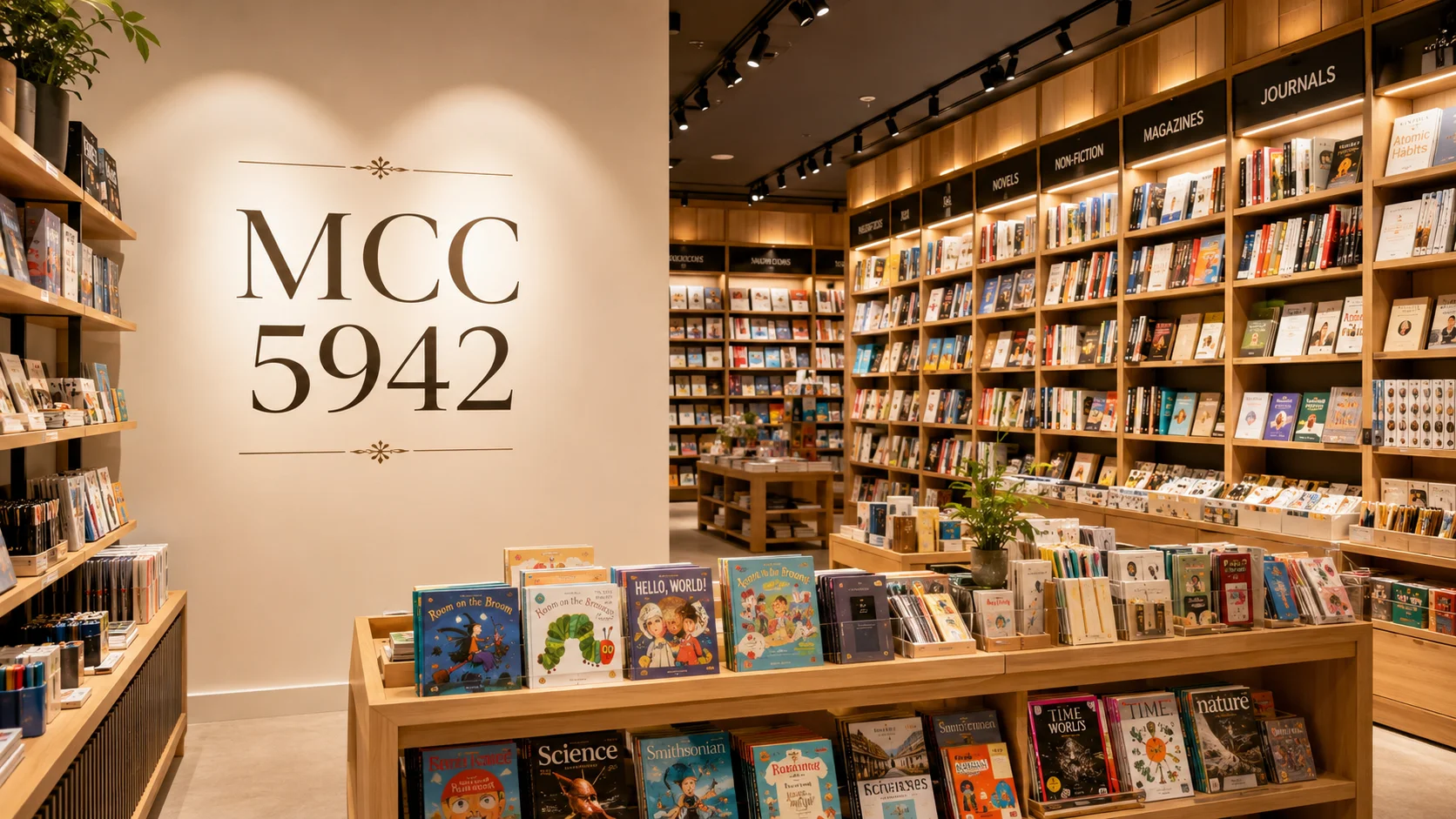

Walk into a well-run bookstore and you’ll quickly notice that it offers far more than rows of bookshelves. It’s a place where students search for textbooks before a new semester, parents introduce children to their first storybooks, professionals look for industry publications, and avid readers discover their next favorite novel. Despite the growth of digital media and online marketplaces, bookstores continue to serve as valuable cultural and educational hubs in communities around the world.
Every purchase made inside a bookstore also becomes part of a much larger payment ecosystem. When a customer pays with a credit or debit card, the transaction is assigned a Merchant Category Code (MCC). This standardized code tells banks, payment processors, and card networks what type of business accepted the payment, helping them classify millions of transactions every day.
Merchant Category Code (MCC) 5942 is assigned to businesses primarily engaged in selling books and related reading materials. Although customers rarely notice this classification, it plays an important role in payment processing, merchant reporting, credit card rewards, fraud monitoring, and financial analytics. Proper classification also ensures that bookstores are accurately identified within the payment industry.
Whether you’re a bookstore owner, payment professional, accountant, or simply curious about merchant category codes, understanding MCC 5942 provides valuable insight into how bookstores are classified and how this designation supports daily business operations. This guide explores the businesses that qualify for MCC 5942, the products they commonly sell, why the code matters, the operational challenges bookstores face, and how modern technology helps retailers operate more efficiently.
Understanding MCC 5942
What Is Merchant Category Code 5942?
Merchant Category Code 5942 is the standardized payment industry classification assigned to bookstores. Payment card networks use this code to identify merchants whose primary business activity involves selling books and other reading materials. Instead of evaluating every business individually, processors rely on MCCs to categorize merchants consistently across millions of transactions worldwide.
The code itself does not determine what products a business may sell. Instead, it reflects the merchant’s primary source of revenue. As long as books remain the main focus of the business, additional merchandise such as stationery or educational supplies typically does not affect the classification.
How Payment Networks Use MCC 5942
Whenever a customer completes a card transaction at a bookstore, the payment travels through multiple financial institutions before being approved. Throughout this process, MCC 5942 helps banks and payment processors recognize the merchant as a bookstore. This information contributes to transaction reporting, fraud analysis, interchange qualification, merchant analytics, and cardholder reward eligibility.
Using standardized merchant codes also creates consistency between payment providers, making it easier for financial institutions to analyze spending across different retail industries.
Why Accurate Classification Matters
Being assigned the correct Merchant Category Code benefits both merchants and financial institutions. Proper classification improves reporting accuracy, reduces processing confusion, supports underwriting decisions, and ensures businesses are grouped alongside similar merchants. For bookstore owners, accurate categorization provides cleaner business reporting while helping payment providers better understand normal purchasing behavior within the industry.
 Businesses Classified Under MCC 5942
 Businesses Classified Under MCC 5942
Independent and Community Bookstores
Independent bookstores represent one of the largest groups operating under MCC 5942. These businesses often specialize in carefully curated collections, personalized customer service, local author events, and community engagement. Many have built loyal customer bases by offering recommendations and experiences that large online retailers cannot easily replicate.
Educational and Campus Bookstores
Universities, colleges, and educational institutions frequently operate bookstores that primarily sell textbooks, academic publications, study guides, reference materials, and learning resources. These stores often experience seasonal demand during the beginning of academic terms while also supplying school merchandise and educational accessories.
Specialty and Collectible Book Retailers
MCC 5942 also includes bookstores specializing in niche markets, such as children’s literature, religious publications, comic books, rare first editions, antique books, professional manuals, or collectible works. Although their inventory differs from traditional bookstores, their primary business remains the sale of books and reading materials.
Products Commonly Sold by MCC 5942 Businesses
Books Across Every Genre
The primary products sold by businesses operating under MCC 5942 are books. Most bookstores carry a diverse inventory that includes fiction, non-fiction, biographies, history, business, science, self-improvement, travel, cookbooks, children’s literature, graphic novels, and reference materials. Many retailers also dedicate sections to local authors and regional publications to better serve their communities.
To satisfy a wide range of readers, bookstores continually refresh their inventory with newly released titles while maintaining collections of timeless classics. Popular genres often change throughout the year based on publishing schedules, bestselling lists, seasonal demand, and customer interests.
Educational and Professional Publications
Many bookstores generate significant revenue from educational materials. Textbooks, exam preparation guides, language-learning resources, certification manuals, legal references, medical publications, engineering handbooks, and academic journals are common products, particularly in university bookstores and retailers that serve professional audiences.
Because educational publications are updated regularly, bookstores must carefully manage editions and publication dates to ensure customers receive the most current versions available.
Reading Accessories and Complementary Merchandise
Although books remain the primary product category, many bookstores also sell complementary merchandise that enhances the reading experience. Common items include bookmarks, journals, notebooks, planners, calendars, greeting cards, reading lights, book covers, writing supplies, puzzles, educational games, and literary-themed gifts. These additional products help increase average transaction value while providing customers with convenient one-stop shopping.
Why MCC 5942 Matters
Supports Accurate Payment Processing
Merchant Category Codes help payment processors recognize the type of business accepting a payment. When a bookstore is correctly classified under MCC 5942, financial institutions can process transactions more efficiently while maintaining standardized reporting across payment networks.
Accurate merchant classification also contributes to improved fraud detection by allowing payment providers to compare transactions against expected purchasing behavior within the bookstore industry.
Improves Financial Reporting
Business owners, accountants, and financial institutions rely on Merchant Category Codes to organize transaction data. Proper classification makes it easier to analyze sales trends, prepare financial reports, evaluate merchant performance, and understand customer purchasing habits over time.
Because bookstores often experience seasonal demand, organized reporting helps owners make informed inventory purchasing decisions throughout the year.
May Influence Credit Card Rewards
Some credit card issuers use Merchant Category Codes when determining whether purchases qualify for bonus rewards or promotional cashback categories. While every rewards program operates differently, bookstores classified under MCC 5942 may qualify for education, retail, or specialty merchant promotions depending on the card issuer’s policies.
MCC 5942 Comparison Table
| Category | MCC 5942 Book Stores |
|---|---|
| Primary Business | Retail sale of books and reading materials |
| Typical Customers | Students, educators, professionals, collectors, and general readers |
| Common Products | Books, textbooks, journals, magazines, stationery, and reading accessories |
| Sales Channels | Physical bookstores, online stores, and special-order services |
| Inventory Complexity | High due to thousands of unique ISBNs, editions, and publishers |
| Peak Seasons | Back-to-school, holidays, major book releases, and graduation periods |
| Operational Priorities | Inventory accuracy, customer service, catalog management, and community engagement |
How Book Stores Operate
Managing Large Book Catalogs
Unlike many retail businesses that stock a limited number of products, bookstores often manage thousands of unique titles. Every book has its own ISBN, publisher, edition, author, genre, pricing, and inventory quantity. Maintaining organized catalogs requires accurate inventory systems capable of handling large amounts of product data.
Efficient catalog management also helps employees locate books quickly, reducing customer wait times and improving the overall shopping experience.
Balancing In-Store and Online Sales
Today’s bookstores frequently operate through both physical storefronts and e-commerce websites. Customers may browse books in person before completing purchases online, reserve titles for in-store pickup, or order unavailable books for future delivery. Synchronizing inventory between multiple sales channels has become an essential part of modern bookstore operations.
Building Customer Loyalty
Successful bookstores focus on creating long-term relationships rather than simply completing transactions. Book clubs, author signings, reading events, membership programs, personalized recommendations, and community partnerships encourage repeat visits while helping bookstores differentiate themselves from larger online competitors.
Inventory and Operational Challenges
Managing Slow- and Fast-Moving Inventory
One of the biggest challenges for bookstores is balancing inventory levels. Bestselling titles may sell out within days, while specialized or niche books can remain on shelves for months before finding the right buyer. Ordering too few copies results in missed sales opportunities, while overstocking ties up valuable capital and storage space.
Successful bookstores continuously monitor sales performance, publisher release schedules, and customer demand to maintain an inventory that is both diverse and profitable.
Tracking Thousands of Individual SKUs
Every title, edition, format, and publisher variation represents a unique inventory item. A single novel may exist in hardcover, paperback, collector’s edition, and boxed-set versions, each requiring separate inventory tracking. Without an organized inventory management system, maintaining accurate stock counts quickly becomes difficult and time-consuming.
Barcode scanning and automated inventory updates significantly reduce manual errors while making stock audits faster and more reliable.
Responding to Seasonal Demand
Bookstores experience predictable sales fluctuations throughout the year. Back-to-school shopping, holiday gift seasons, author releases, graduation periods, and promotional events can dramatically increase customer traffic. Preparing for these seasonal peaks requires careful purchasing decisions, inventory forecasting, staffing adjustments, and efficient checkout processes.
Industry Trends
Independent Bookstores Are Reinventing the Shopping Experience
Rather than competing solely on price, many independent bookstores focus on creating memorable customer experiences. Comfortable reading spaces, coffee shops, community events, local author partnerships, and personalized recommendations encourage visitors to spend more time in-store while strengthening customer loyalty.
Technology Is Improving Retail Operations
Modern bookstores increasingly rely on cloud-based retail technology to simplify daily operations. Real-time inventory tracking, integrated eCommerce platforms, mobile POS systems, barcode scanning, customer relationship management, and automated reporting help businesses operate more efficiently while reducing manual administrative work.
These tools also provide valuable sales insights that support smarter purchasing decisions and better inventory planning.
Data-Driven Decision Making
Retail analytics have become an important competitive advantage for bookstores of every size. By analyzing bestselling genres, customer purchasing habits, seasonal trends, and inventory turnover, owners can make informed decisions about future stock levels, promotional campaigns, pricing strategies, and merchandising. Data-driven operations allow bookstores to remain competitive while continuing to serve the evolving needs of modern readers.
How Biyo Helps Book Stores Operating Under MCC 5942
 How Biyo Helps Book Stores Operating Under MCC 5942
Managing a bookstore involves much more than processing sales. Owners must keep track of thousands of unique titles, monitor inventory across multiple genres, manage seasonal demand, fulfill special orders, and provide customers with a fast and enjoyable shopping experience. A modern point-of-sale system can simplify these daily operations while helping bookstores operate more efficiently.
Biyo POS is designed to help retailers manage complex inventory with ease. Every transaction automatically updates inventory levels in real time, allowing bookstore owners to maintain accurate stock counts without relying on manual adjustments. This is especially valuable for businesses that carry thousands of books identified by individual ISBNs, multiple editions, and different publishers.
For bookstores that sell both in-store and online, Biyo keeps inventory synchronized across every sales channel, reducing the risk of overselling and giving customers confidence that listed products are actually available. Businesses with multiple locations can also manage inventory, monitor sales performance, and transfer stock between stores from a single cloud-based dashboard.
Beyond inventory management, Biyo provides detailed reporting that helps bookstore owners identify bestselling genres, monitor inventory turnover, understand seasonal buying patterns, and make smarter purchasing decisions. Features like barcode scanning also speed up checkout by instantly recognizing ISBN barcodes, creating a faster experience for both employees and customers.
Whether you’re operating a neighborhood bookstore, a campus bookstore, or a growing retail chain, Biyo provides the tools needed to simplify operations and improve efficiency. You can get started with Biyo POS or schedule a personalized demo to see how the platform can support your bookstore.
Frequently Asked Questions
What is MCC 5942?
MCC 5942 is the Merchant Category Code assigned to bookstores. It identifies businesses whose primary activity is selling books and related reading materials for payment processing and merchant classification.
Which businesses qualify for MCC 5942?
Independent bookstores, national bookstore chains, campus bookstores, religious bookstores, children’s bookstores, and specialty book retailers generally qualify when book sales are their primary source of revenue.
Can bookstores sell products besides books under MCC 5942?
Yes. Many bookstores also sell journals, stationery, bookmarks, educational supplies, puzzles, magazines, and literary gifts. As long as books remain the primary business activity, these additional products typically do not affect the merchant classification.
Does MCC 5942 affect credit card rewards?
It can. Some credit card issuers use Merchant Category Codes to determine eligibility for cashback or bonus reward categories. Whether bookstore purchases qualify depends on the specific card issuer and rewards program.
Why is Merchant Category Code 5942 important?
MCC 5942 helps payment processors, banks, and card networks accurately classify bookstore transactions. It supports payment processing, financial reporting, fraud monitoring, merchant analytics, and transaction categorization.
How can bookstores improve inventory management?
Modern POS systems with real-time inventory tracking, barcode scanning, centralized reporting, and multi-channel inventory synchronization help bookstores reduce stock errors, improve purchasing decisions, and provide a better customer experience.