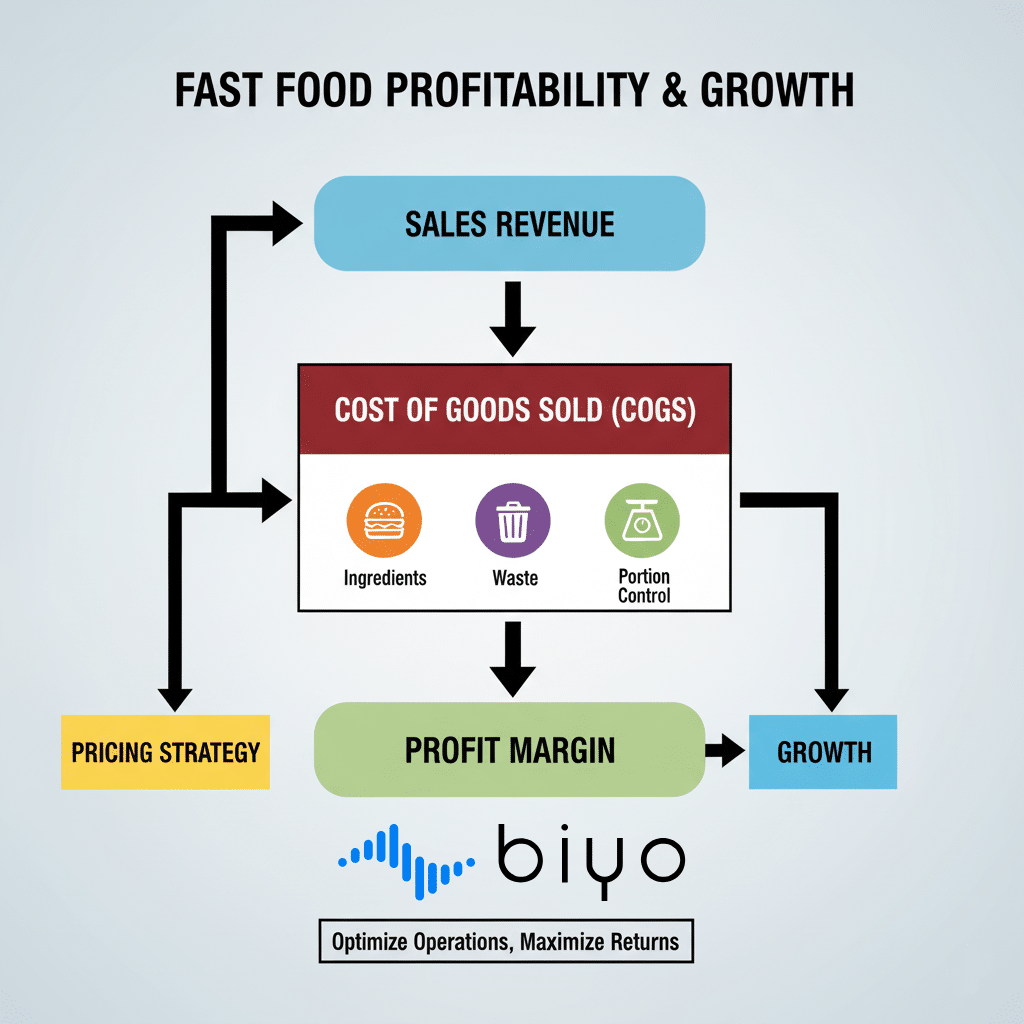
In the fast food industry, profitability often hinges on a few crucial financial metrics. Among them, one stands out as the backbone of financial decision-making: Understanding (COGS) in fast food. COGS, or cost of goods sold, includes all the direct expenses tied to producing and serving food—ingredients, packaging, and related supply costs. When fast food operators manage COGS efficiently, they maintain stronger profit margins, build sustainable pricing strategies, and improve long-term financial stability. However, when COGS spirals out of control, restaurants quickly find themselves struggling with shrinking profits and increased operating expenses.
For owners, managers, and investors, mastering COGS is not just about accounting. It’s about understanding the relationship between ingredient costs, portion control, supply chain management, and pricing strategy. This knowledge empowers operators to anticipate fluctuations, make adjustments, and align daily operations with broader financial goals. In the world of fast food, where margins are razor-thin and competition is fierce, getting COGS right often separates thriving businesses from those that fail to survive.
This article explores everything you need to know about COGS in the fast food industry. We’ll break down why it matters, what factors contribute to it, strategies for controlling it, methods of analysis, and its impact on profitability and growth. By the end, you’ll not only understand what COGS is but also how to use it as a tool to make smarter financial and operational decisions in your business.
Table of Contents
- Why Understanding (COGS) in Fast Food Matters
- Key Components That Make Up COGS
- Strategies to Reduce and Control COGS
- How to Analyze and Report on COGS
- The Impact of COGS on Profitability and Growth
- How Biyo POS Helps with COGS and Profitability
- FAQ: Understanding COGS in Fast Food
Why Understanding (COGS) in Fast Food Matters
Fast food operates in a uniquely competitive landscape where speed, volume, and consistency dictate success. In this environment, even small changes in cost can make or break profitability. Understanding (COGS) in fast food gives operators a clear lens to evaluate how much of their revenue is consumed by direct expenses and how much remains available for overhead, labor, and profit. Without this understanding, business decisions become reactive instead of proactive, leaving owners vulnerable to fluctuations in ingredient pricing and unexpected financial stress.
COGS and Profit Margin
Profit margin is the lifeline of any restaurant. It represents the percentage of revenue left after covering expenses. In the fast food industry, margins are notoriously slim, averaging between 6% and 9% for many operators. This means that even slight increases in COGS—say, a rise in meat prices or packaging costs—can cause margins to collapse. For instance, a restaurant earning $1 million annually with a 30% COGS rate spends $300,000 on direct food costs. If that percentage rises to 35% without changes in pricing, the restaurant absorbs an additional $50,000 in costs. That difference could have funded marketing campaigns, equipment upgrades, or expansion plans. By maintaining tight control over COGS, owners safeguard margins and keep financial flexibility intact.
Operators who neglect to track these numbers often find themselves blindsided when profits shrink despite steady or even growing sales. Customers may still be lining up, but the money left over at the end of the month dwindles because costs silently consume revenue. Monitoring profit margins alongside COGS ensures operators can make quick adjustments—whether through menu repricing, portion recalibration, or renegotiating with suppliers—to protect the bottom line. Without this alignment, businesses risk long-term instability.
Another critical link between COGS and margins is pricing power. Restaurants with efficient COGS management can afford to be more competitive in pricing or offer promotions without undermining profitability. For example, if you know your burger costs $2.25 to produce and you sell it at $7, you have a comfortable margin that allows flexibility. If costs balloon to $3.50 but you don’t adjust pricing, your margins vanish. Understanding this balance ensures your financial health stays resilient, even in a highly competitive environment.
Influence on Menu Pricing
Menu pricing is directly influenced by COGS. If you don’t know the exact cost of making each item, pricing becomes guesswork. Imagine selling a combo meal for $8 without realizing the true COGS is $5.50. While you may assume the margin is acceptable, the reality is that overhead expenses and labor costs eat away most of the remaining revenue. Eventually, this mismatch leads to losses, even if sales volumes appear strong. By accurately calculating COGS, owners can set prices that not only cover expenses but also generate sustainable profits.
Portion control plays an essential role here. When employees overfill fries or add extra slices of cheese, the effective cost per serving increases beyond what was planned. Across thousands of transactions, these “invisible giveaways” amount to thousands of dollars in lost revenue. By standardizing recipes and training staff to follow strict measurements, restaurants ensure predictable costs and maintain consistency in both product quality and financial performance. Customers receive the same product every time, while operators maintain stable food cost percentages.
Another aspect of menu pricing influenced by COGS is bundling and promotions. High-margin items can subsidize lower-margin ones in combo deals, creating attractive offers for customers while preserving profitability. For example, pairing fries and a drink—both with lower COGS—with a sandwich allows restaurants to promote value meals without significant financial risk. This strategy only works if you thoroughly understand the COGS of each component, reinforcing why precise cost analysis is critical to pricing decisions.
COGS and Financial Stability
Financial stability depends on predictable, controlled expenses, and COGS forms a large portion of these costs. Inconsistent ingredient prices, poor vendor management, or unchecked waste can lead to erratic financial performance. A business that does not track or analyze its COGS regularly may appear profitable in one quarter but struggle in the next due to unexpected cost spikes. This volatility makes it difficult to forecast cash flow, plan investments, or secure financing from lenders who want to see reliable financial reporting.
COGS management also influences the ability to withstand market shocks. During the COVID-19 pandemic, for example, disruptions in supply chains caused sudden spikes in food prices. Restaurants that tracked and adjusted their COGS quickly were better equipped to pivot—by revising menus, adjusting portion sizes, or substituting ingredients—than those operating without cost visibility. Financial stability depends not only on generating revenue but also on maintaining expense control, and COGS sits at the center of that balance.
Lenders and investors often scrutinize COGS when evaluating restaurants. A business demonstrating strong control over COGS signals operational efficiency and financial discipline, both of which are attractive to financiers. On the other hand, inflated or unstable COGS raises red flags, discouraging investment. Therefore, mastering COGS is not simply an internal exercise but also a critical factor in building external trust and credibility within the financial community.
Key Components That Make Up COGS
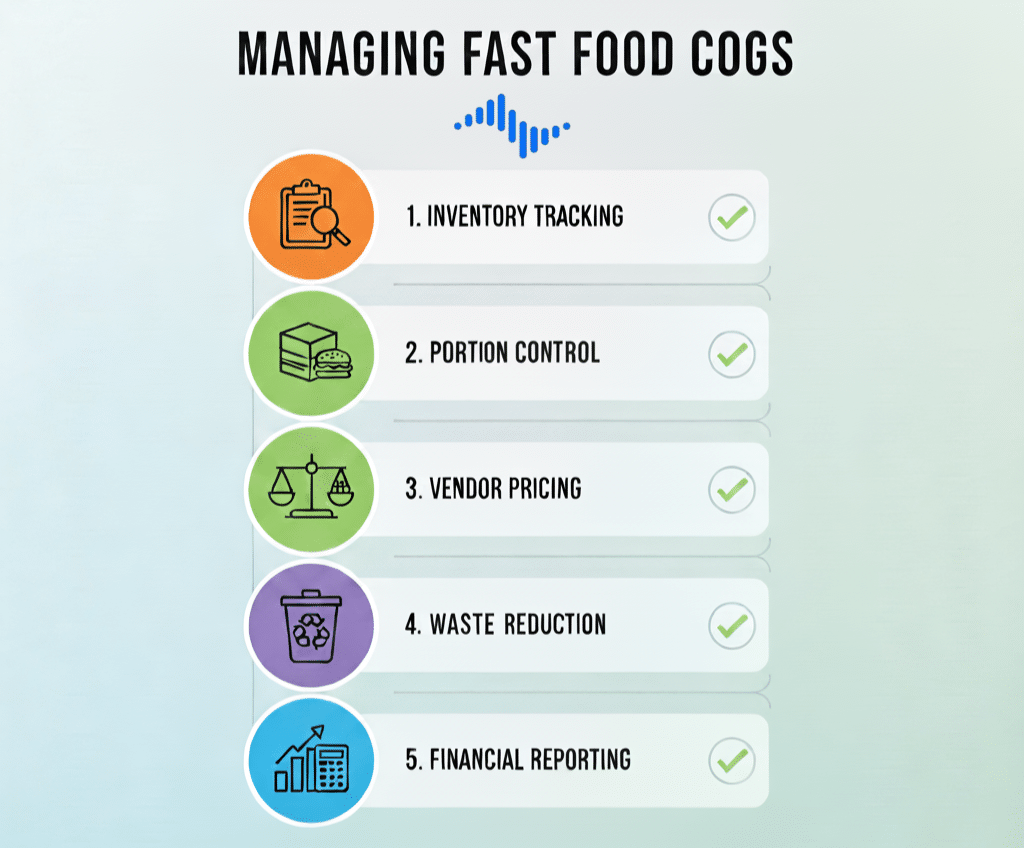
To truly master understanding (COGS) in fast food, owners must examine its core components. COGS is not a single number but the sum of multiple direct costs that together reveal how much money is tied to the production of each meal. By breaking down these elements, operators can pinpoint where inefficiencies arise and take targeted actions to reduce costs. The three biggest contributors to COGS in fast food are ingredient costs, portion control, and waste or shrinkage.
Ingredient Costs
Ingredients typically account for 25% to 35% of a fast food restaurant’s total revenue, making them the largest factor in COGS. Every bun, patty, condiment packet, and beverage cup contributes to the bottom line. Rising food inflation in recent years has amplified the importance of tracking ingredient costs carefully. For instance, if beef prices climb 15% in a single quarter, a burger-heavy menu suffers significant cost pressure unless adjustments are made. Ignoring these shifts can push food cost percentages well beyond industry benchmarks, leaving little room for profit.
Establishing strong relationships with suppliers is key to managing these costs. Vendors who value long-term partnerships may offer discounts, payment flexibility, or exclusive deals that reduce expenses. Regularly comparing quotes from multiple suppliers also ensures restaurants avoid being locked into uncompetitive pricing. In practice, an operator might discover that sourcing lettuce locally reduces shipping costs while ensuring fresher quality. These small adjustments, multiplied across thousands of sales, create measurable improvements in cost efficiency.
Technology also supports ingredient cost management. Advanced POS systems integrated with supply chain management tools track prices over time, highlight trends, and provide alerts when costs exceed thresholds. These insights empower managers to renegotiate contracts or adjust menus before costs erode profits. By combining supplier strategy with digital tracking, restaurants build resilience against price volatility and protect margins.
Portion Control
Consistency in portioning is essential in fast food, both for customer satisfaction and cost control. Every ounce of cheese, sauce, or fries must be measured accurately to keep food cost percentages in line. Without portion control, staff may unintentionally serve larger portions, inflating COGS without increasing revenue. For example, giving an extra scoop of fries might seem harmless, but across 1,000 transactions per week, it could add hundreds of dollars in unnecessary expense. Portion control ensures financial predictability while reinforcing a consistent brand experience for customers.
Effective portion control starts with standardized recipes and clear training. Employees must understand not only how much of each ingredient to use but also why consistency matters. Providing portioning tools such as scoops, scales, or dispensers further supports accuracy. Managers can also implement regular quality checks, observing staff and correcting deviations before they become costly habits. These operational practices create a culture where consistency is valued, improving both customer satisfaction and profitability.
Technology again plays a valuable role. POS systems integrated with recipe management modules allow operators to compare theoretical food costs (based on recipes) with actual costs (based on inventory usage). If discrepancies appear, managers know that portioning errors or waste are driving up COGS. Addressing these discrepancies quickly prevents small mistakes from snowballing into major financial problems. This combination of training, tools, and tracking makes portion control a powerful lever for managing COGS.
Waste and Shrinkage
Food waste is one of the most common and costly issues in fast food operations. Spoilage, overproduction, and incorrect orders all contribute to higher COGS. Studies estimate that restaurants waste between 4% and 10% of purchased food, representing tens of thousands of dollars annually for a single location. For example, if a restaurant spends $200,000 on food purchases annually and wastes 5%, that’s $10,000 lost directly to inefficiency. By implementing waste-tracking systems and staff training, operators can significantly reduce these losses and improve overall profitability.
Shrinkage, which includes theft and unrecorded usage, is another contributor to inflated COGS. Whether it’s employees eating meals without recording them or inventory disappearing due to poor tracking, shrinkage silently drains profits. Regular audits, inventory counts, and technology-based monitoring systems can help detect and deter theft. When employees know that inventory is being monitored closely, they are less likely to misuse or steal products, further reducing unnecessary costs.
Beyond the financial aspect, addressing waste and shrinkage also supports sustainability initiatives. Many modern consumers prefer to support businesses committed to eco-friendly practices. Reducing food waste not only saves money but also aligns the restaurant’s brand with values that resonate with customers. This dual benefit makes waste and shrinkage control a central part of both financial efficiency and long-term brand strategy.
Strategies to Reduce and Control COGS
Once you understand what contributes to COGS, the next step is implementing strategies to reduce and control it. A proactive approach helps fast food businesses stay competitive while maintaining healthy margins. Some of the most effective strategies involve vendor negotiations, inventory tracking, and menu engineering. These methods ensure that costs remain predictable and aligned with revenue targets, allowing operators to grow sustainably.
Supplier and Vendor Negotiations
Vendors directly influence COGS by setting the prices for ingredients and packaging. Strong negotiation skills can make a significant difference in profitability. For example, committing to a long-term contract with a trusted supplier might secure lower rates or guarantee stable pricing in volatile markets. On the other hand, operators who fail to negotiate risk paying inflated prices, eroding their margins over time. Developing supplier partnerships based on transparency and trust often leads to better terms and more consistent quality.
It’s equally important not to depend on a single vendor. If one supplier raises prices suddenly, having alternate sources creates leverage and prevents cost shocks. Competitive bidding among suppliers keeps prices fair and encourages accountability. For instance, comparing quotes from three meat suppliers may reveal a 10% difference in pricing, translating into thousands of dollars in savings annually. Diversifying your supplier base also reduces risks tied to supply chain disruptions, which became especially evident during the pandemic.
Monitoring vendor performance goes beyond price. Reliability, delivery timeliness, and billing accuracy matter as much as cost. A supplier offering cheap ingredients but delivering late can disrupt operations and create hidden costs in wasted labor or overtime. By tracking vendor performance metrics and aligning them with cost efficiency goals, operators ensure that vendor partnerships genuinely improve profitability rather than create new problems.
Inventory Tracking Systems
Inventory management is the backbone of cost efficiency. Without proper systems, operators may overorder, leading to spoilage, or underorder, resulting in stockouts and lost sales. Advanced POS systems with inventory tracking features solve this problem by syncing sales data with ingredient usage in real time. For example, if 500 burgers are sold, the system automatically deducts buns, patties, and condiments from inventory. This level of automation minimizes manual errors and provides accurate insights into food cost percentages.
Inventory tracking also reveals discrepancies between theoretical and actual usage. If the system predicts 50 pounds of chicken should remain but only 40 are in stock, managers know that waste or shrinkage occurred. Identifying these gaps early allows operators to take corrective action, such as retraining staff or tightening security. Over time, this process builds a culture of accountability where every ingredient is tracked and valued, reducing both waste and theft.
Smarter inventory tracking further supports better purchasing decisions. By analyzing trends, restaurants can predict demand more accurately and order accordingly. For example, if sales data shows that milkshake orders spike during summer months, managers can adjust stock levels to match demand. This alignment reduces waste, improves cash flow, and ensures customers always get the products they expect, enhancing both financial and operational performance.
Menu Engineering
Menu engineering combines COGS analysis with sales performance to identify high-margin items and optimize menu design. By categorizing items into stars (high sales, high margin), plow horses (high sales, low margin), puzzles (low sales, high margin), and dogs (low sales, low margin), operators can make data-driven decisions on what to promote, reprice, or remove. For example, if fries generate strong margins and consistent sales, highlighting them in combos boosts profitability. On the other hand, low-margin items can be adjusted through recipe modifications or price increases to improve performance.
Another tactic is bundling profitable items with those that are less so. Pairing a high-margin soda with a lower-margin burger creates a combo that customers perceive as valuable while maintaining overall profitability. This approach requires precise knowledge of COGS to ensure the bundle still produces a positive margin. Without this insight, promotions risk cannibalizing profits instead of boosting them.
Menu design also influences customer behavior. Strategic placement of profitable items on the menu—through visual cues, descriptions, or pricing anchors—guides customers toward selections that improve margins. For instance, placing a profitable sandwich in the menu’s center panel with an enticing description encourages more orders. This psychological aspect of menu engineering, backed by COGS data, transforms menus from simple lists of products into powerful financial tools.
How to Analyze and Report on COGS
Understanding COGS requires not just calculation but continuous analysis and reporting. Regular reviews allow managers to spot inefficiencies, track progress, and adjust operations accordingly. By making COGS analysis a routine part of financial management, fast food businesses avoid surprises and strengthen their decision-making capabilities. Three key approaches include expense analysis, break-even analysis, and financial reporting tools.
Expense Analysis
Expense analysis involves breaking down COGS into its individual components and comparing them against benchmarks or historical data. For example, if beef suddenly accounts for 40% of food costs when it previously averaged 30%, managers know that either prices increased significantly or portion control failed. This type of granular analysis helps operators identify problem areas quickly. Regular expense analysis also creates accountability, as managers and staff understand how their actions directly impact the bottom line.
Conducting expense analysis monthly—or even weekly for high-volume operations—provides ongoing visibility. By examining variances between actual and projected costs, managers can adjust purchasing, menu pricing, or staffing before issues escalate. This process also fosters better financial discipline, ensuring that costs remain aligned with revenue goals. Over time, expense analysis becomes second nature, creating a culture where efficiency is consistently prioritized.
Expense analysis also informs larger strategic decisions. For instance, if analysis reveals that vendor prices are steadily increasing, management may decide to invest in vertical integration, such as sourcing ingredients directly from local farms. By using expense data to justify such moves, operators make decisions that are both financially sound and strategically advantageous. In this way, expense analysis turns raw numbers into actionable business strategies.
Break-even Analysis
Break-even analysis calculates the sales volume required to cover all expenses, including COGS and labor. For fast food restaurants, this metric is crucial because sales volumes fluctuate daily. By knowing the break-even point, operators can set realistic sales targets and design promotions to achieve them. For example, if a restaurant’s break-even point is $5,000 per day in sales, managers know they must reach that threshold before generating profit. This clarity helps align marketing campaigns, staffing schedules, and inventory purchasing with financial realities.
Break-even analysis also supports decision-making during expansion or investment. Before opening a new location, operators can model potential sales and expenses to determine feasibility. If projections show that the location cannot realistically meet its break-even point, resources can be redirected elsewhere. This prevents costly mistakes and ensures growth is sustainable. For investors, clear break-even data provides confidence that the business understands its financial dynamics and can manage risk effectively.
Integrating break-even analysis with POS data enhances accuracy. Real-time sales figures and updated expense inputs ensure that break-even calculations reflect current conditions rather than outdated estimates. This integration provides managers with a live financial dashboard, enabling quicker, more informed decisions. Whether adjusting staffing levels during slow hours or launching targeted promotions during peak periods, break-even analysis equips operators with the insights needed to stay profitable.
Financial Reporting Tools
Modern POS and accounting systems simplify COGS analysis by automating financial reporting. These tools generate detailed reports on ingredient costs, sales performance, and profit margins with minimal manual input. Automation reduces human error and saves time, allowing managers to focus on interpreting data rather than collecting it. Reports can be customized to highlight specific areas, such as labor vs. food costs, vendor performance, or seasonal sales patterns.
Advanced reporting also supports proactive decision-making. For example, if reports indicate rising food cost percentages, managers can intervene early by adjusting menus or negotiating with suppliers. Over time, these small adjustments add up to significant savings. Consistent reporting also reveals trends, enabling long-term planning and budgeting with greater accuracy. This strategic approach ensures that financial performance remains predictable and aligned with business goals.
Another advantage of financial reporting tools is transparency. Clear, data-driven reports can be shared with stakeholders, from staff to investors, fostering trust and collaboration. Employees who see how their actions—like reducing waste or following portion guidelines—affect COGS are more likely to stay engaged. Investors who review consistent, accurate financial reports gain confidence in the business’s management. In this way, financial reporting strengthens both internal operations and external relationships.
The Impact of COGS on Profitability and Growth
Managing COGS effectively doesn’t just protect margins—it fuels growth and long-term success. When fast food restaurants control costs, they free up resources to reinvest in marketing, technology, and expansion. Conversely, poor COGS management limits flexibility, stifles innovation, and creates vulnerability in competitive markets. By viewing COGS as a driver of growth rather than a constraint, operators can transform financial efficiency into a powerful strategic advantage.
Revenue Growth
One of the most direct impacts of controlling COGS is revenue growth. When margins are healthy, businesses have more money to reinvest in customer acquisition and retention strategies. For example, savings from renegotiated vendor contracts could fund digital advertising campaigns or loyalty programs, attracting new customers and increasing repeat visits. In turn, higher sales volumes further improve economies of scale, reinforcing the cycle of growth. By aligning COGS management with marketing and sales efforts, operators unlock new revenue streams without compromising profitability.
Investing in technology upgrades is another path to growth. Savings from efficient COGS management can fund wireless payment processing systems, touchless payment setups, or near-field communication (NFC) solutions that enhance customer experience. These digital payment acceptance methods not only improve speed and convenience but also attract tech-savvy customers who prefer cashless payment systems. Better customer experience drives higher sales, while cost efficiency ensures profitability remains intact. In this way, COGS optimization fuels both financial and operational growth.
Revenue growth also depends on adaptability. Restaurants that monitor and manage COGS closely can respond quickly to market trends. For example, if plant-based menu items rise in popularity, operators who understand their cost structures can introduce such options confidently, pricing them to maintain profitability. This adaptability ensures that growth opportunities are seized without jeopardizing margins, keeping the business competitive and relevant.
Expense Control and Efficiency
Strong COGS management enhances overall expense control across the business. When food costs are monitored and reduced, operators develop habits of discipline that extend to other areas, such as labor scheduling, energy use, and marketing spend. This culture of efficiency helps maintain balance between expenses and revenue, creating a leaner, more resilient operation. For example, by tracking both food and labor costs together, managers can evaluate whether staffing levels align with sales volumes, preventing overstaffing that drains profitability.
Expense control also improves financial forecasting. Predictable COGS allows operators to project future costs with greater accuracy, supporting more reliable budgets and investment decisions. For instance, if a restaurant consistently maintains food cost percentages at 30%, managers can confidently plan for expansion knowing that margins will remain stable. This predictability reduces financial risk and builds confidence among stakeholders, including investors and lenders.
Efficiency in COGS management also supports sustainability initiatives. Reducing waste lowers disposal costs, while smarter inventory practices reduce unnecessary purchasing. These improvements not only save money but also align with consumer preferences for environmentally responsible businesses. Customers increasingly choose brands that reflect their values, meaning that efficient COGS management enhances both profitability and reputation. By linking expense control with sustainability, operators achieve financial and social benefits simultaneously.
Long-Term Profitability
Ultimately, understanding (COGS) in fast food is the foundation of long-term profitability. Short-term gains can be wiped out quickly if costs spiral, but consistent control creates a steady base for sustainable growth. Restaurants that manage COGS effectively generate higher margins, reinvest profits wisely, and remain competitive even in volatile markets. This stability allows them to expand strategically, attract investors, and build strong brands that endure over time.
Long-term profitability also depends on continuous improvement. Operators who regularly analyze and refine their cost structures stay ahead of industry trends. For example, as automation and artificial intelligence enter the restaurant space, those with disciplined cost management will have the resources to adopt these technologies first, gaining a competitive advantage. In contrast, businesses that ignore COGS may lack the capital to innovate, falling behind in a rapidly evolving market.
Profitability fueled by cost control creates resilience. Whether facing inflation, economic downturns, or shifting consumer preferences, restaurants with optimized COGS maintain the flexibility to adapt without sacrificing margins. This resilience ensures survival in tough times and accelerates success during growth periods. For fast food operators, mastering COGS is not just an accounting task—it is the key to long-term financial strength and competitive dominance.
How Biyo POS Helps with COGS and Profitability
Biyo POS equips fast food operators with the tools they need to manage COGS effectively. With features like real-time inventory tracking, recipe-level portion control, and automated financial reporting, Biyo POS transforms cost management from a manual chore into a seamless process. Managers gain visibility into ingredient costs, shrinkage patterns, and sales performance, allowing them to act quickly when costs deviate from benchmarks. By aligning operational data with financial reporting, Biyo POS ensures that decisions are based on accurate, up-to-date information.
Beyond inventory, Biyo POS also supports smarter vendor management. Integration with supply chain tools allows operators to compare vendor pricing, track performance, and negotiate better contracts. Combined with expense analysis and reporting, this functionality reduces unnecessary spending and improves overall profitability. Restaurants using Biyo POS also benefit from advanced payment solutions, including NFC and wireless payment processing, which enhance customer experience and support revenue growth. These integrated tools create a comprehensive platform for cost efficiency and profitability.
If you’re ready to take control of your costs, schedule a call with Biyo POS today to see how our platform can transform your operations. For those ready to move forward, you can also sign up directly here and start building a more profitable and efficient restaurant operation immediately.
FAQ: Understanding COGS in Fast Food
What does COGS include in fast food?
It covers direct costs like ingredients, packaging, and supplies. Understanding (COGS) in fast food means knowing exactly what goes into each menu item.
How do you calculate food cost percentage?
Divide total COGS by total sales, then multiply by 100. For example, $3,000 COGS on $10,000 sales equals 30%.
Why is portion control important in reducing COGS?
Consistent portions prevent unplanned giveaways that raise costs. Standard recipes keep COGS in fast food predictable.
Can technology help lower COGS?
Yes. POS systems track inventory, highlight waste, and automate reporting. This makes understanding (COGS) in fast food easier and more accurate.
What role does COGS play in menu pricing?
COGS shows if menu items are priced profitably. Knowing COGS helps adjust prices, recipes, or portions to protect margins.