In the fast food industry, profitability often hinges on a few critical financial metrics. Among them, one stands out as the backbone of financial control: understanding (COGS) in fast food. COGS, or cost of goods sold, includes all direct expenses tied to producing and serving food—ingredients, packaging, and supply costs.
When operators control COGS effectively, they protect margins, improve pricing decisions, and build long-term financial stability. When they don’t, profits quietly disappear—even when sales look strong. That’s the trap most fast food businesses fall into.
This guide breaks down what actually matters: how COGS works, what drives it, how to control it, and how it directly impacts your growth.
Table of Contents
- Why Understanding COGS in Fast Food Matters
- Key Components That Make Up COGS
- Strategies to Reduce and Control COGS
- How to Analyze and Report on COGS
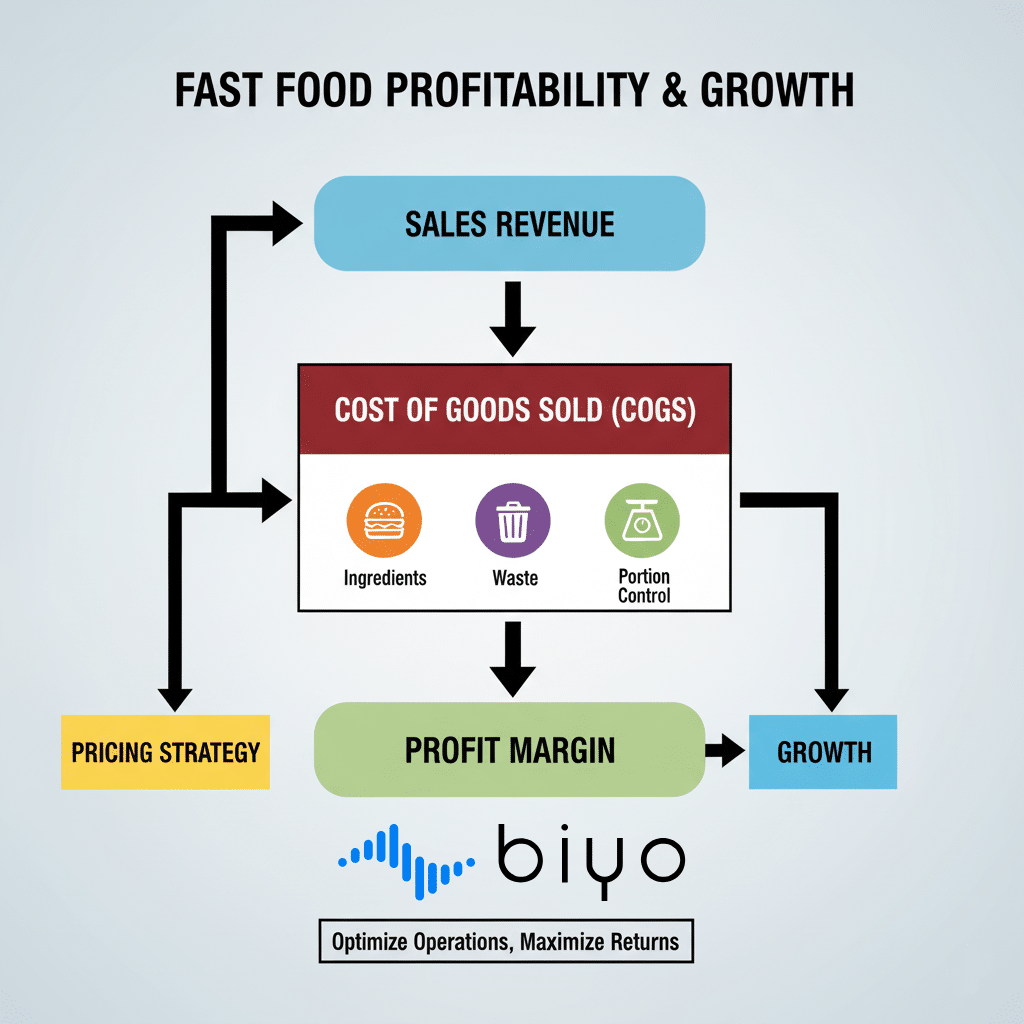
- The Impact of COGS on Profitability and Growth
- How Biyo POS Helps with COGS
- Frequently Asked Questions
Why Understanding COGS in Fast Food Matters
Fast food runs on thin margins—typically between 6% and 9%. That means small cost changes have massive impact. If your COGS increases even slightly, your profit doesn’t shrink—it collapses.
COGS and Profit Margins
Let’s make it simple. If you’re doing $1M in sales with 30% COGS, that’s $300,000 in food costs. If that jumps to 35%, you lose $50,000 instantly—without any drop in sales.
This is why most operators think they’re doing fine—sales look good—but profits feel tight. COGS is silently eating their business.
Influence on Menu Pricing
If you don’t know your exact item cost, your pricing is guesswork. That’s dangerous. A meal priced at $8 might look profitable, but if the real cost is $5.50, your margins are already weak before labor and overhead.
Accurate COGS allows you to:
– price confidently
– run promotions safely
– protect margins consistently
COGS and Financial Stability
Uncontrolled COGS creates unpredictable cash flow. That means:
– unstable profits
– poor forecasting
– weak investor confidence
Strong operators don’t just track sales—they control costs daily.
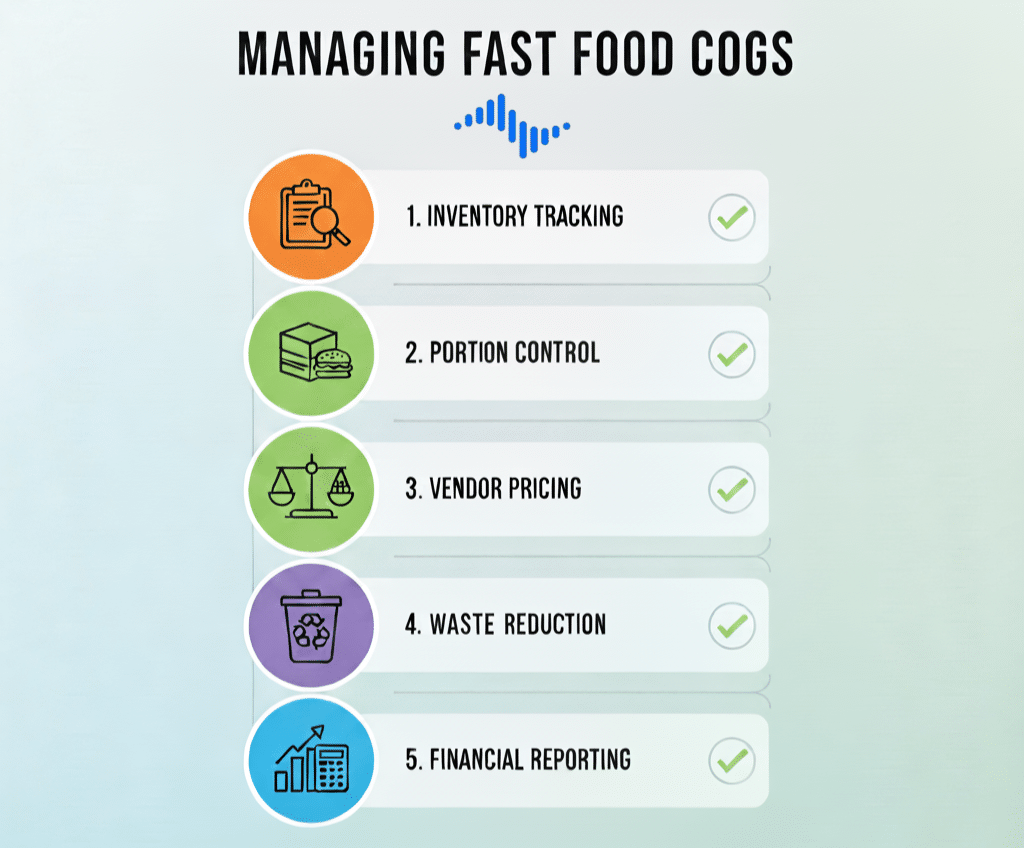
Key Components That Make Up COGS
COGS is not one number—it’s a combination of operational behaviors. If you don’t break it down, you can’t fix it.
Ingredient Costs
Ingredients are the biggest driver—typically 25–35% of revenue. Any fluctuation directly hits your margins.
Smart operators:
– monitor supplier pricing
– compare vendors regularly
– adjust sourcing strategies
Ignoring supplier pricing is basically choosing to lose money.
Portion Control
This is where most businesses leak profit.
Extra fries. Extra sauce. Slight over-serving.
Individually, it looks harmless. At scale, it destroys margins.
Consistency = predictable costs = stable profits.
Waste and Shrinkage
Restaurants waste 4–10% of food inventory on average. That’s not a small issue—it’s thousands lost annually.
Waste comes from:
– overproduction
– spoilage
– incorrect orders
– poor tracking
Shrinkage adds another layer—untracked usage and theft.
If you’re not tracking it, you’re paying for it.
Strategies to Reduce and Control COGS
Supplier Negotiation
Vendors control your cost base. If you’re not negotiating, you’re overpaying.
Use:
– multiple suppliers
– bulk agreements
– pricing comparisons
Even a 5–10% improvement here has a major impact.
Inventory Tracking Systems
Manual tracking is unreliable. You need automation.
A proper system:
– syncs sales with inventory
– tracks real-time usage
– identifies discrepancies
This is where technology stops guesswork.
Menu Engineering
Not all menu items are equal.
You should categorize:
– high profit + high sales → push
– low profit + high sales → optimize
– high profit + low sales → promote
– low profit + low sales → remove
Menu design is a financial strategy—not just presentation.
How to Analyze and Report on COGS
Expense Analysis
Break costs into components. Compare with past performance.
If something spikes, investigate immediately.
Break-even Analysis
You need to know your daily survival number.
If your break-even is $5,000/day and you’re doing $4,200, you’re losing money—even if sales feel busy.
Financial Reporting
Modern POS systems automate reporting.
You should always know:
– current food cost %
– margin trends
– cost deviations
If you wait for monthly reports, you’re already late.
The Impact of COGS on Profitability and Growth
Revenue Growth
Lower costs = more reinvestment.
You can:
– run better marketing
– improve customer experience
– expand operations
Expense Control
When you control COGS, you naturally improve discipline across the business.
Long-Term Profitability
This is the difference between surviving and scaling.
Strong COGS control gives:
– stability
– flexibility
– growth potential
How Biyo POS Helps with COGS
Managing COGS manually is slow and inaccurate. That’s where Biyo POS changes the game.
Biyo gives you:
– real-time inventory tracking
– recipe-level cost control
– automated reporting
– visibility into waste and shrinkage
Instead of guessing, you see exactly where money is going.
You can schedule a call to see how it fits your workflow, or sign up and start using it immediately.
Frequently Asked Questions
What does COGS include?
It includes ingredients, packaging, and all direct food-related costs.
What is a good COGS percentage?
Most fast food businesses aim for 25%–35%.
How do you calculate food cost percentage?
COGS ÷ total sales × 100.
Why is portion control important?
It prevents cost leakage and keeps margins stable.
Can POS systems reduce COGS?
Yes. They track inventory, reduce waste, and improve accuracy.