The way restaurants handle phone calls is changing fast. Long hold times, missed calls during rush hours, and overworked staff juggling multiple tasks are quickly becoming outdated problems. Enter the AI Voice Phone Assistant for Restaurants — a powerful, automated solution that uses voice recognition, natural language processing, and customer service automation to manage orders, reservations, and inquiries. By integrating this technology into their daily operations, restaurants can not only reduce errors and improve efficiency but also deliver a level of service that keeps customers coming back. With real-time updates, upselling suggestions, and multilingual support, this AI tool is setting a new gold standard in restaurant customer communication.
Table of Contents
- How an AI Voice Phone Assistant for Restaurants Works
- Key Benefits for Restaurants
- Transforming the Customer Experience
- Integrating AI Voice Assistants with POS Systems
- The Future of AI Voice Phone Assistants in Restaurants
How an AI Voice Phone Assistant for Restaurants Works
To appreciate the full potential of an AI Voice Phone Assistant for Restaurants, it’s essential to understand the technology behind it. These systems use advanced speech-to-text capabilities combined with natural language processing (NLP) to understand and respond to human speech in real time. The AI doesn’t just hear words — it interprets meaning, intent, and context. This allows restaurants to offer instant, accurate responses for everything from menu questions to table bookings. It’s like having a trained staff member who never gets tired, never makes mistakes, and can handle unlimited calls simultaneously.
Voice Recognition and Natural Language Processing
Voice recognition is the core of an AI Voice Phone Assistant for Restaurants. This technology listens to a caller’s words and converts them into structured data that a computer can understand. Unlike older voice menu systems that forced customers to “press 1 for reservations” or “press 2 for delivery,” modern AI assistants understand natural speech patterns. For example, if a caller says, “I’d like to reserve a table for four tomorrow at 7,” the AI can extract key details — party size, date, and time — without needing extra clarification. Natural language processing then interprets the intent behind the words and formulates a relevant, human-like response.
Advanced NLP also accounts for different accents, speech speeds, and even background noise, which is critical in the restaurant industry where callers may be in loud environments. This reduces the risk of misunderstandings and ensures customers don’t have to repeat themselves. By combining voice recognition with NLP, restaurants can offer a service that feels human but delivers the precision and efficiency of automation.
From a business perspective, this means fewer missed details, faster call resolution, and a consistent brand experience on every call. Customers notice when they don’t have to repeat information or clarify orders — and they reward that convenience with loyalty.
Automated Ordering and Order Customization
One of the most powerful features of an AI Voice Phone Assistant for Restaurants is its ability to handle automated ordering. Rather than relying on a busy server or host to take phone orders, the AI connects directly to the restaurant’s menu database. It can list menu items, offer descriptions, suggest add-ons, and even confirm special requests. This isn’t limited to simple orders — the AI can handle complex, multi-item requests with modifications like “extra cheese,” “no onions,” or “gluten-free crust.”
Imagine a Friday night rush when staff are busy serving dine-in customers. With an AI system, phone orders still get handled instantly, without putting pressure on floor staff. The AI confirms every detail before sending it to the kitchen, eliminating costly mistakes. Upselling suggestions — like pairing a main dish with a dessert or drink — are built into the process. Since the system operates without fatigue or distractions, upsell rates tend to be higher than with human staff.
This automation doesn’t just save time; it increases revenue and improves order accuracy. In industries where a single wrong order can hurt reviews and profit margins, the impact is substantial.
Reservation and Table Booking Management
Another area where the AI Voice Phone Assistant for Restaurants shines is in managing reservations. Instead of customers waiting on hold for a host to answer, the AI instantly checks availability in real time. It confirms bookings, updates the reservation system, and even sends confirmation texts or emails. This ensures that every booking is recorded accurately, reducing the risk of double bookings or missed reservations.
For customers, this means a smoother booking experience without delays. For restaurants, it frees up front-of-house staff to focus on greeting and serving in-house guests. The AI can also handle modifications and cancellations just as efficiently, updating seating charts and notifying staff immediately.
By automating this process, restaurants maintain tighter control over table management and improve their ability to maximize seating capacity — which directly translates into more covers and higher revenue.
Key Benefits for Restaurants
Adopting an AI Voice Phone Assistant for Restaurants is not just about keeping up with technology trends — it’s about solving real operational challenges and unlocking new revenue opportunities. From cost savings to improved service quality, the advantages are both immediate and long-lasting.
24/7 Availability and Multilingual Support
One of the biggest advantages of an AI Voice Phone Assistant for Restaurants is its ability to operate around the clock. While human staff need rest, the AI can take orders, answer questions, and handle reservations 24 hours a day. This is especially valuable for late-night diners, customers in different time zones, or early planners who call outside regular business hours. Every call is answered immediately, meaning no lost sales due to unanswered phones.
Multilingual support further expands the customer base. The AI can switch between languages seamlessly, allowing restaurants to serve tourists, immigrants, and multilingual communities more effectively. For example, a restaurant in Miami might get calls in English and Spanish daily. The AI can detect the caller’s language and respond appropriately, removing language barriers entirely.
This combination of 24/7 availability and multilingual capability positions restaurants as more accessible, customer-friendly, and inclusive — qualities that strengthen brand reputation and customer loyalty.
Reduced Labor Costs and Increased Efficiency
Labor is one of the largest expenses for any restaurant. By automating call handling, restaurants can reduce the number of staff hours spent on routine phone tasks. This doesn’t mean replacing human workers entirely — it means freeing them to focus on higher-value work like in-person guest service, food prep, and quality control. During peak hours, this shift in labor allocation can make a noticeable difference in service speed and quality.
Efficiency gains are not just about saving time. The AI processes calls with consistent accuracy, eliminating common mistakes like misheard orders or forgotten details. Since the AI never takes breaks, has no distractions, and can handle multiple calls at once, it ensures that service quality doesn’t dip during busy periods.
These operational improvements often translate directly into higher profit margins, as restaurants serve more customers without significantly increasing payroll expenses.
Improved Order Accuracy and Upselling
Mistakes in phone orders can lead to wasted food, unhappy customers, and negative reviews. An AI Voice Phone Assistant for Restaurants dramatically reduces these risks by confirming every detail before the order is finalized. The system follows structured scripts and double-checks key information, which minimizes human error while still sounding conversational.
Upselling is another area where AI excels. By suggesting relevant add-ons based on the customer’s order, the AI increases average ticket size without feeling pushy. For example, if a customer orders a large pizza, the AI might recommend adding a side salad or dessert. Since these prompts are data-driven and consistent, they outperform human upselling attempts, especially when staff are busy or distracted.
Over time, these small increases in order value can have a significant impact on overall revenue, making AI a profitable investment beyond labor savings.
Transforming the Customer Experience
Modern diners expect convenience, personalization, and fast service — whether they’re dining in, ordering takeout, or making a reservation. The AI Voice Phone Assistant for Restaurants directly addresses these expectations by delivering consistent, high-quality interactions over the phone. This technology doesn’t just replace manual call handling; it enhances it by making every conversation smoother, more informative, and more engaging for the customer.
Personalized Greetings and Smart Responses
One of the most memorable touches in customer service is personalization, and the AI Voice Phone Assistant for Restaurants excels here. When integrated with customer databases or loyalty programs, the AI can recognize repeat callers and greet them by name. It can even reference previous orders to provide a tailored experience, such as, “Hi John, would you like to reorder your usual pepperoni pizza and garlic knots?” These interactions make customers feel recognized and valued, building a stronger emotional connection to the brand.
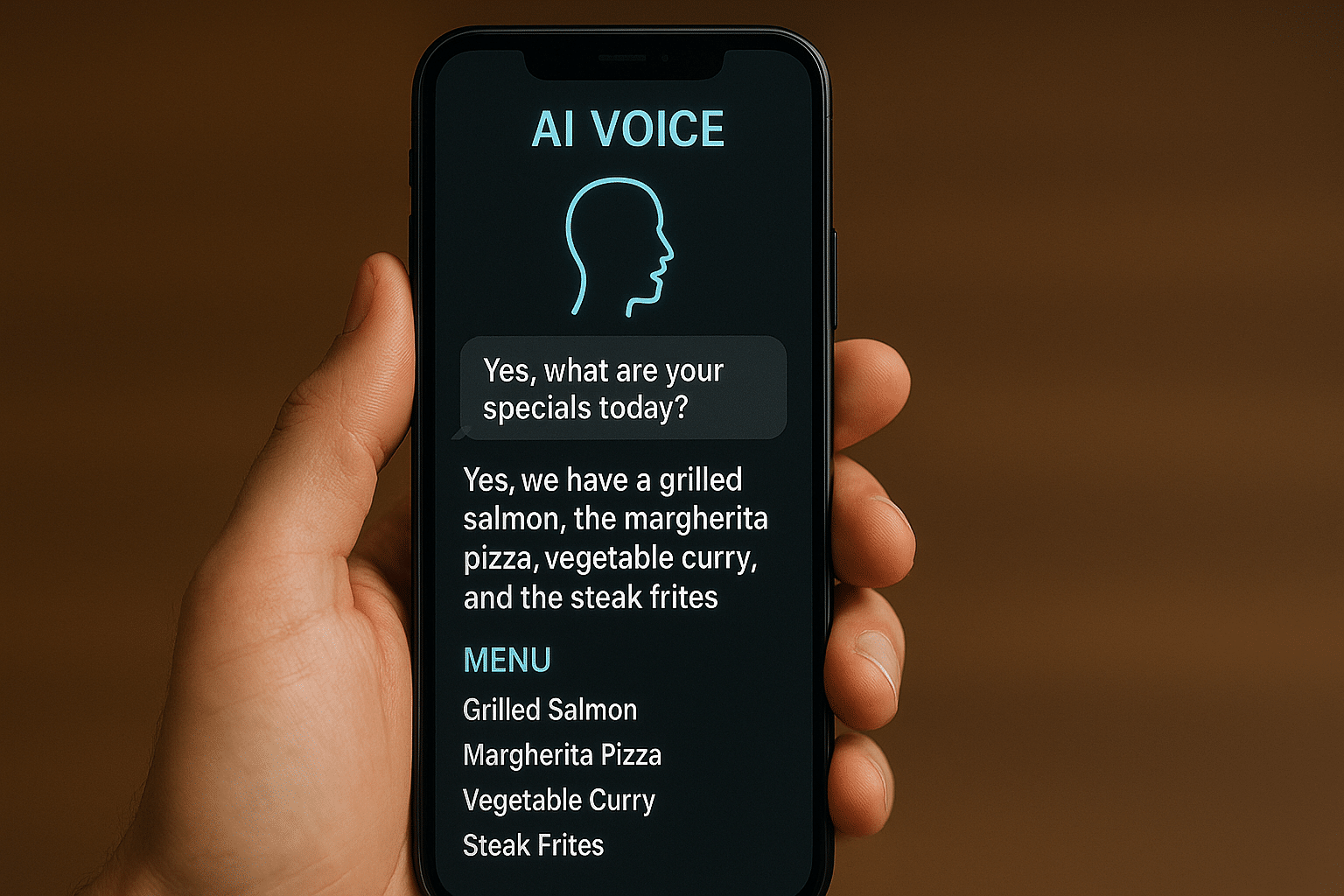
Smart responses allow the AI to handle a wide range of inquiries without the need for human intervention. Whether it’s answering questions about today’s specials, providing estimated delivery times, or explaining dietary options, the AI responds with accurate, relevant information instantly. It can also adjust its phrasing to sound friendly, helpful, and aligned with the restaurant’s brand voice, avoiding the robotic tone of older automated systems.
For customers, these intelligent and personalized interactions turn a simple phone call into a satisfying, streamlined experience that encourages repeat business. For restaurants, they create brand consistency and reduce reliance on staff memory or availability.
Real-Time Updates and Order Tracking
Keeping customers informed is one of the most important aspects of great service. The AI Voice Phone Assistant for Restaurants connects directly to the POS system, allowing it to provide real-time updates on orders and reservations. For example, if a customer calls to ask when their food will arrive, the AI can instantly pull delivery status from integrated tracking systems and share accurate, up-to-the-minute information.
Beyond delivery, real-time updates are useful for dine-in reservations, waitlist times, and even event bookings. The AI can notify customers if their table is ready earlier than expected or if there’s a delay in preparation. This transparency reduces frustration, builds trust, and makes the customer feel respected and valued.
In today’s competitive foodservice market, providing timely, accurate updates can be the difference between a one-time order and a loyal, returning customer. By automating this process, restaurants ensure that every customer receives the same level of service, no matter how busy the kitchen or front-of-house may be.
Hands-Free Ordering for Accessibility
Accessibility is often overlooked in restaurant operations, but it can significantly impact customer reach and satisfaction. The AI Voice Phone Assistant for Restaurants enables hands-free ordering, making it easier for customers with mobility challenges, visual impairments, or those driving to place orders safely and conveniently. This inclusivity is not just socially responsible — it also opens the restaurant to a broader audience.
For example, a visually impaired customer can call, navigate the menu verbally, and place a complete order without ever needing to read a menu or press phone buttons. Similarly, a parent driving with children in the car can order dinner without pulling over to manually enter details into an app. These scenarios highlight how hands-free technology can solve real-world customer problems.
Restaurants that embrace this accessibility not only enhance their brand image but also position themselves as forward-thinking and customer-focused — values that resonate strongly in today’s socially conscious marketplace.
Integrating AI Voice Assistants with POS Systems
While the AI Voice Phone Assistant for Restaurants is powerful on its own, its true potential is unlocked when fully integrated with the restaurant’s POS system. This connection allows for instant order transmission, inventory tracking, and seamless coordination between the front and back of the house. Integration transforms the AI from a simple call handler into a central hub for restaurant operations.
POS Integration for Accurate Order Processing
POS integration eliminates one of the most common bottlenecks in restaurant service: manual order entry. When the AI takes an order, it sends it directly to the POS in real time, ensuring that kitchen staff receive accurate, complete details instantly. This prevents common mistakes like incorrect toppings, missing items, or wrong preparation notes that often occur when orders are relayed verbally.
For multi-location businesses, POS integration ensures that orders are routed to the correct store automatically, based on the customer’s location or preference. This not only improves efficiency but also reduces the risk of missed or misrouted orders.
By removing human intermediaries from the order entry process, restaurants gain speed, accuracy, and consistency — all critical factors in delivering high-quality customer experiences.
Real-Time Inventory Management
Nothing frustrates a customer more than ordering a dish only to be told later that it’s unavailable. The AI Voice Phone Assistant for Restaurants solves this by integrating with real-time inventory data. When an item runs out, the AI knows instantly and can suggest alternatives before the customer completes their order. This proactive communication prevents disappointment and helps maintain a positive brand image.
On the operational side, real-time inventory tracking enables better forecasting and purchasing decisions. If the AI notices frequent stockouts of a particular item, management can adjust ordering patterns to meet demand. This reduces waste, avoids missed sales opportunities, and ensures popular items are always available when customers want them.
Such data-driven inventory management isn’t just a convenience — it’s a competitive advantage in a market where margins are thin and customer satisfaction is paramount.
Data Collection and Analytics
Every interaction handled by the AI Voice Phone Assistant for Restaurants generates valuable data. This includes details about order patterns, peak call times, customer preferences, and even common questions or concerns. When analyzed, this data offers powerful insights that can shape everything from menu design to marketing campaigns.
For example, if the AI logs an increase in vegetarian orders during certain months, the restaurant could introduce seasonal vegetarian specials to capitalize on demand. If peak call times occur between 6 and 7 PM, management can adjust staffing or promotions to optimize those hours. Even upsell performance can be tracked, allowing restaurants to refine AI scripts for maximum conversion.
By turning call data into actionable insights, restaurants can make more informed business decisions, improve customer satisfaction, and continually refine their operations for greater efficiency and profitability.
The Future of AI Voice Phone Assistants in Restaurants
The AI Voice Phone Assistant for Restaurants is already transforming the industry, but the technology is still evolving rapidly. As AI models become more sophisticated and integrations grow deeper, the capabilities of these systems will expand in exciting ways. Forward-thinking restaurants can gain a competitive edge by adopting these advancements early.
Advanced Upselling with AI Recommendations
Today’s upselling is based on basic product pairings, but future AI Voice Phone Assistants will leverage machine learning to create highly personalized recommendations. The AI will analyze past order history, customer preferences, and even current promotions to suggest items that are more likely to appeal to each caller. This means upselling will feel less like a sales pitch and more like a helpful suggestion tailored to the individual.
Imagine a customer who regularly orders spicy dishes being offered a new jalapeño-infused appetizer, or a wine enthusiast being informed about a limited-edition pairing for their entree. These targeted suggestions can significantly increase average order value and customer satisfaction simultaneously.
By making upselling feel like personalized service rather than a generic script, AI can turn what was once an overlooked sales opportunity into a consistent revenue driver.
Deeper Integration with Delivery Platforms
As more restaurants rely on third-party delivery services, integrating AI Voice Phone Assistants directly with these platforms will become a priority. This means customers could place a phone order through the AI, have it processed instantly, and then track delivery in real time — without ever speaking to a human. The AI could even provide updates on estimated arrival times, delays, or courier changes automatically.
For restaurants, deeper integration ensures consistent branding and service quality across both in-house and third-party delivery channels. It also allows them to collect valuable customer data that might otherwise remain with the delivery service, helping build stronger direct relationships with diners.
This level of connectivity will make voice-based ordering as seamless and convenient as app-based ordering, appealing to customers who prefer talking over tapping.
Enhanced Emotional Recognition and Tone Adjustment
One of the most exciting frontiers for AI Voice Phone Assistants is emotional recognition. By analyzing vocal cues such as pitch, pace, and volume, the AI could detect a caller’s emotional state and adjust its tone accordingly. For instance, a frustrated customer might receive a slower, more empathetic response, while an excited caller could be met with matching enthusiasm.
This adaptability creates interactions that feel more human and responsive, reducing customer frustration and increasing satisfaction. Emotional recognition could also help identify potential issues before they escalate, allowing restaurants to resolve concerns proactively.
By blending advanced emotional intelligence with operational efficiency, the next generation of AI Voice Phone Assistants will bring an unprecedented level of personalization and care to phone-based restaurant service.
Biyo POS is at the forefront of this transformation, offering AI Voice Phone Assistant solutions tailored specifically for restaurants. With features like real-time POS integration, automated ordering, multilingual support, upselling suggestions, and powerful analytics, Biyo POS helps restaurants increase efficiency, improve customer satisfaction, and boost revenue — all while staying ahead of industry trends.
FAQ
Q: Can an AI Voice Phone Assistant handle complex menu orders?
Yes. The AI can process detailed customizations, dietary requests, and special instructions while confirming accuracy before sending the order to the kitchen.
Q: Does the AI replace human staff completely?
No. It complements staff by handling routine tasks, freeing employees to focus on in-person service and food preparation where human interaction adds the most value.
Q: Is it difficult to integrate with my current POS system?
Not at all. Most modern AI Voice Phone Assistants, like those from Biyo POS, integrate seamlessly with popular POS platforms, making setup quick and straightforward.
Q: Can the AI handle multiple calls at the same time?
Yes. It can manage unlimited simultaneous calls, ensuring no customer is left waiting during peak hours.
Q: How does it handle multiple languages?
The AI uses multilingual voice recognition to interact with customers in their preferred language, improving accessibility and inclusivity for diverse communities.