
A Multi-Location Owner Dashboard is no longer optional for growing retailers, restaurants, and franchise operators. Once a business expands beyond a single location, operational complexity increases rapidly. Sales reports become fragmented, inventory visibility weakens, labor tracking becomes inconsistent, and managers often send data in different formats that slow decision-making.
At that point, spreadsheets and disconnected systems stop being reliable operational tools. Business owners need centralized visibility that allows them to monitor performance, compare locations, analyze profitability, and identify operational issues in real time. This is where a modern Multi-Location Owner Dashboard becomes essential.
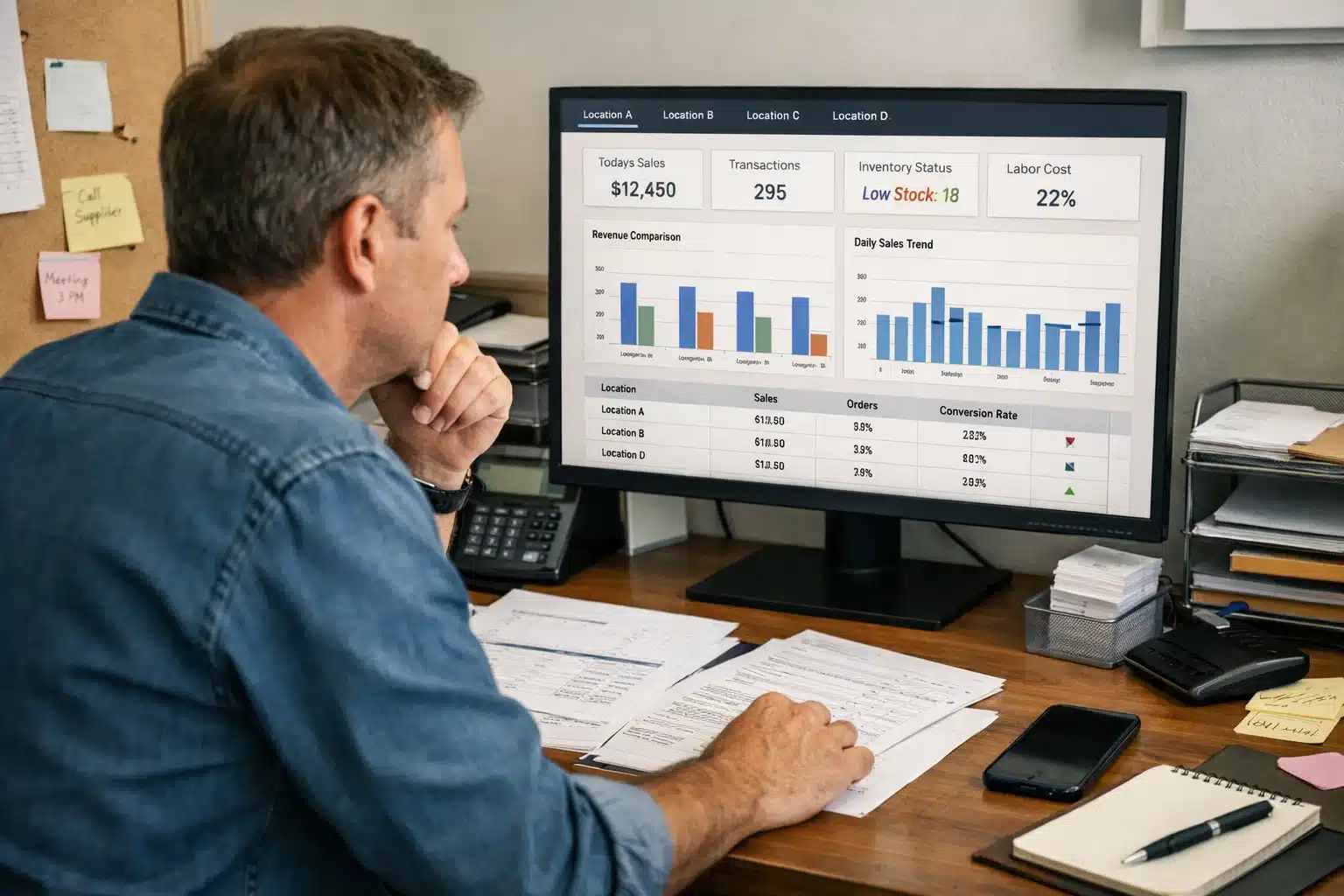
A centralized dashboard transforms how businesses operate. Instead of managing each store individually, owners gain a unified view of the entire organization from one system. Revenue, inventory, labor costs, customer activity, and operational metrics can all be monitored from a single interface.
This level of visibility improves strategic decision-making because owners no longer rely on delayed reports or incomplete information. Problems can be identified early, opportunities become easier to spot, and operational consistency improves across every location.
In this guide, we’ll explore how a Multi-Location Owner Dashboard works, why centralized reporting matters, the core features businesses should prioritize, and how platforms like Biyo POS help growing brands maintain control while scaling efficiently.
Table of Contents
- Why a Multi-Location Owner Dashboard Matters
- Core Features of a Powerful Dashboard
- Location Comparison and Performance Insights
- Centralized Financial Oversight Made Simple
- Operational Control Across All Stores
- Executive Reporting and Strategic Planning
- Cloud Access, Security, and Remote Visibility
- The Future of Multi-Location Management
- How Biyo POS Delivers a Modern Dashboard
- Frequently Asked Questions
Why a Multi-Location Owner Dashboard Matters
As businesses expand into multiple locations, operational management becomes significantly more complicated. What once worked for a single store quickly becomes inefficient across several locations.
Without centralized reporting systems, managers often generate separate spreadsheets, PDF reports, screenshots, or manual updates that owners must compile themselves. This process wastes time, increases reporting errors, and delays important business decisions.
A Multi-Location Owner Dashboard eliminates these operational inefficiencies by consolidating information into one centralized interface.
Eliminating Fragmented Reporting
Fragmented reporting is one of the biggest problems multi-store operators face. When each location reports differently, comparing performance accurately becomes difficult.
Some managers may prioritize sales numbers while others focus on labor costs or inventory updates. This inconsistency creates visibility gaps that prevent owners from understanding the full picture.
A centralized dashboard standardizes reporting across all stores automatically. Revenue, expenses, labor, inventory, and customer metrics all flow into one unified system in real time.
This consistency improves accuracy while reducing the manual workload associated with collecting and organizing business data.
Real-Time Revenue Tracking
Real-time revenue tracking gives business owners immediate visibility into sales activity across every location.
Instead of waiting for end-of-day summaries or weekly reports, owners can monitor hourly sales trends, transaction activity, and operational performance live.
If one location underperforms during peak periods, management can respond immediately instead of discovering problems days later.
Real-time visibility also improves confidence in decision-making because owners rely on current operational data rather than assumptions or delayed reporting.
Centralized Leadership and Strategic Oversight
A Multi-Location Owner Dashboard shifts leadership from reactive management toward strategic oversight.
Instead of spending hours collecting reports manually, owners can focus on growth planning, operational improvements, marketing strategy, and financial optimization.
This transition becomes especially important for businesses preparing to scale further because operational complexity grows exponentially with each new location.
 Core Features of a Powerful Dashboard
 Core Features of a Powerful Dashboard
Not every reporting system qualifies as a true Multi-Location Owner Dashboard. Basic reporting screens may display sales totals, but modern businesses require deeper operational intelligence and actionable insights.
Consolidated Performance Views
A powerful dashboard combines multiple operational metrics into one centralized view.
Sales performance, profit margins, inventory movement, labor costs, customer traffic, and employee productivity should all appear within one ecosystem instead of separate disconnected reports.
This consolidated structure allows owners to understand relationships between metrics more effectively.
For example, declining profitability may connect directly to rising labor costs, discount overuse, or inventory waste at a specific location.
Without centralized visibility, identifying these relationships becomes far more difficult.
Drill-Down Reporting Capability
While summary-level reporting is important, owners also need the ability to investigate deeper operational details.
A strong Multi-Location Owner Dashboard allows users to drill down into individual locations, departments, transactions, or employee activity instantly.
Owners can analyze specific stores experiencing performance issues without losing centralized visibility over the rest of the business.
This flexibility improves problem-solving precision because operational issues can be isolated quickly instead of relying on generalized assumptions.
Customizable Dashboard Views
Different businesses prioritize different operational metrics depending on industry, size, and management structure.
Restaurant operators may prioritize labor percentages and ticket times, while retailers may focus more heavily on inventory turnover and transaction volume.
Customizable dashboards allow businesses to prioritize the data most relevant to their operational goals.
This personalization improves usability while making decision-making faster and more focused.
Location Comparison and Performance Insights
One of the most valuable benefits of a Multi-Location Owner Dashboard is the ability to compare stores consistently using standardized performance metrics.
Location Comparison Metrics
Location comparison metrics allow owners to identify top-performing stores, operational weaknesses, and revenue trends across the organization.
Businesses can compare metrics such as:
• revenue performance
• average transaction value
• customer traffic
• profit margins
• labor efficiency
• inventory turnover
Clear comparisons remove guesswork and create measurable accountability across every location.
Managers can no longer rely on subjective explanations because performance becomes visible through standardized reporting.
Benchmarking Operational Standards
Benchmarking helps businesses establish performance expectations based on the strongest-performing locations.
If one store consistently outperforms others, management can analyze its operational practices and apply successful strategies across the organization.
This process improves consistency while helping underperforming locations close operational gaps more effectively.
Standardized KPIs also improve employee accountability and management transparency.
Identifying Regional Trends
Businesses operating across multiple cities or regions often experience location-specific customer behaviors and operational challenges.
A Multi-Location Owner Dashboard helps identify regional sales trends, seasonal fluctuations, customer preferences, and local performance patterns.
These insights support smarter inventory planning, marketing campaigns, staffing strategies, and expansion decisions.
Centralized Financial Oversight Made Simple
Financial visibility becomes increasingly difficult as businesses expand into multiple locations. Without centralized oversight, hidden financial issues can develop between stores unnoticed.
Unified Financial Reporting
A centralized dashboard combines revenue, expenses, taxes, discounts, labor costs, and profitability data into one financial reporting system.
Owners can monitor total business performance instantly while also reviewing individual location profitability.
This aggregated visibility improves strategic financial planning and simplifies executive reporting.
Businesses gain a clearer understanding of overall organizational health instead of analyzing stores in isolation.
Labor and Expense Monitoring
Labor costs often vary significantly between locations depending on staffing efficiency, scheduling practices, and sales performance.
A Multi-Location Owner Dashboard helps businesses track labor percentages relative to revenue across all stores.
Managers can identify locations with excessive overtime, inefficient scheduling, or inconsistent staffing patterns.
Expense monitoring also improves operational discipline because unusual spending patterns become visible much faster.
Margin Analysis and Profitability
Revenue alone does not determine business success. Profit margins ultimately define long-term sustainability.
Dashboards that combine sales and expense data help owners understand which stores generate the strongest profitability rather than simply the highest revenue.
This distinction becomes critical during expansion planning because high-volume locations may still operate inefficiently.
Operational Control Across All Stores
Operational consistency directly affects customer experience and brand reputation. A Multi-Location Owner Dashboard helps businesses maintain control beyond financial reporting alone.
Inventory and Stock Visibility
Centralized inventory tracking allows owners to monitor stock levels across all locations in real time.
If one location experiences shortages while another carries excess inventory, the dashboard highlights those imbalances immediately.
This visibility improves inventory transfers, purchasing efficiency, and waste reduction.
Restaurants and retailers especially benefit because inventory directly affects profitability and customer satisfaction.
Employee Productivity Insights
Employee performance tracking helps businesses evaluate staffing efficiency across locations.
Metrics such as sales per labor hour, average transaction value per employee, and productivity trends provide deeper operational insight.
Businesses can reward high-performing teams while identifying locations that require additional training or management support.
Consistent performance measurement strengthens accountability across the organization.
Operational Consistency Across Locations
As businesses grow, maintaining consistent customer experiences becomes increasingly difficult.
Dashboards help enforce operational standards by monitoring service metrics, inventory availability, pricing consistency, and sales performance uniformly across all stores.
This centralized control supports stronger brand reliability and customer trust.
Executive Reporting and Strategic Planning
Executive leadership depends on accurate and timely information. Manual reporting processes slow strategic planning and create unnecessary inefficiencies.
Automated Executive Reports
Automated reporting tools generate daily, weekly, and monthly summaries instantly without requiring manual compilation.
This saves management time while improving reporting consistency and accuracy.
Executives can focus more heavily on business strategy rather than data collection.
Automated reports also support board meetings, investor discussions, and long-term planning initiatives.
Forecasting and Expansion Planning
Historical performance data supports more accurate forecasting and business planning.
Owners can evaluate whether operational models scale effectively before expanding into new markets.
If multiple locations consistently demonstrate stable profitability and operational efficiency, expansion becomes significantly less risky.
Data-driven planning improves confidence during high-investment business decisions.
Faster Decision-Making
One of the greatest advantages of centralized dashboards is speed.
Instead of waiting days for manual updates, owners gain immediate visibility into operational conditions.
Faster access to accurate data improves responsiveness during operational challenges and market changes.
Cloud Access, Security, and Remote Visibility
Modern Multi-Location Owner Dashboards increasingly rely on cloud infrastructure to improve accessibility and operational reliability.
Remote Access from Any Device
Cloud-based dashboards allow owners and executives to monitor operations remotely using laptops, tablets, or smartphones.
This flexibility becomes extremely valuable for multi-location businesses where leadership may travel frequently or manage operations across multiple regions.
Remote access ensures visibility is always available regardless of physical location.
Automatic Data Backup and Security
Cloud systems also improve operational security through automatic backups and centralized data storage.
Businesses reduce the risk of losing critical operational information due to hardware failures, local outages, or manual reporting errors.
Modern cloud infrastructure often includes encryption, permission management, and role-based access controls that strengthen overall data security.
Scalability for Growing Businesses
Cloud-based dashboards scale far more efficiently than older local systems.
As businesses add locations, employees, products, and operational complexity, centralized cloud infrastructure supports expansion without requiring complete system replacements.
This scalability makes cloud dashboards especially valuable for growing brands.
The Future of Multi-Location Management
Multi-location business management will continue evolving alongside automation, artificial intelligence, predictive analytics, and cloud technology.
Future dashboards will likely provide even deeper operational insights through AI-powered forecasting, automated anomaly detection, and predictive business recommendations.
Businesses may eventually receive automatic alerts about inventory risks, staffing inefficiencies, customer behavior changes, or financial abnormalities before problems fully develop.
As competition increases across retail and restaurant industries, businesses that rely on centralized operational intelligence will gain stronger long-term advantages over organizations still dependent on fragmented reporting systems.
How Biyo POS Delivers a Modern Dashboard
 How Biyo POS Delivers a Modern Dashboard
Biyo POS provides a cloud-based Multi-Location Owner Dashboard designed specifically for restaurants, retailers, kiosks, and growing multi-unit businesses.
The platform centralizes sales reporting, inventory management, labor tracking, customer analytics, and financial oversight into one unified operational system.
Because Biyo operates in real time, owners can monitor performance instantly across all locations while accessing detailed drill-down reporting whenever needed.
The system also supports automated executive reporting, inventory visibility, and employee performance tracking that help businesses maintain operational consistency while scaling efficiently.
If you want a centralized dashboard that improves visibility and simplifies multi-store management, you can schedule a live demo or explore the platform directly through the Biyo signup page.
Frequently Asked Questions
What is a Multi-Location Owner Dashboard?
A Multi-Location Owner Dashboard is a centralized reporting system that allows businesses to monitor sales, inventory, labor, and operational performance across multiple locations in real time.
Why is centralized reporting important for multi-store businesses?
Centralized reporting eliminates fragmented data, improves visibility, reduces manual reporting errors, and helps owners make faster operational decisions.
What metrics should a multi-location dashboard include?
Important metrics include revenue tracking, profit margins, inventory levels, labor costs, employee productivity, customer activity, and location comparison data.
Can dashboards help businesses scale more efficiently?
Yes. Centralized dashboards improve operational consistency, strategic planning, forecasting, and executive oversight, which supports more controlled expansion.
How does Biyo POS support multi-location management?
Biyo POS provides centralized cloud-based reporting, inventory tracking, employee analytics, financial oversight, and real-time operational visibility across all business locations.