A solid restaurant marketing plan is more than just a document—it’s the strategic roadmap that steers every promotional decision you make. It’s what turns random spending into a real investment, leading to fuller tables, sustainable growth, and a brand that people talk about.
Setting The Stage For Sustainable Growth
Before you even think about launching an ad or printing a flyer, the most successful restaurants are busy laying a strategic foundation. This is the crucial work that separates the businesses that thrive year after year from those that are always chasing the latest trend. It’s all about getting to the heart of your market, your customers, and what makes you special.
Jumping straight into tactics without a plan is a bit like trying to cook a five-course meal without a recipe. You might get one dish right, but the whole thing will probably be a mess. This foundational stage is where you gather your ingredients: customer insights, a clear picture of the competition, and objectives you can actually measure.
Know Your Ideal Customer Intimately
Going beyond basic demographics is non-negotiable. You need to build a detailed, almost personal, picture of your ideal diner. What do they really care about when they go out to eat? Is it speed and convenience on a lunch break, a unique atmosphere for a special night out, or just a place that’s great for the kids?
Dig a little deeper with questions like these:
- What are their pain points? Are they bored with the same old takeout options? Do they struggle to find places that cater to dietary needs?
- Where do they hang out online? Are they scrolling food pics on Instagram, Googling “best brunch near me,” or asking for recommendations in a local Facebook group?
- What actually influences their choices? Do they trust food bloggers, listen to their friends, or get hooked by a compelling social media ad?
Ultimately, this all comes back to creating an amazing visit from start to finish. You can explore proven strategies to improve customer experience and boost loyalty to get a head start. Answering these questions lets you fine-tune your marketing to connect with the people you really want walking through your doors.
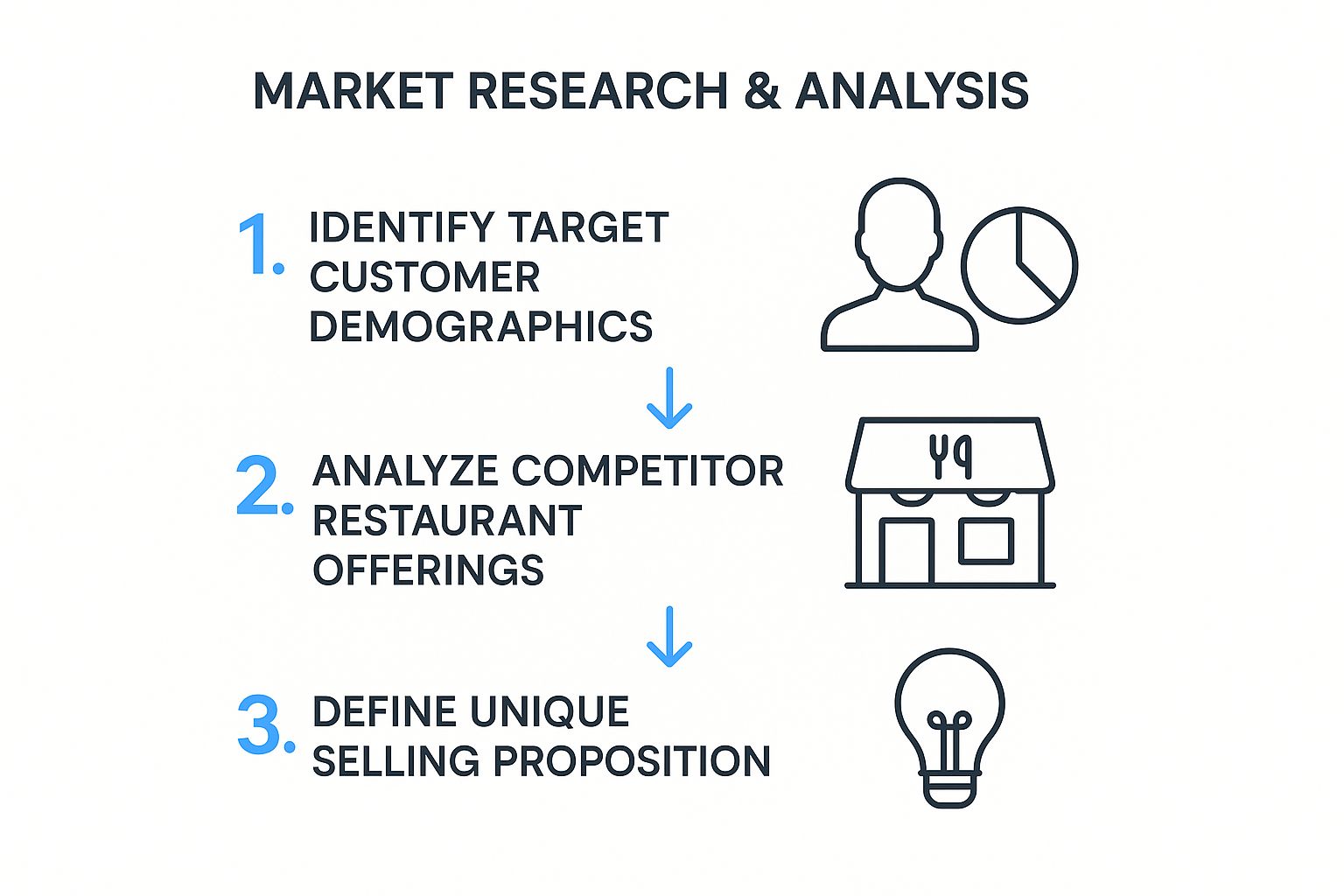
This process lays out a clear path, starting from understanding your audience and competitors and ending with a crystal-clear idea of what makes your restaurant the best choice.
Analyze The Competitive Landscape
Studying your competition isn’t about copying their menu. It’s about finding the gaps in the market that your restaurant can perfectly fill. Start by making a list of your direct and indirect competitors. A direct competitor is the other Italian spot down the street. An indirect one might be that popular meal-kit delivery service everyone’s trying.
Once you have your list, do a quick SWOT analysis (Strengths, Weaknesses, Opportunities, Threats) for each. This exercise is incredibly revealing. It shows you what they’re great at and where they’re dropping the ball, pointing directly to opportunities for you to shine.
This isn’t just an academic exercise. With the global restaurant market projected to hit $376.2 billion by 2025, the competition is fierce. The U.S. market alone makes up a massive 69.18% of the North American share, and it’s expected to jump from $88.3 billion in 2021 to $117 billion in 2025. In a market this crowded, knowing exactly where you fit in is everything.
Set Clear and Measurable Goals
Finally, all this prep work leads to setting SMART goals. That means every objective you set should be Specific, Measureable, Achievable, Relevant, and Time-bound. A vague goal like “get more customers” is useless because you’ll never know if you’ve actually succeeded.
Here’s the difference:
- The Vague Goal: “Get more customers.”
- The SMART Goal: “Increase the number of dinner reservations by 15% over the next quarter by running targeted Facebook ads and an email campaign to our existing customer list.”
See how the second one gives you a clear target, a deadline, and the exact methods you’ll use? That’s a goal you can build a real plan around.
To bring it all together, think of your foundational plan as having a few core pillars. This table breaks down what those are and why they matter.
Core Components of a Foundational Marketing Plan
| Component | Objective | Key Actions |
|---|---|---|
| Audience Definition | To create a detailed profile of the ideal customer. | Conduct surveys, analyze social media data, interview current patrons. |
| Competitive Analysis | To identify market gaps and differentiation opportunities. | Perform SWOT analysis on top 3-5 competitors, monitor their pricing and promotions. |
| Unique Selling Prop. | To clearly state what makes your restaurant special. | Define your core value (e.g., farm-to-table, best happy hour, authentic cuisine). |
| SMART Goals | To set clear, actionable targets for growth. | Establish specific KPIs for revenue, customer acquisition, and brand awareness. |
With these components locked in, you have a solid, strategic base. You’re no longer just guessing—you’re making informed decisions that will drive real, sustainable growth for your restaurant.
What’s Your Restaurant’s Story? Defining Your Brand
In a sea of dining options, your brand is what makes you stand out. It’s so much more than just a cool logo or a clever name. It’s the entire feeling a customer gets from the moment they hear about you to the time they pay the bill—and the story they remember long after. A rock-solid brand identity is the foundation of any good marketing plan, turning curious first-timers into regulars who evangelize for you.
So, what’s the soul of your restaurant? Your identity is built on this unique narrative. Maybe you’re using cherished family recipes passed down through three generations. Perhaps you’re fiercely committed to sourcing every single ingredient from farms within a 50-mile radius. Or maybe you’re just doing something bold and innovative that no one else in town has the guts to try.

Whatever your story is, figuring it out is the first and most crucial step. This core narrative will guide every single decision you make, from the font on your menu to your latest Instagram post.
Finding Your Voice (and Using It Everywhere)
Your brand voice is simply the personality of your restaurant, but in word form. Are you warm and welcoming? A bit more exclusive and sophisticated? Or are you quirky and fun? Nailing this down and sticking to it builds trust and makes your restaurant feel authentic.
This voice needs to be consistent across every single place a customer interacts with you. It has to feel connected.
- Your Menu: The descriptions should ooze personality. A farm-to-table spot might get descriptive: “Our heritage tomatoes are hand-picked at dawn from Sunny Meadow Farms.” A buzzing taco joint could go for something punchier: “Brace yourself for a flavor explosion.”
- Your Website: The ‘About Us’ page is prime real estate for sharing your origin story. Tell it with a tone that perfectly matches the vibe inside your restaurant.
- Social Media: Your captions should sound like they’re written by a real person, not a marketing bot. Jump into the comments and chat with your followers using that same, consistent voice.
When you maintain this consistency, you create a seamless and enjoyable experience. A customer who loves your witty Instagram feed shouldn’t walk in and be handed a formal, stuffy menu. That disconnect is jarring.
Your brand isn’t what you say it is. It’s what your customers feel it is. Every single interaction—from a click on your website to the greeting at the host stand—either builds that feeling up or tears it down.
A well-defined voice makes all your marketing work harder. It helps you attract the right crowd and ensures your message actually connects, which is a critical piece when you master restaurant marketing plan implementation like a pro.
Creating a Look People Won’t Forget
Once you’ve got your story and voice down, it’s time to make it visual. A strong visual identity makes your restaurant instantly recognizable, whether someone is driving by your sign, scrolling past an ad, or seeing a post on their feed. This all comes down to your logo, colors, and typography.
These elements need to sing in harmony.
- Logo: Keep it simple, memorable, and true to your concept. A high-end steakhouse might lean into an elegant, classic font, while a trendy cafe could go for a clean, minimalist design.
- Colors: Color is all about emotion. Warm tones like reds and oranges are known to stimulate appetite. Earthy greens and browns can signal fresh, organic ingredients. Pick a palette that creates the mood you’re going for.
- Photography: Don’t skimp here. Your photos of food and your space are some of your most powerful marketing assets. Invest in a professional who can make your dishes look incredible and capture the unique atmosphere of your dining room. People absolutely eat with their eyes first, especially online.
Pull all these pieces together, and you have a cohesive visual brand that tells your story at a glance. It’s this powerful combination of narrative, voice, and visuals that elevates a simple meal into a brand experience people will remember and return for.
Mastering Your Digital Front Door
Long before a guest ever steps through your physical door, they’ve already “visited” you online. Your website, your Google listing, your reviews—they all combine to create a first impression. A clunky, outdated website is the modern equivalent of a flickering neon sign and peeling paint on the window. It silently tells potential customers you might not care about the details.
Getting this right isn’t just about looking good. It’s about turning those online browsers into paying diners. This is where your marketing plan gets real, creating a clear, easy path from a quick search to a reservation.
Your Website Is Your Most Important Location
Think of your website as your flagship location. It’s the one that’s open 24/7, and it needs to work hard for you. It’s not a digital brochure; it’s a tool that drives business. If someone lands on your site and can’t find your menu in under ten seconds, they’re probably gone for good.
A great restaurant website isn’t complicated, but it has to nail a few key things:
- Mobile-First, Always: The overwhelming majority of your visitors will be on their phones, often looking for a place to eat right now. Your site has to be dead simple to use on a small screen.
- Irresistible Photos: Grainy, poorly lit pictures of your food are a complete non-starter. Professional, high-quality images of your dishes and atmosphere aren’t an expense; they’re an investment that makes people hungry.
- An Awesome Online Menu: Your menu should be a webpage. A simple, easy-to-read webpage. Don’t make people download a clunky PDF they have to pinch and zoom to read. Keep it clear, current, and straightforward.
- Easy Online Ordering: Make it incredibly easy for people to give you money. Whether they’re booking a table or ordering takeout, the process should be frictionless, with big, obvious “Book a Table” or “Order Now” buttons.
This digital experience has to match the type of restaurant you run. The data backs this up. Full-service restaurants, a sector projected to grow to $1.97 trillion by 2032, rely on an online presence that sells the experience. On the other hand, quick-service spots, a market expected to hit $381.8 billion by 2033, have to offer extreme digital convenience. Knowing which camp you’re in helps you focus your efforts. You can dive deeper into these restaurant industry statistics to see the full picture.
Win the “Near Me” Search Game
When someone pulls out their phone and types “tacos near me,” you want to be at the top of that list. That’s what local Search Engine Optimization (SEO) is all about, and it’s probably the most powerful tool you have for attracting new local customers. The heart of this strategy is your Google Business Profile (GBP).
Your Google Business Profile is no longer optional—it’s your most critical piece of digital real estate. Treat it with the same care you give your dining room.
Keeping your profile in top shape is pretty straightforward, but it demands consistency. Make sure every single field is filled out: hours, address, phone number, and website are the bare minimum. You should also be uploading new, high-quality photos regularly, posting updates about specials or events, and—this is a big one—actively responding to questions that people ask on your profile.
The Power of Online Reviews and Reputation
Reviews are the new word-of-mouth. They’re incredibly influential. A steady stream of recent, positive reviews on sites like Google, Yelp, and TripAdvisor is pure marketing gold. But you can’t just sit back and hope they appear.
You have to actively encourage happy customers to share their feedback. A small note on the bottom of a receipt, a link in an email, or even a small sign by the door can work wonders. What’s even more important, though, is how you engage with the reviews you receive.
Responding to feedback—good and bad—shows everyone that you listen and you care.
- For positive reviews: Thank the guest by name and mention a specific detail they brought up. It shows a real person is reading it.
- For negative reviews: Always, always respond publicly. Acknowledge their experience, apologize that you fell short, and offer a concrete way to make it right. This isn’t just for that one unhappy customer; it shows every potential customer that you take service seriously.
By mastering your website, owning your local search results, and actively managing your online reputation, you build a digital presence that does more than just get attention. It builds trust and drives real, measurable business.
Building a Community Beyond Your Four Walls
The best marketing plans today are about connection, not just transactions. Your goal should be to build a loyal community of fans who feel like they’re part of your restaurant’s story. Social media is your biggest stage for this, but it takes more than just posting pretty food pictures.
Real community building starts when you create content that sparks conversation and gives people a reason to jump in. It’s about letting your personality shine, celebrating your customers, and making them feel seen. That’s how you turn a first-time visitor into a regular who brings all their friends.
Go Beyond the Food Pics on Social Media
High-quality food photography is table stakes, but it’s only one piece of the puzzle. To really connect with people, you have to show them the heart and soul behind the business. Think of your social media as an all-access, behind-the-scenes pass to your restaurant.
Mix up your content to keep your feed fresh and exciting:
- Introduce the Team: Post a short video of your head chef explaining the inspiration behind a new dish. Or do a fun Q&A with your star bartender. It humanizes your brand instantly.
- Showcase Your Process: A quick time-lapse of dough being made or fresh produce arriving from a local farm tells a story of quality and care.
- Embrace Video: Use Instagram Stories and TikTok for candid, unpolished moments. These formats are perfect for showing off your restaurant’s vibe on a busy night.
This approach forges a much deeper bond than a simple photo of a burger ever could. It makes your followers feel like insiders, and that feeling is a powerful driver of loyalty.
Turn Your Customers into Your Best Marketers
Your happiest customers are your most powerful marketing assets. When they share photos and videos—what we call user-generated content (UGC)—it’s social proof at its most authentic. The trick is to actively encourage and celebrate it.
Start by creating an “Instagrammable” spot in your restaurant. It could be a unique mural, a clever neon sign, or a dessert that looks like a work of art. Make it easy and fun for people to snap a picture and share it.
Then, make it a habit to feature your favorite customer posts on your own channels (always ask for permission and give them credit!). This simple act of recognition makes that customer feel special and inspires others to share their own experiences. To build a tribe around your restaurant, it’s crucial to follow customer engagement best practices.
A customer’s post is more than just a photo; it’s a personal endorsement shared with their trusted network. When you amplify that voice, you’re not just sharing content—you’re building a community one post at a time.
Keep the Conversation Going with Email
While social media is great for reaching a wide audience, email is your direct line for more personal conversations. It’s the perfect way to keep your restaurant top-of-mind, whether for a weeknight craving or a big celebration. The key is sending emails that actually feel valuable, not like spam.
Try segmenting your email list to send more relevant messages. A first-time visitor, for example, should get a different offer than a loyal regular who’s been with you for years.
Here are a few simple but effective email tactics:
- Birthday & Anniversary Reminders: Collect special dates from customers and send them a personalized offer a few weeks ahead. A simple “Celebrate with us!” email can lock in a high-value booking.
- Exclusive Offers: Make your email subscribers feel like VIPs by sending them offers they can’t get anywhere else, like early access to a new menu or a secret discount code.
- Tell a Story: Use email to share news about an upcoming event, introduce a new local supplier, or just say thank you for the support.
This targeted approach makes sure your messages hit home, reinforcing the personal connection that turns customers into a true community.
Tracking What Matters to Drive Profitability
A brilliant restaurant marketing plan means nothing if you can’t tell what’s working. Running campaigns without tracking your results is like cooking blindfolded—you might get lucky once, but you’ll never be able to repeat your success. To drive real profit, you have to move past the vanity metrics and focus on the key performance indicators (KPIs) that directly impact your bottom line.
Likes and shares on an Instagram post feel good, but they don’t always put diners in seats. The real goal is to connect specific marketing activities to tangible business results. That means getting disciplined about measurement so you can double down on what works and cut what doesn’t.
Identifying Your Most Important KPIs
To really see if your marketing is paying off, you need to track the right numbers. It’s not just about the top social media metrics to track; your restaurant’s plan needs to go deeper, zeroing in on metrics that link directly to revenue.
Here are the KPIs that actually matter for a restaurant:
- Customer Acquisition Cost (CAC): This is the total cost of your marketing efforts divided by the number of new customers you gained. Calculating CAC tells you exactly how efficient your spending is and helps you make much smarter budget decisions.
- Customer Lifetime Value (CLV): CLV predicts the total amount of money a single customer will spend at your restaurant over time. A high CLV is a fantastic sign of strong customer loyalty and repeat business.
- Reservation Sources: Knowing where your bookings are coming from—whether it’s a Google search, your website, or a link on social media—shows you which channels are most effective at filling your tables.
- Offer Redemption Rates: For any promotion or special you run, you have to track how many people actually use it. This data quickly reveals which deals are hitting the mark with your audience.
Understanding these numbers is everything. The restaurant industry is seeing a major post-pandemic rebound, with U.S. sales projected to hit a staggering $1.6 trillion by 2025. But even with that growth, profitability is razor-thin—the average net profit margin is only 3% to 5%. Every single marketing dollar has to count.
A vanity metric makes you feel good. An actionable metric helps you make decisions. A successful restaurant marketing plan is built entirely on the latter.
Using Simple Tools to Track Progress
You don’t need a data science degree to monitor your marketing. Many of the tools you already use have powerful analytics built right in. The key is knowing what to look for and making a habit of checking in consistently.
Google Analytics can show you exactly how people find your website and which pages lead to the most online orders or reservation clicks. Your email marketing platform provides open and click-through rates, while your social media accounts offer detailed insights into audience engagement and reach.
When you pull these sources together, you get a clear picture of your entire marketing ecosystem. Once you know which efforts are driving real business, you can refine your strategy. For more ideas, you can find extra guidance here: https://biyopos.com/blog/how-to-increase-restaurant-sales/
Creating a Practical Content Calendar
Consistency is the engine of a great marketing plan. A content calendar is your roadmap, ensuring you maintain a steady presence without scrambling for ideas at the last minute. This simple tool helps you plan promotions, schedule social media posts, and keep your messaging aligned across every channel.
Your calendar doesn’t need to be fancy—a shared spreadsheet often works perfectly.
Measuring your efforts isn’t just about looking back; it’s about making smarter decisions moving forward. The table below outlines some of the most critical metrics for any restaurant and the straightforward tools you can use to keep an eye on them.
Key Restaurant Marketing Metrics and How to Track Them
| Metric (KPI) | What It Measures | How to Track It |
|---|---|---|
| Online Order Conversion Rate | The percentage of website visitors who place an order. | Google Analytics, POS System Reporting |
| Table Turnover Rate | How quickly tables are filled during a service period. | Reservation System, POS Data |
| Email Click-Through Rate | The percentage of email recipients who clicked a link. | Email Marketing Platform Analytics |
| Review Sentiment Score | The overall positivity or negativity of online reviews. | Review Management Software, Manual Tracking |
By focusing on these vital signs, you can make informed, data-backed adjustments to your marketing plan. This is how you transform your strategy from a set of creative ideas into a profit-driving machine that gets better and better over time.
Frequently Asked Questions About Restaurant Marketing
Even with the best plan in hand, you’re bound to have questions. Let’s tackle some of the most common ones I hear from restaurant owners, with practical answers to help you fine-tune your marketing strategy.
How Can I Market My Restaurant With a Small Budget?
Marketing on a shoestring budget isn’t a handicap; it’s a call for creativity. It forces you to be smart and focus on what truly moves the needle. Before you spend a single dollar, you need to nail your free channels.
Your Google Business Profile is, without a doubt, your most powerful free tool for attracting local customers. Seriously, treat it like gold. Beyond that, make it a habit to ask your happy customers for reviews. That kind of social proof is incredibly persuasive and costs you nothing more than a simple, friendly request.
Next, get serious about your organic social media. You don’t need a massive ad budget to build a real community.
- Share mouth-watering photos and fun behind-the-scenes videos.
- Run a simple contest—ask people to tag a friend they’d share a meal with to enter. It’s a classic for a reason.
- Feature photos from your customers (user-generated content). It’s a great way to make them feel special and show off your authentic vibe.
Finally, start building your email list from the moment you open your doors. Offer a small treat, like a free appetizer on their next visit, for signing up. That direct line to your biggest fans is one of the most cost-effective marketing tools you’ll ever have.
What Are the Most Important Digital Channels for a Restaurant?
For most restaurants, a solid digital marketing foundation rests on three pillars: your website, your Google Business Profile, and a visually driven social media account like Instagram. If one of these is shaky, your entire online presence suffers.
Think of your website as your digital flagship. It’s the one place online you completely own, housing your official menu, hours, and online ordering system. Your Google Business Profile, on the other hand, is how new people find you when they’re hungry and searching for “tacos near me.”
Instagram is your visual playground. It’s where you make your food look so good people can almost taste it through the screen. Of course, other channels have their place. Facebook is still fantastic for community building and running targeted ads, while TikTok is a game-changer if you’re trying to connect with a younger crowd through short, engaging videos.
How Do I Measure My Restaurant Marketing ROI?
Measuring your Return on Investment (ROI) is the difference between hoping for the best and knowing what works. It’s how you figure out which campaigns are putting butts in seats and which are just draining your bank account. The trick is to make every single marketing effort trackable.
Let’s say you run a social media ad for a new brunch special. Don’t just cross your fingers. Give the ad a unique promo code that customers have to mention to get the deal. When you send an email about a wine-tasting night, use a special reservation link. Now you can see exactly how many bookings came directly from that email.
The go-to formula is simple: (Revenue from Campaign – Cost of Campaign) / Cost of Campaign. By using specific codes, unique links, and dedicated landing pages, you can tie real sales back to your marketing spend.
This approach gives you the clarity to stop throwing money at tactics that aren’t delivering and to double down on the ones that are. For more ideas on building promotions that work, explore these restaurant marketing proposal strategies that guarantee success. When you consistently track your results, you can invest your marketing budget with confidence and drive real growth.
Ready to streamline your operations and get the data you need to power your marketing? Biyo POS provides an all-in-one solution with advanced analytics, customer management, and seamless integrations to help you understand your business and grow your profits. https://biyopos.com