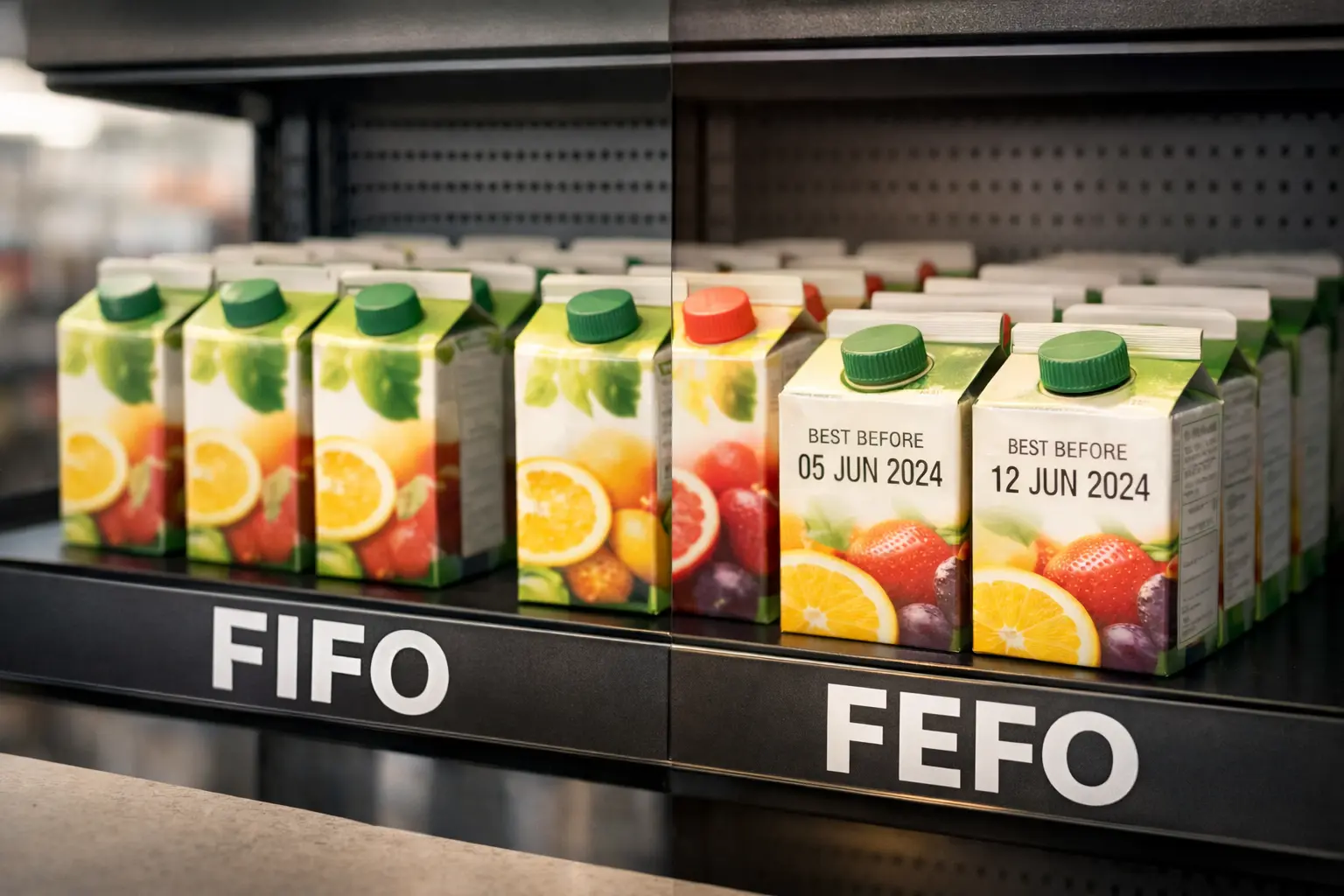
When retailers evaluate FIFO and FEFO inventory strategies inside retail POS systems, they are not simply choosing a stock rotation rule. They are deciding how their POS inventory management handles product freshness, inventory expiry tracking, and operational stock control across multiple locations.
Both FIFO (First In, First Out) and FEFO (First Expired, First Out) are designed to improve retail stock rotation, but they address different operational risks. FIFO focuses on chronological product movement, while FEFO prioritizes expiration dates to minimize spoilage and waste.
Understanding how these strategies work within modern POS inventory management systems helps retailers protect product quality, maintain compliance for regulated goods, and optimize inventory turnover. This guide explores how FIFO and FEFO inventory models operate, where each approach performs best, and how POS technology enables automated stock rotation and expiry tracking.
FIFO inventory management, short for First In, First Out, is one of the most widely used stock rotation methods in retail and supply chain operations. Under FIFO, the items that enter inventory first are the first ones sold or distributed.
This method assumes that inventory moves in chronological order. When new stock arrives, it is placed behind older stock so that the older units are sold before newer ones.
FIFO is commonly used in retail sectors where product freshness matters but expiration dates are either long or less critical, such as clothing, electronics, packaged goods, and hardware supplies.
Chronological Product Movement
In a FIFO system, the POS inventory management platform tracks when inventory batches arrive and prioritizes selling the oldest stock first. This prevents products from sitting in storage for long periods while newer items are sold ahead of them.
Retailers implement FIFO through structured shelf organization, barcode scanning, and inventory batch tracking. When integrated with POS systems, FIFO logic can automatically deduct the oldest available inventory during sales transactions.
Operational Advantages of FIFO
FIFO improves inventory turnover and reduces the likelihood of outdated products remaining in storage. Because products move in the order they arrive, retailers maintain consistent stock rotation and avoid excess aging inventory.
For many retail environments, FIFO offers a simple and reliable stock rotation strategy that aligns well with typical merchandising practices.
What is FEFO Inventory Management?
FEFO inventory management stands for First Expired, First Out, a strategy that prioritizes selling items with the earliest expiration date rather than the earliest arrival time.
This approach is particularly important for industries where inventory expiry tracking is critical, such as food retail, pharmaceuticals, cosmetics, and perishable goods.
Rather than focusing on chronological inventory movement, FEFO ensures that products closest to expiration leave the inventory first.
Expiration-Based Stock Prioritization
In a FEFO system, the POS inventory management platform tracks expiration dates at the batch or product level. During transactions or picking operations, the system selects the item with the nearest expiry date.
This ensures that products approaching expiration are sold or used first, reducing the likelihood of waste, spoilage, or regulatory compliance issues.
For retailers handling perishable goods, FEFO often becomes a mandatory inventory strategy.
Waste Reduction and Compliance Benefits
Because FEFO focuses on expiration dates, it significantly reduces product loss due to spoilage. Businesses operating in regulated industries also benefit from improved traceability and compliance with safety standards.
Inventory expiry tracking combined with FEFO rotation allows managers to identify expiring stock early and apply discounts or promotions before products become unsellable.
FIFO vs FEFO Inventory in Retail POS Systems
While both FIFO and FEFO support efficient retail stock rotation, the operational logic behind them differs significantly.
FIFO organizes inventory movement based on arrival time, while FEFO prioritizes expiration risk. POS inventory management systems determine how easily these methods can be implemented and automated.
FIFO Operational Model
FIFO works best in environments where products do not expire quickly or where expiration dates are not the primary operational risk.
Retailers using FIFO focus on maintaining proper shelf organization and chronological stock movement. POS systems track inventory batches and ensure older products are deducted first during transactions.
Because FIFO relies primarily on arrival time, it remains one of the simplest inventory rotation models to manage operationally.
FEFO Operational Model
FEFO requires deeper inventory tracking capabilities because expiration dates must be recorded for each product batch.
POS inventory systems implementing FEFO must evaluate expiry dates in real time and prioritize selling the soonest-expiring inventory first.
Although FEFO requires more sophisticated inventory data management, it significantly improves waste control and product safety.
Inventory Expiry Tracking in POS Systems
Inventory expiry tracking is a critical component of modern POS inventory management systems, especially for retailers managing consumable goods.
Without digital expiry monitoring, businesses rely on manual inspections and spreadsheets, which increase the risk of missed expiration dates and product loss.
Manual Expiry Monitoring Challenges
Traditional inventory management methods often track expiration dates using spreadsheets or handwritten labels. These manual approaches are time-consuming and prone to human error.
When inventory volumes grow, it becomes difficult for staff to monitor expiration dates across multiple products and locations consistently.
As a result, expired products may remain on shelves or be discovered only after becoming unsellable.
Automated Expiry Tracking with POS Systems
Modern POS inventory management platforms can record expiration dates during product intake and automatically track them across the inventory lifecycle.
The system can generate alerts for approaching expiration dates, prioritize expiring batches during sales, and support FEFO inventory rotation automatically.
Automation reduces human error while giving managers better visibility into expiring inventory.
Retail Stock Rotation and Operational Efficiency
Effective retail stock rotation improves both product quality and financial performance. When inventory moves efficiently, businesses avoid spoilage, reduce shrinkage, and maintain optimal product freshness.
FIFO and FEFO strategies both contribute to stronger operational efficiency when supported by capable POS systems.
Inventory Turnover Optimization
Retailers aim to maintain healthy inventory turnover rates. Products that sit in storage for long periods tie up working capital and increase the risk of damage or expiration.
By enforcing structured stock rotation strategies, businesses ensure that inventory flows consistently from storage to point of sale.
This improves cash flow and reduces unnecessary inventory waste.
Operational Visibility Across Locations
Multi-location retailers often face challenges coordinating stock rotation across different stores or warehouses.
POS inventory management systems with centralized dashboards allow managers to monitor stock levels, expiration dates, and inventory movement across locations.
With real-time visibility, businesses can transfer stock between locations or run targeted promotions to move aging inventory before losses occur.
POS Inventory Management for Automated Rotation
Modern POS inventory management systems play a crucial role in enabling FIFO and FEFO strategies without requiring manual tracking.
Automation allows retailers to enforce stock rotation policies consistently across all locations and product categories.
Batch-Level Inventory Tracking
Advanced POS systems track inventory batches, including arrival dates and expiration dates. When products are scanned at the register, the system automatically deducts stock according to FIFO or FEFO rules.
This eliminates the need for staff to manually select which inventory batch should be sold.
Batch-level tracking also improves traceability for recalls and regulatory compliance.
Integrated Inventory Intelligence
Beyond basic stock rotation, POS systems can analyze inventory movement patterns to optimize restocking decisions.
Managers gain insights into product demand, expiration timelines, and inventory turnover rates. These insights help businesses maintain optimal stock levels while minimizing waste.
Integrated POS inventory management platforms therefore transform inventory rotation from a manual process into a data-driven operational strategy.
Side-by-Side Comparison
Category
FIFO Inventory
FEFO Inventory
Meaning
First In, First Out — inventory sold based on arrival time
First Expired, First Out — inventory sold based on earliest expiration date
Primary Focus
Chronological stock movement
Expiration date prioritization
Best For
Products with long shelf life
Perishable or regulated products
Inventory Tracking
Tracks inventory arrival order
Tracks expiration dates at batch level
Waste Reduction
Helps prevent aging inventory
Minimizes spoilage and expired stock
POS System Requirement
Basic batch tracking
Advanced expiry tracking and batch monitoring
Common Industries
Retail goods, electronics, apparel
Food retail, pharmaceuticals, cosmetics
How Biyo Supports Smart Inventory Rotation
Biyo POS provides a unified platform that combines POS inventory management, real-time stock deduction, and inventory expiry tracking within one cloud-based system.
Retailers can monitor inventory movement across locations, manage batch-level stock tracking, and maintain structured retail stock rotation using FIFO or FEFO strategies.
FIFO stands for First In, First Out. It is a stock rotation method where the earliest inventory received is sold first.
What is FEFO inventory management?
FEFO stands for First Expired, First Out. This method prioritizes selling inventory with the earliest expiration date.
Which industries use FEFO inventory?
Industries handling perishable or regulated products, including food retail, pharmaceuticals, cosmetics, and healthcare, commonly use FEFO inventory systems.
Can POS systems automate FIFO and FEFO inventory?
Yes. Modern POS inventory management platforms can automatically track batch dates and expiration data to enforce FIFO or FEFO stock rotation during transactions.
Why is inventory expiry tracking important?
Inventory expiry tracking helps retailers prevent product spoilage, maintain regulatory compliance, and reduce financial losses caused by expired goods.