At its core, convenience store inventory management is the art and science of getting the right products on your shelves at the right time. It’s all about tracking and controlling the flow of goods—from your supplier's truck, to your backroom, to the customer's hands. Get it right, and you’re a hero. Get it wrong, and you're drowning in expired milk or staring at empty snack shelves.
Why Inventory Management Is Your C-Store's Engine
Think of your convenience store as a finely tuned engine. Your sales are the horsepower, but your inventory? That’s the fuel. Good convenience store inventory management isn't just some boring back-office task; it’s the system that keeps that engine running at peak performance.
If you don't have enough fuel—say, an empty spot where the most popular energy drink should be—the engine sputters. You've lost a sale and annoyed a customer. But if you have too much fuel—like a stockroom crammed with sandwiches nearing their sell-by date—the engine floods. That's just cash tied up and profits going down the drain.
To really nail this, you need to understand the core pillars that hold up a modern inventory strategy. These components work together to turn chaos into control.
Core Components of Modern Inventory Management
Here’s a quick look at the essential pieces we'll be diving into.
| Component | Primary Goal | Key Benefit |
|---|---|---|
| Data Tracking & Automation | To capture real-time sales and stock data accurately. | Eliminates manual errors and provides an up-to-the-minute view of inventory. |
| Forecasting & Ordering | To predict future demand based on past performance. | Prevents stockouts and overstocking by ordering what you actually need. |
| Supplier Relationship Management | To optimize purchasing and delivery schedules. | Ensures reliable stock replenishment and better purchasing terms. |
| Shrinkage & Loss Prevention | To identify and minimize inventory loss. | Protects profit margins from theft, spoilage, and administrative errors. |
Each of these elements plays a crucial role. Mastering them means you're not just managing stock; you're actively driving profitability.
The High-Speed C-Store Environment
Let's be honest, convenience stores operate at a different speed. It’s a fast-paced world where small details have a huge impact, making tight inventory control absolutely essential.
- Rapid Turnover: The hot sellers—coffee, snacks, sodas—can disappear from the shelves in a matter of hours, not days.
- Thin Margins: You aren't making a fortune on a single candy bar. Profit comes from high volume and keeping waste to an absolute minimum.
- Perishable Goods: A huge chunk of your inventory, from fresh sandwiches to dairy, has a ticking clock. Spoilage is a constant threat to your bottom line.
In this kind of environment, even a tiny mistake can snowball. One miscounted case of chips or a forgotten box of pastries is a direct hit to your profits.
Effective inventory management is the difference between guessing what your customers want and knowing with certainty. It transforms chaotic stockrooms into streamlined, profit-generating assets by turning raw sales data into actionable business intelligence.
The Shift to Smarter Systems
Because of these pressures, the days of clipboards and messy spreadsheets are numbered. The industry is making a major move toward specialized software, and the numbers back it up. The convenience store management software market was valued at around USD 5.3 billion in 2023 and is expected to more than double to USD 11.6 billion by 2033. This massive growth shows a clear, global trend toward smarter, automated systems. You can discover more about the convenience store software market to see where the industry is headed.
This guide will break it all down for you. We'll cover everything from finding the hidden leaks in your operation to using a modern POS system to get a firm grip on your stock. By the time we're done, you'll have a clear plan to make your inventory your biggest strength.
Confronting the Hidden Costs of Poor Inventory Control
Poor inventory control is like a slow leak in a tire. You might not notice it at first, but over time it quietly drains your business of its most vital resource: profit. These aren't just minor accounting errors on a spreadsheet; they're real, daily problems that snowball into serious financial losses if you don't get a handle on them.
The damage goes way beyond just running out of a popular snack. When a regular walks in for their morning coffee and finds an empty pot, or reaches for their favorite energy drink only to find a bare shelf, you've done more than miss one sale. You’ve broken their routine, and that’s often enough to send them down the street to your competitor—maybe for good.
The Perishables Predicament
For any convenience store, one of the most immediate and painful financial drains is spoilage. Every sandwich, carton of milk, and yogurt cup has a ticking clock. Guess wrong on demand, and you're either staring at empty shelves or, worse, tossing expired products into the trash. That’s literally throwing money away.
Trying to manage this delicate balance is a constant battle. A cold snap can send hot coffee sales through the roof, but a warm afternoon brings them to a grinding halt. During a heatwave, you can't keep cold drinks in stock, but they'll sit gathering dust when it's cool. Without a solid system, you're always reacting instead of anticipating, and that constant scramble is incredibly costly.
A high food waste percentage—calculated by dividing the cost of wasted inventory by your total revenue—is a flashing red light for forecasting failure. Every single percentage point is profit you could have put back into your business.
And it isn't just about food. Health and beauty products, specialty beverages, and even promotional items have expiration dates that can easily sneak up on you, turning prime shelf space into a financial black hole. Good convenience store inventory management transforms this high-stakes guessing game into a calculated strategy.
The Unseen Thief: Shrinkage
Even more sinister than spoilage is shrinkage, the industry term for any inventory lost for reasons other than a legitimate sale. It’s a quiet, insidious problem that can eat up a shocking amount of your profits. Think of shrinkage as a cocktail of different issues, all of which chip away at your bottom line.
There are three main culprits behind inventory shrinkage:
- Shoplifting: This is the most obvious one, where customers simply take items without paying. Without spot-on stock counts, it could be weeks or even months before you realize a specific product is being targeted.
- Employee Theft: This one can be trickier to spot, ranging from pocketing small items to running more elaborate schemes. It’s an uncomfortable reality to face, but tight inventory control is your best defense because it creates clear accountability.
- Administrative Errors: These are the simple, honest mistakes that really add up. A receiving clerk might accidentally sign for an incomplete delivery, or a cashier could mis-scan an item. Each little error creates a gap between what your system says you have and what's actually on the shelf.
Without a robust tracking system, these small leaks quickly become a flood. You end up reordering products you already have sitting in the backroom or fail to spot theft patterns until they've cost you thousands. It's a battle you fight every single day, and winning requires more than just keeping an eye out—it requires data. Facing these hidden costs head-on is the first, most crucial step toward building a more resilient and profitable business.
Using Key Metrics to Diagnose Your Inventory Health
You can't fix what you can't measure. In the world of convenience stores, that’s not just an old saying—it's the bedrock of a profitable business. To stop guessing and start making smart, data-backed decisions, you have to monitor your inventory’s vital signs. These vital signs are your Key Performance Indicators, or KPIs.
Think of KPIs as diagnostic tools. They take a mountain of raw data and turn it into a clear story about your store’s performance, showing you exactly where cash is flowing and where it’s getting stuck. Understanding the logic behind choosing the right KPIs for your business is the first step to gaining control.
Uncover Hidden Cash with Inventory Turnover Rate
Picture your inventory as a big pool of cash. The inventory turnover rate tells you how fast you're turning that pool back into actual money in your register. A high turnover is great—it means products are flying off the shelves, and your cash is constantly working for you. A low rate, however, is a major red flag that your money is tied up in dead stock.
This single metric is a powerful way to find which products are just collecting dust and hogging precious shelf space. By tracking it across different categories, you can pinpoint exactly where your capital is stagnating.
The formula is pretty straightforward:
Inventory Turnover Rate = Cost of Goods Sold (COGS) / Average Inventory Value
If that number is low, it’s a clear signal you might be overstocking certain items or that customer demand has quietly shifted. It’s your cue to immediately rethink your ordering strategy for those products.
Identify Your True Stars with Sell-Through Rate
While turnover gives you the big picture, the sell-through rate zooms in on how individual products perform during a specific window, like a single month. This KPI is your secret weapon for finding your true best-sellers, not just the products that seem popular. It works by comparing how many units you sold versus how many you received from your supplier.
Here’s a real-world example: you might sell 50 units of a new energy drink, which sounds decent. But if you ordered 200 units to get a bulk discount, your sell-through rate is only 25%. Despite the sales, you’re clearly overstocked. This is the kind of insight that helps you fine-tune reorders with surgical precision.
Calculating it is simple:
- Sell-Through Rate = (Units Sold / Units Received) x 100
A high sell-through rate confirms an item is a winner and can justify deeper stock levels. A low rate on a new product might mean it needs better placement, a promotion, or maybe it’s just not a fit for your customers.
Ensure Every Product Earns Its Keep with GMROI
Gross Margin Return on Investment, or GMROI, is arguably the most important number for any retailer. It answers the one question that matters for every single item on your shelf: "Are you making me enough money to justify the investment I made in you?" It directly connects your gross margin (profit) to the money you spent on the inventory itself.
This KPI ensures that every product is pulling its weight. A product might sell like crazy, but if its profit margin is razor-thin, its GMROI could be lower than a slower-moving item with a huge markup. This principle is exactly how restaurants use food costing to make sure every dish is profitable. You can see how these concepts work across industries in our guide to master food costing for restaurants.
The goal is a GMROI greater than 1. That means you're making more in profit than you spent on the product. If the number is below 1, you're actually losing money on that inventory investment.
By keeping a close eye on these three key metrics, you can shift from putting out fires to proactively building a smarter strategy. You get a clear, unbiased look at your inventory's health, empowering you to make the small adjustments that lead to a much healthier bottom line.
Actionable Strategies for Streamlined Stock Management
Once you've diagnosed your inventory's health using key metrics, it's time to roll up your sleeves and apply proven strategies that bring order to your stockroom. These are the hands-on tactics that turn data into decisions, helping you slash waste, eliminate stockouts, and ultimately, boost your bottom line. Think of this as the playbook for turning a chaotic backroom into a well-oiled machine.
The goal here is to shift from constantly putting out fires to proactively controlling your stock. It all starts with simple, logical systems that build a rock-solid foundation for accuracy and efficiency.
Master the Flow with FIFO
In a convenience store, the First-In, First-Out (FIFO) method isn’t just a good idea—it’s your best defense against the constant threat of spoilage. The concept couldn't be simpler: the first products that arrive should be the first products you sell. This ensures older stock is always moved to the front, preventing items from getting lost in the back only to be discovered after their expiration date.
Think about two cartons of milk arriving a week apart. Without FIFO, a newer carton might get plunked right in front, leaving the older one hidden until it's too late. This simple organizational habit directly translates into less waste and more profit. It’s a fundamental practice that requires consistent team training but pays huge dividends by protecting your margins on perishable goods.
Automate Reordering with Par Levels
Constantly walking the aisles to see what needs to be ordered is a massive time sink. This is where setting par levels changes the game. A par level is simply the minimum amount of a product you want to have on hand at all times. When your inventory count dips below this pre-set number, it’s the automatic signal to place a new order.
This approach removes all the guesswork from restocking your most popular items. You no longer have to sweat about running out of your best-selling energy drink on a busy Friday night. By establishing smart par levels based on your actual sales data, you create a semi-automated system that keeps you in stock without falling into the overstocking trap.
Setting effective par levels is all about finding that perfect balance. It’s the sweet spot between having enough to satisfy every customer and keeping your cash flow healthy by not tying it all up in excess product.
The following infographic shows just how smoothly modern systems can automate this reordering cycle.
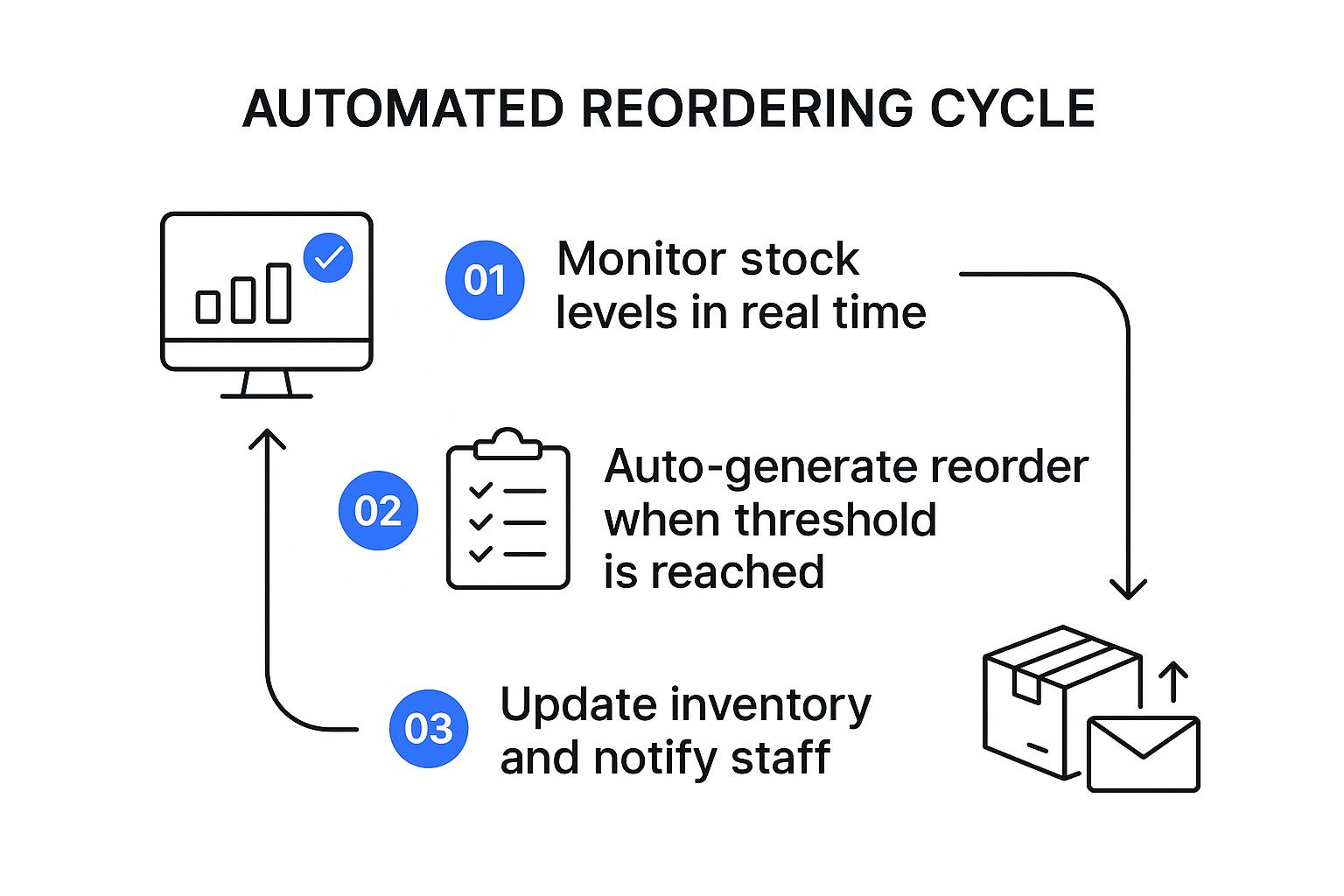
This visual lays out a powerful loop: technology monitors your stock, automatically generates orders when you hit the threshold, and updates inventory when the new shipment arrives. It keeps the whole process seamless and error-free.
Maintain Accuracy with Smart Counting Methods
Shutting down your entire store for a massive, wall-to-wall inventory count is both disruptive and impractical. A much smarter approach is to use cycle counting and ABC analysis—two methods that work together to maintain accuracy with minimal interruption to your business.
ABC analysis is really just a way to prioritize your inventory based on its value:
- A-Items: Your big-ticket products. They make up a small portion of your total inventory but a huge chunk of your revenue (think tobacco products or specialty electronics).
- B-Items: The middle-of-the-road items with moderate value and sales volume (like popular snack brands or craft beverages).
- C-Items: Your low-value, high-volume products (like penny candy or basic condiments).
Once you've sorted your products into these buckets, you can apply cycle counting—the process of counting small portions of your inventory on a continuous schedule. Instead of doing it all at once, you count your "A" items frequently (maybe weekly), "B" items less often (monthly), and "C" items perhaps only quarterly. This focuses your energy where it matters most: on the items with the biggest financial impact.
These strategies are powerful on their own, but they're even better when they work together. If you're looking for a holistic approach to optimization that goes beyond just inventory, you might find some useful tips on streamlining various business processes for maximum efficiency. By putting these practices into place, you’ll build a robust framework for managing your stock with confidence and precision.
How a Modern POS System Automates Your Inventory
Putting solid strategies like FIFO and par levels into practice is a huge step in the right direction. But when you're doing it all by hand, you’re still wrestling with human error and sinking a ton of time into the process.
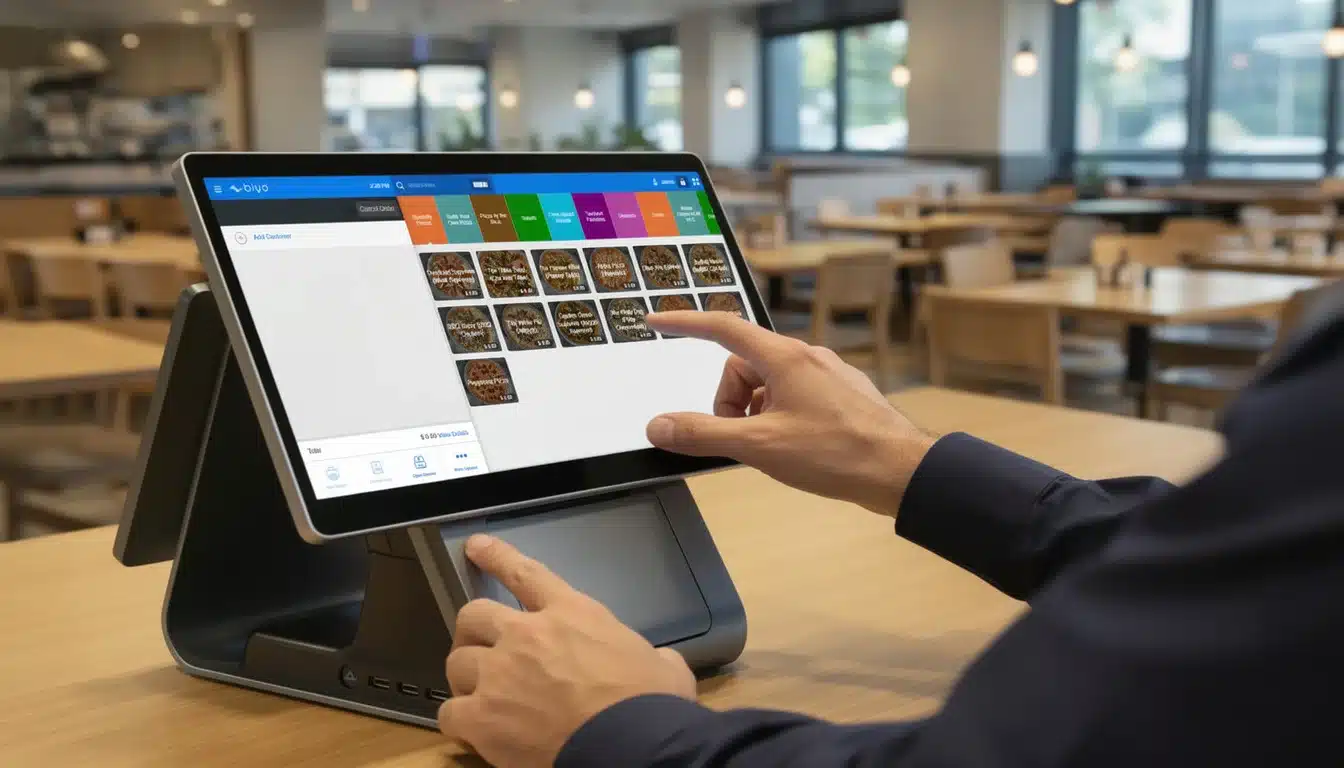
This is where technology changes the game. It takes those great strategies and puts them on autopilot, moving you from clipboards and spreadsheets into a world of speed and precision. A modern Point of Sale (POS) system, like Biyo, becomes the central hub of your store, connecting every single sale directly to your stockroom.
What was once a reactive chore—counting what you’ve already sold—becomes a proactive, strategic advantage for your convenience store inventory management.
Real-Time Tracking with Every Scan
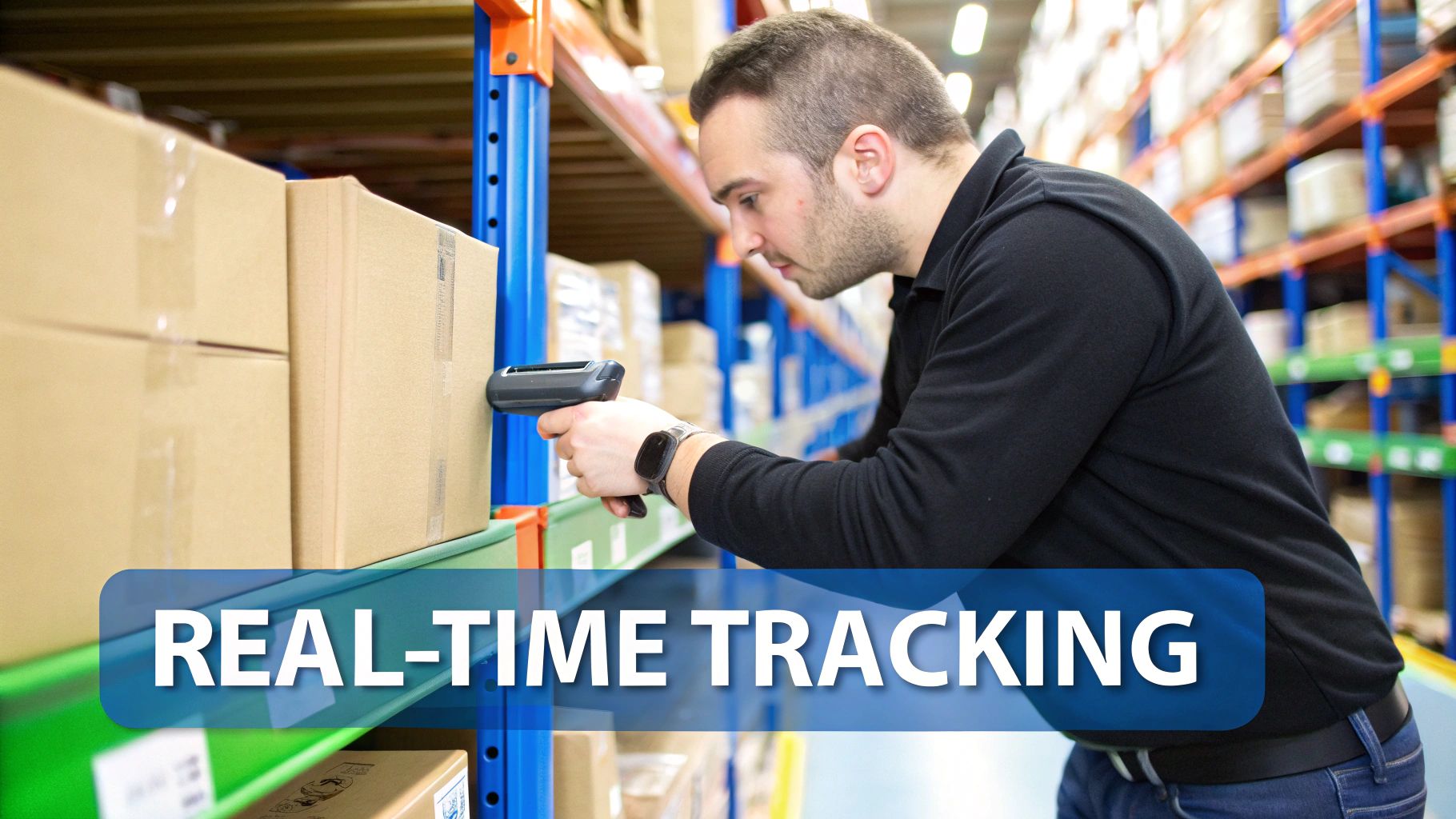
The biggest change a POS brings is real-time visibility. The moment a cashier scans a bag of chips or a soda, the system instantly deducts it from your total stock count. No more waiting until the end of the day to tally up sales receipts. No more guesswork.
This gives you a precise, up-to-the-minute picture of what’s on your shelves. This live data is the bedrock for everything else, turning your inventory from a static list into a dynamic asset that works for you.
Automated Alerts That Prevent Empty Shelves
Remember those par levels we talked about? A modern POS handles all of that for you. Instead of walking the aisles to check stock levels, the system is your lookout.
When a popular energy drink dips below the threshold you’ve set, the system can automatically:
- Trigger a low-stock alert: You or your manager get a notification right away that it’s time to reorder.
- Draft a purchase order: The system can even create a draft PO with the right vendor and quantity, just waiting for your approval.
- Flag expiring items: For perishables, you can set alerts for products nearing their sell-by date. This gives you a chance to run a quick promotion instead of just throwing them out.
A POS system acts as your vigilant co-pilot, making sure you never miss a reordering window. By automating these triggers, you practically eliminate the risk of running out of your best-selling items, which directly protects your sales and keeps customers happy.
This kind of automation is a huge reason why the industry is embracing new tech. The move toward cloud-based systems gives store owners powerful, accessible software that streamlines tracking and unlocks features like loyalty programs and real-time analytics. You can read more about the rise of cloud-based management systems to see just how much of an impact they're having on retail.
Powerful Analytics That Reveal Your True Winners
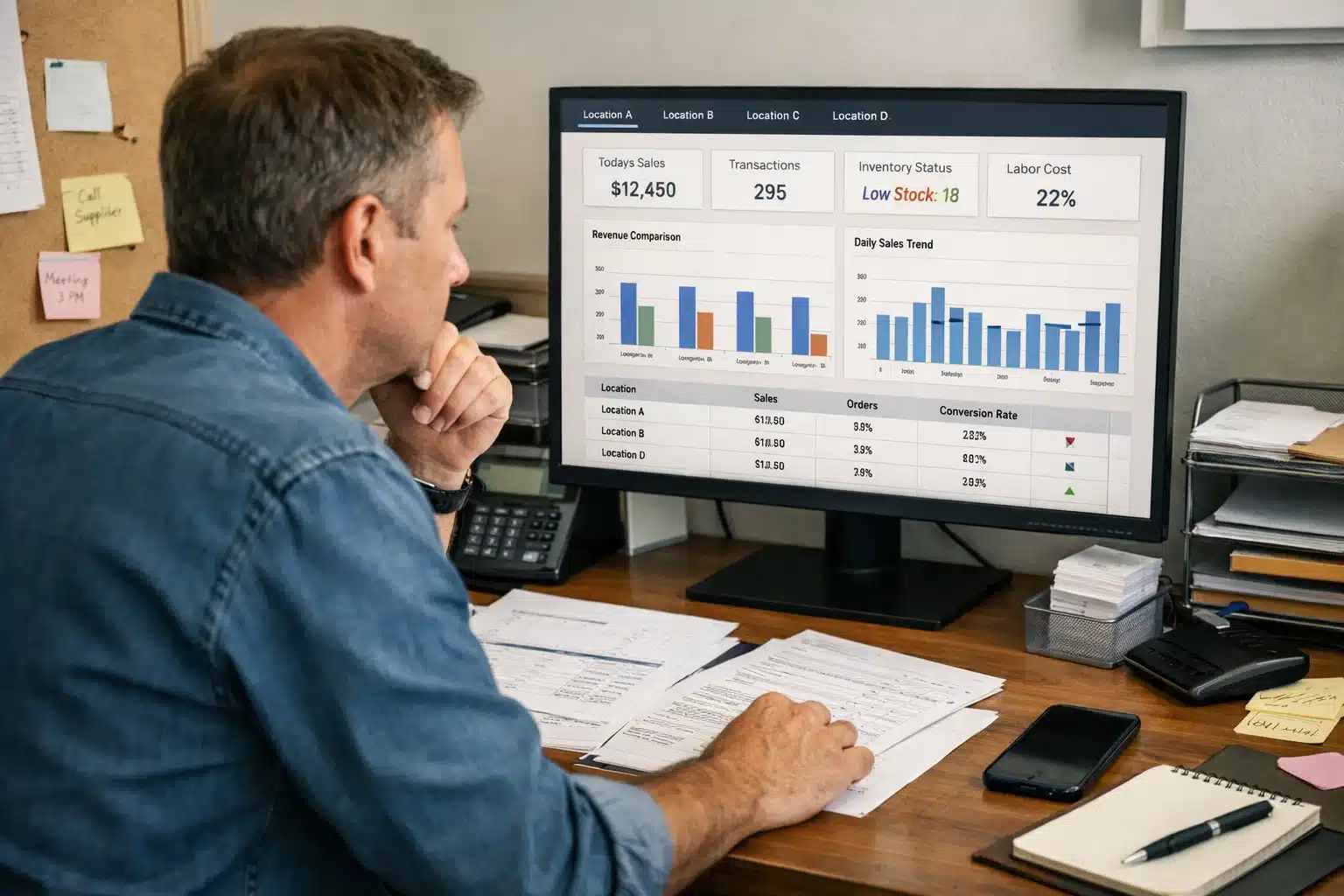
Perhaps the most valuable part is the analytics engine humming away in the background. A POS system doesn’t just record what you sold; it tells you the story behind those sales. With a few clicks, you can instantly find out:
- Your top performers: Which items are really driving your profits?
- Your slow-moving duds: Pinpoint the products tying up cash and valuable shelf space.
- Sales trends: Does coffee fly off the shelves at 7 AM while snack sales spike at 3 PM?
Getting this level of insight with manual methods is nearly impossible. It allows you to make smarter purchasing decisions, optimize your store layout, and ensure every single product is earning its spot. While the tech details vary, the core idea is the same across industries. For another angle, see how a restaurant inventory management system uses similar tools to tackle fast-moving perishables.
Thinking about making the switch? Here’s a quick breakdown of how a system like Biyo POS transforms those tedious manual tasks.
Manual vs. Biyo POS Inventory Management
| Task | Manual Method | With Biyo POS |
|---|---|---|
| Stock Counting | Physically counting items with a clipboard and pen. | Live inventory updates automatically with every sale. |
| Reordering | Visually checking shelves and guessing when to order. | Automated low-stock alerts and purchase order drafts. |
| Sales Tracking | Tallying up paper receipts at the end of the day or week. | Instant sales data and real-time performance reports. |
| Shrinkage Control | Relying on periodic counts to discover missing items. | Discrepancy reports highlight issues between expected and actual counts. |
| Product Analysis | Gut feelings or complex spreadsheet formulas to find best-sellers. | One-click reports show top-selling and slow-moving products. |
| Receiving Stock | Manually checking invoices and updating paper records. | Scan items in with a barcode reader to update inventory instantly. |
As you can see, it's not just about saving time. It's about gaining a level of control and insight that was once out of reach for the average convenience store owner. This is how you stop reacting to problems and start making data-driven decisions that grow your business.
Turning Inventory Control into a Competitive Edge

As we've seen, mastering convenience store inventory management isn't just about counting boxes or keeping shelves full. It’s about taking the reins of your store's financial health and steering it toward real, sustainable growth.
We started this journey by uncovering the silent profit killers, from product spoilage to outright theft. From there, we moved into practical, data-backed solutions. By tracking the right metrics, you can stop guessing and start making decisions based on what's actually happening in your store. Simple but powerful strategies like FIFO and setting smart par levels lay the groundwork for a truly efficient operation.
From Chore to Advantage
The final piece of the puzzle is technology. A modern POS system brings all these best practices together, automating the tedious work and eliminating the costly human errors that creep in with manual tracking. It transforms inventory from a constant headache into one of your most powerful business assets.
Masterful inventory management is the ultimate competitive advantage. It ensures you have exactly what your customers want, right when they want it, turning satisfaction into loyalty and resilience into profit.
This level of control frees up your cash flow, sharpens the customer experience, and ultimately builds a much stronger business. The discipline you learn managing stock can even be applied to other areas of growth. For instance, many of the same principles of operational efficiency are key to learning how to increase restaurant sales.
When you put these tools and strategies to work, you're doing more than just managing products. You’re building a smarter, more responsive, and far more profitable convenience store that’s ready for whatever comes next.
Got Questions About Convenience Store Inventory? We've Got Answers.
Even with a solid plan, managing inventory in a busy convenience store can throw some curveballs. Let's tackle some of the most common questions that pop up for store owners, giving you straightforward answers to help you stay on top of your game.
How Often Should I Really Do a Full Inventory Count?
While you should be doing quick cycle counts on your top-selling or high-risk items daily or weekly, a full, wall-to-wall physical count is a much bigger deal. For most stores, doing one of these quarterly or semi-annually is plenty.
Think about it: shutting down or disrupting operations to count every single item is a huge drain on time and resources. This is where a modern POS system becomes your best friend. With real-time tracking and regular spot checks, you can trust the numbers in your system day-to-day. You can save those massive, disruptive counts for when you absolutely need them, like for end-of-year financial reporting.
What's the Biggest Reason for Inventory Shrinkage?
It's rarely just one thing. Inventory shrinkage is usually a mix of three culprits: shoplifting, employee theft, and basic administrative mistakes. Any one of these can hurt, but together, they can seriously eat into your profits if you're not paying attention.
A powerful POS system is your first line of defense against all three. It slashes admin errors by automating data entry and can flag suspicious activity—like a high number of voided sales by a specific cashier—that might point to internal theft.
By giving you accurate, up-to-the-minute data, your POS helps you see the gap between what the system says you should have and what's actually on the shelves. This lets you jump on potential theft or procedural problems before they become massive financial headaches.
Can a POS System Really Help Me Manage Perishable Goods?
Absolutely. In fact, this is one of its most critical jobs, especially when you're selling fresh food, dairy, or grab-and-go drinks. A good POS lets you master the First-In, First-Out (FIFO) method by tracking items based on their expiration dates.
You can even set up alerts for products getting close to their sell-by date. This is huge. It gives you the chance to run a quick sale or bundle items to move that product off the shelf, turning what would have been a total loss into actual revenue. Over time, you can use that sales data to order perishables more accurately, cutting down on waste from the start. It takes one of your biggest inventory risks and turns it into a smart, data-driven process.
Ready to transform your inventory from a source of stress into your greatest asset? Biyo POS provides the real-time tracking, automated alerts, and powerful analytics you need to take complete control of your store. Start your free trial today and see the difference for yourself.