At its core, customer loyalty program software is a strategic retention engine designed to systematically identify high-value customers, incentivize repeat engagement, and increase lifetime profitability. While it may appear to function as a digital rewards tracker, its true value lies in transforming transactional data into sustained customer relationships.
Modern loyalty platforms are not about issuing points. They are about engineering behavior.
Understanding Customer Loyalty Program Software
Customer acquisition costs continue to rise across industries. In many retail and service sectors, acquiring a new customer costs between five and seven times more than retaining an existing one. Against that backdrop, loyalty program software has become a central component of growth strategy rather than a supplementary marketing tool.
Historically, loyalty programs relied on paper punch cards or basic discount systems. Today’s platforms are data-driven ecosystems that integrate with POS systems, e-commerce platforms, CRM tools, and marketing automation systems to deliver measurable ROI.
At a practical level, customer loyalty program software automates:
* Points accumulation
* Tier progression
* Reward redemption
* Behavioral tracking
* Targeted communications
* Retention analytics
However, its competitive advantage emerges from what it reveals about customer behavior.
By analyzing purchase frequency, average order value (AOV), visit intervals, and product preferences, businesses gain a detailed view of buying patterns. This intelligence enables strategic personalization rather than broad, inefficient promotions.
For a broader understanding of how modern loyalty programs have evolved, it is useful to examine their transition from discount mechanisms to data-driven retention frameworks.
Core Functions of Loyalty Software at a Glance
| Core Function | Business Impact |
|---|---|
| Rewards Management | Automates points, tiers, bonuses, and redemptions to sustain engagement. |
| Behavioral Segmentation | Groups customers by spend, frequency, and product affinity for precision targeting. |
| Automated Communication | Delivers personalized emails, SMS, and push notifications triggered by behavior. |
| Advanced Analytics | Tracks retention rate, CLV, redemption efficiency, and campaign ROI. |
| POS & E-commerce Integration | Ensures seamless reward earning and redemption across all channels. |
A Market Driven by Retention Economics
The rapid expansion of loyalty technology reflects its financial impact. The global customer loyalty program software market is projected to reach approximately $8.64 billion by 2031, growing at a compound annual growth rate (CAGR) of 20.2%.
This growth is not speculative. It is driven by measurable retention economics:
* Increasing retention by 5% can raise profits by 25% to 95% depending on industry margin structure.
* Repeat customers spend up to 67% more than first-time buyers.
* Loyal customers are more price resilient and less likely to defect to competitors.
In this context, loyalty software becomes a capital allocation decision rather than a marketing expense.
What to Look For: 8 Essential Features of Modern Loyalty Platforms
Not all loyalty platforms deliver strategic value. Basic point tracking is insufficient. The following features differentiate high-impact systems from superficial ones.
1. Tiered Rewards Architecture
Tiered structures (e.g., Silver, Gold, Platinum) introduce status psychology. Customers progress toward elevated benefits, encouraging incremental spending to unlock superior perks.
Research indicates that 66% of shoppers modify purchasing behavior when motivated by rewards progression. Tier-based models increase both purchase frequency and AOV by embedding aspirational incentives.
2. Advanced Behavioral Segmentation
Segmentation converts raw data into actionable clusters such as:
* High-value VIPs
* At-risk customers (lapsed 60+ days)
* First-time buyers
* Product-category loyalists
Rather than broadcasting generic promotions, businesses deploy targeted incentives aligned with each segment’s behavioral profile.
For foundational strategy considerations, reviewing frameworks for building effective loyalty programs provides structural insight before selecting software.
3. Omnichannel Integration
Customers expect consistency across in-store and digital interactions. Loyalty systems must integrate seamlessly with:
* POS platforms
* E-commerce platforms
* Mobile applications
* CRM systems
Without integration, manual reconciliation increases errors and undermines program credibility.
4. Real-Time Data Synchronization
Instant reward updates at checkout reduce friction and increase engagement. Delayed synchronization weakens perceived value.
5. Automation and Trigger-Based Campaigns
Behavior-triggered workflows—such as “We Miss You” offers or milestone rewards—activate automatically based on pre-defined conditions.
Automation reduces operational burden while increasing personalization.
6. Analytics and KPI Reporting
High-performing platforms measure:
* Customer Retention Rate
* Customer Lifetime Value (CLV)
* Average Order Value (AOV)
* Redemption Rate
* Incremental Revenue from Members
Without analytics, program performance remains anecdotal.
7. Scalability
Systems must support membership growth from hundreds to tens of thousands without performance degradation.
8. Compliance and Data Security
Customer data protection and regulatory compliance (GDPR, PCI standards) are non-negotiable in modern ecosystems.
How Loyalty Software Drives Measurable Business Growth
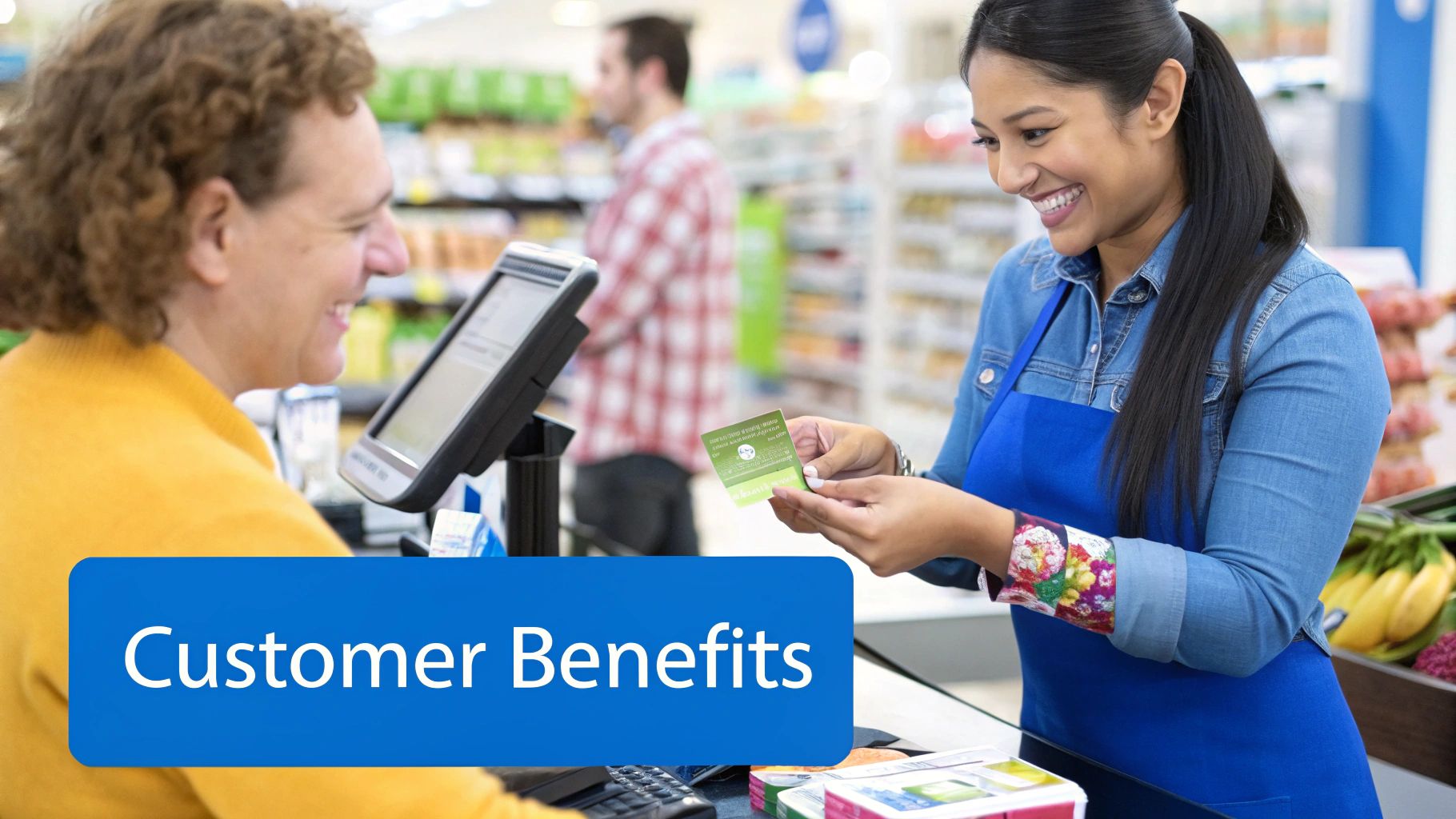
Customer loyalty program software influences revenue through three primary levers: retention, spend acceleration, and behavioral intelligence.
Retention and Customer Lifetime Value Expansion
Acquisition-heavy strategies often erode margin. Loyalty systems shift focus toward maximizing CLV.
Example:
If a customer spends $40 monthly and remains active for 12 months, CLV equals $480.
If loyalty incentives extend engagement to 24 months, CLV doubles to $960—without additional acquisition cost.
Small improvements in churn reduction compound significantly over time.
Increasing Purchase Frequency and AOV
Reward thresholds motivate incremental behavior.
If a customer needs $15 more to reach a reward tier, basket size frequently increases to close the gap. This psychological mechanism elevates AOV without discount-heavy promotions.
Gamification elements—points, milestones, bonus multipliers—further stimulate repeat purchases.
Businesses using integrated CRM frameworks, such as those outlined in restaurant CRM retention models, often report significant frequency improvements when loyalty data drives communication.
Unlocking Strategic Intelligence
Loyalty platforms generate granular behavioral insights:
* Peak purchasing periods
* Cross-selling opportunities
* Dormancy triggers
* Product affinity clusters
This intelligence informs:
* Inventory forecasting
* Campaign design
* Pricing strategies
* Product development
Decisions transition from intuition-based to evidence-based.
How to Choose the Right Customer Loyalty Program Software
Software selection should align with long-term strategy rather than immediate features.
Step 1: Define Business Objectives
Clarify whether the primary objective is:
* Increasing visit frequency
* Expanding basket size
* Reducing churn
* Collecting customer data
* Building community engagement
Objectives determine platform requirements.
Step 2: Evaluate Scalability
Projected membership growth must not trigger disproportionate cost increases or performance issues.
Step 3: Prioritize Integration
Integration with existing POS and e-commerce systems is mission-critical.
For example, platforms that integrate natively with systems like Shopify or WooCommerce reduce implementation friction.
Email marketing integrations with platforms such as Mailchimp enable targeted automation.
Loyalty Software Selection Checklist
| Evaluation Criteria | Assessment Question | Strategic Importance |
|---|---|---|
| POS Integration | Does it sync transactions in real time? | Ensures frictionless checkout reward processing. |
| Scalability | Can it support multi-location growth? | Prevents costly migration later. |
| User Experience | Is the dashboard intuitive? | Improves adoption and program management. |
| Customer Interface | Can customers easily track and redeem rewards? | Higher engagement equals higher ROI. |
| Analytics Depth | Does it calculate CLV and retention metrics? | Supports ROI validation. |
Integrating Loyalty Software with Your Tech Stack
Integration transforms loyalty software from a standalone tool into an operational asset.
Without integration:
* Staff must manually enter transactions
* Data inconsistencies increase
* Reward errors frustrate customers
* Reporting becomes unreliable
Seamless synchronization ensures every purchase updates reward balances instantly. Businesses seeking to understand integration value can explore broader discussions on third-party integrations and their operational impact.
Questions to Ask Vendors
1. Is integration native or API-based?
2. What data fields synchronize automatically?
3. Is onboarding supported with technical assistance?
4. Are updates deployed without system downtime?
Vendor transparency often predicts long-term partnership success.
The Future of Loyalty: AI and Predictive Intelligence

Artificial Intelligence is redefining loyalty program architecture.
Traditional systems reward past behavior. AI-driven systems anticipate future behavior.
Predictive Churn Prevention
Machine learning models detect behavioral shifts indicating disengagement. Automated reactivation campaigns deploy before churn occurs.
Dynamic Personalization
AI recommends rewards based on individual preference probability rather than static catalogs.
Behavioral Forecasting
Predictive models estimate:
* Likely next purchase
* Price sensitivity
* Promotion responsiveness
This transition from reactive to proactive loyalty strategy enhances both customer experience and revenue precision.
Market projections reflect this evolution. The customer loyalty software market is forecast to expand at approximately 15% CAGR through 2033, driven largely by AI integration and personalization demand.
FAQ
What is customer loyalty program software?
Customer loyalty program software is a digital platform that tracks customer purchases, manages rewards, segments members, and delivers personalized incentives to increase retention and lifetime value.
How does loyalty software improve profitability?
It increases retention, boosts purchase frequency, raises average order value, and provides actionable customer insights—collectively enhancing customer lifetime value and reducing acquisition dependency.
How much does loyalty software cost?
Costs range from approximately $30–$100 per month for small businesses to several hundred or thousands monthly for enterprise-level platforms with AI capabilities and advanced analytics.
Is integration with POS systems necessary?
Yes. Real-time POS integration ensures seamless reward processing, accurate tracking, and consistent customer experiences across channels.
How do you measure loyalty program success?
Key metrics include retention rate, customer lifetime value, purchase frequency, average order value, and incremental revenue generated by program members.
Businesses seeking integrated loyalty capabilities can leverage platforms like Biyo POS, which combines transaction processing, customer data management, and rewards automation into a unified system designed to increase retention and maximize customer lifetime value.