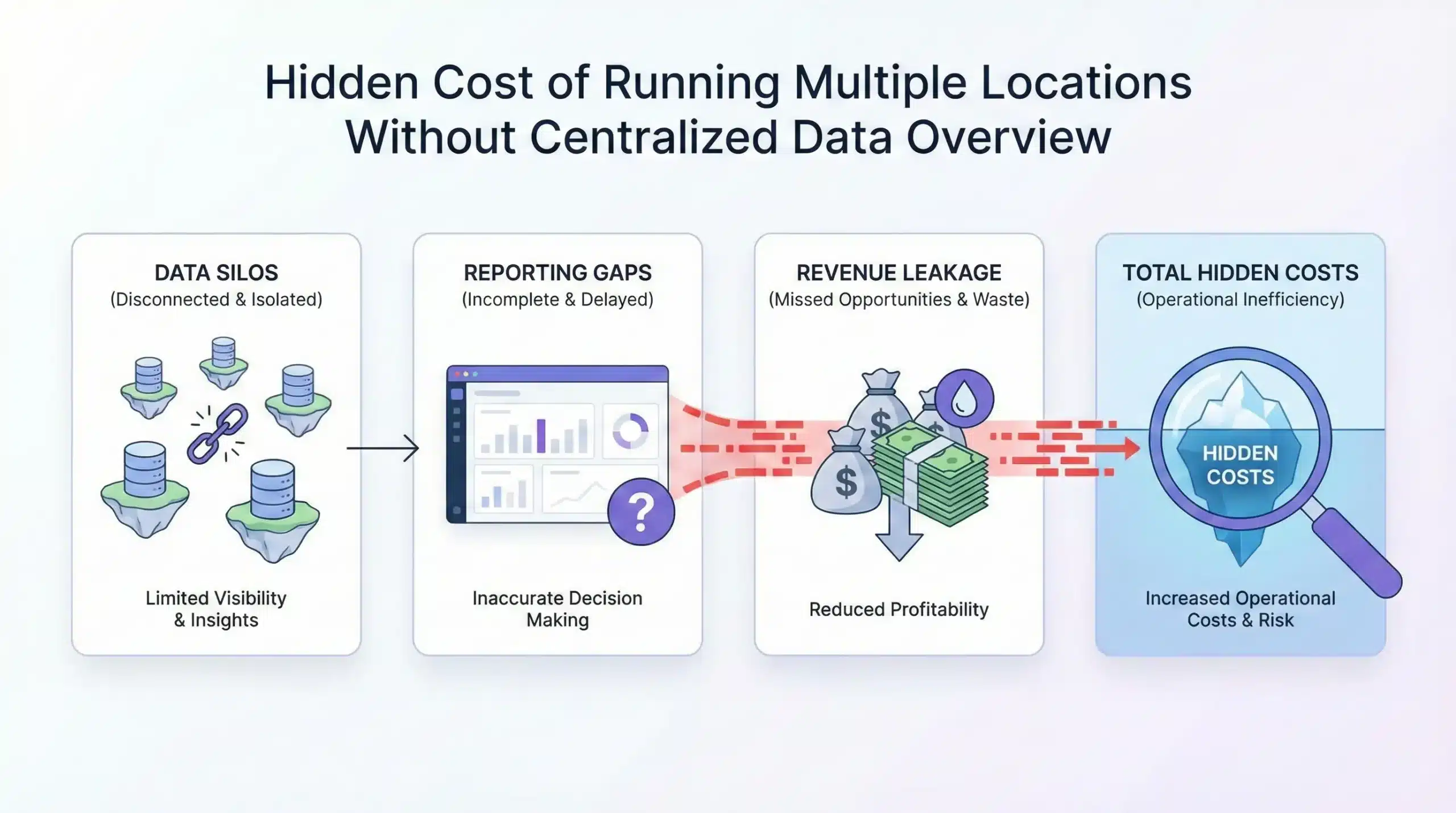
Running multiple business locations often feels like a sign of success. More stores usually mean more customers, more revenue, and greater brand reach. However, many owners underestimate the Hidden Cost of Running Multiple Locations Without Centralized Data. These costs do not always appear on financial statements, yet they slowly drain profit, efficiency, and control.
When each location operates with its own data systems, spreadsheets, or disconnected POS reports, decision-making becomes fragmented. Owners and managers spend more time reconciling numbers than improving operations. Over time, this lack of clarity creates blind spots that are difficult to detect and expensive to fix.
This article explores the Hidden Cost of Running Multiple Locations Without Centralized Data, explains how data silos damage performance, and shows why centralized analytics is essential for scalable growth.
Table of Contents
- How Data Silos Form Across Multiple Locations
- Inconsistent Reporting and Decision Errors
- Operational Inefficiencies That Quietly Add Up
- Revenue Leakage You Cannot See in Isolated Systems
- Why Centralized Analytics Changes Everything
- How Biyo Helps Multi-Location Businesses Stay Aligned
- Frequently Asked Questions
How Data Silos Form Across Multiple Locations
As businesses expand, systems often grow in isolation. Each new location introduces new staff, workflows, and reporting habits.
Different Systems at Different Locations
Many multi-location businesses adopt new tools incrementally. One location may use updated POS software, while another relies on older systems or manual reports.
Over time, these differences create data silos. Sales, inventory, and labor data live in separate environments that do not communicate with each other.
The Hidden Cost of Running Multiple Locations Without Centralized Data begins with these disconnected systems.
Manual Data Consolidation Becomes the Norm
Without centralized POS data, owners often rely on spreadsheets and manual exports. Managers email reports, which then get merged into summary files.
This process is time-consuming and error-prone. Small inconsistencies compound into large inaccuracies.
Manual consolidation also delays insights.
Lack of Real-Time Visibility
When data arrives late, decisions are based on outdated information. Problems remain hidden longer.
Managers cannot respond quickly to sales dips or inventory issues.
Delayed data reduces agility.
 Inconsistent Reporting and Decision Errors
 Inconsistent Reporting and Decision Errors
Inconsistent reporting is one of the most damaging outcomes of decentralized data.
Different Metrics Across Locations
Each location may track performance differently. Some focus on gross sales, others track net revenue or ticket size.
Without standard definitions, comparisons become meaningless.
This inconsistency fuels the Hidden Cost of Running Multiple Locations Without Centralized Data.
Conflicting Performance Insights
One report may suggest growth, while another signals decline. Leaders struggle to trust the numbers.
Confusion slows decision-making.
Uncertainty leads to inaction.
Misguided Strategic Decisions
Expansion, staffing, and marketing decisions depend on accurate data.
When reporting is inconsistent, strategies are built on faulty assumptions.
Mistakes become expensive at scale.
Operational Inefficiencies That Quietly Add Up
Operational inefficiencies often go unnoticed when data is fragmented.
Duplicated Work Across Teams
Managers at each location spend time generating similar reports. Corporate teams then repeat the same work.
This duplication wastes labor hours.
Centralized systems eliminate redundancy.
Inventory Misalignment Between Locations
Without centralized inventory data, some locations overstock while others run out.
Transfers become reactive rather than planned.
Inventory inefficiencies increase carrying costs.
Inconsistent Staff Scheduling
Labor planning relies on accurate sales forecasts.
Disconnected data makes forecasting unreliable.
Overstaffing and understaffing both reduce profitability.
Revenue Leakage You Cannot See in Isolated Systems
Revenue leakage is one of the most serious consequences of decentralized data.
Missed Patterns in Sales Performance
Centralized data reveals trends across locations.
Without it, underperforming stores remain unnoticed.
Small losses accumulate silently.
Pricing and Promotion Inconsistencies
Different locations may run promotions inconsistently.
Some discounts may not perform as expected.
Central visibility ensures alignment.
Shrinkage and Loss Go Unnoticed
Inventory discrepancies are harder to spot without centralized analytics.
Shrinkage spreads before detection.
Unified reporting improves accountability.
Why Centralized Analytics Changes Everything
Centralized analytics transforms how multi-location businesses operate.
Single Source of Truth
Centralized POS data provides consistent metrics.
All locations speak the same data language.
Confidence in numbers increases.
Faster, Smarter Decisions
Real-time dashboards reveal issues immediately.
Leaders can act before small problems grow.
Speed improves competitiveness.
Scalable Growth Without Chaos
Expansion becomes manageable with centralized data.
Processes scale without adding complexity.
This eliminates the Hidden Cost of Running Multiple Locations Without Centralized Data.
How Biyo Helps Multi-Location Businesses Stay Aligned
 How Biyo Helps Multi-Location Businesses Stay Aligned
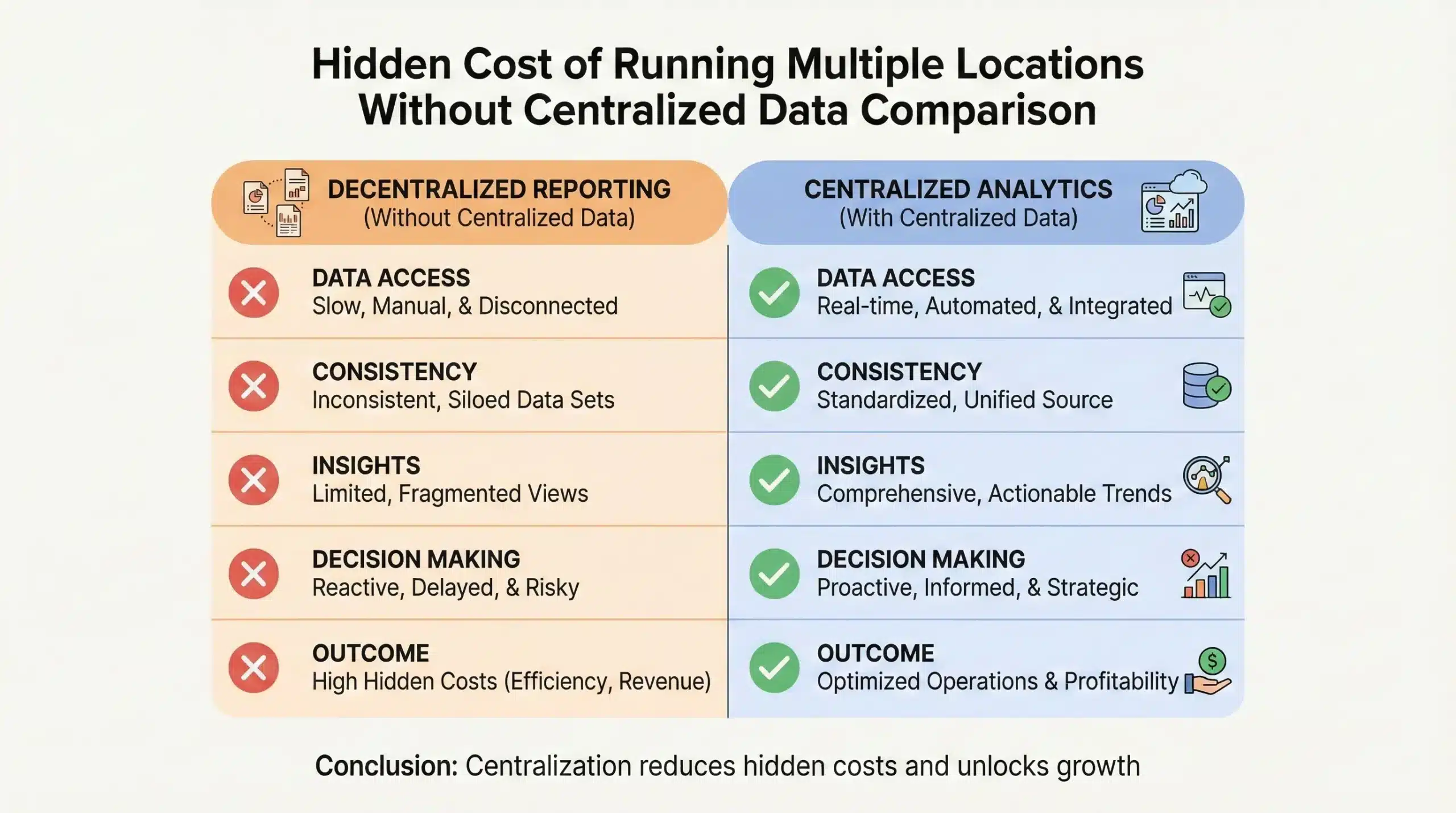
Biyo POS helps eliminate the Hidden Cost of Running Multiple Locations Without Centralized Data by unifying reporting, inventory, and performance analytics across all locations. With centralized dashboards, business owners gain real-time visibility into every store.
Biyo supports standardized metrics, location performance tracking, and centralized analytics that simplify decision-making. Instead of juggling spreadsheets, leaders focus on growth and optimization.
To see how centralized data can improve multi-location performance, you can schedule a call for a guided walkthrough or sign up to explore Biyo’s capabilities.
Frequently Asked Questions
What is centralized POS data?
Centralized POS data means all location data flows into one unified system.
Why do data silos hurt multi-location businesses?
They cause inconsistent reporting, inefficiencies, and delayed decisions.
Can centralized analytics reduce revenue leakage?
Yes. It exposes trends, shrinkage, and performance gaps.
Is centralized data only for large chains?
No. Even small multi-location businesses benefit significantly.
How does Biyo POS support multi-location management?
Biyo provides centralized reporting, real-time insights, and scalable control.