When we talk about food inventory management, we're really talking about the art and science of tracking every single ingredient that comes through your kitchen door. It’s the entire journey: from sourcing and ordering to storing, using, and ultimately, costing it all out.
Done right, it's the system that ensures you have precisely what you need, exactly when you need it—preventing both profit-killing waste and the dreaded "86" on a busy Friday night.
Why Inventory Management Is Your Restaurant's Lifeline
It’s helpful to stop thinking of your inventory as just a list of supplies. Instead, picture it as cash sitting on your shelves. Every bottle of olive oil, every prime cut of beef, and every bag of flour is a direct financial investment. Without a solid system, that cash is exposed to spoilage, theft, and simple misuse.
This is where food inventory management comes in. It acts as the financial heartbeat of your restaurant, making sure every dollar you've invested in ingredients is tracked and accounted for.
Think about an air traffic controller. Their job is to guide incredibly valuable assets—airplanes—safely from their origin to their destination, preventing collisions and costly delays. Your inventory manager does the exact same thing for your ingredients. They guide those assets from the delivery truck all the way to the customer's plate, avoiding profit-destroying "collisions" like spoilage and frustrating "delays" like running out of a bestseller during the dinner rush.
The Foundation of Profitability and Stability
Getting a handle on your inventory isn't just another task on the checklist; it's a core business strategy that directly shapes your profitability and long-term stability. When you nail this process, you gain control over one of the biggest and most volatile expenses in the restaurant world.
At its core, food inventory management is about creating a predictable, efficient, and profitable kitchen. It transforms guesswork into data-driven decisions, giving you the power to protect your margins and weather the industry's notorious unpredictability.
This control pays off in real, tangible ways that you'll see across your entire operation. It's often the single biggest difference between ending the month with a healthy profit and scratching your head, wondering where all the money went.
Direct Impacts on Your Business
A well-run inventory system delivers far more than just an accurate stock count. In fact, it's probably the most critical operational skill you can develop, with ripple effects that touch everything from the back of the house to the front.
Here’s a quick look at how it shapes your success:
- Maximizes Profit Margins: By cutting down on food waste and making smarter purchasing decisions, you directly lower your Cost of Goods Sold (COGS)—a restaurant's largest expense right after labor.
- Enhances Customer Satisfaction: Consistency is king. When you always have the necessary ingredients on hand, you never have to disappoint a customer by telling them their favorite dish is unavailable. That reliability builds serious loyalty.
- Improves Operational Efficiency: An organized stockroom and clear tracking processes save your team a ton of time during prep and service. This means less chaos in the kitchen and a smoother workflow for everyone.
- Provides Crucial Business Insights: Your inventory data is a goldmine. It tells you what’s selling, what isn't, and where your waste is coming from, empowering you to make sharper decisions about your menu and ordering strategy.
Mastering the Core Inventory Control Methods
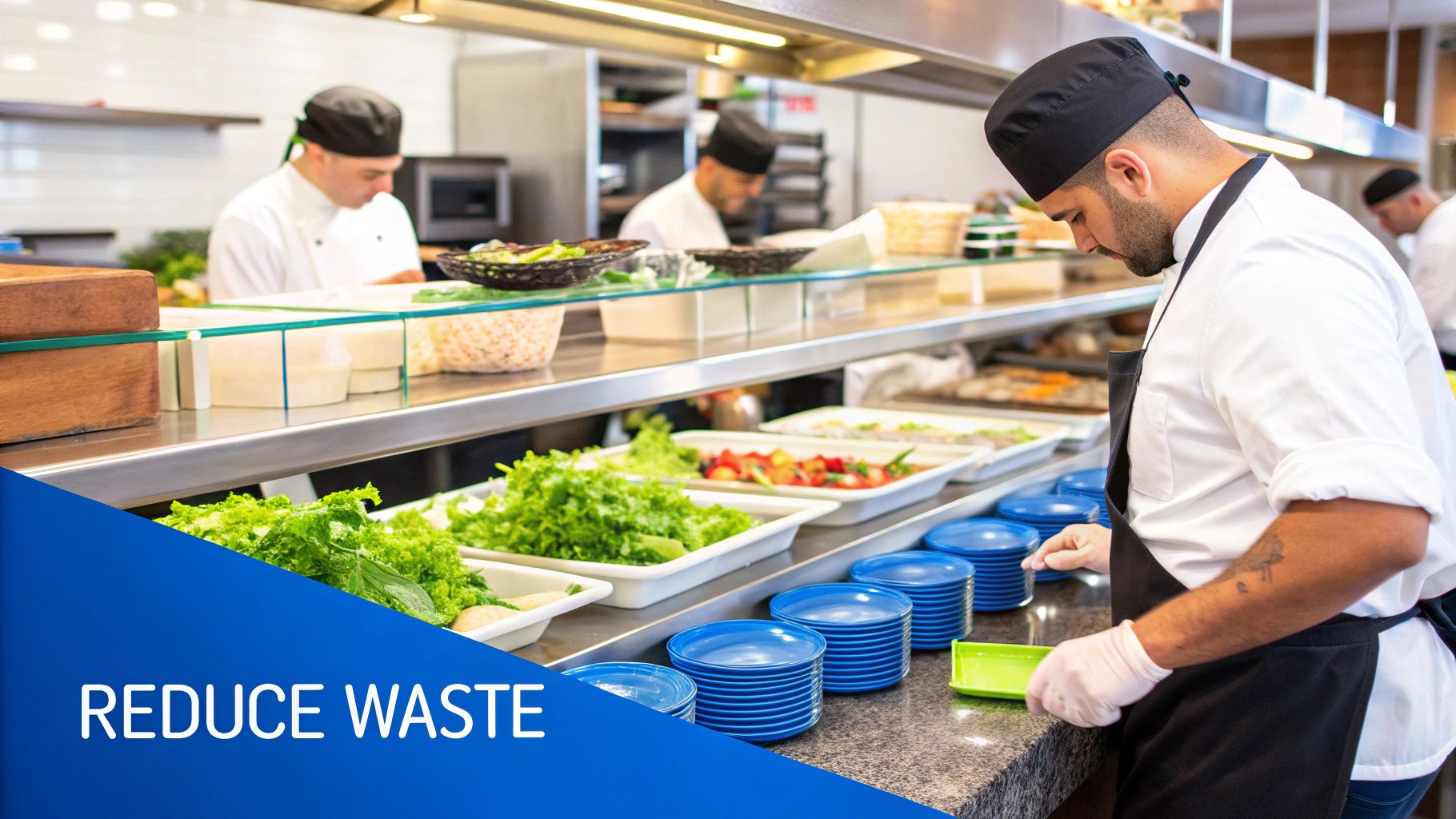
Great food inventory management isn't just about counting boxes. It’s about strategically controlling the flow of every ingredient to boost freshness and profitability. To get it right, successful restaurants lean on a few proven techniques that bring a sense of order to the chaos of the storeroom.
Think of these methods as a framework that transforms reactive stock-taking into a proactive system for financial health. By putting them into practice, you build a reliable structure for handling everything from perishable produce to high-dollar proteins, helping you slash waste and make smarter purchasing decisions based on hard data, not just gut feelings.
First In, First Out for Peak Freshness
The First-In, First-Out (FIFO) method is the golden rule for anyone working with perishable goods. The idea is simple but incredibly powerful: the first items that come in the door should be the first ones you use. Picture your walk-in cooler as a single-file line—the ingredients that arrived first are always at the front, ready to be used long before they expire.
This systematic rotation is your single best defense against spoilage. By consistently moving older stock to the front, you ensure products get used well within their prime, guaranteeing every dish is as fresh as possible. It’s a discipline that protects not only your bottom line but also your restaurant's hard-earned reputation.
A disciplined FIFO process is non-negotiable in the food industry. It is the single most effective practice for minimizing spoilage, which directly translates into protecting profits that would otherwise end up in the trash.
To make FIFO work, you have to be organized. Label every case with its delivery date and arrange your shelves so older products are physically in front of newer ones. This simple visual cue makes it easy for your kitchen crew to grab the right item every time, making freshness the default. For a deeper look into the financial side of this, check out our guide on choosing your inventory costing method.
Prioritize with ABC Analysis
Let's be honest: not all of your inventory items are created equal. A case of filet mignon carries a lot more financial weight than a box of salt packets. ABC analysis is a smart way to categorize your inventory so you can focus your energy where it counts the most.
Think of it like sorting your inventory into three tiers:
- 'A' Items: These are your high-value superstars—the premium steaks, top-shelf liquor, and fresh seafood. They might only make up 10-20% of your item count but represent a whopping 70-80% of your inventory's total dollar value. These need your full attention with tight controls and frequent counts.
- 'B' Items: This is your middle group. Think house wines, poultry, and specialty cheeses. They account for about 15-25% of your inventory value and require regular, but less intense, tracking than your 'A' items.
- 'C' Items: These are your low-cost, high-volume workhorses like spices, flour, sugar, and napkins. They represent a tiny fraction of your inventory value and need the least amount of direct oversight.
This approach stops you from wasting time micromanaging cheap items and puts your focus squarely on the products that have the biggest impact on your budget.
Set Smart Par Levels
Finally, setting par levels is your key to keeping the perfect amount of stock on hand—no more, no less. A par level is simply the minimum amount of an ingredient you need to get you through to the next delivery. It’s like the fuel gauge in your car; you don’t want it to hit empty, but there’s no need to constantly top it off.
When you establish a specific par for each item, you create an automatic trigger for reordering. Once a count shows an item has dipped below its par, you know it's time to add it to the next purchase order. This straightforward system is incredibly effective at preventing both frustrating stockouts and the cash-flow crunch that comes from tying up money in excess inventory.
How to Build Your Inventory System From Scratch
Building a solid food inventory system isn't something that happens overnight, but it's absolutely one of the most important things you can do for your business. Think of it like building a house: you need a strong foundation, a clear blueprint, and the right tools for the job. By following a clear, step-by-step process, you can build a system that cuts down on waste, makes your kitchen run smoother, and protects your profits from the get-go.
The first step is always the most tedious, but it's also the most important. You can't figure out where you're going if you don't know where you are.
Step 1: Conduct a Complete Physical Inventory Count
Before you can manage anything, you need a complete and totally accurate picture of every single item you have in-house. This is your baseline, your ground zero. It means physically counting every bag of flour, every bottle of wine, and every piece of chicken in your walk-in, freezer, and dry storage. No exceptions.
This initial count establishes your sitting inventory—the total dollar value of the stock you currently own. This number is the foundation that all your future tracking, ordering, and cost calculations will be built on. If you start with a guess, your entire system will be built on shaky ground.
Step 2: Organize Your Storage for Efficiency
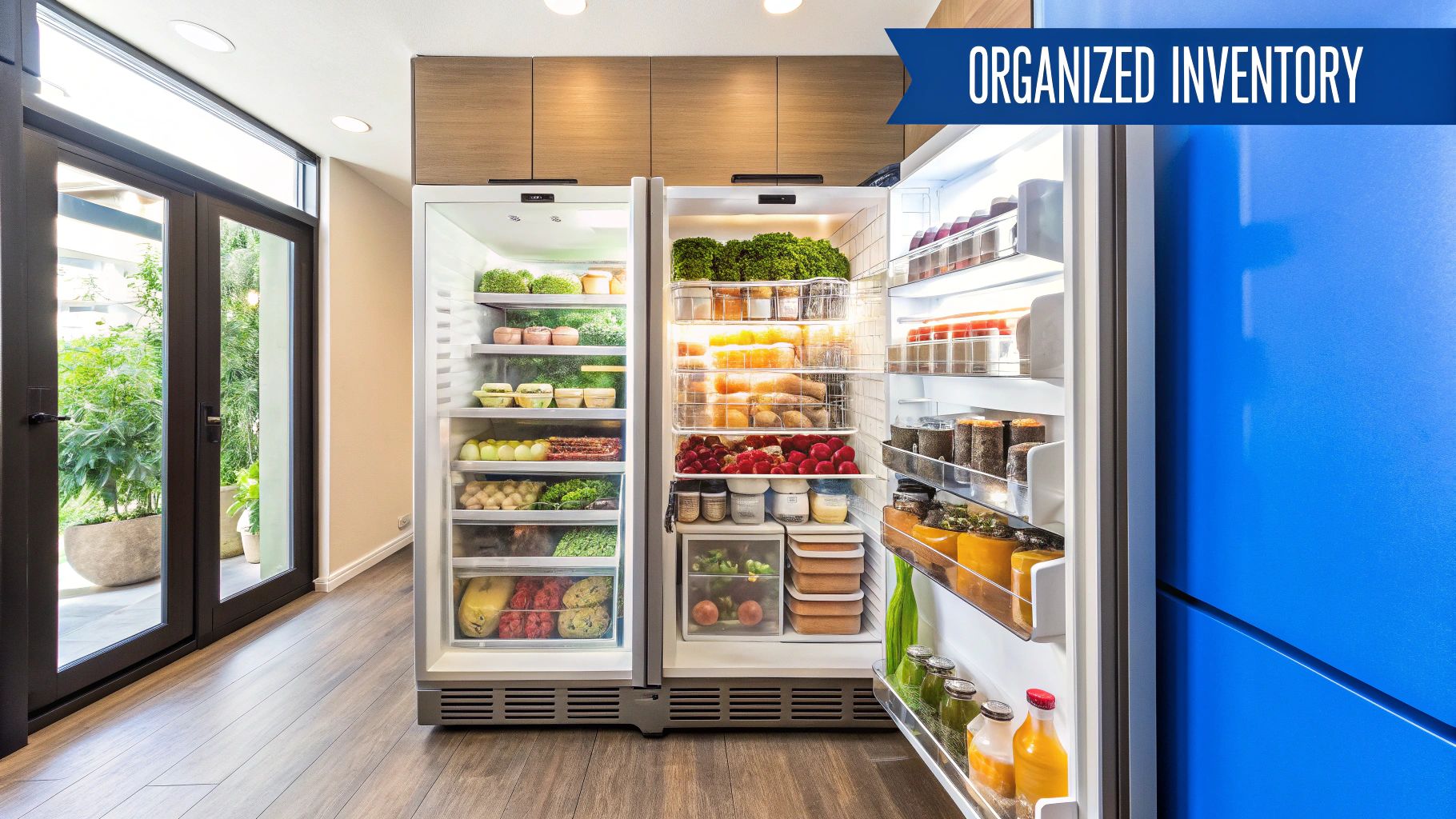
Once you know what you have, you need to get it organized. A messy stockroom is a direct line to waste and lost money. The goal here is to arrange all your storage spaces—shelves, walk-ins, freezers—so that following the First-In, First-Out (FIFO) method is the easiest, most natural thing for your team to do.
This means creating a simple, logical system where new deliveries are always placed behind the existing stock. Clear labeling is non-negotiable. Every box and container should be marked with the delivery date and use-by date, making it a no-brainer for staff to grab the right item every time.
A well-organized storeroom does more than just look professional; it actively guides your team to do the right thing. When the correct way is also the easiest way, following your inventory rules becomes second nature.
This simple visual organization drastically cuts the chances of older products getting lost at the back of a shelf, only to be found long after they've expired. It's a small physical change with a direct and immediate financial impact.
Step 3: Standardize Your Receiving and Tracking Procedures
Consistency is what makes any inventory system work. You have to create standard operating procedures (SOPs) for how inventory comes into your restaurant and how you track it. This makes sure every team member handles these crucial tasks the exact same way, every single time.
Your receiving process is your first line of defense against mistakes. The employee accepting a delivery must be trained to:
- Verify the order: Always check the delivery invoice against your original purchase order. Are the quantities, items, and prices correct?
- Inspect for quality: Look over every item, especially perishables, for any signs of damage or spoilage before you sign off on it.
- Log it immediately: As soon as an order is accepted, the new stock must be entered into your tracking system—whether it’s a spreadsheet or software—before it gets put away.
Next, you have to decide what tool you'll use for tracking. If you're just starting out or running a smaller operation, a set of well-organized spreadsheets can work just fine. You can check out these top food inventory templates for restaurant management to find a structure that fits your needs. As your business gets bigger, though, investing in dedicated software becomes essential for accuracy and efficiency.
This infographic lays out the core workflow, from receiving goods to triggering new orders.
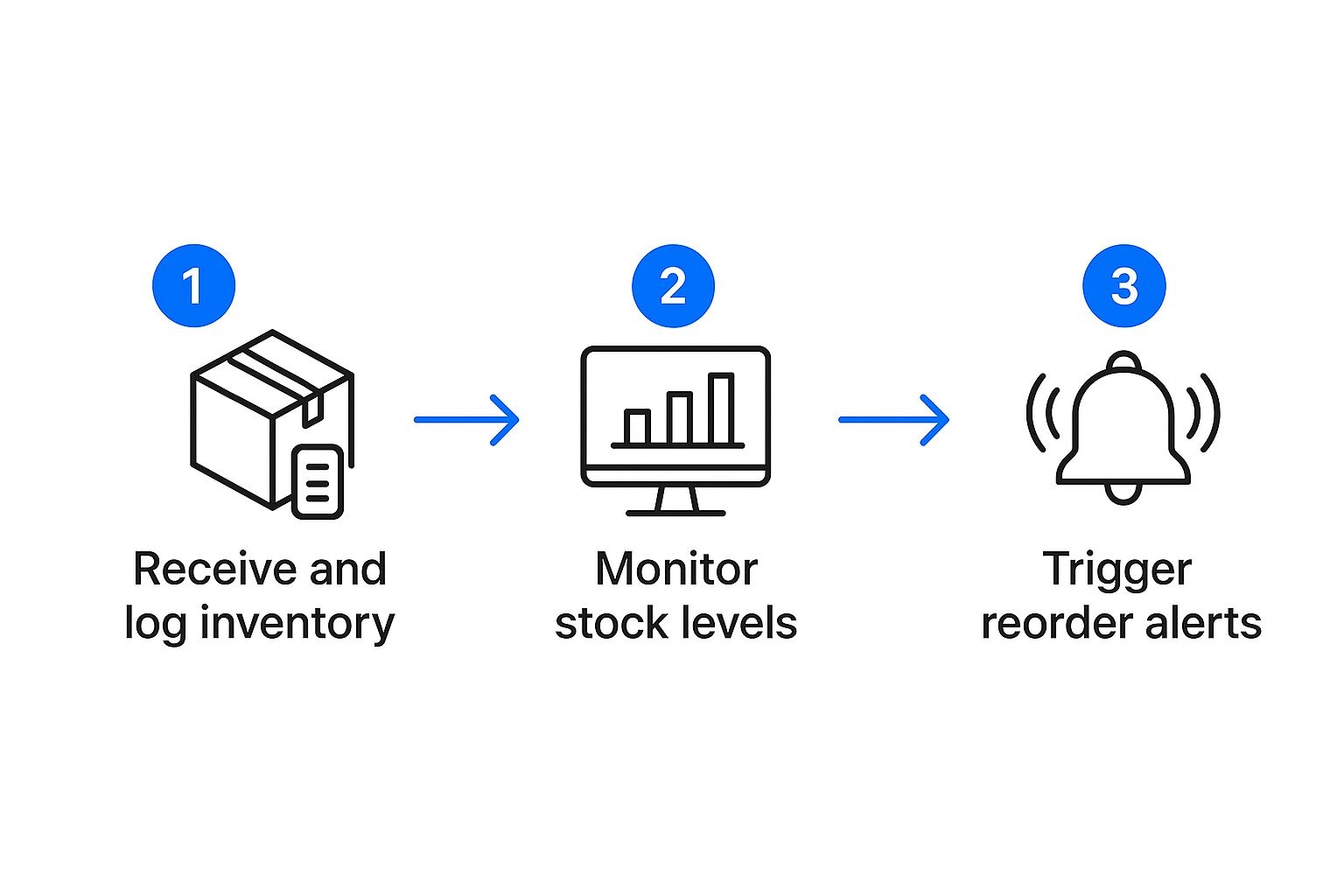
This simple, three-stage cycle is the backbone of any system that prevents stockouts while keeping overstocking in check.
Step 4: Train Your Team Thoroughly
At the end of the day, a system is only as good as the people who use it. You have to invest time in training your entire team on their specific roles in the inventory process. This isn't just a manager's job; chefs, line cooks, and even porters have a part to play.
Make sure everyone understands why inventory control matters—not just as a bunch of rules, but as a practice that directly impacts the restaurant's financial health and their own job security. When your team is educated and feels empowered, they become active partners in protecting your bottom line. That's how a system on paper becomes a living, breathing part of your daily operations.
Tackling Common Inventory Management Headaches
Even the most well-oiled inventory system hits a few bumps in the road. You might get a late delivery from a supplier, or notice small but consistent errors from staff. These hurdles are just part of the business. The trick isn't to avoid them entirely—it's to build an operation that's resilient enough to handle them and come out stronger.
Think of this section as your field guide to troubleshooting the most frequent inventory frustrations. We'll break down the problem and give you practical, proven solutions to protect your profits and keep things running smoothly.
Dealing with Supplier Issues
So much of your inventory control is out of your hands—it’s in the hands of your suppliers. A late truck, an unexpected price jump, or a case of subpar produce can send your kitchen into a tailspin. This is why managing those vendor relationships is so crucial.
Stop thinking of your suppliers as just a name on an invoice. They're your partners. When you have a solid relationship, they're more likely to give you a heads-up about a potential price hike or a supply chain snag. It’s also just good business sense to never put all your eggs in one basket.
Here’s how to build a more reliable supply chain:
- Have a Backup Plan: For your most critical ingredients, you need to have at least one other vendor you can call. This gives you a safety net and a bit of leverage when you need it.
- Set Your Standards—and Stick to Them: Be crystal clear about your expectations for quality from day one. If a delivery doesn't meet your standards, send it back. It establishes a precedent that quality matters.
- Schedule Regular Check-ins: A quick call once a week can keep you in the loop on market shifts and shows you value the partnership.
Combating Waste and Spoilage
Food waste is the silent killer of a restaurant's bottom line. Every bit of food that ends up in the trash is a direct hit to your profits, usually stemming from over-ordering, poor stock rotation, or a menu that isn't working. To fix it, you need to attack the problem from two angles: precise portioning and smart menu design.
Your first line of defense is portion control. Use standardized recipes, scales, scoops, and regular training to make sure every plate that goes out is consistent. This takes the guesswork out of cooking and stops ingredient waste before it happens.
A dollar saved from waste is a pure dollar of profit. By focusing on smart menu engineering and strict portion control, you are actively moving money from the trash can back into your bank account.
Smart menu engineering is all about diving into your sales data. What’s selling? What’s profitable? If you have a dish that uses a pricey, perishable ingredient but barely sells, it might be time to eighty-six it or find a new recipe. This data-first approach makes sure the inventory you buy actually ends up on a customer's plate.
Preventing Inventory Shrinkage
Inventory shrinkage is a nice way of saying stock has vanished for reasons other than a sale—usually due to employee error or, unfortunately, theft. It’s a sensitive topic, but one you can’t ignore. Those small losses can easily add up to thousands of dollars over the course of a year. The solution is to build a culture of accountability with clear, easy-to-follow procedures.
Beyond the basics, truly getting a handle on loss means learning about proven strategies to reduce inventory shrinkage.
Simple things can make a huge difference. Limiting access to storage areas is a good start. So are regular, unannounced spot-checks. You could also implement a two-person system for verifying counts of high-cost items, like your prime cuts of meat or top-shelf liquor. Remember, these systems aren't just about catching wrongdoing; they also protect your honest employees by creating a fair and transparent environment for everyone.
Using Technology for Smarter Inventory Control
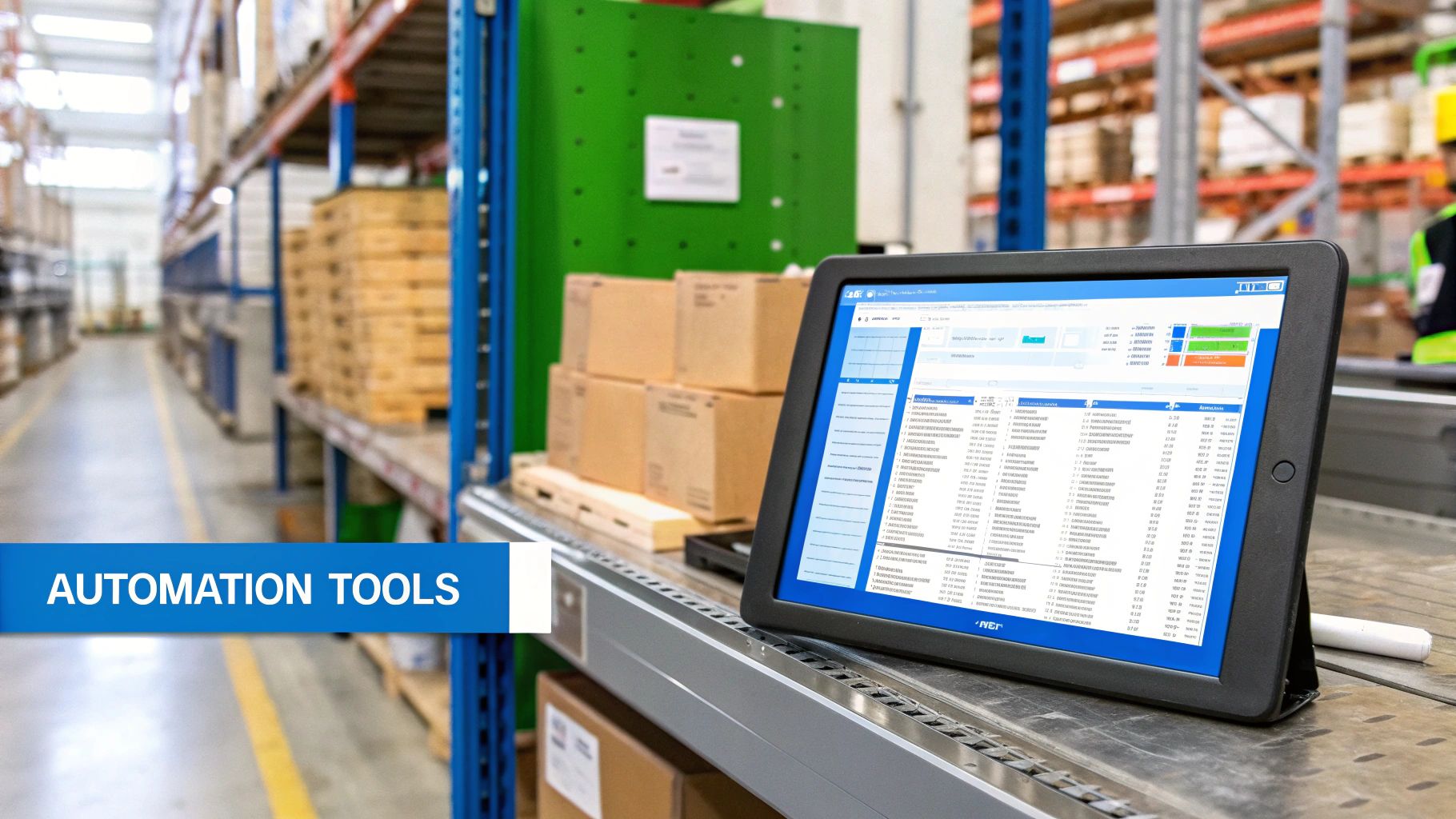
Let's be honest, manual inventory tracking with clipboards and spreadsheets can only take you so far. It might work when you're just starting out, but those methods are slow, riddled with human error, and just can't keep pace with a busy restaurant. It’s time to stop reacting to inventory problems and start proactively managing them with modern technology.
Making this shift turns food inventory management from a chore everyone dreads into a powerful tool for growth. It’s not just about counting faster; it's about getting real-time data that helps you make smarter, more profitable decisions every single day.
The Power of an Integrated POS System
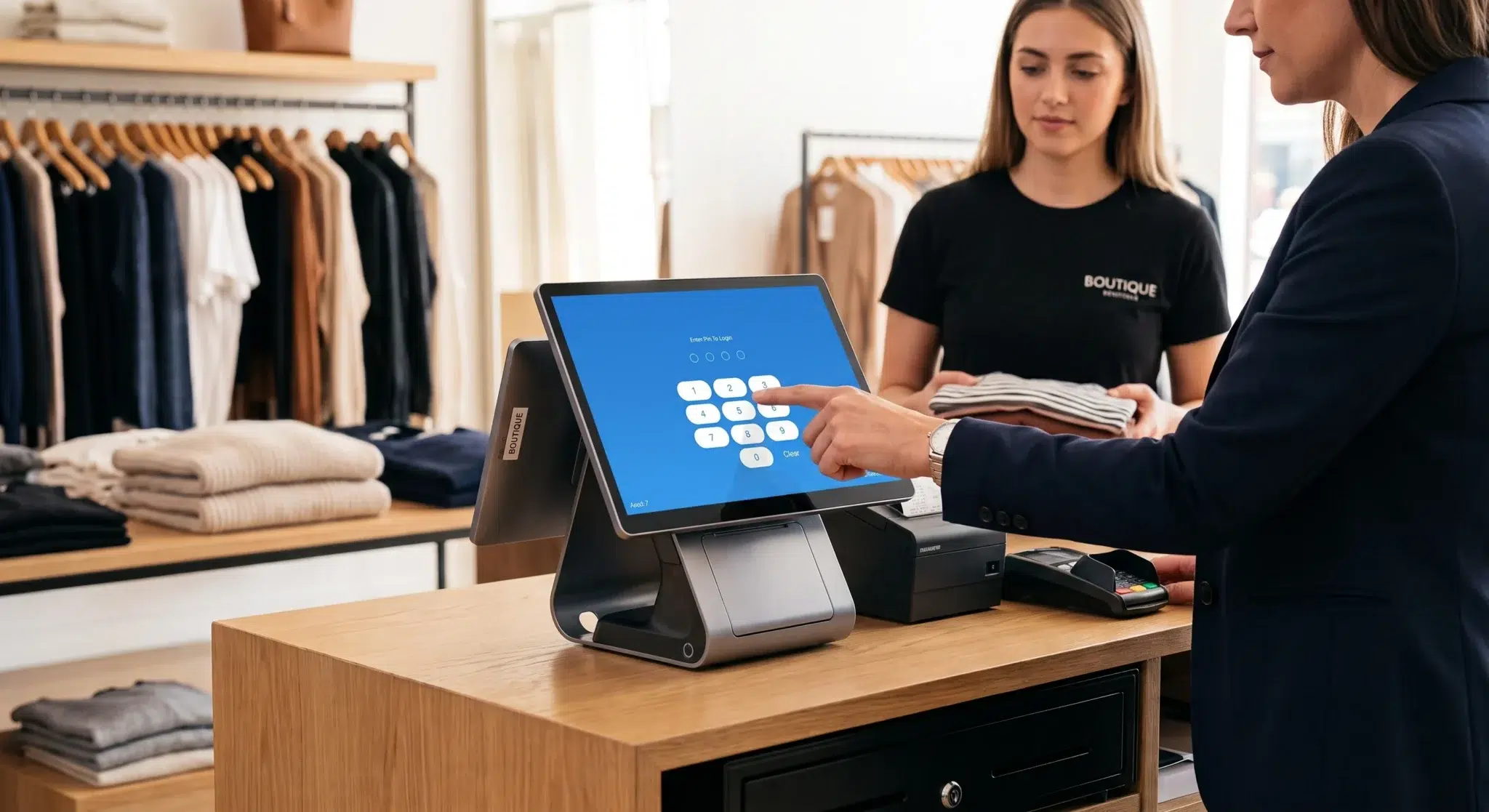
Your Point of Sale (POS) system is the central hub of your entire operation. When you integrate it with your inventory, it becomes your eyes and ears, tracking every ingredient that leaves the kitchen.
Think about it this way: a server rings up a cheeseburger. The system instantly deducts one bun, one beef patty, a slice of cheese, and the exact portions of lettuce and tomato from your digital stock count. You get a live, constantly updating view of what you have on hand, no manual guesswork needed.
This kind of automation delivers some huge wins right away:
- Reduces Human Error: Say goodbye to the miscounts and forgotten entries that throw off manual sheets. The data is simply more accurate.
- Saves Dozens of Labor Hours: Your team can spend less time in the walk-in with a clipboard and more time focused on creating great food and serving guests.
- Provides Real-Time Visibility: You always know precisely what's on the shelves, which means no more 86'ing a popular dish in the middle of a Friday night rush.
Unlocking Data with Dedicated Software
Going a step further, dedicated inventory management software acts as your strategic partner. It takes all the raw data your POS collects and turns it into actionable insights that a spreadsheet could never provide. You can learn more about what inventory management software can do for your restaurant and see how deep these capabilities go.
These platforms generate detailed reports on food costs, track price fluctuations from your suppliers, and even pinpoint your most—and least—profitable menu items. They transform sales numbers into a clear roadmap for improving your kitchen's financial health.
Technology moves inventory management from a historical record of what you had to a predictive tool that tells you what you will need. It’s the difference between looking in the rearview mirror and having a clear view of the road ahead.
For example, the software can analyze past sales trends to forecast future demand. It can send you an alert when you're running low on a key ingredient, automatically generate purchase orders based on your par levels, and help you find the exact source of food waste.
Preparing for Future Trends
Technology’s role in the kitchen is only getting bigger. As an industry, we're adopting smarter systems to fight back against rising costs and labor shortages. A major trend on the horizon is the use of Artificial Intelligence (AI) and automation to fine-tune inventory control even further. AI-powered systems are already enabling real-time stock monitoring and highly accurate demand forecasting, helping restaurants keep just the right amount of product on hand.
By embracing these tools now, you're not just solving today's inventory headaches. You're building a more agile, efficient, and resilient restaurant that's ready for whatever comes next.
The Key Performance Indicators You Must Track
Managing your food inventory effectively isn't about gut feelings or educated guesses—it’s about knowing your numbers. To get a real handle on how well your system is working, you need to track specific Key Performance Indicators (KPIs). Think of these metrics as the vital signs of your restaurant; they tell you exactly what’s working, what’s broken, and where your money is actually going.
Imagine trying to fly a plane without an instrument panel. That's what running a kitchen without KPIs is like. You're flying blind, hoping you don’t run out of fuel or veer off course. These numbers give you the clarity you need to make smart, informed decisions.
Cost of Goods Sold
One of the most foundational metrics in the restaurant business is the Cost of Goods Sold (COGS). This number tells you the direct cost of all the ingredients that went into the food and drinks you sold over a certain period. It's a bottom-line measure of your kitchen's efficiency.
The formula is straightforward:
COGS = (Beginning Inventory + Purchases) – Ending Inventory
Keeping a close eye on your COGS helps you catch problems before they spiral. If that number starts to climb, it could be a red flag for anything from rising supplier prices and food waste to sloppy portion control. A stable, predictable COGS is a clear sign of a well-oiled machine.
Food Cost Percentage
While COGS gives you a raw dollar amount, your food cost percentage is what truly puts it into perspective. This is easily one of the most critical numbers you'll track, as it shows you how your inventory costs stack up against your revenue. You can learn how to Master Your Restaurant Food Cost Percentage to really take control of this crucial KPI.
This metric reveals exactly what slice of your revenue pie is being eaten up by ingredient costs. If your percentage is too high, it's a direct assault on your profit margins, suggesting that your menu prices are too low or your ingredient costs have gotten out of hand.
Inventory Turnover Rate
How fast are you moving through your stock? That’s what the inventory turnover rate tells you. This KPI measures how many times you’ve sold and replaced your entire inventory over a specific period. It’s a fantastic indicator of how efficiently you're using the cash sitting on your shelves.
A high turnover rate is usually a good thing. It means ingredients are flying off the shelves and into dishes, not sitting around waiting to spoil. But be careful—a rate that’s too high could mean you're constantly on the verge of running out of key items, which can frustrate both your kitchen staff and your customers.
A low turnover rate is a major red flag for your food inventory management. It often points directly to overstocking, which ties up valuable cash flow and dramatically increases the risk of spoilage and waste.
On the flip side, a slow turnover rate is a classic sign of overstocking. This means you have too much cash tied up in products that aren't selling, which is a major drain on your cash flow and a recipe for spoilage. The goal is to find that sweet spot, keeping inventory lean but sufficient.
Your Top Food Inventory Questions, Answered
Even with the best system in place, you're bound to have questions. Let's dive into some of the most common ones that pop up for restaurant owners and managers.
Getting the hang of these details can be a game-changer for your daily grind and your bottom line. It’s all about finding a solid rhythm that fits your restaurant's unique flow.
How Often Should I Do a Full Physical Inventory Count?
Figuring out the right frequency for a full physical count is a classic balancing act. While you should absolutely be doing daily spot-checks on your high-cost, high-use 'A' items (think prime cuts of steak or fresh lobster), a complete wall-to-wall count doesn't need to happen every single day. For most restaurants, the sweet spot is weekly.
A weekly count gives you a reliable, consistent snapshot of everything you have on hand. It's the key to accurately calculating your Cost of Goods Sold (COGS) for that period. This timing is just right—frequent enough to catch problems like over-portioning, waste, or even theft before they get out of hand, but not so often that it completely burns out your team. Some smaller spots might get away with a bi-weekly schedule, but pushing it out any further than that is asking for trouble.
What Is the Single Biggest Mistake to Avoid?
If there's one thing that will sink your inventory management efforts, it's inconsistency. You can have the fanciest software or the most detailed spreadsheets in the world, but they're useless if you don't stick to the process.
This applies across the board:
- Counting: If you decide on a weekly count, it has to be done on the same day and at the same time, every single week. A count done on a quiet Sunday night will look drastically different from one done on a busy Tuesday morning before a delivery.
- Receiving: Every delivery needs to be checked, verified, and logged the exact same way. No shortcuts. No "I'll get to it later."
- Tracking Waste: You have to log every spoiled item, every dropped plate, every mistake. If you only track waste when it's convenient, your data becomes worthless.
Inconsistency is the silent killer of a good inventory system. It creates huge blind spots in your data, making it impossible to trust your numbers or make smart, cost-saving decisions. It slowly chips away at your control and, ultimately, your profits.
How Can a Small Restaurant Start on a Tight Budget?
You don't need a massive budget to get a handle on your inventory. For a small restaurant watching every penny, the secret is to build simple, powerful habits and use the tools you already have.
Start with a good old-fashioned spreadsheet. Create a simple system to log your starting inventory, track every purchase you make, and then record your ending inventory each week. This is all you need to manually calculate your COGS and see exactly what you're using.
Pair that simple spreadsheet with a commitment to the fundamentals. Make FIFO (First-In, First-Out) a non-negotiable rule in your kitchen to slash spoilage. Figure out clear par levels for your most important ingredients to take the guesswork out of ordering. A disciplined manual system that you actually use will always beat expensive software that gathers dust.
Ready to move beyond spreadsheets and put your inventory on autopilot? Biyo POS connects your real-time sales directly to your stock levels, giving you a crystal-clear view of your food costs and profitability without all the manual data entry. See how our all-in-one system can simplify your operations by visiting the official Biyo POS website.