Ever had that sinking feeling when you count your stock and the numbers just don't add up? That gap between what your inventory records say you should have and what’s actually sitting on your shelves is what we call inventory shrinkage.
Think of it as a silent profit killer. It’s the merchandise that vanishes somewhere between your receiving dock and the customer's shopping bag. This happens for all sorts of reasons—theft, simple administrative errors, damaged goods, or even fraud from suppliers. For any business that holds physical products, it's a constant battle.
Understanding Inventory Shrinkage
Let's break it down with an analogy. Picture your inventory as a full tank of gas. It represents your potential profit. Every time an item gets stolen, damaged, or lost before a sale, it’s like a tiny, invisible leak in that tank. You’re losing fuel—and money—without even realizing it. That difference between the expected fuel level and the actual amount left is your shrinkage.
This isn’t just some abstract accounting term; it has a real, tangible impact on your bottom line. The global retail industry loses an estimated $132 billion to this problem. In the U.S. alone, retail shrinkage rates have crept up from 1.4% to 1.6%, showing it’s a growing concern for businesses of all sizes.
The Core Concept Visualized
This infographic perfectly illustrates the idea. Shrinkage is simply the difference between the stock you've recorded and the stock you physically count.
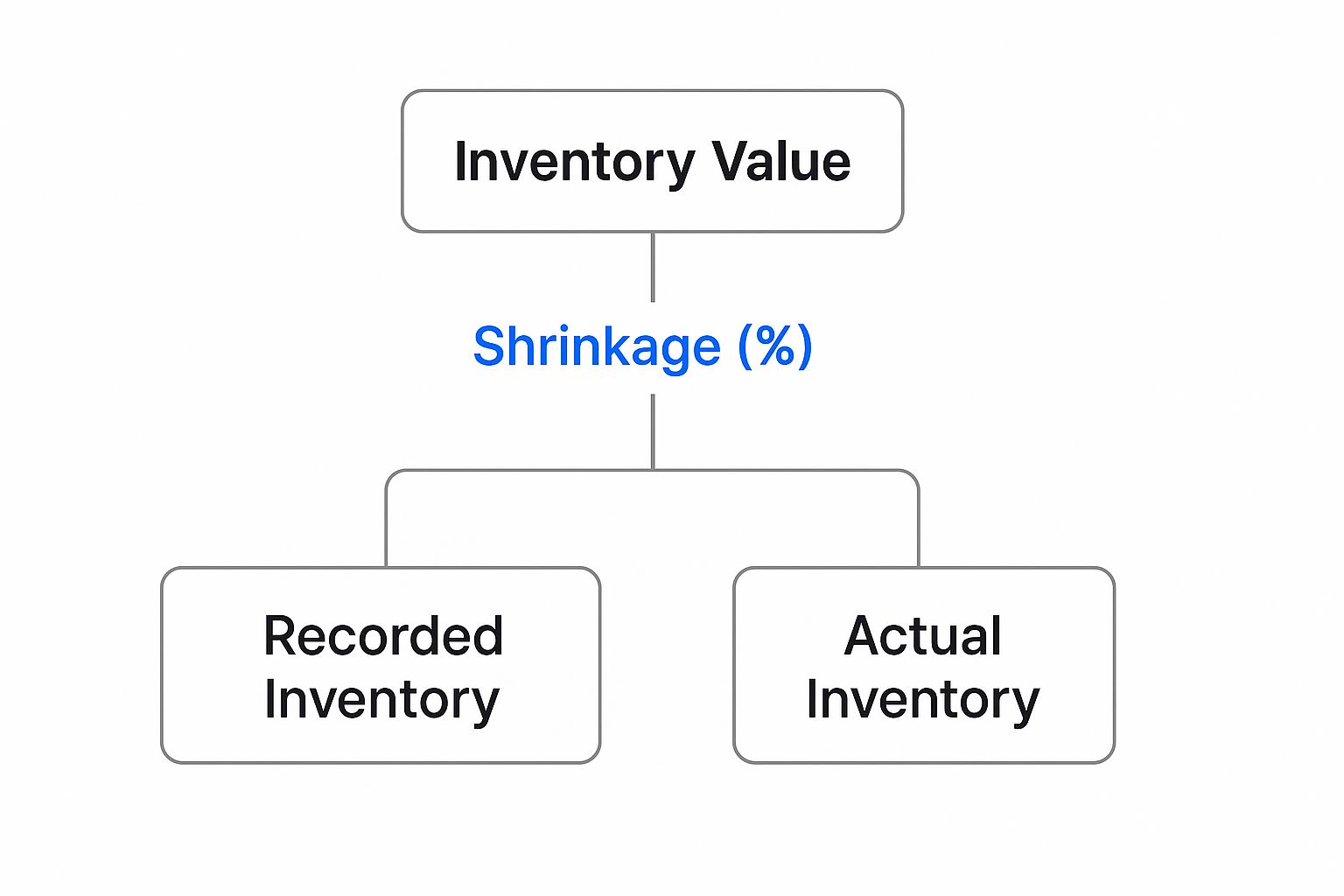
It’s a straightforward calculation, but one that reveals a lot about the health of your operations.
Why Shrinkage Matters More Than You Think
Sure, a tiny amount of shrinkage might be the cost of doing business, but when it starts to climb, it’s a major red flag pointing to deeper operational problems. It’s about more than just a few missing items; the ripple effects can be surprisingly damaging.
Inventory shrinkage is more than a simple loss of goods; it's a direct threat to profitability that distorts financial reporting, complicates purchasing decisions, and can ultimately harm customer satisfaction through unexpected stockouts.
Getting a handle on shrinkage starts with understanding it. Once you know why it’s happening, you can build a solid strategy to protect your assets. This means more than just preventing theft; it’s about fine-tuning your internal processes to cut down on errors and damage.
It's also closely tied to another key metric: inventory turnover, which measures how fast you sell through your stock. By managing both shrinkage and turnover, you get a much clearer, more accurate picture of your operational efficiency and financial health. This helps you move from just reacting to losses to proactively building a more profitable business.
The Four Main Causes of Inventory Loss
To really get a handle on shrinkage, you have to figure out where the leaks are coming from. That gap between your inventory records and what’s actually on the shelves doesn't just happen by magic. It's the result of specific, and often preventable, problems. Once you understand the root causes, you can stop just reacting to losses and start proactively protecting your business.

Just about every business owner wrestles with four main sources of inventory loss. While the exact mix can differ depending on your industry, these categories are the main battlegrounds in the fight against shrinkage. Let’s break each one down so you can spot your own weak points and build a better defense.
External Theft: The Obvious Threat
When most of us hear "shrinkage," our minds immediately jump to external theft. This is everything from casual shoplifting to professional, organized retail crime (ORC). It’s often the most visible type of loss and can be a huge drain, with some studies showing it’s responsible for more than a third of all shrinkage.
Shoplifters might be opportunistic, but ORC groups are a different beast entirely. They work like a well-oiled machine, systematically targeting high-value items to sell on the black market, costing the retail industry billions.
- Shoplifting: A customer slips a small, expensive cosmetic item into their bag and walks out.
- Organized Retail Crime (ORC): A team enters a store, creates a distraction, and clears a shelf of high-end electronics in a "smash-and-grab" attack.
These external threats yank products right off your shelves, leading to immediate financial hits and unhappy customers who can't find what they came for. This is where solid security measures and sharp, well-trained employees become your first line of defense.
Internal Theft: The Inside Job
While shoplifting grabs the headlines, internal theft—when employees steal from the business—can be just as devastating, if not more so. Your staff has privileged access and knows your store’s procedures, including where the security blind spots are. This allows them to exploit weaknesses from the inside.
This kind of theft is often much harder to spot because it can be so subtle. It isn't always about walking out with merchandise. It can also look like manipulating sales data, processing fraudulent returns, or giving out unauthorized "friends and family" discounts.
Employee theft is a particularly tough problem because it erodes the trust that holds a team together. It often flies under the radar for long stretches, letting small, repeated losses snowball into a major financial headache.
To get ahead of it, you need strong internal controls, regular audits, and a company culture that promotes accountability. Simple steps like limiting access to high-value stock and keeping a close eye on point-of-sale transactions can make a huge difference.
To help visualize how these causes stack up, here's a quick breakdown:
Primary Sources of Inventory Shrinkage at a Glance
This table breaks down the primary sources of inventory shrinkage, showing their typical contribution to total losses and providing clear examples for each category.
| Cause of Shrinkage | Typical Contribution | Common Examples |
|---|---|---|
| External Theft | 35-40% | Shoplifting, organized retail crime (ORC), smash-and-grab incidents |
| Internal Theft | 25-30% | Merchandise theft, fraudulent returns, discount abuse, cash register theft |
| Administrative Errors | 20-25% | Data entry mistakes, receiving errors, pricing inaccuracies, miscounting |
| Supplier Fraud/Damage | 5-10% | Vendor short-shipping, damaged goods in transit, spoiled/expired products |
Understanding this breakdown helps clarify that shrinkage isn't just one thing; it’s a multifaceted problem that requires a multifaceted solution.
Administrative Errors: The Silent Culprit
Often overlooked but a massive contributor to shrinkage, administrative and clerical errors are the unintentional mistakes that mess up your inventory records. No one is stealing anything, but the numbers still don't add up.
These slip-ups can happen at any stage, from the loading dock to the checkout counter. A simple typo during data entry or a miscounted box in a new shipment can throw your entire system out of whack, leading to bad ordering decisions and flawed financial reports.
Here are a few common examples:
- Receiving Errors: A shipment of 50 new jackets arrives, but someone accidentally enters it as 5 in the system.
- Pricing Mistakes: An item is marked with the wrong price in the POS, so it sells for far less than it should.
- Data Entry Issues: A cashier types in the wrong product code, which messes up the stock count for two different items.
These "oops" moments add up fast, leaving you with a completely unreliable picture of what you actually have in stock. The good news? The right training and technology can eliminate a huge portion of these human errors.
Supplier Fraud and Damage
Finally, some shrinkage happens before your products even make it to the sales floor. This bucket includes supplier fraud, where a vendor might short-ship an order but bill you for the full amount, and damage, where products get broken or spoiled somewhere along the way.
While these might not be the most frequent causes, they can be incredibly expensive when they do happen. Think about a pallet of glassware getting dropped by a forklift in the warehouse or a crate of fresh produce spoiling because it wasn't stored properly. To manage this, it's crucial to implement a first-in, first-out (FIFO) system for perishables and to meticulously check incoming shipments against their invoices.
By understanding these four drivers of what is inventory shrinkage, you can start to see where your own business might be vulnerable. The key is to recognize that loss can come from anywhere—from a dishonest supplier to an honest mistake at the register. Accepting that is the first step toward building a more secure and profitable business.
How to Accurately Calculate Your Shrinkage Rate
You can't fix a problem you can't measure. Before you can even begin to tackle inventory shrinkage, you need to turn it from a vague worry into a hard number. Calculating your shrinkage rate gives you that crucial baseline—it tells you exactly how big the problem is and helps you track whether your prevention efforts are actually working.
Think of it like stepping on a scale before starting a new fitness plan. You have to know your starting point to see how far you’ve come.

Quantifying your losses isn't just an accounting chore, either. It’s the data you need to justify spending money on better security, new technology, or more in-depth staff training. Without a solid number, you’re just guessing where your profits are vanishing.
Understanding the Inventory Shrinkage Formula
The good news? The math here is pretty simple. The standard formula gives you a clear percentage that shows how much inventory value you've lost compared to what you should have on hand.
Shrinkage Rate (%) = [(Recorded Inventory Value – Actual Inventory Value) / Recorded Inventory Value] x 100
Let's quickly break down what those terms actually mean in your store:
- Recorded Inventory Value: This is the inventory value according to your books. It's the number your POS system or accounting software says you should have.
- Actual Inventory Value: This is what you find when you physically count every item on your shelves and in the backroom. It’s the real-world value of what you actually have.
- The Result: The formula spits out a percentage. So, a 2% shrinkage rate means that for every $100 of product you thought you had, $2 of it has disappeared.
This simple calculation is the first step in understanding the true scale of your losses. When you quantify what is inventory shrinkage, you start to see its ripple effects on profit margins, supply chain headaches, and even customer satisfaction from unexpected stockouts. If you want to dive deeper into how this impacts your business, you can discover more insights about inventory management on wareiq.com.
Gathering Accurate Data for the Calculation
Your shrinkage calculation is only as good as the data you feed it. Garbage in, garbage out. The most important piece of the puzzle is getting an accurate physical inventory count to determine your Actual Inventory Value. There are a couple of ways to go about this.
Full Physical Inventory Counts
This is the old-school method. You close up shop for a day or count after hours, getting your team to physically tally every single item you own. It’s definitely thorough, but it's also a massive disruption to your business and can be full of human error if you're not careful. For this reason, most businesses only do a full count once or twice a year.
Cycle Counting
A much more modern and manageable approach is cycle counting. Instead of trying to count everything at once, you break your inventory down into smaller, logical chunks and count them on a rotating schedule. For instance, you could count all your high-value electronics one week and your accessories the next.
This method has some big advantages:
- Less Disruption: Your business keeps running as usual.
- Improved Accuracy: Smaller, frequent counts mean fewer mistakes.
- Faster Discrepancy Detection: You can spot a problem and fix it in days, not months.
No matter which method you pick, using tools like barcode scanners hooked up to your POS system will make the process faster and far more accurate. Once you have a precise shrinkage rate, you're no longer operating in the dark. You have a real, actionable number to guide your loss prevention strategy and protect your bottom line.
The Real-World Price Tag on Inventory Shrinkage
It’s easy to dismiss inventory shrinkage as just another line item on a spreadsheet—a minor, unavoidable cost of doing business. But in reality, it’s a silent drain on your profitability, with financial consequences that ripple through every part of your operation. Left unchecked, it quietly eats away at your bottom line and makes sustainable growth a much harder climb.
The most obvious hit is to your profits. Every item that walks out the door unpaid or gets lost in the backroom is invested capital that will never earn you a penny. This forces you to work that much harder just to break even, let alone turn a healthy profit.
How Shrinkage Multiplies Your Losses
To really understand the damage, you have to look past the cost of the lost item itself. Let's break it down with a real-world example.
Imagine your business runs on a lean 5% net profit margin. If you lose a $1 item to shrinkage, you haven't just lost a dollar of product. You've lost a dollar of pure profit.
Now, think about what it takes to earn that dollar back. Because you only keep 5 cents of profit for every dollar you sell, you have to generate $20 in new sales just to replace the $1 you lost. That's the painful math of shrinkage.
Shrinkage isn't just about losing inventory; it's about losing the sales potential that inventory represented. It forces you to sell exponentially more just to stay in the same place.
This is exactly why getting a handle on shrinkage isn't just an operational chore—it's a critical financial strategy.
The Hidden Costs and Ripple Effects
The damage doesn't stop with the lost profit. Shrinkage creates a domino effect of problems that can hurt your business in ways that are less obvious but just as damaging. These are the hidden costs that often sneak up on you.
Here are a few of the most common ripple effects:
- Bad Financial Reporting: When your physical inventory doesn't match your records, your financial statements are fundamentally flawed. This can lead to poor business decisions, trouble with tax reporting, and even difficulty getting a loan.
- Messed-Up Purchasing: Inaccurate stock counts are a recipe for disaster. You might reorder products you're already overstocked on or, worse, fail to order items that are selling fast. Both scenarios kill your cash flow and lead to missed sales.
- Eroding Customer Trust: There’s nothing more frustrating for a customer than seeing an item available online, only to be told it's out of stock when they arrive. These stockouts, often a direct result of shrinkage, can send loyal customers straight to your competition.
These issues show how shrinkage can destabilize your entire business, from the stockroom to the front counter. And it's a massive problem. A recent report pegged the global retail shrinkage rate at 1.82% of annual sales—a figure that’s even higher than previously thought.
In the U.S. alone, that translates to an estimated $112.1 billion in losses. You can explore the full findings of this global issue to see just how widespread the problem is. At the end of the day, understanding and controlling what is inventory shrinkage is fundamental to keeping your business healthy, stable, and growing.
Proven Strategies to Reduce Inventory Shrinkage
Knowing what causes inventory shrinkage is one thing; actually doing something about it is a completely different ballgame. To really tackle the problem, you need to shift from a defensive stance to an offensive one. This means creating a deliberate, multi-layered strategy that plugs the vulnerabilities across your entire operation, from the stockroom to the sales floor.
By taking proactive steps, you can stop the slow leak of profits and build a more secure, efficient business.

A solid loss prevention plan is about much more than just catching thieves. It's about fostering a culture of accountability, designing your physical space smartly, tightening up daily procedures, and using today's technology to gain an edge. Let's break down some real-world tactics for each of these areas.
Foster a Culture of Accountability Through Training
Your employees are your single greatest asset in the fight against shrinkage. A well-trained, engaged team is your first line of defense, capable of stopping losses from both honest mistakes and deliberate theft. The goal is to create a culture where every single person understands they play a part in protecting the business's assets.
It all starts with comprehensive training right from day one. When you bring on a new hire, make sure they understand what inventory shrinkage is and how it directly affects the company's bottom line—and ultimately, their own job security. This training needs to cover the nitty-gritty: how to handle merchandise, process transactions correctly, and spot suspicious activity.
Since employee theft is a major piece of the shrinkage puzzle, strong internal controls are a must. For a deeper dive, check out these effective strategies to prevent employee theft in the workplace.
A culture of accountability is built on clear expectations and consistent reinforcement. When employees feel valued and understand the "why" behind loss prevention rules, they are more likely to become active partners in protecting your inventory.
Don't let it be a one-and-done conversation. Regular refresher courses and open communication keep these principles fresh in everyone's mind, turning loss prevention from a management headache into a shared responsibility.
Optimize Your Store Layout and Security
The physical layout of your store can either be an invitation for theft or a major deterrent. A well-planned space not only makes for a better customer experience but also closes the door on many opportunities for shoplifters. It’s all about the strategic placement of products, fixtures, and security tech.
Consider making these practical adjustments:
- Improve Visibility: Keep your shelves low and your aisles wide to get rid of blind spots. Position the checkout counter near the entrance, giving your team a clear line of sight across the entire store.
- Secure High-Value Items: Small, expensive, or commonly stolen products belong in locked display cases or close to the registers where they can be easily monitored.
- Install Modern Security: High-definition cameras should cover crucial spots like entrances, exits, cash registers, and high-value product displays. Electronic Article Surveillance (EAS) tags, which set off an alarm if they aren't deactivated at checkout, are another powerful tool.
Even something as simple as keeping the store clean and organized sends a strong message. It signals that the space is actively managed and watched over, which can be enough to discourage a potential thief.
Tighten Your Operational Procedures
A surprising amount of inventory loss comes from nothing more than sloppy or inconsistent internal processes. By standardizing your day-to-day operations, you can dramatically cut down on shrinkage from administrative mistakes, product damage, and even internal theft. The idea is to create a predictable, trackable system for every item that moves through your business.
Zero in on tightening up procedures in these key areas:
- Receiving Protocols: This is your first chance to catch a problem. Train your staff to meticulously check every incoming shipment against the purchase order. They need to verify counts and inspect for damage before signing off. Any issues should be documented and reported right away.
- Return Management: Set up a clear, firm return policy and stick to it. Always require a receipt, and carefully inspect returned items to make sure they're the original product and still in sellable condition. This is crucial for stopping fraudulent returns.
- Trash Management: A clear-bag policy for trash can work wonders. Also, require a manager to sign off on anything being discarded, especially items marked as damaged. This simple step makes it much harder for an employee to sneak merchandise out with the garbage.
These structured routines leave far less room for error or dishonesty, creating a much more secure environment for your inventory.
Use Technology for Smarter Inventory Control
In today’s retail world, trying to track inventory with a clipboard and pen just won't cut it. Modern technology gives you the tools to keep pinpoint-accurate records, spot troubling patterns, and get a real advantage over shrinkage. At the heart of this strategy is a powerful Point of Sale (POS) system with fully integrated inventory management.
A good system automates many of the tasks where human error creeps in. When you have real-time tracking, you get an immediate, up-to-the-minute view of your stock levels. This allows you to perform cycle counts more efficiently and catch discrepancies almost as soon as they happen, instead of waiting months for a full physical inventory to reveal a disaster.
For a deeper look at these techniques, our guide on inventory control methods provides some great information. By pairing smart procedures with the right technology, you can turn your inventory data from a simple number into a powerful weapon against loss.
How Biyo POS Helps You Control Inventory Loss
Knowing the strategies to fight shrinkage is one thing, but having the right tools in your corner makes all the difference. While good old-fashioned procedures are vital, the right technology is what truly moves the needle, automating the tedious work and giving you the hard data you need to make smart decisions. Biyo POS is built to be that tool—a command center for your business that tackles the root causes of loss head-on.
Think of it this way: instead of relying on tedious manual counts and gut feelings, a modern POS system gives you the power to manage your stock with total clarity. It transforms raw inventory numbers into insights you can actually use to protect your profit margins.
Gain Control with Real-Time Inventory Tracking
Let's be honest, one of the biggest culprits behind shrinkage is simple human error. A misplaced decimal point when receiving a shipment or one miscounted box can create a ripple effect that throws off your records for months. Biyo POS puts a stop to these costly mistakes with real-time inventory tracking.
Every time you make a sale, process a return, or log a new delivery, the system updates instantly. This means your on-hand counts are always current. More importantly, it means you can spot a problem the moment it happens, not six months down the line during a painful physical inventory. This constant visibility is the bedrock of any solid loss prevention plan.
Minimize Internal Theft with User Permissions
It’s an uncomfortable truth, but employee theft is a major reason for inventory loss. Biyo POS helps you secure your business from the inside out with user-specific permissions and access controls. You get to decide exactly who can do what.
You can create custom roles for each team member, restricting access to sensitive actions like voiding a sale, applying a major discount, or manually changing inventory counts. This ensures only trusted managers can perform high-risk tasks, closing the door on most opportunities for fraud. It also creates a clear digital paper trail, building a culture of accountability that naturally discourages theft.
A powerful Point of Sale system does more than just process payments; it acts as your digital security guard, monitoring every transaction and inventory movement to protect your business from the inside out.
Identify Suspicious Patterns with Detailed Reporting
Sometimes, the clues to shrinkage are buried deep within your sales data. A sudden jump in voided transactions under one employee's name, or an unusually high number of discounts, can be a major red flag. Biyo’s detailed sales reporting helps you pull these patterns out of the noise before they escalate.
You can run reports that break down sales by employee, monitor every discount, and track returns, giving you the information needed to investigate anything that looks off. This data-driven approach shifts you from simply reacting to losses to proactively spotting vulnerabilities.
For any business, solid inventory management systems are the key to maintaining control. And for food service businesses, a specialized restaurant inventory management system is non-negotiable for tracking every ingredient down to the ounce. Using these tools turns your POS from a simple cash register into your most powerful asset for solving what is inventory shrinkage.
Answering Your Questions About Inventory Shrinkage
Even with the best strategies in place, some questions about inventory shrinkage always seem to pop up. Let's tackle a few of the most common ones to clear up any lingering confusion and help you confidently address this challenge.
What Is a Good Shrinkage Percentage?
Every business owner dreams of 0% shrinkage, but let's be realistic—that's just not going to happen. In the real world of retail and hospitality, a shrinkage rate hovering between 1% and 2% is pretty standard.
But "good" is all about context. A grocery store juggling fresh produce will naturally have a higher acceptable rate than a shop selling high-end electronics. The real goal isn't to hit a magic number but to establish your own baseline and then consistently chip away at it.
Think of a "good" shrinkage rate not as a fixed target, but as a downward trend. Your first measurement is just the starting line; the win comes from continuously improving your processes and using smart tech to beat that initial number.
How Often Should I Calculate Inventory Shrinkage?
This really depends on how you count your inventory. If you're still doing the old-school, all-hands-on-deck annual physical count, then you’ll calculate shrinkage once a year. Maybe twice if you're ambitious.
But if you've adopted cycle counting—a much more efficient method of counting small sections of your inventory regularly—you can get a read on shrinkage far more often. Think monthly or quarterly for specific product groups. This gives you a massive advantage, letting you spot problems early and tweak your loss prevention plan before small issues become big disasters. It's always a good idea to keep a closer eye on your most valuable or most frequently stolen items.
Can Inventory Shrinkage Ever Be Positive?
Nope, that's impossible. By its very definition, inventory shrinkage is a loss. It's the gap between the inventory you think you have on your books and the inventory you actually have on your shelves.
If you somehow end up with a positive number, you're not looking at shrinkage. You've got an inventory surplus (or overage), which means you have more product than your records show. While finding extra stock might sound like a win, it's actually a red flag for major clerical errors in your system—whether in receiving, sales, or data entry—that need to be fixed immediately for your financial reports to be accurate.
Ready to get a firm grip on your inventory and put a stop to shrinkage for good? See how Biyo POS gives you the tools you need with real-time tracking, powerful reporting, and secure employee permissions. Learn more about Biyo POS and start protecting your hard-earned profits today.